
The Private Dumpster License Checklist (L_001_CHK) is a three-step review guide published by the City of Philadelphia Department of Licenses and Inspections (L&I). L&I staff use it to decide whether a license for a dumpster on private property can be issued, denied or sent in for zoning or building review. It also shows applicants what the review turns on: the site plan, where the dumpster sits and how it is screened. On FillingPDF you can fill out the checklist online and download or print the completed PDF; the City's dumpster license documents are published on the L&I page at phila.gov.
Last updated
What is L_001_CHK?
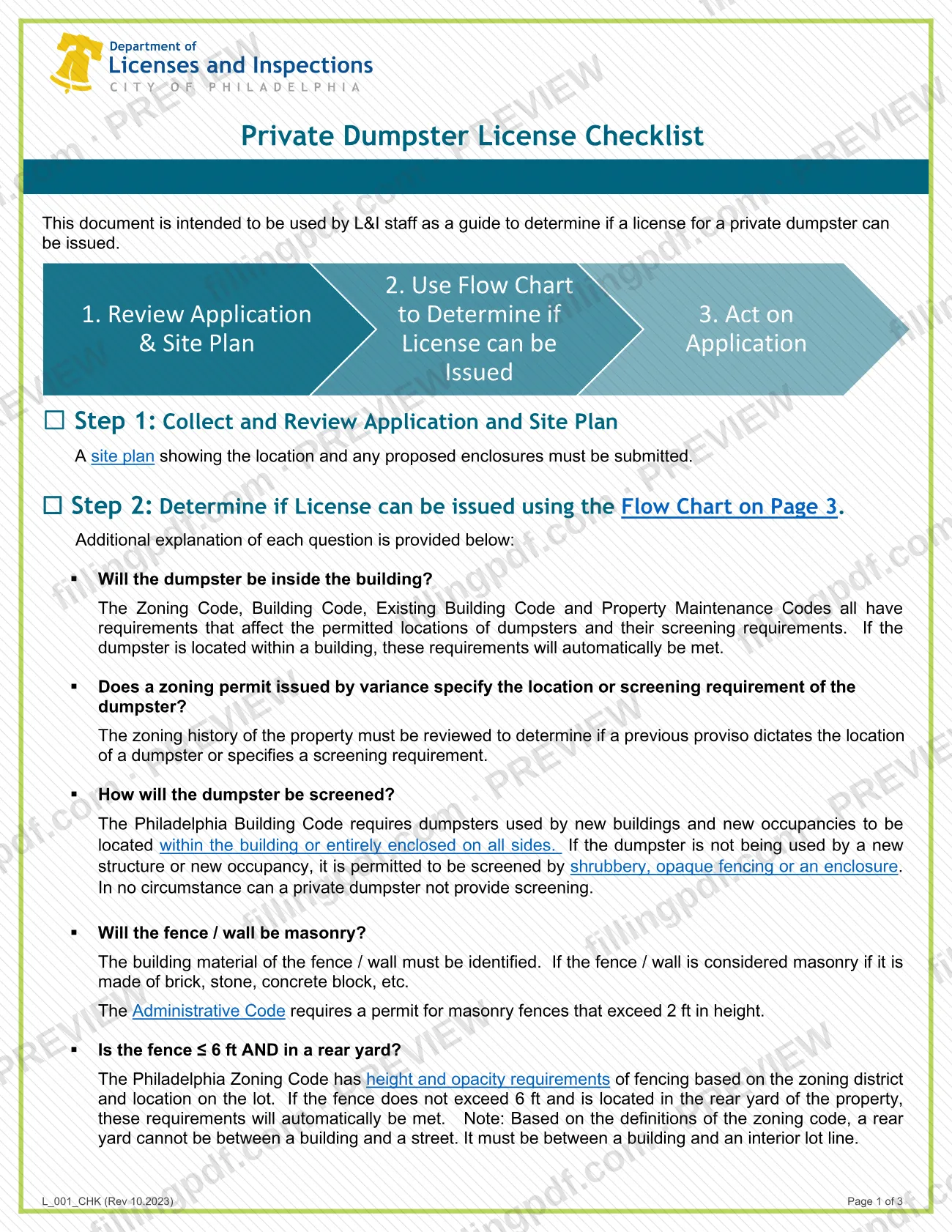
The Private Dumpster License Checklist (L_001_CHK, Rev 10.2023) is a guide used by staff of the City of Philadelphia Department of Licenses and Inspections (L&I) to decide whether a license for a private dumpster can be issued.
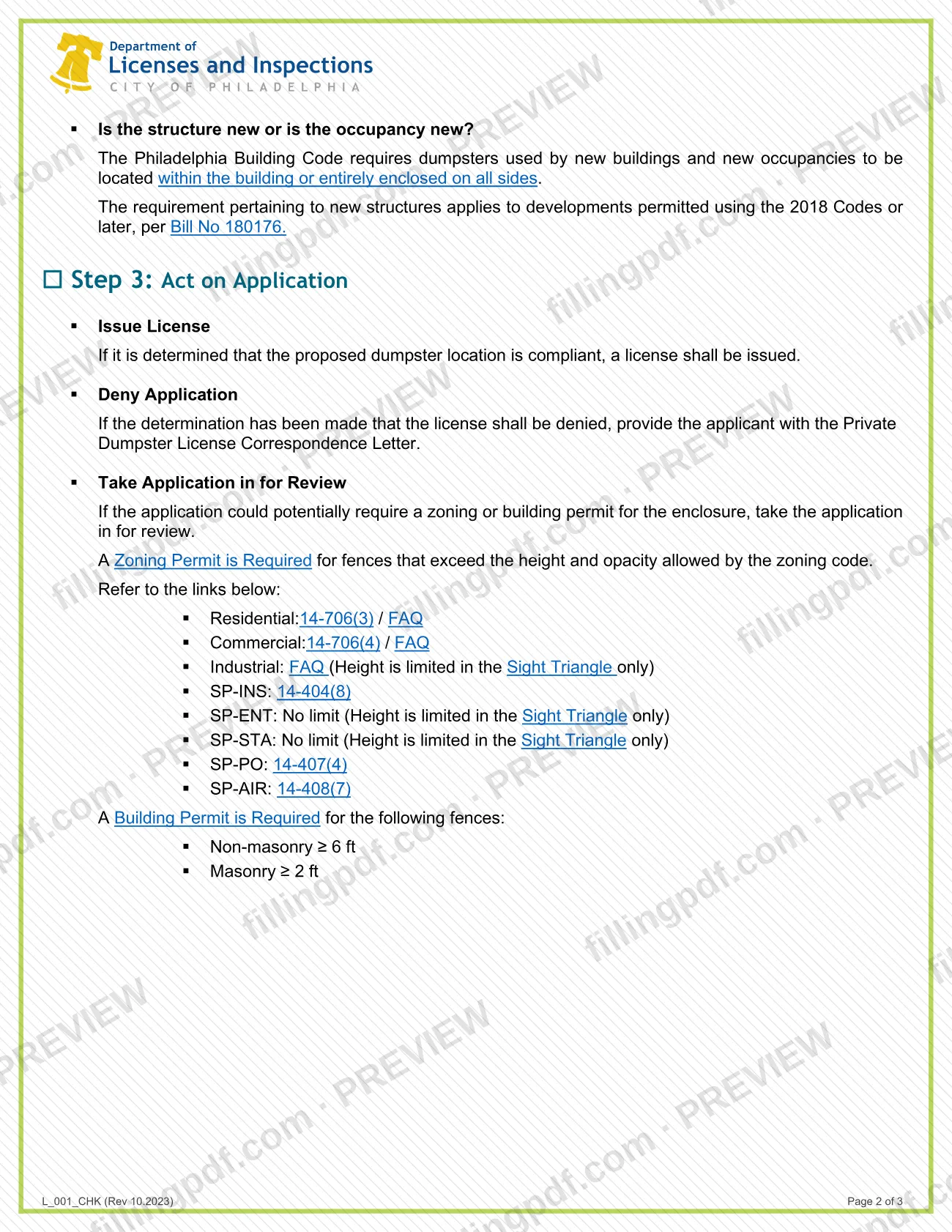
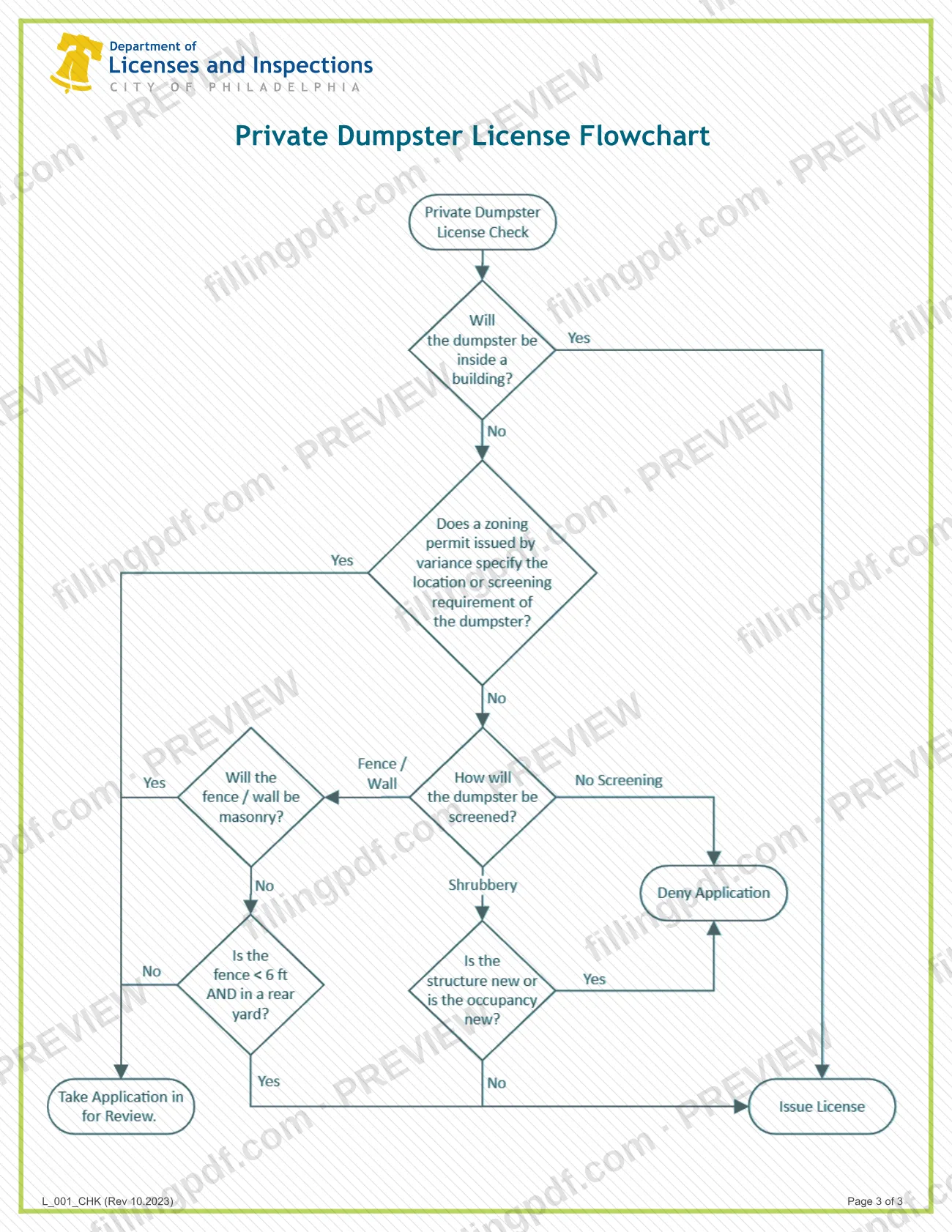
The checklist has three steps: collect and review the application and site plan; determine whether the license can be issued using the flow chart on page 3; and act on the application. The flow chart asks whether the dumpster will be inside the building, whether a zoning permit issued by variance sets the location or screening, how the dumpster will be screened, whether a fence or wall will be masonry, whether a fence is 6 ft or lower and in a rear yard, and whether the structure or occupancy is new. Page 2 explains each question and lists the heights at which a zoning or building permit is needed for a fence.
The outcome is one of three actions: issue the license, deny the application with the Private Dumpster License Correspondence Letter, or take the application in for review when a zoning or building permit for an enclosure may be needed.
The checklist is not the license application. L&I publishes the dumpster license application, a waste hauler form and a dumpster plot plan form separately. Dumpsters on the public right-of-way have their own Public dumpster license checklist.
Who needs to file L_001_CHK?
The main users are L&I staff who review private dumpster license applications; the document says it is intended to be used by L&I staff as a guide.
Applicants can use it to see how their application will be judged. The L&I page says anyone who wants to place a dumpster on private property or in the right-of-way (along a street or sidewalk) needs a dumpster license. This checklist covers the private-property case.
Exclusions and related paths:
- A dumpster placed in the public right-of-way is reviewed under the separate Public dumpster license checklist, and the Streets Department has its own Streets ROW Public Dumpster Form for approval to place a dumpster there.
- A dumpster inside a building meets the location and screening requirements automatically, according to the checklist.
- Applications that could require a zoning or building permit for an enclosure are taken in for review rather than decided on the checklist alone.
When to file L_001_CHK
The checklist is used when L&I reviews an application for a private dumpster license, so it has no due date of its own. The trigger is the application: a site plan showing the location and any proposed enclosures must be submitted with it, and the review starts from that application and plan.
Timing also depends on the enclosure. If the application could require a zoning or building permit for a fence or enclosure, staff take it in for review before a decision. The requirement that dumpsters serving new buildings and new occupancies be inside the building or fully enclosed applies to developments permitted under the 2018 Codes or later, per Bill No 180176. The checklist sets no processing time.
Documents you need
- Site plan showing the location of the dumpster and any proposed enclosures; the checklist says it must be submitted with the application.
- Dumpster license application for placing a dumpster on private property or in the public right-of-way, published by L&I; the checklist reviews it.
- Dumpster license waste hauler form, the supplemental form L&I publishes to identify the waste hauler for new dumpster licenses.
- Dumpster plot plan form, which L&I publishes to depict the dumpster location and any required enclosures; one way to prepare the site plan.
How to fill out L_001_CHK
Collect the application and site plan
Step 1: gather the dumpster license application and the site plan showing the dumpster location and any proposed enclosures, and check the box when both are in hand.
Ask whether the dumpster is indoors
On the flow chart, first ask whether the dumpster will be inside the building. If so, the location and screening requirements are automatically met.
Check for a zoning variance proviso
Review the property's zoning history to see whether a permit issued by variance specifies the dumpster location or screening requirement.
Determine how the dumpster is screened
Record whether it will be enclosed, behind opaque fencing or behind shrubbery. Dumpsters for new buildings and new occupancies must be inside the building or enclosed on all sides.
Identify the fence or wall details
Note whether the fence or wall is masonry (brick, stone, concrete block, etc.) and whether it is 6 ft or lower and in a rear yard. A rear yard cannot be between a building and a street.
Confirm new structure or occupancy
Mark whether the structure or occupancy is new. The new-structure requirement applies to developments permitted using the 2018 Codes or later, per Bill No 180176.
Act on the application
Step 3: issue the license if the location is compliant; deny and send the Private Dumpster License Correspondence Letter; or take the application in for review if a zoning or building permit for the enclosure may be needed.
Review and download the completed PDF
Check the boxes and answers against the application, then download or print the completed PDF from FillingPDF. The application itself is submitted as described under How to submit.
How to submit L_001_CHK
The checklist itself is a staff worksheet. The application it supports is submitted in one of two ways: online, or in person at the Permit and License Center in the MSB Concourse. The L&I page is explicit: Do not mail applications.
- Online: apply for the dumpster license through the City's online application, linked from the L&I dumpster license documents page at https://www.phila.gov/documents/dumpster-license-documents/.
- In person: take the application to the Permit and License Center in the MSB Concourse.
Include the site plan showing the dumpster location and any proposed enclosures. If the license is denied, the applicant receives the Private Dumpster License Correspondence Letter. FillingPDF lets you fill out and download the PDF; submission follows the channels above.
Common mistakes to avoid
- Submitting an application without a site plan showing the dumpster location and any proposed enclosures.
- Mailing the dumpster license application; L&I says not to mail applications and to apply online or in person.
- Proposing no screening for a private dumpster; the checklist says a private dumpster must always provide screening.
- Using shrubbery or an open fence for a dumpster serving a new building or new occupancy, which must be inside the building or enclosed on all sides.
- Treating a yard between a building and a street as a rear yard; it must lie between a building and an interior lot line.
- Building a masonry fence taller than 2 ft, or a non-masonry fence of 6 ft or more, without the required permit.
- Overlooking a prior zoning variance whose proviso sets the dumpster location or screening.
Frequently asked questions
What is the Private Dumpster License Checklist?
It is form L_001_CHK (Rev 10.2023), a guide L&I staff use to decide whether a license for a private dumpster can be issued. It walks through reviewing the application and site plan, using a flow chart, and then issuing, denying or sending the application in for review.
Do I need a license to put a dumpster on private property in Philadelphia?
Yes. The L&I page says that if you want to place a dumpster on private property or in the right-of-way, you need a dumpster license, issued by the Department of Licenses and Inspections. This checklist is the guide for the private-property case.
Can I mail my dumpster license application to L&I?
No. L&I says not to mail applications. You can apply online or take your application to the Permit and License Center in the MSB Concourse.
Does a private dumpster have to be screened?
Yes. The checklist says a private dumpster can never be left without screening. If it serves a new building or new occupancy, it must be inside the building or enclosed on all sides; otherwise shrubbery, opaque fencing or an enclosure is allowed.
When does a dumpster fence need a building permit?
The checklist lists a building permit for non-masonry fences of 6 ft or more and masonry fences of 2 ft or more. A zoning permit is also required for fences that exceed the height and opacity the zoning code allows.
What is the difference between the private and public dumpster license checklists?
The private checklist covers dumpsters on private property. L&I publishes a separate Public dumpster license checklist for the public right-of-way, and the Streets Department has its own Streets ROW Public Dumpster Form for approval to place a dumpster there.
What happens if my dumpster license is denied?
Under the checklist, staff give the applicant the Private Dumpster License Correspondence Letter. If the application could require a zoning or building permit for the enclosure, staff take it in for review instead of deciding right away.
Can I fill out the Private Dumpster License Checklist online?
You can fill out the PDF online on FillingPDF and download or print it. FillingPDF is independent of the City and does not file anything; the dumpster license application goes to L&I online or in person at the Permit and License Center.
Ready to fill out L_001_CHK?
Fill out L_001_CHK now