
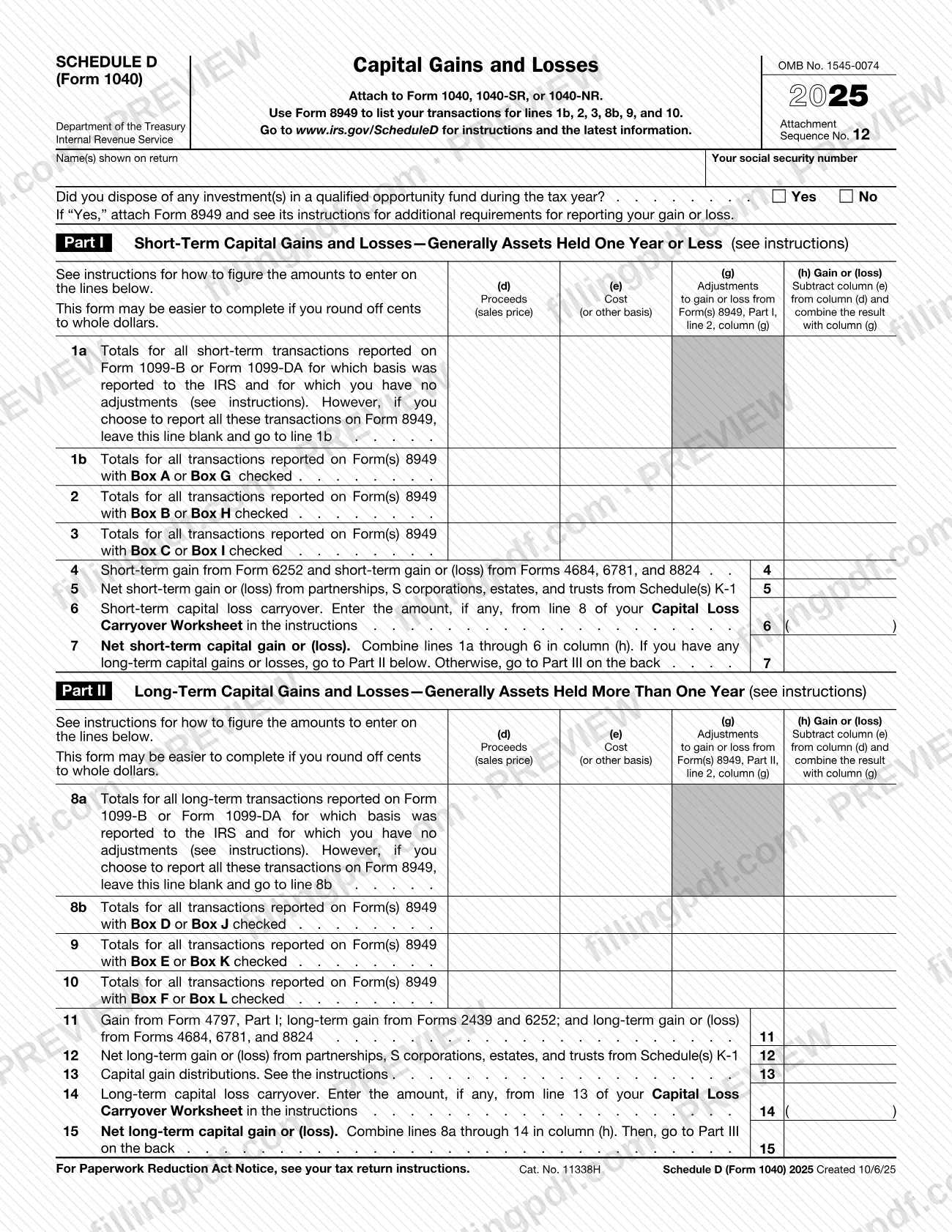
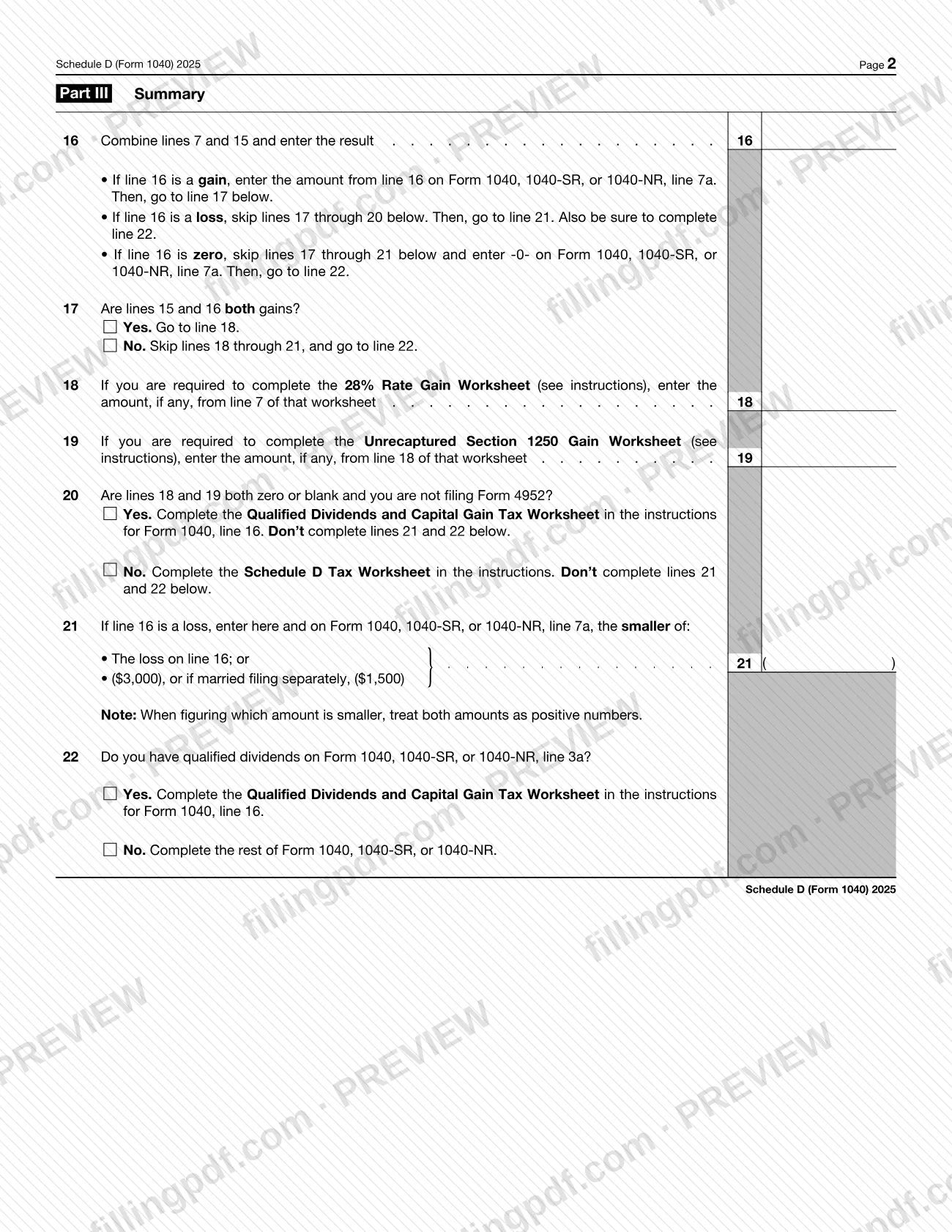
Schedule D (Form 1040), Capital Gains and Losses, is the Internal Revenue Service (IRS) schedule for totaling your short-term and long-term capital gains and losses for tax year 2025. You attach it to Form 1040, 1040-SR, or 1040-NR, and its result carries to line 7a of that return. Individual transactions are listed on Form 8949 first; Schedule D adds up the totals and figures any loss limit and carryover. On this page you can fill out the form online on FillingPDF and download or print the completed PDF; the form and its instructions are published by the IRS at www.irs.gov/ScheduleD.
Last updated
What is Schedule D (Form 1040)?
Schedule D (Form 1040), Capital Gains and Losses, is the IRS schedule you attach to Form 1040, 1040-SR, or 1040-NR to total your short-term and long-term capital gains and losses and arrive at the net amount that carries to line 7a of your return.
The form has three parts. Part I covers short-term gains and losses, generally on assets held one year or less. Part II covers long-term gains and losses, generally on assets held more than one year. Part III is a summary: it combines the two results on line 16, directs the result to Form 1040 line 7a, applies the capital loss limit on line 21, and sends you to the right tax worksheet.
Schedule D does not list your individual sales. The form tells you to use Form 8949 for the transactions behind lines 1b, 2, 3, 8b, 9, and 10, and to complete Form 8949 before those lines. Some transactions, such as those on a Form 1099-B or Form 1099-DA with basis reported to the IRS and no adjustments, can go straight onto lines 1a and 8a.
The schedule also collects amounts from other forms: Form 6252, Form 4684, Form 6781, Form 8824, Form 4797 (Part I), Form 2439, and Schedules K-1 from partnerships, S corporations, estates, and trusts. It picks up capital gain distributions on line 13 and your capital loss carryover from 2024 on lines 6 and 14. The 2025 revision adds codes G, H, I, J, K, and L for digital asset transactions reported on Form 1099-DA.
Who needs to file Schedule D (Form 1040)?
You use Schedule D (Form 1040) if you file Form 1040, 1040-SR, or 1040-NR and have any of the following, according to the IRS instructions:
- an overall gain or loss from transactions reported on Form 8949;
- transactions you are allowed to report without Form 8949;
- a gain from Form 2439, Form 6252, or Part I of Form 4797;
- a gain or loss from Form 4684, 6781, or 8824;
- a gain or loss from a partnership, S corporation, estate, or trust;
- capital gain distributions not reported directly on Form 1040 or 1040-SR, line 7a (or effectively connected capital gain distributions not reported directly on Form 1040-NR, line 7a);
- a capital loss carryover from 2024 to 2025.
Most property you own for personal use or investment, such as a house, furniture, a car, stocks, and bonds, is a capital asset. The instructions list exceptions, including inventory, depreciable business property, and real estate used in a trade or business.
Other forms handle other situations. Business property sales go on Form 4797, casualty and theft conversions on Form 4684, section 1256 contracts and straddles on Form 6781, and like-kind exchanges on Form 8824. Form 8949 is the place for sales and exchanges of capital assets not reported elsewhere.
When to file Schedule D (Form 1040)
Schedule D (Form 1040) is completed whenever you file a return that reports capital gains or losses, because it is attached to Form 1040, 1040-SR, or 1040-NR. The schedule prints no due date of its own: it travels with the return and follows that return's deadline.
The 2025 schedule reports transactions for the 2025 tax year. If you had a capital loss carryover from 2024, you enter it on line 6 (short term) or line 14 (long term) using the Capital Loss Carryover Worksheet in the instructions. If your 2025 loss is larger than what line 21 allows, the excess carries to 2026, and the instructions say to use the 2026 version of the worksheet to figure it. Report all your capital gains and losses even if you cannot use all of your losses in 2025.
Documents you need
- Form 8949, with all necessary pages completed first: needed for the totals you enter on lines 1b, 2, 3, 8b, 9, and 10. Also attach it if you answer Yes to the qualified opportunity fund question at the top.
- Form 1099-B or Form 1099-DA (or substitute statement): the source of the totals on lines 1a and 8a, usable only when basis was reported to the IRS and no adjustments apply.
- Forms 6252, 4684, 6781, 8824, 4797 (Part I), or 2439: only if you have amounts from them for lines 4 and 11; the form lists which lines take which form.
- Schedule(s) K-1 from a partnership, S corporation, estate, or trust: only if you have a net gain or loss to enter on line 5 or line 12.
- Form 1099-DIV, box 2a: the source of capital gain distributions entered on line 13, when you received them.
- A statement showing the full amount received and the amount belonging to you: attach it if you report line 13 distributions received as a nominee.
- Form 8997, Part III: complete it if you disposed of any investment in a qualified opportunity fund during the tax year.
How to fill out Schedule D (Form 1040)
Enter your name and Social Security number
At the top, enter the name(s) shown on your return and your social security number. Then check Yes or No for whether you disposed of any investment in a qualified opportunity fund during the tax year.
Complete Form 8949 first
List your transactions on Form 8949, completing all necessary pages, before you fill in lines 1b, 2, 3, 8b, 9, or 10. If you answered Yes to the qualified opportunity fund question, attach Form 8949 and see its instructions.
Decide whether to use lines 1a and 8a
Enter on line 1a (short term) or line 8a (long term) the totals for transactions on Form 1099-B or 1099-DA with basis reported to the IRS and no adjustments. If you prefer to report them on Form 8949, leave these lines blank and go to line 1b or 8b.
Enter Part I totals from Form 8949
On lines 1b, 2, and 3, enter the Form 8949 totals for transactions with Box A or G, Box B or H, and Box C or I checked. Fill in columns (d) proceeds, (e) cost or other basis, (g) adjustments, and (h) gain or (loss).
Complete Part I lines 4 through 7
Enter short-term gain from Form 6252 and short-term gain or (loss) from Forms 4684, 6781, and 8824 on line 4, and Schedule K-1 net short-term amounts on line 5. Enter your short-term carryover from line 8 of the Capital Loss Carryover Worksheet on line 6, then combine lines 1a through 6 in column (h) on line 7.
Enter Part II totals from Form 8949
On lines 8a, 8b, 9, and 10, enter the long-term totals for Box D or J, Box E or K, and Box F or L, using the same columns as in Part I. Use line 8a only for transactions that qualify to skip Form 8949.
Complete Part II lines 11 through 14
Line 11 takes gain from Form 4797, Part I, long-term gain from Forms 2439 and 6252, and long-term gain or (loss) from Forms 4684, 6781, and 8824. Line 12 takes Schedule K-1 amounts, line 13 your capital gain distributions, and line 14 your long-term carryover from line 13 of the Capital Loss Carryover Worksheet.
Figure net long-term gain or loss
On line 15, combine lines 8a through 14 in column (h). Then go to Part III on page 2.
Combine the two parts on line 16
Combine lines 7 and 15. If the result is a gain, enter it on Form 1040, 1040-SR, or 1040-NR, line 7a and go to line 17. If it is a loss, skip lines 17 through 20, go to line 21, and complete line 22. If it is zero, enter -0- on line 7a and go to line 22.
Answer lines 17 through 20
Line 17 asks whether lines 15 and 16 are both gains. If yes, enter the 28% Rate Gain Worksheet line 7 amount on line 18 and the Unrecaptured Section 1250 Gain Worksheet line 18 amount on line 19, where those worksheets are required. Line 20 then sends you to the Qualified Dividends and Capital Gain Tax Worksheet or the Schedule D Tax Worksheet.
Apply the loss limit on line 21
If line 16 is a loss, enter on line 21 and on line 7a of your return the smaller of the loss on line 16 or the limit printed on the form (a lower limit applies if married filing separately). Treat both amounts as positive when comparing.
Answer line 22 on qualified dividends
Check Yes or No for whether you have qualified dividends on Form 1040, 1040-SR, or 1040-NR, line 3a. Yes sends you to the Qualified Dividends and Capital Gain Tax Worksheet; No means you complete the rest of your return.
Review and download the completed PDF
Check that each total ties to Form 8949 and your other forms, and that all amounts are rounded the same way. Then download or print the completed PDF from FillingPDF and attach it to your return.
How to submit Schedule D (Form 1040)
Schedule D (Form 1040) is not filed on its own. It goes with your federal return, through whichever channel you use for Form 1040, 1040-SR, or 1040-NR.
- With the return: attach the completed schedule, and the completed pages of Form 8949 that support lines 1b, 2, 3, 8b, 9, and 10, to Form 1040, 1040-SR, or 1040-NR. The schedule prints no mailing address, portal, or appointment rule of its own.
- E-filed returns: if you report transactions on lines 1a and 8a and e-file your return, the instructions say you do not need to file Form 8453 for those entries.
- Worksheets: the Capital Loss Carryover Worksheet, the 28% Rate Gain Worksheet, the Unrecaptured Section 1250 Gain Worksheet, and the Schedule D Tax Worksheet are marked "Keep for Your Records." They are not attached.
For the latest information, the form directs you to www.irs.gov/ScheduleD. FillingPDF lets you fill out and download the PDF; submission follows the channels that apply to your Form 1040, 1040-SR, or 1040-NR.
Common mistakes to avoid
- Filling in lines 1b, 2, 3, 8b, 9, or 10 before completing all necessary pages of Form 8949; the instructions say to complete Form 8949 first.
- Using line 1a or 8a when Form 1099-B or 1099-DA shows basis was not reported to the IRS, or when box 1f/1g (Form 1099-B) or box 1h/1i (Form 1099-DA) shows an adjustment. Those go on Form 8949.
- Reporting a sale of collectibles on line 1a or 8a, which are not available for collectibles sales.
- Rounding only some amounts to whole dollars; if you round, you must round all amounts, and add cents before rounding a line made up of several amounts.
- Comparing the loss and the loss limit for line 21 as negative numbers; the form says to treat both amounts as positive when figuring which is smaller.
- Completing lines 21 and 22 after line 20 or line 16 tells you to skip them; follow the Yes/No arrows in Part III.
- Leaving out capital gains and losses because you cannot use all of your losses in 2025; the instructions say to report all of them.
- Treating distributions of net realized short-term capital gains as capital gain distributions; they are ordinary dividends on Form 1099-DIV, not line 13.
- Claiming a loss on a sale between related parties, or on personal-use property, as a deductible loss; enter code L in column (f) of Form 8949.
Frequently asked questions
What is Schedule D (Form 1040) used for?
Schedule D (Form 1040) totals your short-term and long-term capital gains and losses for the year and carries the net result to line 7a of Form 1040, 1040-SR, or 1040-NR. It also reports certain transactions without Form 8949, capital gain distributions, and your capital loss carryover.
Do I need Form 8949 to complete Schedule D?
Usually, yes. Lines 1b, 2, 3, 8b, 9, and 10 take totals from Form 8949, which you complete first. You can skip Form 8949 only for transactions that qualify for lines 1a and 8a: basis reported to the IRS on Form 1099-B or 1099-DA and no adjustments.
What is the difference between line 1a and line 1b on Schedule D?
Line 1a is for short-term transactions reported on Form 1099-B or 1099-DA with basis reported to the IRS and no adjustments, so no Form 8949 is needed. Line 1b takes totals from Form 8949 with Box A or G checked. The same split applies to lines 8a and 8b for long-term transactions.
What counts as short-term versus long-term on Schedule D?
Short-term gains and losses, generally on assets held one year or less, go in Part I. Long-term gains and losses, generally on assets held more than one year, go in Part II. The instructions note a longer holding period for certain gains on applicable partnership interests.
How much capital loss can I deduct on Schedule D?
You can deduct capital losses up to the amount of your capital gains plus the limit printed on line 21, which is lower if you are married filing separately. Losses above that limit may carry to future years, and the instructions explain how to figure the carryover.
How do I figure my capital loss carryover from last year?
Use the Capital Loss Carryover Worksheet in the Schedule D instructions. Enter the short-term result on line 6 and the long-term result on line 14. You have a carryover only if your 2024 Schedule D line 21 was a loss that met the worksheet's tests.
Do I file Schedule D by itself?
No. Schedule D (Form 1040) is attached to Form 1040, 1040-SR, or 1040-NR, and the form prints no separate address or due date. It follows the deadline and the submission channel of the return it supports.
Can I fill out Schedule D (Form 1040) online?
Yes. You can fill out the PDF online on FillingPDF and download or print it. FillingPDF is an independent service and does not file the schedule with the IRS; you submit it with your return through the IRS channels.
Where do I report the sale of my main home?
Report it on Form 8949 if you cannot exclude all of the gain or you received a Form 1099-S for the sale; the totals then flow to Schedule D. Short-term sales use Box C or I in Part I, and long-term sales use Box F or L in Part II.
Ready to fill out Schedule D (Form 1040)?
Fill out Schedule D (Form 1040) now