
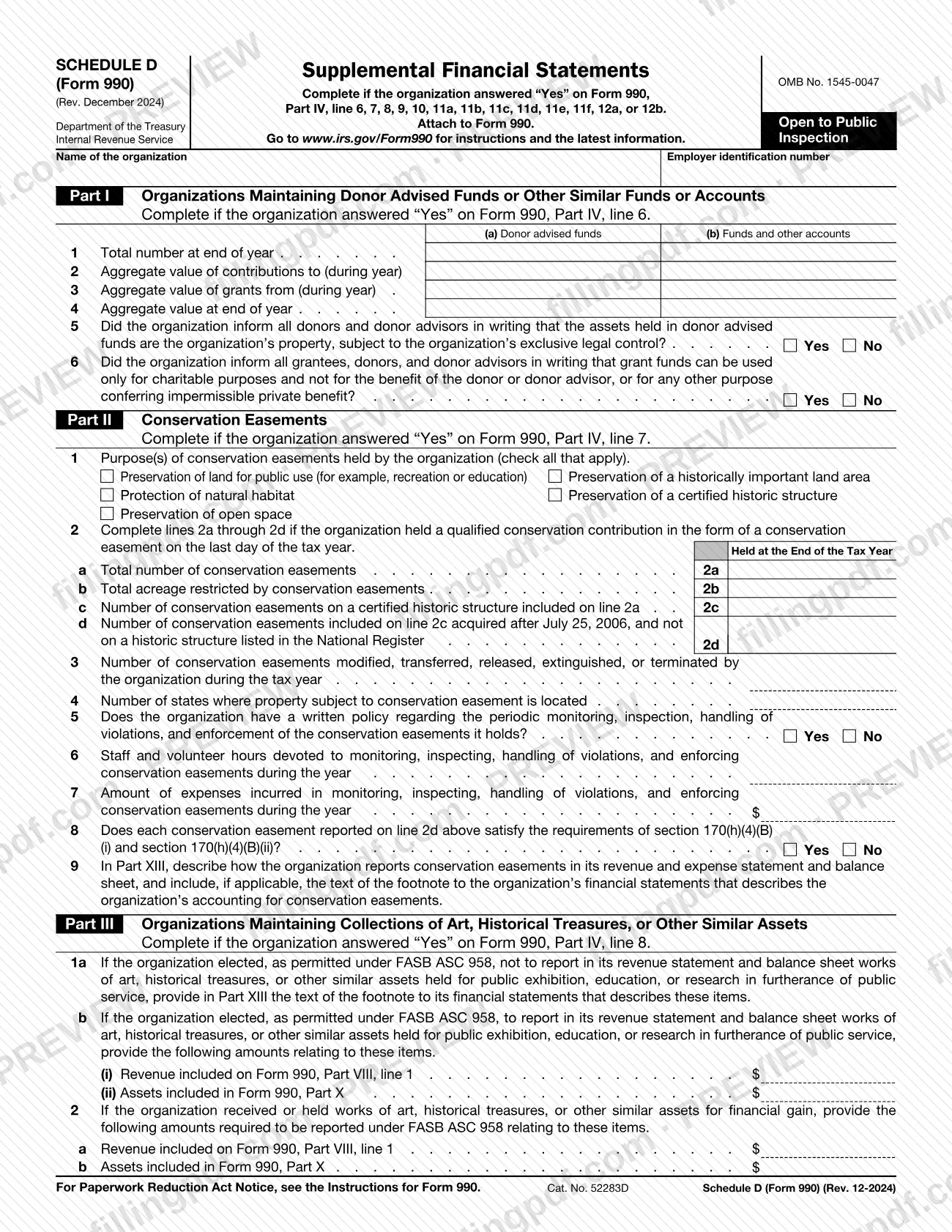
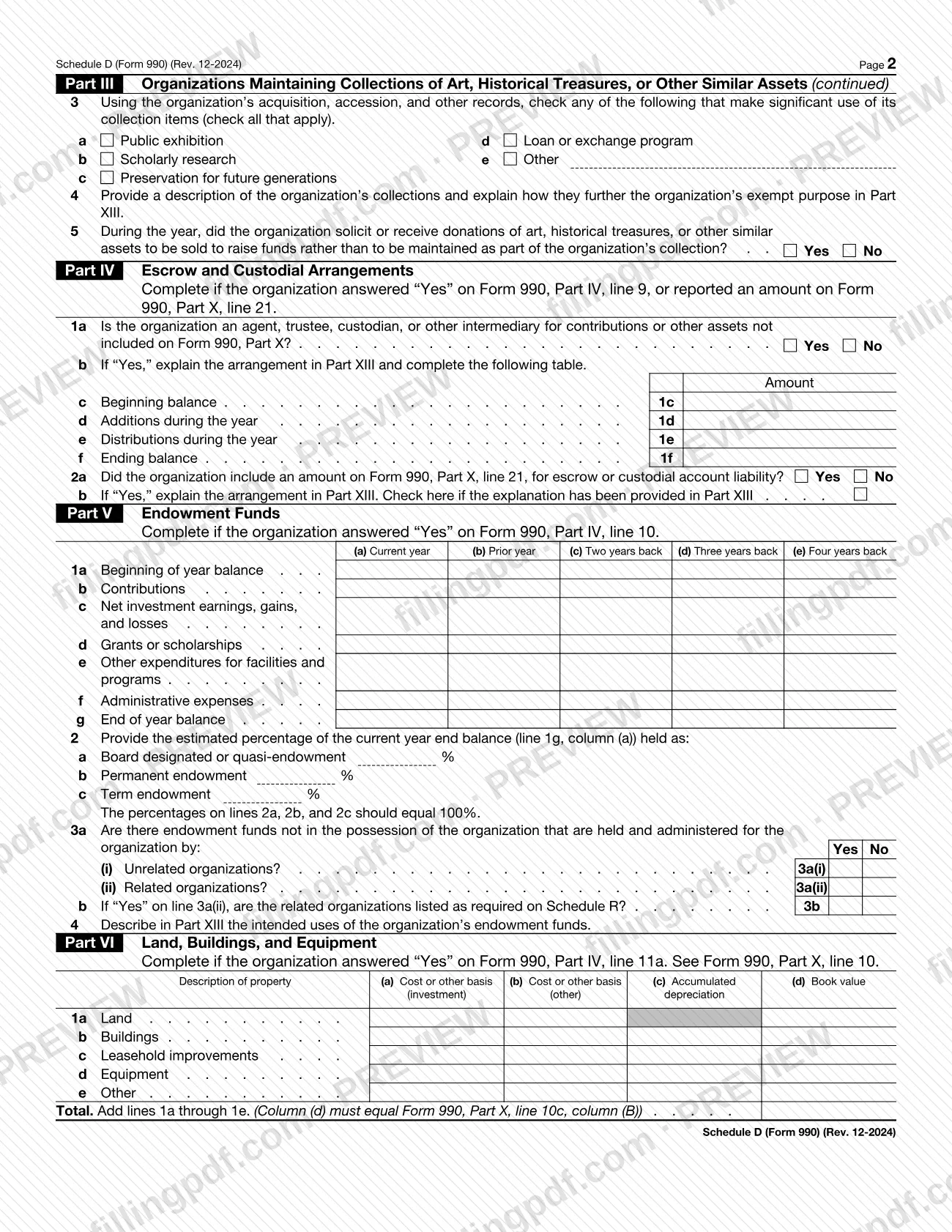
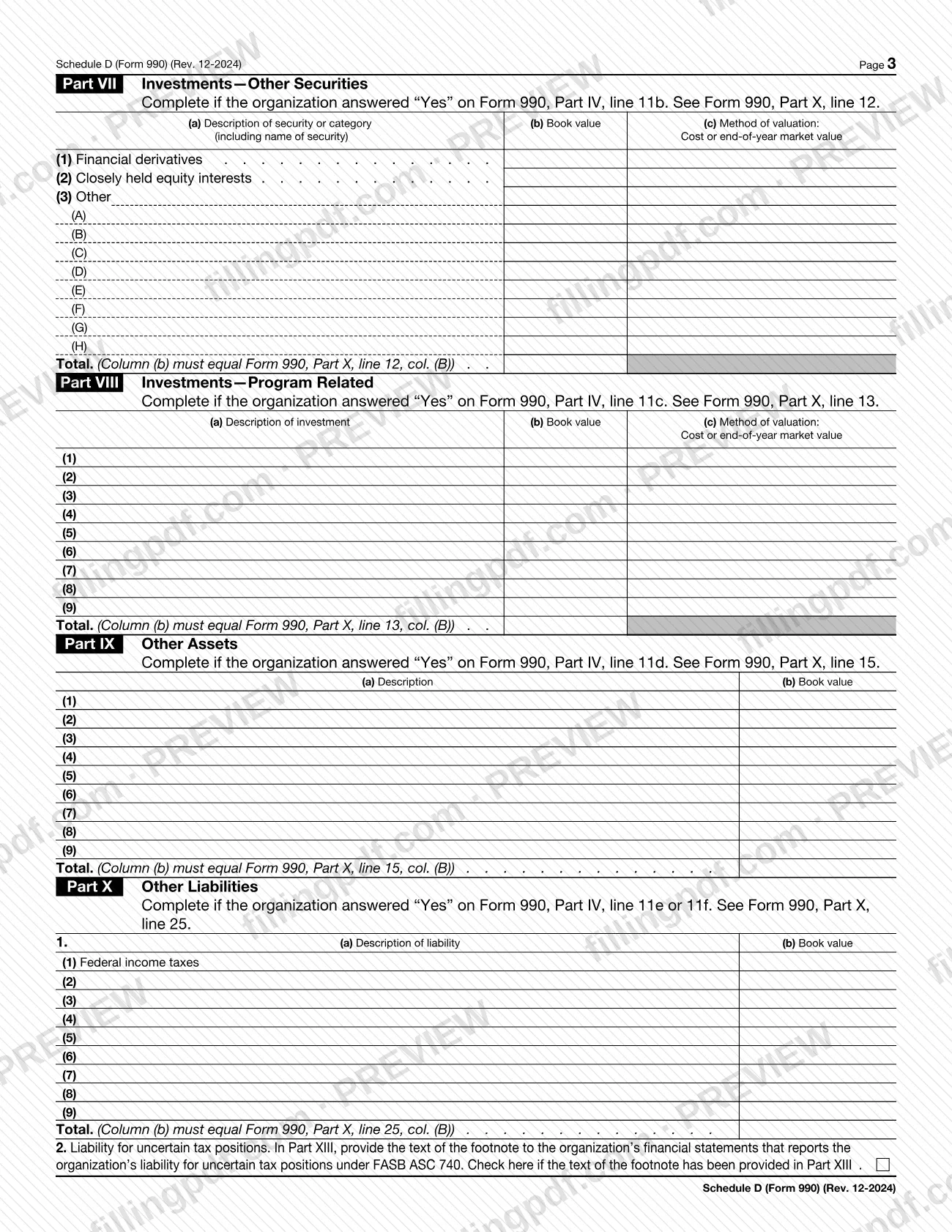
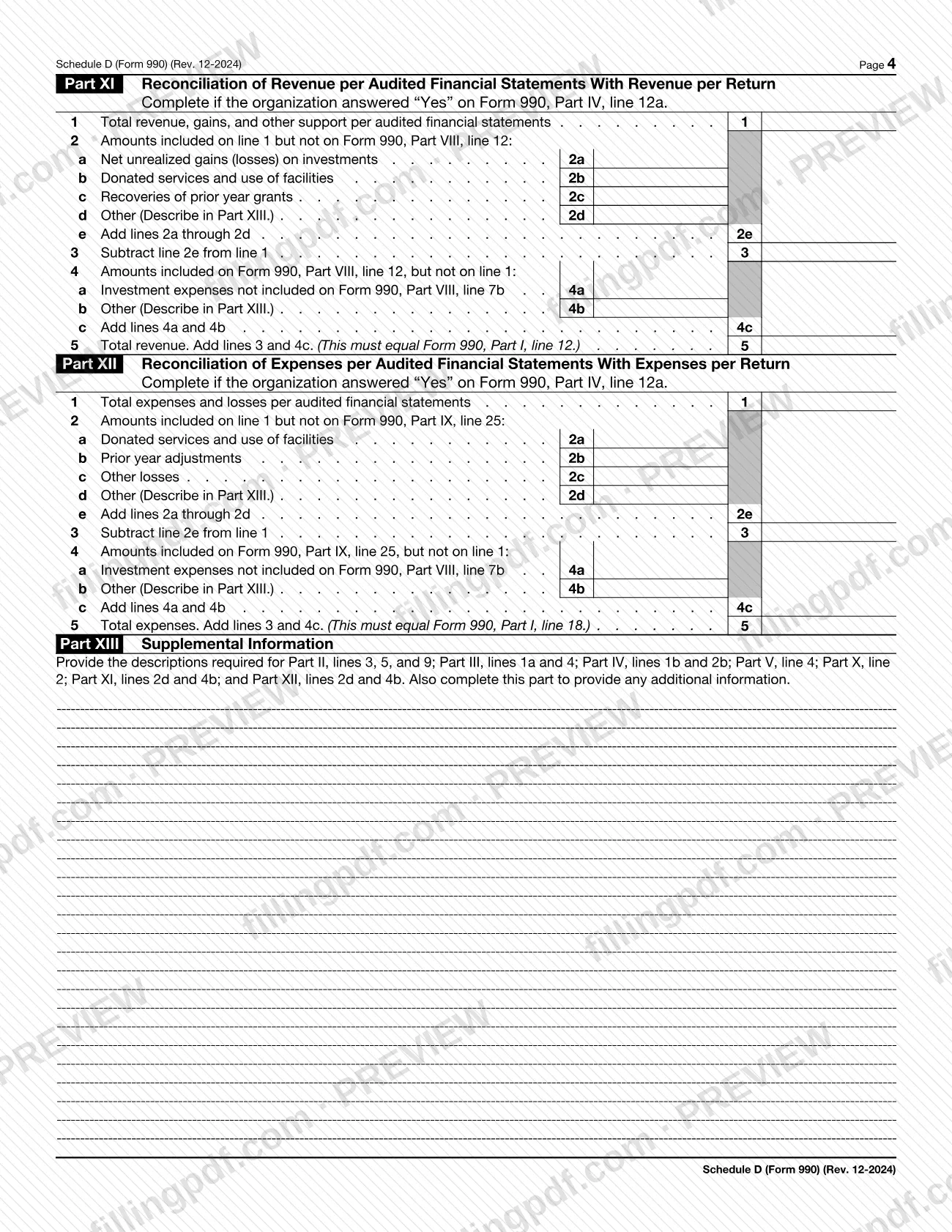

Schedule D (Form 990), Supplemental Financial Statements, is the Internal Revenue Service (IRS) schedule that an organization filing Form 990 attaches to report donor advised funds, conservation easements, art and museum collections, escrow and custodial arrangements, endowment funds and related financial detail. You complete only the parts that match your “Yes” answers on Form 990, Part IV. On this page you can fill out Schedule D (Form 990) online on FillingPDF and download or print the completed PDF; the IRS publishes the original form and its instructions at irs.gov.
Last updated
What is Schedule D (Form 990)?
Schedule D (Form 990), Supplemental Financial Statements, is the Internal Revenue Service (IRS) schedule that an organization filing Form 990 attaches to report donor advised funds, conservation easements, art and museum collections, escrow or custodial arrangements, endowment funds and supplemental financial information.
It is a schedule, not a return: it is attached to Form 990, carries OMB No. 1545-0047 and is marked Open to Public Inspection. Form 990, Part IV, the Checklist of Required Schedules, tells the organization which parts to complete. The schedule has thirteen parts:
- Part I: donor advised funds and similar funds or accounts.
- Part II: conservation easements.
- Part III: collections of art, historical treasures or similar assets.
- Part IV: escrow and custodial arrangements.
- Part V: endowment funds.
- Parts VI to IX: land, buildings and equipment; other securities; program-related investments; other assets.
- Part X: other liabilities, including uncertain tax positions.
- Parts XI and XII: reconciliations of revenue and expenses per audited financial statements with those on the return.
- Part XIII: supplemental information, where the narrative answers called for in other parts are written.
Several totals must agree with Form 990, Part X, and the reconciliations must agree with Form 990, Part I. The revision printed on the form is Rev. December 2024; the IRS instructions say the form and instructions were converted from an annual revision to continuous use, valid for tax year 2024 and later years until a superseding revision is issued.
Who needs to file Schedule D (Form 990)?
An organization that answered “Yes” to any of lines 6 through 12a on Form 990, Part IV, Checklist of Required Schedules, must complete the matching part or parts of Schedule D (Form 990) and attach the schedule to Form 990.
- An organization that answered “Yes” on Form 990, Part IV, line 12b, but “No” on line 12a may complete Parts XI and XII but is not required to.
- An organization with no audited financial statements for the reporting year is not required to complete Part XI or XII.
- Group returns do not have to complete Parts XI and XII.
- An organization that receives contributions of art, historical treasures or similar assets but does not maintain collections as described in FASB ASC 958-360-25-2 is not required to complete Part III, though it may have to complete Schedule M.
- An organization that is not required to file Form 990 but chooses to must file a complete return, including the required schedules.
Some parts also apply on a financial trigger. Part IV applies if the organization reported an amount on Form 990, Part X, line 21, and Parts VII, VIII and IX turn on amounts that are 5% or more of total assets on Form 990, Part X, as the IRS instructions explain.
When to file Schedule D (Form 990)
Schedule D (Form 990) has no due date of its own. You complete it when the organization answers “Yes” to Form 990, Part IV, line 6, 7, 8, 9, 10, 11a through 11f, 12a or 12b, and it is submitted with Form 990 for that tax year.
The IRS instructions say the form and instructions are now continuous use: use them for tax year 2024 and later years until the IRS issues a superseding revision. Check www.irs.gov/Form990 for the latest information before you file.
Gather the figures early. The totals in Parts VI through X and the reconciliations in Parts XI and XII must match amounts on Form 990, Part X, Part VIII, Part IX and Part I, so the schedule is best finished alongside the return rather than before it. For any deadline that applies to Form 990 itself, use the instructions for that return.
Documents you need
- Form 990, to which Schedule D is attached; the schedule is completed only for the parts triggered by your Part IV answers on that return.
- Audited financial statements for the reporting year, as the source of the revenue and expense figures for Parts XI and XII, if the organization received them.
- Text of the footnote to the financial statements describing collection items, to be reproduced in Part XIII, if the organization elected not to report its collections (Part III, line 1a).
- Text of the footnote on conservation easement accounting, to be included in Part XIII, if applicable (Part II, line 9).
- Full text of the footnote on liability for uncertain tax positions, provided in Part XIII when Part X applies, even if no liability was reported (Part X, line 2).
- Schedule R (Form 990), listing all related organizations, if the organization answers “Yes” on Part V, line 3b.
How to fill out Schedule D (Form 990)
Enter organization name and EIN
At the top of page 1, enter the name of the organization and its employer identification number. Then complete only the parts that match your “Yes” answers on Form 990, Part IV.
Complete Part I for donor advised funds
Use column (a) for donor advised funds and column (b) for other similar funds or accounts. Enter the total number at year end (line 1), contributions (line 2), grants (line 3, including transfers within the organization) and value at year end (line 4), then answer Yes or No on lines 5 and 6.
Report conservation easements in Part II
Check the purposes on line 1, then enter lines 2a to 2d (exact counts and acreage, not estimates), line 3 (easements modified, transferred, released, extinguished or terminated), line 4 (states), and the hours and expenses on lines 6 and 7. Answer lines 5 and 8 Yes or No, and describe your accounting for easements in Part XIII (line 9).
Describe collections in Part III
On line 1a, provide the footnote in Part XIII if you elected not to report collections; on line 1b, enter revenue and assets if you elected to report them. Complete line 2 for items held for financial gain, check the uses on line 3, describe the collections on line 4 in Part XIII, and answer line 5 Yes or No.
Explain escrow and custodial arrangements
On line 1a, answer whether the organization is an agent, trustee, custodian or other intermediary for assets not on Form 990, Part X. If Yes, explain in Part XIII and enter the beginning balance, additions, distributions and ending balance on lines 1c to 1f; then answer line 2a and, if Yes, explain on line 2b.
Complete the endowment table in Part V
For the current year and the four prior years, enter lines 1a to 1g in columns (a) to (e). On lines 2a to 2c, enter the estimated percentages of the year-end balance (they should equal 100%), answer lines 3a(i), 3a(ii) and 3b, and describe intended uses on line 4 in Part XIII.
List land, buildings and equipment
In Part VI, enter cost or other basis for investment (column (a)) and other (column (b)) assets, accumulated depreciation in column (c), and book value in column (d) for lines 1a to 1e. Leave column (c) blank for Land; the total of column (d) must equal Form 990, Part X, line 10c, column (B).
Complete Parts VII, VIII and IX
In Part VII, list other securities with book value and method of valuation (cost or end-of-year market value); Part VIII lists program-related investments the same way; Part IX lists other assets with book value. Each column (b) total must equal the matching amount on Form 990, Part X.
List other liabilities in Part X
On line 1, list each liability, including federal income taxes on line (1), with its book value; the total must equal Form 990, Part X, line 25, column (B). On line 2, provide the uncertain tax positions footnote text in Part XIII and check the box.
Reconcile revenue and expenses
In Part XI, start from total revenue per audited financial statements (line 1), subtract the items on lines 2a to 2d, and add the items on lines 4a and 4b; line 5 must equal Form 990, Part I, line 12. Part XII follows the same pattern for expenses, and line 5 must equal Form 990, Part I, line 18.
Write the narrative in Part XIII
Provide the descriptions required for Part II, lines 3, 5 and 9; Part III, lines 1a and 4; Part IV, lines 1b and 2b; Part V, line 4; Part X, line 2; and Parts XI and XII, lines 2d and 4b. Identify the part and line each answer supports, in schedule order.
Review and download the completed PDF
Check that each completed part matches your Form 990, Part IV answers and that all totals agree with Form 990. Download or print the completed PDF from FillingPDF and attach it to Form 990 as described under How to submit.
How to submit Schedule D (Form 990)
Schedule D (Form 990) is not filed on its own. You attach it to Form 990 and it is submitted together with that return; the schedule prints no address, portal or appointment rule of its own.
- Attach to Form 990: include only the parts that apply, with Part XIII where narrative answers are required.
- More space: the IRS instructions allow Part XIII to be duplicated if you need more room. Identify the part and line each answer supports, in the order they appear on the schedule.
- Instructions and updates: the form directs you to www.irs.gov/Form990 for instructions and the latest information.
- Public inspection: the form is marked Open to Public Inspection, so review the narrative text before attaching it.
Enter the organization's name and employer identification number at the top. FillingPDF lets you fill out and download the PDF; submission follows the channels used for Form 990.
Common mistakes to avoid
- Entering an estimate or a rounded number on Part II, line 2a; the instructions say the total number of conservation easements must be exact.
- Including easements on certified historic structures in the acreage on Part II, line 2b, or reporting utility easements anywhere in Part II.
- Entering an amount in column (c), accumulated depreciation, for line 1a, Land, in Part VI.
- Totals in Parts VI to X that do not equal the matching Form 990, Part X lines (for example, Part VI column (d) and Form 990, Part X, line 10c, column (B)).
- Percentages on Part V, lines 2a, 2b and 2c that do not add up to 100%.
- Reporting only grants outside the organization on Part I, line 3; the instructions say to include transfers within the organization.
- Leaving required explanations out of Part XIII, such as the changes to each easement modified, transferred, released, extinguished or terminated (Part II, line 3).
- Summarizing the filing organization's own portion of the uncertain tax positions footnote in Part X, line 2; that portion must be provided verbatim.
- Including program-related investment expenses or program service expenses on line 4a of Part XI or XII; only investment expenses netted against investment income belong there.
- Listing publicly traded stock in Part VII without name, class and number of shares, or omitting a class that meets a 5% test.
Frequently asked questions
What is Schedule D (Form 990)?
Schedule D (Form 990), Supplemental Financial Statements, is the IRS schedule that organizations filing Form 990 use to report donor advised funds, conservation easements, collections, escrow or custodial arrangements, endowment funds and supplemental financial information. It is attached to Form 990.
Who has to file Schedule D (Form 990)?
An organization that answered “Yes” to any of lines 6 through 12a on Form 990, Part IV, must complete the matching parts and attach the schedule to Form 990. A “Yes” on line 12b alone makes Parts XI and XII optional, not required.
Which parts of Schedule D (Form 990) do I complete?
Only the parts your Form 990, Part IV answers trigger: Part I for line 6, Part II for line 7, Part III for line 8, Part IV for line 9, Part V for line 10, Parts VI to X for lines 11a to 11f, and Parts XI and XII for line 12a. Part XIII supports them all.
Do I have to complete Parts XI and XII?
Yes if you answered “Yes” on Form 990, Part IV, line 12a. If you answered “Yes” only on line 12b, they are optional. You are not required to complete them if the organization received no audited financial statements for the year, and group returns need not complete them.
Where do I submit Schedule D (Form 990)?
You attach it to Form 990 and submit it with that return. The schedule prints no separate address or portal. The form points to www.irs.gov/Form990 for instructions and the latest information on filing.
What goes in Part XIII of Schedule D (Form 990)?
Part XIII holds the narrative answers required elsewhere in the schedule, such as Part II lines 3, 5 and 9, Part III lines 1a and 4, and Part V line 4, plus any additional explanations. Label each answer with its part and line, and duplicate Part XIII if you need more space.
Can I fill out Schedule D (Form 990) online?
Yes. You can fill out the PDF online on FillingPDF and download or print it. FillingPDF is an independent service and does not file the schedule with the IRS; it is submitted with Form 990 through the IRS channels.
Does Schedule D (Form 990) have its own deadline?
No. The schedule is part of the Form 990 package, so it is completed and submitted with that return. The Rev. December 2024 form is continuous use: the IRS says to use it for tax year 2024 and later years until a superseding revision is issued.
Ready to fill out Schedule D (Form 990)?
Fill out Schedule D (Form 990) now