
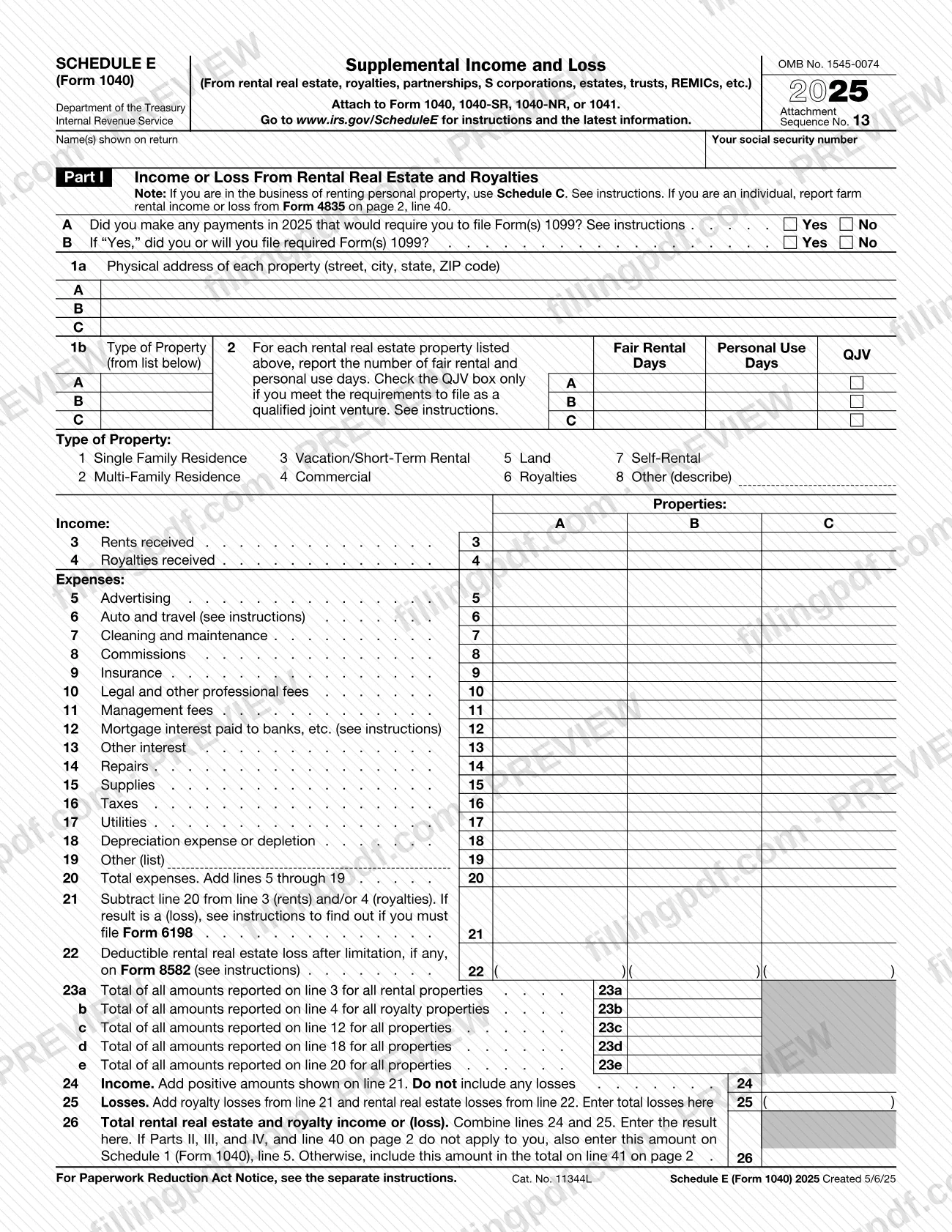
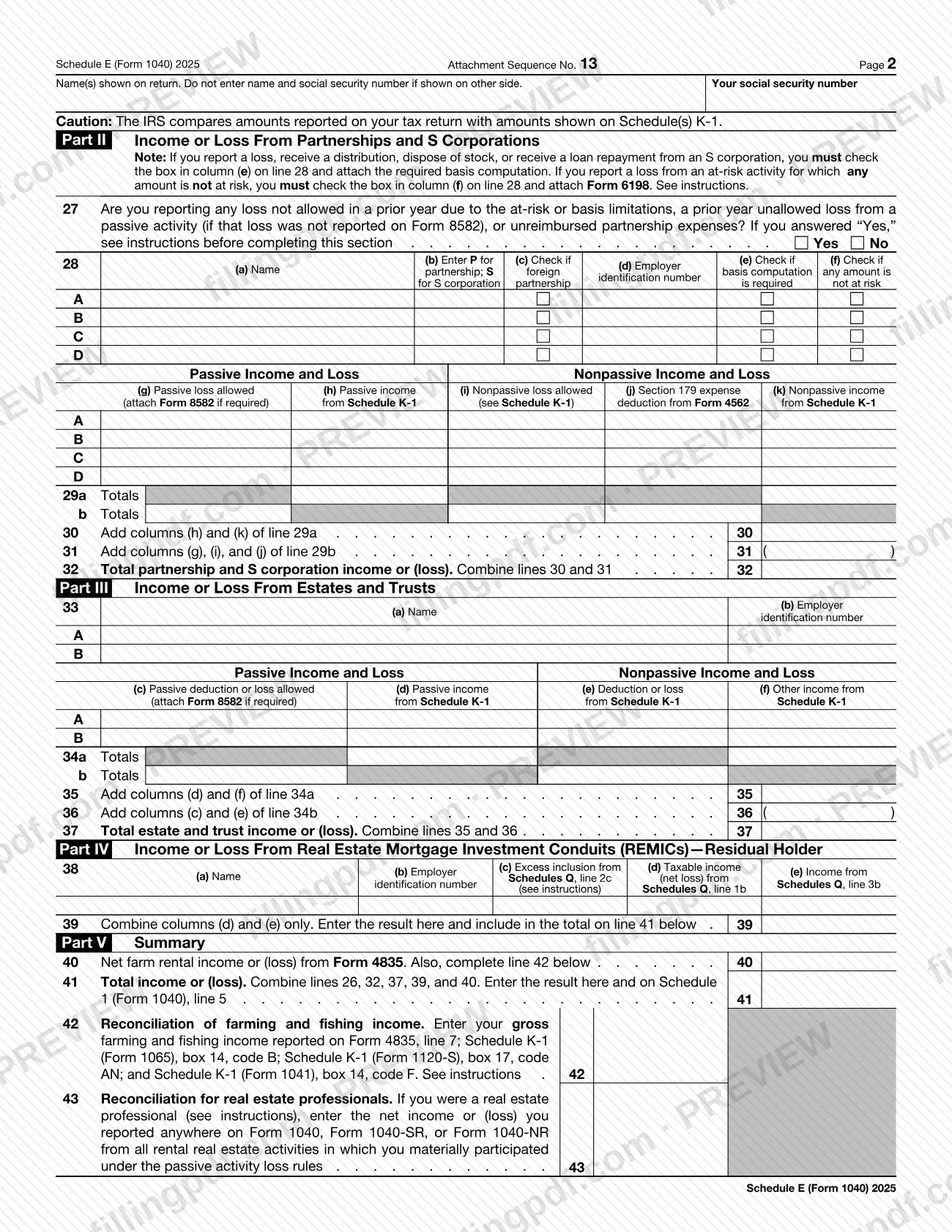
Schedule E (Form 1040), Supplemental Income and Loss, is the Internal Revenue Service (IRS) schedule for reporting income or loss from rental real estate, royalties, partnerships, S corporations, estates, trusts and residual interests in REMICs. You attach it to Form 1040, 1040-SR, 1040-NR or 1041. On this page you can fill out Schedule E (Form 1040) online on FillingPDF and download or print the completed PDF; the form, its instructions and the latest updates are published by the IRS at www.irs.gov/ScheduleE.
Last updated
What is Schedule E (Form 1040)?
Schedule E (Form 1040), Supplemental Income and Loss is the Internal Revenue Service (IRS) schedule that reports income or loss from rental real estate, royalties, partnerships, S corporations, estates, trusts and residual interests in real estate mortgage investment conduits (REMICs). It is attached to a tax return, not filed alone.
The two-page form is built in parts:
- Part I: rental real estate and royalties, with columns A, B and C for up to three properties, income on lines 3 and 4, expenses on lines 5 through 19 and totals on lines 20 through 26.
- Part II: partnerships and S corporations (lines 27 to 32).
- Part III: estates and trusts (lines 33 to 37).
- Part IV: REMICs, residual holder (lines 38 and 39).
- Part V: summary (lines 40 to 43), including the total on line 41 that carries to Schedule 1 (Form 1040), line 5.
The IRS instructions say to enter the total income and the total loss for each part separately, with loss figures in parentheses. This schedule is not the place for every kind of rental or royalty income. The form's note sends a business of renting personal property to Schedule C, and farm rental income from Form 4835 is reported on page 2, line 40. The instructions also send some royalty income of self-employed writers, inventors and artists to Schedule C. The form is issued under OMB No. 1545-0074, Attachment Sequence No. 13, for tax year 2025.
Who needs to file Schedule E (Form 1040)?
Taxpayers who have income or loss from any of these sources use Schedule E (Form 1040), according to the IRS instructions:
- rental real estate, including personal property leased with real estate (Part I);
- royalties, such as oil, gas or mineral royalties, copyrights, patents and name, image and likeness rights that are not self-employment income (Part I);
- a partnership or S corporation, for which you should receive a Schedule K-1 (Part II);
- an estate or trust, as a beneficiary (Part III);
- a residual interest in a REMIC (Part IV).
Fiduciaries who file Schedule E with Form 1041 enter the estate's or trust's employer identification number (EIN) in the space for "Your social security number."
Do not use Schedule E for these cases:
- Renting personal property, such as equipment or vehicles, as a business: use Schedule C.
- Rentals where you provide significant services to the renter, such as maid service: use Schedule C.
- Rentals of real estate you held for sale to customers as a real estate dealer: use Schedule C.
- Farm rental income based on crops or livestock, for an individual who did not materially participate: use Form 4835.
- A regular interest in a REMIC: report it on Form 1040 or 1040-SR, line 2b.
Spouses who qualify as a qualified joint venture (QJV) rental business each report their interest as separate properties on line 1.
When to file Schedule E (Form 1040)
Schedule E (Form 1040) is completed when you prepare the return it is attached to, so it has no separate due date: it is submitted with Form 1040, 1040-SR, 1040-NR or 1041 whenever that return is filed. The form for tax year 2025 covers income and expenses for that year, and the days entered on line 2 are the days in 2025. Line 42 adds one timing rule for farming and fishing income: no estimated tax underpayment penalty is charged if your gross farming or fishing income for 2024 or 2025 is at least two-thirds of your gross income and you file your 2025 return and pay the tax due by March 2, 2026. For any other deadline, check the instructions for the return you attach it to.
Documents you need
- Form 1040, 1040-SR, 1040-NR or 1041: Schedule E is attached to one of these returns; it is not filed alone.
- Additional Schedules E: attach as many as needed if you have more than three rental real estate or royalty properties, completing lines 23a through 26 on only one.
- Form 4562: attach if you claim depreciation on property first placed in service in 2025, depreciation on listed property including a vehicle, or a section 179 deduction or amortization that began in 2025. Also required if you claim any auto expenses (Part V).
- Form 6198: attach if you have amounts in an activity for which you are not at risk and need to figure your deductible loss; write "Form 6198" to the left of line 21.
- Form 8582: attach if required to figure your passive activity loss limit; the instructions explain when you do not need it.
- Form 7203 or other basis computation: required if you check the box in Part II, column (e), for an S corporation loss, distribution, stock disposal or loan repayment.
- Form 8990: file if your rental real estate activity is a trade or business and your business interest deduction may be limited, unless a filing exception applies.
- Form 461: use if your loss may be subject to the excess business loss limitation; the limitation is figured there and not reflected on Schedule E.
- Statement for line 3: attach if you report any other income on line 3.
- Statement for line 1b code 8: attach a statement describing the property if you enter code "8" (Other).
- Statement for line 12 or 13 interest: attach if you paid more mortgage interest than shown on Form 1098, or if another person received Form 1098 for a mortgage you share.
- Continuation sheet: attach, in the same format, if you need more space in Part II, III or IV.
- Statement for the real estate professional election: attach to your original return if you elect to treat all your rental real estate interests as one activity under section 469(c)(7)(A).
How to fill out Schedule E (Form 1040)
Enter your name and taxpayer number
At the top of page 1, enter the name(s) shown on your return and your social security number. Fiduciaries filing with Form 1041 enter the estate's or trust's EIN in that space.
Answer lines A and B
Line A: check Yes if you made payments in 2025 that would require you to file any Form 1099, otherwise No. Line B: if you answered Yes, check whether you did or will file the required Forms 1099.
List each property on lines 1a and 1b
On line 1a, enter the street address, city or town, state and ZIP code of each rental real estate property in rows A, B and C. On line 1b, enter the type code 1 through 8; use code 6 for royalties and leave 1a and 2 blank, and attach a description for code 8.
Report rental days and QJV on line 2
For each rental real estate property, enter the number of fair rental days and personal use days in 2025. Check the QJV box only if you meet the requirements to file as a qualified joint venture.
Enter rents and royalties on lines 3 and 4
Use a separate column for each property. Line 3 is rents received; line 4 is the gross royalties received.
Enter expenses on lines 5 through 19
Enter each expense in the column of its property: advertising, auto and travel, cleaning, commissions, insurance, fees, interest, repairs, supplies, taxes, utilities, depreciation or depletion, and other expenses listed on line 19. Then add lines 5 through 19 on line 20.
Figure income or loss on lines 21 and 22
Subtract line 20 from line 3 and/or line 4 on line 21. For a rental real estate loss, enter the deductible loss after any Form 8582 limitation on line 22; skip line 22 for royalty properties.
Complete totals on lines 23a through 26
Enter the combined totals on lines 23a through 23e, add positive line 21 amounts on line 24 and losses on line 25, then combine lines 24 and 25 on line 26.
Complete Part II for partnerships and S corporations
Answer line 27. On line 28, enter each entity's name, P or S, foreign partnership box, EIN, the box in column (e) or (f) if required, and the passive and nonpassive amounts from Schedule K-1 in columns (g) through (k). Complete totals on lines 29a and 29b, then lines 30 to 32.
Complete Part III for estates and trusts
On line 33, enter each estate or trust's name and EIN and the passive and nonpassive amounts from Schedule K-1 (Form 1041) in columns (c) through (f). Complete totals on lines 34a and 34b, then lines 35 to 37.
Complete Part IV for REMICs
On line 38, enter each REMIC's name and EIN and the amounts from Schedules Q (Form 1066) in columns (c) through (e). Combine columns (d) and (e) on line 39.
Complete the Part V summary
Enter net farm rental income or (loss) from Form 4835 on line 40. Combine lines 26, 32, 37, 39 and 40 on line 41, complete line 42 for farming and fishing income and line 43 if you were a real estate professional.
Review and download the completed PDF
Check that losses are in parentheses, lines 23a through 26 appear on only one Schedule E if you use several, and the totals agree with your supporting forms. Download or print the completed PDF from FillingPDF and attach it to your return.
How to submit Schedule E (Form 1040)
Schedule E (Form 1040) has no filing address or channel of its own: you submit it as an attachment to your tax return, Form 1040, 1040-SR, 1040-NR or 1041, through whichever channel you use for that return.
- With the return: attach the completed schedule, and any additional Schedules E or continuation sheets you need, to the return. If you have more than three rental real estate or royalty properties, attach as many Schedules E as needed, but fill in lines 23a through 26 on only one of them, showing combined totals.
- Supporting forms and statements: attach the forms and statements the instructions require for your situation, such as Form 4562, Form 6198 or Form 7203, as listed under required documents.
- Schedules K-1: do not attach Schedules K-1 to your return; the instructions say to keep them for your records.
For mailing addresses and electronic filing options, use the instructions for your return and IRS.gov. FillingPDF lets you fill out and download the PDF; submission follows the channels above.
Common mistakes to avoid
- Reporting rental of personal property, such as equipment or vehicles, on Schedule E when you are in that business; the form says to use Schedule C.
- Reporting a rental on Schedule E when you provided significant services to the renter, such as maid service; the instructions say to use Schedule C.
- Entering a street address and days for a royalty property; for royalties, enter code "6" on line 1b and leave lines 1a and 2 blank.
- Filling in lines 23a through 26 on more than one Schedule E when you list more than three properties; only one should carry the combined totals.
- Deducting capital improvements or your own labor as expenses; the instructions say neither is deductible on lines 5 through 19, and improvements are generally depreciated.
- Not enclosing losses in parentheses, or combining prior-year unallowed losses with current-year partnership or S corporation amounts instead of using a separate line marked "PYA".
- Reporting rental income and expenses for a dwelling unit you used as a home and rented for fewer than 15 days in 2025.
- Not checking the box in Part II, column (e), and attaching the basis computation when an S corporation reports a loss, distribution, stock disposal or loan repayment.
- Attaching Schedule K-1 to the return; the instructions say to keep it for your records.
- Using line 22 for a royalty loss; do not complete line 22 if the line 21 amount is from royalty properties.
Frequently asked questions
What is Schedule E (Form 1040) used for?
Schedule E (Form 1040) reports income or loss from rental real estate, royalties, partnerships, S corporations, estates, trusts and REMIC residual interests. The IRS form is attached to Form 1040, 1040-SR, 1040-NR or 1041, and its Part V total carries to Schedule 1 (Form 1040), line 5.
Do I file Schedule E or Schedule C for rental income?
Rental real estate generally goes on Schedule E. Use Schedule C instead if you provide significant services to the renter, such as maid service, if you are a real estate dealer renting property held for sale, or if you are in the business of renting personal property.
What if I have more than three rental properties?
Attach as many Schedules E as you need to list them. Answer lines A and B and fill in lines 23a through 26 on only one Schedule E, showing the combined totals for all properties reported on your Schedules E.
How do I report royalty income on Schedule E?
Enter code 6 on line 1b for the royalty property, leave lines 1a and 2 blank, and report the gross royalties on line 4. Self-employed writers, inventors and artists report royalty income and expenses on Schedule C instead, according to the instructions.
Where do I send Schedule E (Form 1040)?
Nowhere separately. You attach it to your return, Form 1040, 1040-SR, 1040-NR or 1041, and submit it through the channel you use for that return. Do not attach Schedules K-1; the instructions say to keep them for your records.
What is a QJV and how do I elect it on Schedule E?
A qualified joint venture lets spouses who both materially participate in a jointly owned rental real estate business and file jointly report income directly instead of filing Form 1065. Check the QJV box on line 2 for each property in the venture. An LLC owned by the spouses does not qualify.
When do I fill in line 43 of Schedule E?
Complete line 43 if you were a real estate professional for 2025. The instructions define this as more than half your personal services in real property trades or businesses in which you materially participated, plus more than 750 hours of those services during the year.
Can I fill out Schedule E (Form 1040) online on FillingPDF?
Yes. You can fill out the PDF online on FillingPDF and download or print it. FillingPDF is an independent service and does not file the schedule with the IRS; you submit it attached to your return through the IRS channels for that return.
Ready to fill out Schedule E (Form 1040)?
Fill out Schedule E (Form 1040) now