
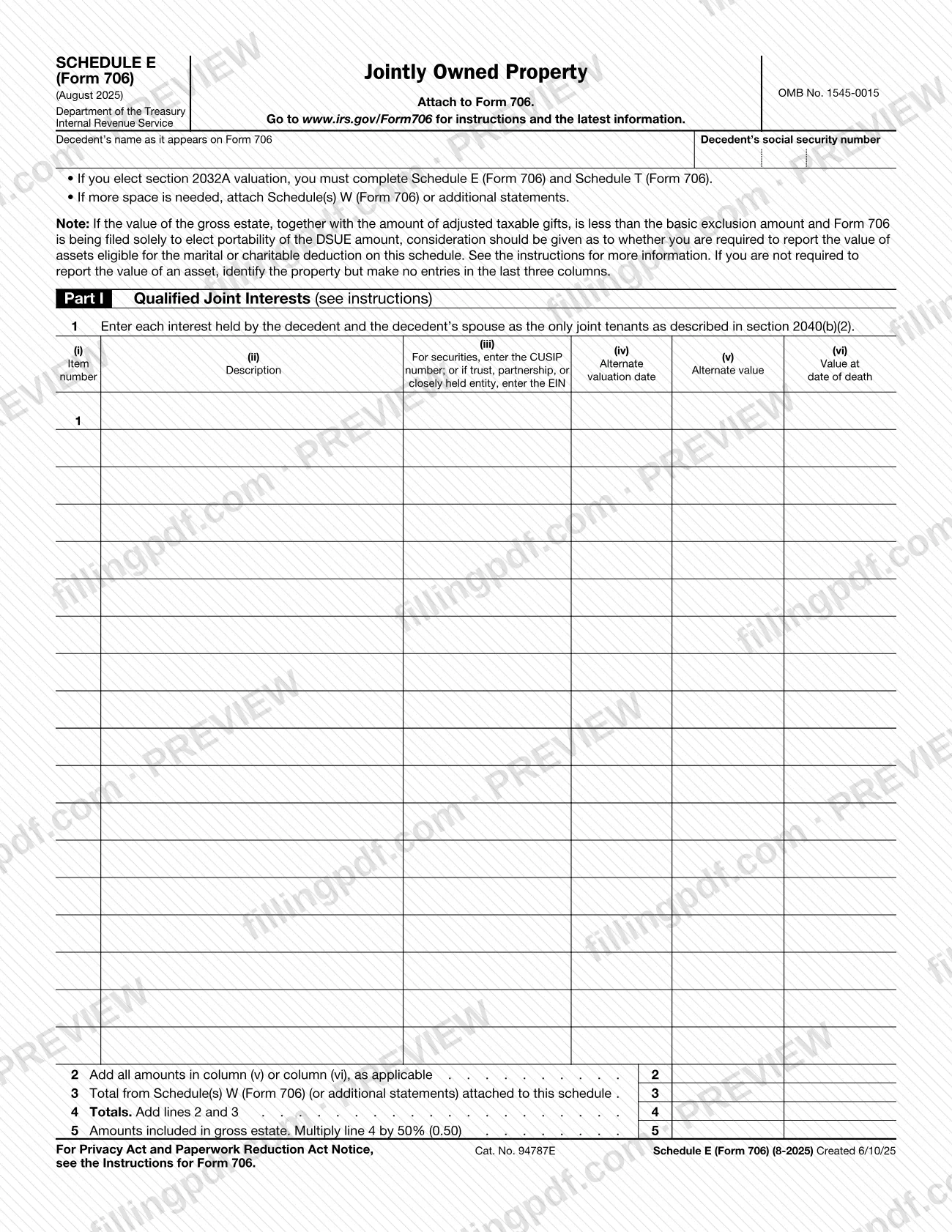
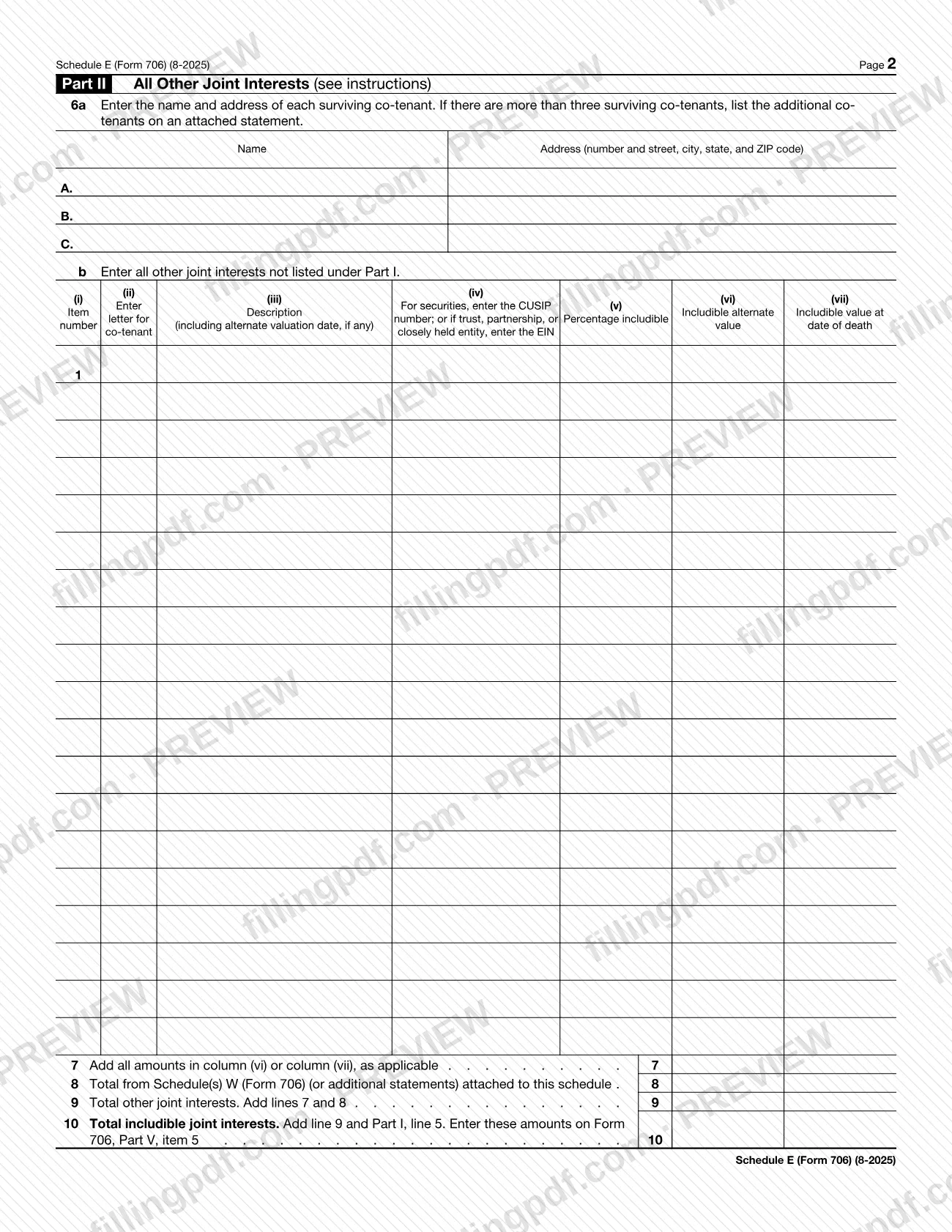
Schedule E (Form 706), Jointly Owned Property, is the Internal Revenue Service (IRS) schedule you attach to Form 706 to report property the decedent held jointly with others. Part I covers qualified joint interests held with a spouse as the only joint tenants, and Part II covers all other joint interests. On this page you can fill out the form online on FillingPDF and download or print the completed PDF; the form and its instructions are published by the IRS at www.irs.gov/Form706.
Last updated
What is Schedule E (Form 706)?
Schedule E (Form 706), Jointly Owned Property, is the IRS schedule attached to Form 706 that lists each jointly held interest, shows its value, and computes the total of includible joint interests that carries to Form 706.
The schedule has two parts. Part I, Qualified Joint Interests, is for each interest held by the decedent and the decedent's spouse as the only joint tenants, as described in section 2040(b)(2). Part II, All Other Joint Interests, is for every other joint interest, and it records the name and address of each surviving co-tenant and the percentage includible.
For each item you give an item number and description, the CUSIP number for securities or the EIN for a trust, partnership or closely held entity, and the value at the date of death or the alternate value. Part I then multiplies the total by 50% (0.50) on line 5 to get the amount included in the gross estate. Line 10 adds the Part II total and Part I, line 5, and the result is entered on Form 706, Part V, item 5.
The form is identified as OMB No. 1545-0015 and the revision printed on it is August 2025. It is a schedule of Form 706 and is not filed on its own: it says to attach it to Form 706. If more space is needed, Schedule(s) W (Form 706) or additional statements are attached.
Who needs to file Schedule E (Form 706)?
Anyone completing Form 706 who has to report property the decedent held jointly with another person attaches this schedule to that form. Use Part I for interests held by the decedent and the decedent's spouse as the only joint tenants, as described in section 2040(b)(2). Use Part II for all other joint interests, listing each surviving co-tenant.
Two situations are called out on the form itself:
- If you elect section 2032A valuation, you must complete Schedule E (Form 706) and Schedule T (Form 706).
- If the value of the gross estate plus adjusted taxable gifts is less than the basic exclusion amount and Form 706 is being filed solely to elect portability of the DSUE amount, consider whether you must report the value of assets eligible for the marital or charitable deduction on this schedule. If you are not required to report a value, identify the property but make no entries in the last three columns.
The form does not say who may sign or file for someone else; the IRS instructions for Form 706 at www.irs.gov/Form706 cover eligibility questions.
When to file Schedule E (Form 706)
You complete Schedule E (Form 706) whenever you complete Form 706 and need to report jointly owned property, because the schedule says to attach it to Form 706. No separate due date is printed on it, so it travels with Form 706 and follows the deadline that applies to that form.
Section 2032A valuation is a trigger of its own: if you elect it, the form requires you to complete both Schedule E (Form 706) and Schedule T (Form 706). Check the IRS instructions at www.irs.gov/Form706 for any deadline that applies to Form 706.
Documents you need
- Form 706, to which Schedule E (Form 706) is attached; the schedule is not filed on its own.
- Schedule T (Form 706), required together with this schedule if you elect section 2032A valuation.
- Schedule(s) W (Form 706) or additional statements, attached when more space is needed; their totals go on lines 3 and 8.
- An attached statement listing the additional surviving co-tenants, only if there are more than three co-tenants for line 6a.
How to fill out Schedule E (Form 706)
Enter the decedent's name and SSN
At the top, enter the decedent's name as it appears on Form 706 and the decedent's social security number.
Check the section 2032A and space notes
If you elect section 2032A valuation, complete Schedule T (Form 706) as well as this schedule. If you need more room, attach Schedule(s) W (Form 706) or additional statements.
Apply the portability note if relevant
If Form 706 is filed solely to elect portability of the DSUE amount and the gross estate plus adjusted taxable gifts is below the basic exclusion amount, you may only identify some property and leave the last three columns blank. See the instructions.
List qualified joint interests
In Part I, line 1, enter each interest held by the decedent and spouse as the only joint tenants under section 2040(b)(2). For each give the item number, description, CUSIP number for securities or EIN for a trust, partnership or closely held entity, and the alternate valuation date, alternate value and value at date of death.
Total Part I and apply 50%
On line 2, add column (v) or (vi), as applicable. Enter any Schedule W or statement total on line 3, add lines 2 and 3 on line 4, and multiply line 4 by 50% (0.50) on line 5.
Name the surviving co-tenants
In Part II, line 6a, enter the name and address of each surviving co-tenant in rows A, B and C. Attach a statement for any additional co-tenants.
List all other joint interests
On line 6b, enter each joint interest not listed in Part I with its item number, the letter of the co-tenant, a description (including the alternate valuation date, if any), and the CUSIP or EIN where required.
Enter percentage and values
For each Part II item enter the percentage includible and the includible alternate value and includible value at date of death, as the columns request.
Total Part II
On line 7, add column (vi) or (vii), as applicable. Enter any Schedule W or statement total on line 8 and add lines 7 and 8 on line 9.
Figure the total on line 10
Add line 9 and Part I, line 5 on line 10, the total includible joint interests. Enter this amount on Form 706, Part V, item 5.
Review and download the PDF
Check the totals and the identifying numbers, then use FillingPDF to download or print the completed PDF and attach it to Form 706.
How to submit Schedule E (Form 706)
Schedule E (Form 706) is submitted as an attachment to Form 706; it has no separate filing channel or address printed on it.
- With Form 706: attach the completed schedule to Form 706 and send the package the way you submit Form 706.
- Extra pages: attach Schedule(s) W (Form 706) or additional statements if more space is needed, and a statement listing any surviving co-tenants beyond the three lines on line 6a.
- Instructions: the form directs you to www.irs.gov/Form706 for instructions and the latest information, including where Form 706 is sent.
Carry the line 10 total to Form 706, Part V, item 5. FillingPDF lets you fill out and download the PDF; submission follows the IRS channels that apply to Form 706.
Common mistakes to avoid
- Filing the schedule without attaching it to Form 706; the form states it is to be attached to Form 706.
- Electing section 2032A valuation but completing only Schedule E (Form 706); the form requires Schedule T (Form 706) as well.
- Listing an interest in Part I when the decedent did not hold it with the spouse as the only joint tenants under section 2040(b)(2); other interests belong in Part II.
- Skipping the 50% step on line 5; Part I line 5 is line 4 multiplied by 50% (0.50).
- Listing more than three surviving co-tenants on line 6a instead of putting the additional ones on an attached statement.
- Omitting the CUSIP number for securities or the EIN for a trust, partnership or closely held entity in the identifier column.
- Entering values in the last three columns for an asset you are not required to report in a portability-only filing, instead of identifying the property and leaving them blank.
- Entering line 10 anywhere other than Form 706, Part V, item 5.
Frequently asked questions
What is Schedule E (Form 706)?
Schedule E (Form 706), Jointly Owned Property, is the IRS schedule attached to Form 706 that lists the decedent's jointly held interests, with values, and totals the joint interests that are includible. It has Part I for spousal qualified joint interests and Part II for all other joint interests.
Is Schedule E (Form 706) filed on its own?
No. The form says to attach it to Form 706, so it is submitted with that form. It has no separate address or due date printed on it; the IRS instructions at www.irs.gov/Form706 cover filing details.
What is the difference between Part I and Part II?
Part I is for each interest held by the decedent and the decedent's spouse as the only joint tenants, as described in section 2040(b)(2). Part II is for all other joint interests and also records each surviving co-tenant's name and address.
Why do I multiply by 50% on line 5?
Line 5 is the amount included in the gross estate for the Part I qualified joint interests. The form has you add lines 2 and 3 on line 4, then multiply line 4 by 50% (0.50) to get line 5.
What if there are more than three surviving co-tenants?
List the first three in rows A, B and C on line 6a and put the additional co-tenants on an attached statement. For other extra space, the form says to attach Schedule(s) W (Form 706) or additional statements.
Where does the line 10 total go?
Line 10 adds line 9 and Part I, line 5. The form says to enter these amounts on Form 706, Part V, item 5.
Do I need Schedule T if I elect section 2032A valuation?
Yes. The form states that if you elect section 2032A valuation, you must complete Schedule E (Form 706) and Schedule T (Form 706).
Can I fill out Schedule E (Form 706) online?
Yes, you can fill out the PDF online on FillingPDF and download or print it. FillingPDF is an independent service and does not file the form with the IRS; you submit it with Form 706 through the IRS channels.
Ready to fill out Schedule E (Form 706)?
Fill out Schedule E (Form 706) now