
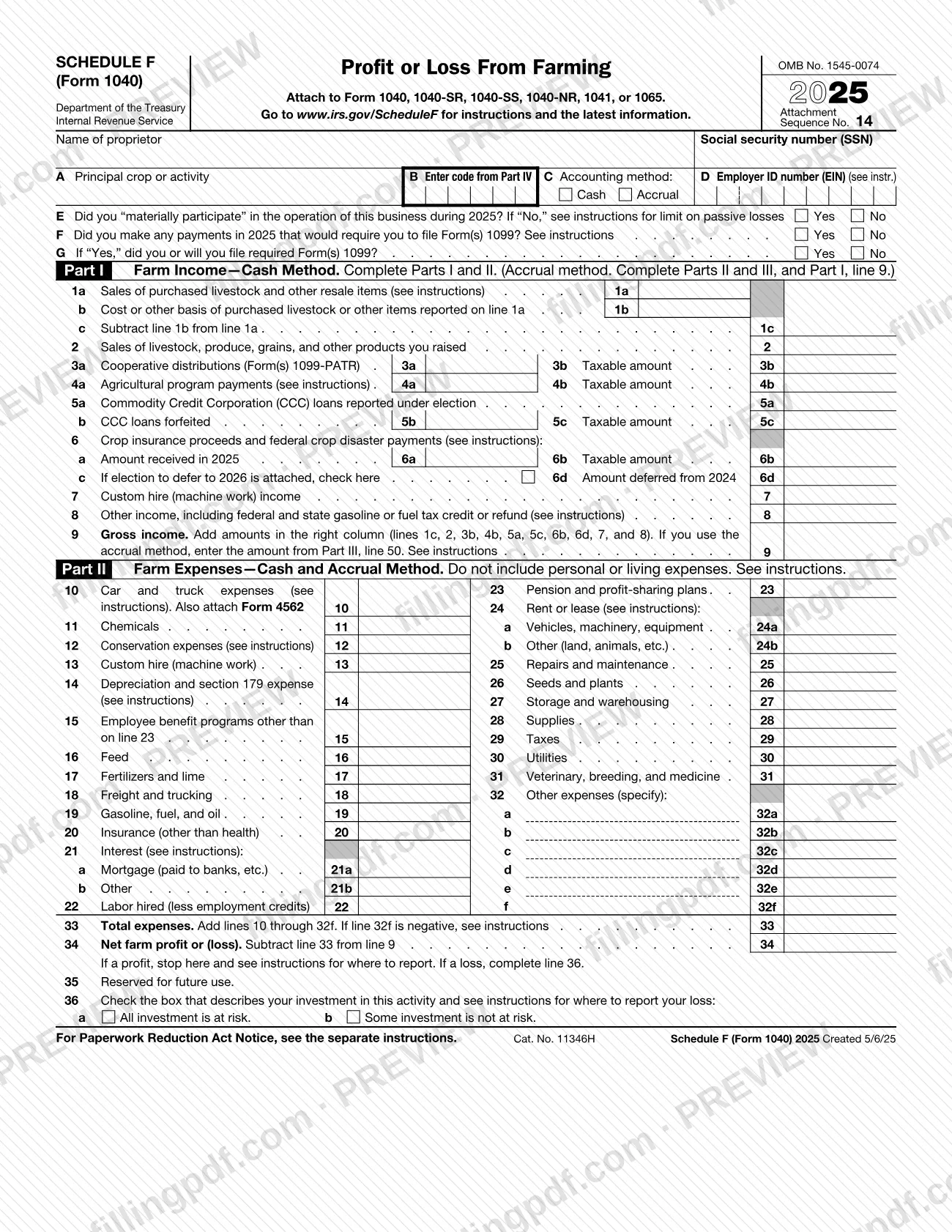
Schedule F (Form 1040), Profit or Loss From Farming, is the Internal Revenue Service (IRS) schedule on which a farmer reports farm income and farm expenses and arrives at a net farm profit or loss for 2025. You attach it to your return: Form 1040, 1040-SR, 1040-SS, 1040-NR, 1041, or 1065. On this page you can fill out the schedule online on FillingPDF and download or print the completed PDF. The IRS publishes the form and its instructions at www.irs.gov/ScheduleF.
Last updated
What is Schedule F (Form 1040)?
Schedule F (Form 1040), Profit or Loss From Farming, is the IRS schedule used to report farm income and expenses. It is attached to a federal return and produces the net farm profit or loss that then moves to that return.
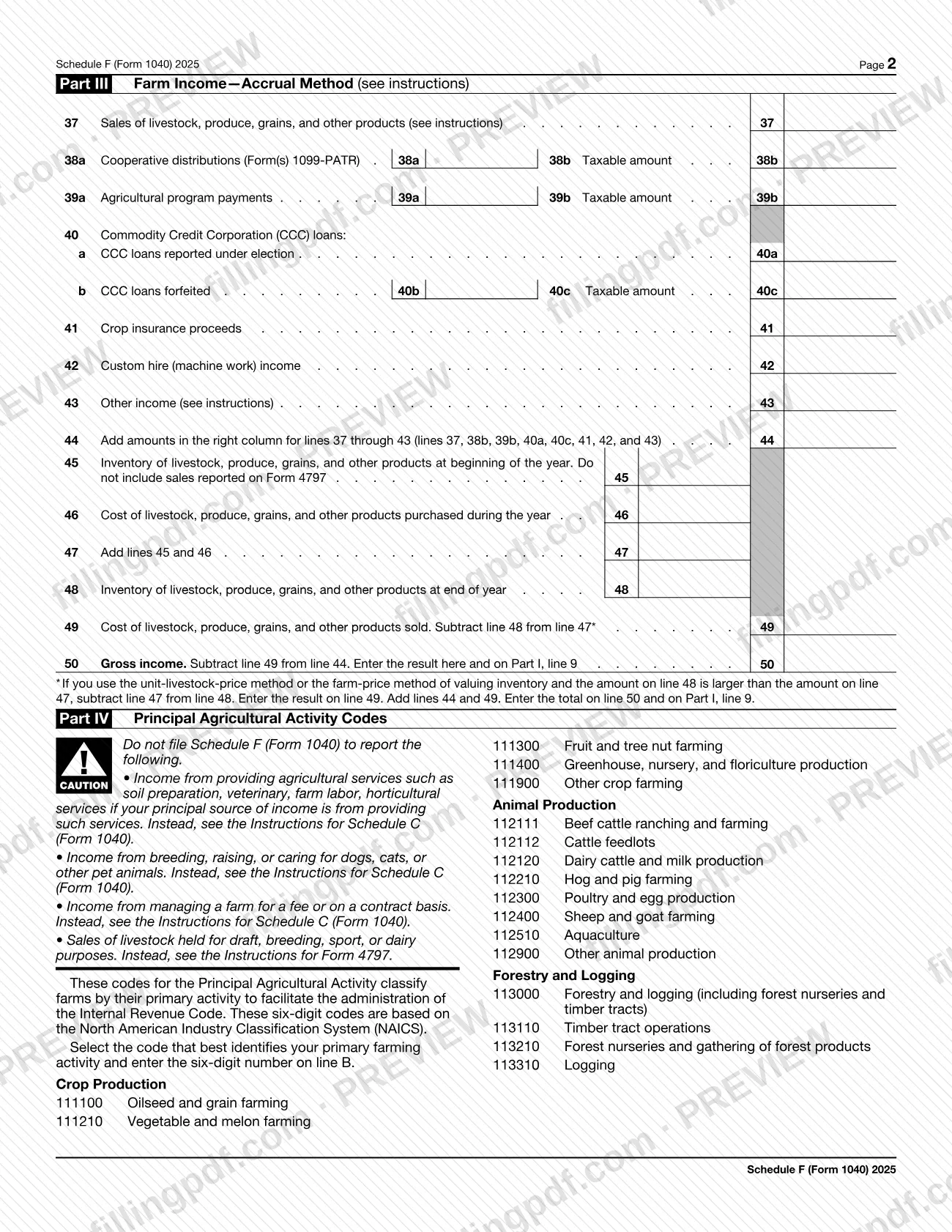
The schedule has four parts. Part I reports farm income under the cash method, lines 1a through 9. Part II lists farm expenses for both cash and accrual filers, lines 10 through 33, and line 34 gives the net farm profit or (loss). Line 36 asks loss filers whether all investment is at risk or some is not. Part III reports income under the accrual method, lines 37 through 50, including inventory, and its result carries to Part I, line 9. Part IV lists the principal agricultural activity codes you use on line B.
The IRS instructions for Schedule F say it is not the form for every activity that sounds agricultural. Income from agricultural services such as soil preparation, veterinary or farm labor services, when that is your principal source of income, belongs on Schedule C (Form 1040), as does income from breeding, raising, or caring for dogs, cats, or other pet animals and income from managing a farm for a fee or on a contract basis. Sales of livestock held for draft, breeding, sport, or dairy purposes go on Form 4797.
Schedule F is also not a stand-alone filing: its result feeds other forms, such as Schedule 1 (Form 1040) and Schedule SE (Form 1040) for individuals.
Who needs to file Schedule F (Form 1040)?
Anyone who has income and expenses from a farming business and files Form 1040, 1040-SR, 1040-SS, 1040-NR, 1041, or 1065 uses Schedule F (Form 1040) to report them.
- Individuals, including nonresident aliens, who operate a farm as a sole proprietor.
- Sole members of a domestic LLC engaged in farming, because a single-member domestic LLC generally is not treated as a separate entity for federal income tax purposes.
- Spouses who jointly own and operate a farm and elect to be a qualified joint venture (QJV): each spouse files a separate Schedule F, entering a share of each item, and each also files a separate Schedule SE (Form 1040). Otherwise, spouses may file Form 1065 as a partnership.
- Spouses with community income who wholly own an unincorporated farm as community property may treat it as a sole proprietorship instead of a partnership.
- Estates, trusts and partnerships that farm file Schedule F with Form 1041 or Form 1065. They leave the Social security number block blank and enter their EIN on line D.
Do not use Schedule F for income from agricultural services as your principal income source, pet breeding, or farm management for a fee (see Schedule C), or for sales of livestock held for draft, breeding, sport, or dairy purposes (see Form 4797). Farming syndicates cannot use the cash method. Form 1040-SS filers skip lines E, F, G and 36.
When to file Schedule F (Form 1040)
Schedule F (Form 1040) has no due date of its own: you complete it for the tax year, 2025 on this edition, and file it with the return it is attached to, so the return's due date applies.
The instructions give one timing rule tied to this schedule. If you had to make estimated tax payments for 2025 and underpaid, you will not be charged a penalty if your gross farming or fishing income for 2024 or 2025 is at least two-thirds of your gross income and you file your 2025 return and pay the tax due by March 2, 2026.
Other timing choices the instructions describe include electing to report income from weather-related livestock sales in the year after the sale, when the stated conditions are met, and electing to include certain crop insurance proceeds in income for 2026 by checking the box on line 6c and attaching a statement.
Documents you need
- Form 4562: attach if you claim any car or truck expenses (standard mileage or actual), and as the instructions direct for depreciation, section 179 expense or amortization that begins in 2025.
- Form 6198: attach if you check box 36b because some investment is not at risk; without it, processing of your return may be delayed.
- Form 8582: complete if you check No on line E and have a loss, or have prior-year unallowed passive activity losses, to figure the amount that goes on line 34.
- A statement showing the details of your CCC loans, if you elect to report loan proceeds as income and enter them on line 5a.
- A statement attached to your return, if you elect to defer crop insurance proceeds to 2026 by checking the box on line 6c.
- A statement explaining the difference, if you enter more mortgage interest on line 21a than your Form 1098 shows; write "See attached" next to the line.
- A statement with the name and address of the person who received Form 1098, if you share liability for the mortgage and enter your share of the interest on line 21b; write "See attached" next to the line.
- Schedule SE (Form 1040), to pay self-employment tax on farming income; spouses who elect QJV status each file their own.
How to fill out Schedule F (Form 1040)
Enter proprietor name and tax ID
At the top, enter the name of proprietor and your social security number (SSN). Estates, trusts and partnerships filing with Form 1041 or 1065 leave the SSN block blank and use line D.
Pick the activity code and method
On line A enter your principal crop or activity. On line B enter the six-digit code from Part IV that best describes the source of most of your income. On line C check Cash or Accrual.
Enter your EIN on line D
Enter the EIN issued to you on Form SS-4, not your SSN. If you have no EIN, leave line D blank.
Answer lines E, F and G
Line E: check Yes or No for whether you materially participated in 2025. Line F: check Yes if you made payments that require Forms 1099, and on line G say whether you filed or will file them. Form 1040-SS filers skip these lines.
Report cash-method income in Part I
Enter sales of purchased livestock and resale items on lines 1a to 1c, products you raised on line 2, and cooperative and agricultural program payments on lines 3 and 4. Enter CCC loans on lines 5a to 5c, crop insurance on lines 6a to 6d, custom hire income on line 7 and other income on line 8.
Total your gross income on line 9
Cash filers add lines 1c, 2, 3b, 4b, 5a, 5c, 6b, 6d, 7 and 8. Accrual filers enter the amount from Part III, line 50.
List farm expenses on lines 10 to 32
Enter each deductible expense on its line, from car and truck expenses on line 10 to other expenses on lines 32a to 32f. Do not include personal or living expenses. Enter capitalized costs in parentheses on line 32f with "263A" beside it.
Figure expenses and net profit or loss
Line 33: add lines 10 through 32f. Line 34: subtract line 33 from line 9. For a loss, apply the at-risk and passive activity rules before entering it on line 34.
Complete line 36 if you have a loss
Check box 36a if all investment is at risk, or box 36b if some is not, and attach Form 6198 for 36b. You do not need line 36 if line 9 is more than line 33.
Fill in Part III for the accrual method
On lines 37 to 43 enter sales, cooperative, program, CCC, crop insurance, custom hire and other income, and total them on line 44. Enter beginning inventory on line 45, purchases on line 46, ending inventory on line 48 and cost of goods sold on line 49. Subtract line 49 from line 44 on line 50.
Carry your result to your return
Individuals enter the line 34 amount on Schedule 1 (Form 1040), line 6, and Schedule SE (Form 1040), line 1a. Partnerships use Form 1065, line 5, and trusts and estates use Form 1041, line 6.
Review and download the completed PDF
Check that the accounting method matches the parts you completed and that each statement and form is ready to attach. Download or print the completed PDF from FillingPDF and submit it with your return as described under How to submit.
How to submit Schedule F (Form 1040)
Schedule F (Form 1040) is submitted as an attachment to your return, through whatever channel you use for that return. The schedule prints no address, portal or appointment rule of its own.
- With Form 1040, 1040-SR, 1040-SS or 1040-NR: attach the completed schedule to the individual return.
- With Form 1041 or Form 1065: attach it to the estate, trust or partnership return.
- Supporting forms and statements: include Form 4562 if you claim car or truck expenses, and Form 6198 if you check box 36b. Attach any statement the line instructions call for.
- Where the result goes: an individual's net profit or loss on line 34 is also entered on Schedule 1 (Form 1040), line 6, and Schedule SE (Form 1040), line 1a; a partnership uses Form 1065, line 5; a trust or estate uses Form 1041, line 6.
For current instructions and updates, go to www.irs.gov/ScheduleF. FillingPDF lets you fill out and download the PDF; submission follows the channels above.
Common mistakes to avoid
- Filing Schedule F for income that belongs elsewhere, such as agricultural services as your principal income source, pet breeding, or farm management for a fee (Schedule C), or sales of livestock held for draft, breeding, sport, or dairy purposes (Form 4797).
- Entering your SSN on line D, another taxpayer's EIN, or the EIN issued to your single-member LLC; line D takes only the EIN issued to you as the sole proprietor, and stays blank if you have none.
- Completing the Social security number block on a Form 1041 or Form 1065 filing instead of entering the EIN of the estate, trust or partnership on line D.
- Claiming car or truck expenses on line 10 without attaching Form 4562.
- Checking box 36b, some investment is not at risk, and leaving out Form 6198, which can delay processing of the return.
- Entering a loss on line 34 before applying the at-risk and passive activity loss rules, so the amount differs from line 9 minus line 33.
- Reducing lines 10 through 32e by capitalized costs, instead of entering the capitalized total in parentheses on line 32f with "263A" to its left.
- Deducting personal or living expenses, the value of animals you raised that died, or inventory losses in Part II.
- Deducting your own accident and health insurance or group-term life contributions on line 15; line 15 is for employee benefit programs.
Frequently asked questions
What is Schedule F (Form 1040) used for?
Schedule F (Form 1040) reports farm income and expenses and figures the net farm profit or loss for 2025. You file it with Form 1040, 1040-SR, 1040-SS, 1040-NR, 1041, or 1065, and the line 34 result carries to the return.
Who has to file Schedule F with Form 1040?
Farmers who operate a farming business as a sole proprietor use it, and so does a sole member of a domestic LLC engaged in farming. Spouses who elect to be a qualified joint venture each file their own Schedule F. Estates, trusts and partnerships that farm file it with Form 1041 or 1065.
Should I use Schedule F or Schedule C for my farm-related income?
Use Schedule C (Form 1040), not Schedule F, for income from agricultural services such as soil preparation or veterinary services when it is your principal source of income, for breeding or caring for pet animals, and for managing a farm for a fee or on contract.
Should I use the cash or accrual method on Schedule F?
You choose on line C. Cash filers complete Parts I and II and generally report income when received and deduct expenses when paid. Accrual filers complete Part I line 9, Part II and Part III. Farming syndicates cannot use the cash method.
When is Schedule F due?
Schedule F has no separate due date: it is filed with the return it is attached to. If you owed estimated tax for 2025, you avoid the underpayment penalty if at least two-thirds of your gross income is from farming or fishing and you file and pay by March 2, 2026.
What do I attach to Schedule F?
Attach Form 4562 if you claim car or truck expenses, and Form 6198 if you check box 36b on line 36. Some elections need a statement, such as deferring crop insurance proceeds (line 6c) or reporting CCC loan proceeds as income (line 5a).
What does line 36 mean on Schedule F?
Line 36 applies only if you have a loss. Check 36a if all your investment in the activity is at risk, or 36b if some is not, such as nonrecourse loans. For 36b, attach Form 6198 to figure your allowable loss; the instructions warn that omitting it may delay processing.
Where do I report my Schedule F profit or loss?
Individuals enter the line 34 amount on Schedule 1 (Form 1040), line 6, and Schedule SE (Form 1040), line 1a. Partnerships enter it on Form 1065, line 5, and trusts and estates on Form 1041, line 6. A nonresident alien uses Schedule 1, line 6.
Can I fill out Schedule F online and file it with FillingPDF?
You can fill out the Schedule F PDF online on FillingPDF and download or print it. FillingPDF is an independent service and does not file it with the IRS; you submit it with your tax return through the IRS channels for that return.
Ready to fill out Schedule F (Form 1040)?
Fill out Schedule F (Form 1040) now