
Schedule H (Form 1120), Section 280H Limitations for a Personal Service Corporation (PSC), is the Internal Revenue Service (IRS) schedule that tests whether a personal service corporation (PSC) with a section 444 tax year meets the section 280H minimum distribution requirement. If it does not, the schedule also figures the most the PSC can deduct for amounts paid to employee-owners. On FillingPDF you can fill out the schedule online and download or print the completed PDF; the original form is published by the IRS.
Last updated
What is Form 1120 (Schedule H)?
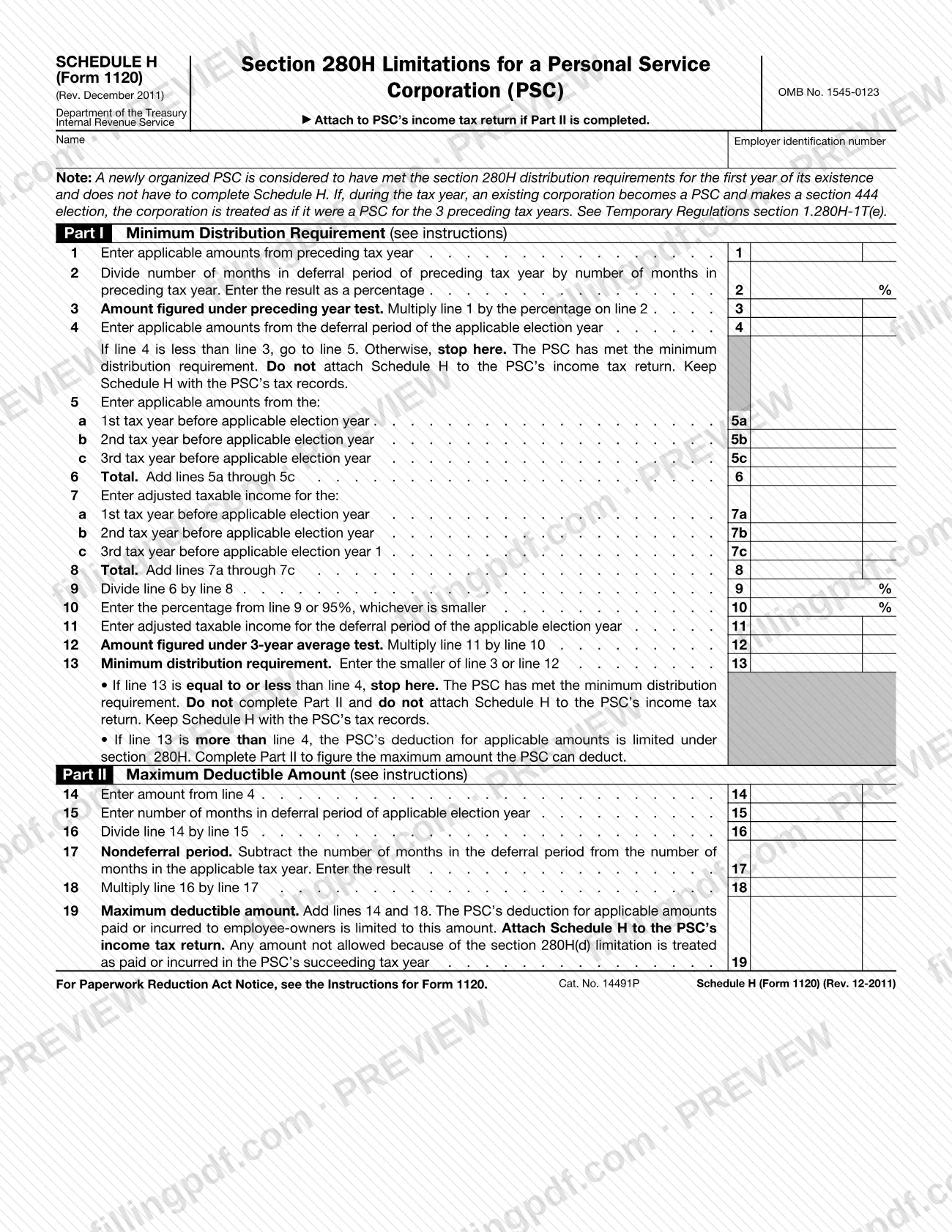
Schedule H (Form 1120), Section 280H Limitations for a Personal Service Corporation (PSC), is the IRS schedule that a PSC with a section 444 election uses to check the minimum distribution requirement of section 280H(c) and, if that test fails, to compute its deduction limit under section 280H(d).
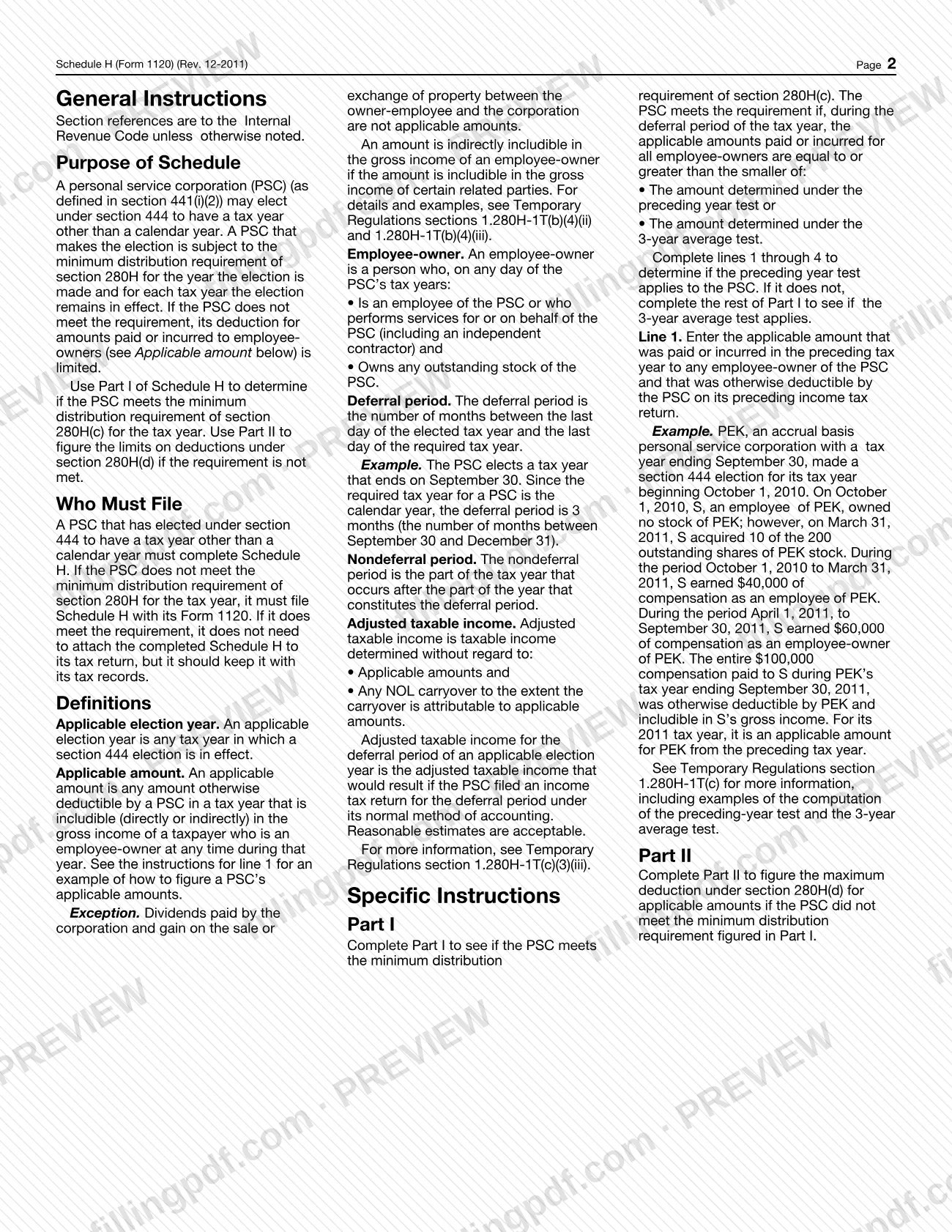
A PSC, as defined in section 441(i)(2), may elect under section 444 to have a tax year other than a calendar year. A PSC that makes the election is subject to the minimum distribution requirement for the year the election is made and every year it stays in effect. If the requirement is not met, the deduction for amounts paid or incurred to employee-owners is limited.
The schedule has two parts:
- Part I, Minimum Distribution Requirement (lines 1 to 13) compares the applicable amounts paid in the deferral period with the smaller of the preceding year test and the 3-year average test.
- Part II, Maximum Deductible Amount (lines 14 to 19) is completed only when line 13 is more than line 4. Line 19 gives the maximum deductible amount, and any amount disallowed under section 280H(d) is treated as paid or incurred in the PSC's succeeding tax year.
The form is a schedule of Form 1120, OMB No. 1545-0123, and is not filed on its own. It is a different document from any other schedule that carries the letter H; this one applies only to PSCs under section 280H.
Who needs to file Form 1120 (Schedule H)?
A PSC that has elected under section 444 to have a tax year other than a calendar year must complete Schedule H. The IRS instructions split this into two outcomes: a PSC that does not meet the minimum distribution requirement must file Schedule H with its Form 1120, and a PSC that meets it does not attach the schedule but keeps it with its tax records.
Exclusions printed on the form:
- A newly organized PSC is considered to have met the section 280H distribution requirements for the first year of its existence and does not have to complete Schedule H.
- If an existing corporation becomes a PSC during the tax year and makes a section 444 election, it is treated as a PSC for the 3 preceding tax years (see Temporary Regulations section 1.280H-1T(e)).
The schedule concerns amounts paid to employee-owners: people who, on any day of the PSC's tax years, are employees of the PSC or perform services for it (including independent contractors) and own any outstanding stock of the PSC. The form prints no separate rule for representatives or signers; it carries the PSC's name and employer identification number.
When to file Form 1120 (Schedule H)
Complete Schedule H for each tax year in which a section 444 election is in effect, because the minimum distribution requirement applies to the election year and every year the election remains in effect. The schedule has no due date of its own. If Part II is completed, you attach it to the PSC's income tax return, so it is due with that return. If the requirement is met, nothing is attached and the completed schedule stays with the PSC's tax records. The deferral period, the number of months between the last day of the elected tax year and the last day of the required tax year, drives the calculations: for a tax year ending September 30, with a calendar year as the required year, it is 3 months. For the deadline of Form 1120 itself, see the Instructions for Form 1120.
How to fill out Form 1120 (Schedule H)
Enter the PSC's name and EIN
At the top of the form, write the PSC's name and employer identification number. Check the note above Part I to confirm a newly organized PSC is not exempt from completing the schedule.
Figure the preceding year test
On line 1, enter the applicable amounts from the preceding tax year. On line 2, divide the months in the preceding year's deferral period by the months in that year and enter a percentage, then multiply line 1 by it for line 3.
Compare with the deferral period
On line 4, enter the applicable amounts from the deferral period of the applicable election year. If line 4 is not less than line 3, stop: the requirement is met, and the schedule is kept, not attached.
Enter amounts for the 3 prior years
On lines 5a to 5c, enter applicable amounts from the 1st, 2nd and 3rd tax years before the election year, and add them on line 6.
Enter adjusted taxable income
On lines 7a to 7c, enter adjusted taxable income for the same three years, determined without regard to applicable amounts or the related NOL carryover, and total them on line 8.
Compute the percentage
Divide line 6 by line 8 for line 9, then enter the smaller of that percentage or 95% on line 10.
Figure the 3-year average test
On line 11, enter adjusted taxable income for the deferral period of the election year; reasonable estimates are acceptable. Multiply line 11 by line 10 for line 12.
Find the minimum distribution requirement
On line 13, enter the smaller of line 3 or line 12. If line 13 is equal to or less than line 4, stop and keep the schedule; if it is more, complete Part II.
Start Part II with line 4
Enter the amount from line 4 on line 14 and the months in the deferral period on line 15. Divide line 14 by line 15 and enter the result on line 16.
Figure the nondeferral period
On line 17, subtract the months in the deferral period from the months in the applicable tax year. Multiply line 16 by line 17 for line 18.
Compute the maximum deductible amount
Add lines 14 and 18 for line 19. The PSC's deduction for applicable amounts paid to employee-owners is limited to this amount, and any disallowed amount is treated as paid in the succeeding tax year.
Review and download the PDF
Check that each line follows the stop instructions and that the PSC's name and EIN are entered. Download or print the completed PDF from FillingPDF, and attach it to Form 1120 only if Part II was completed.
How to submit Form 1120 (Schedule H)
Schedule H (Form 1120) has no separate filing channel or address: when it must be filed, it goes with the PSC's income tax return, Form 1120.
- Attach it to Form 1120 when Part II is completed, meaning line 13 is more than line 4. The header on the form says to attach it to the PSC's income tax return if Part II is completed.
- Do not attach it if line 4 is not less than line 3, or if line 13 is equal to or less than line 4. In those cases the form says the PSC has met the requirement; keep Schedule H with the PSC's tax records.
- Where to send the return: follow the filing channels and addresses in the Instructions for Form 1120, which the schedule names for the Paperwork Reduction Act Notice.
FillingPDF lets you fill out and download the PDF; submission follows the channels above.
Common mistakes to avoid
- Attaching Schedule H to Form 1120 when the PSC has met the minimum distribution requirement; the form says to keep it with the tax records instead.
- Completing Part II when line 13 is equal to or less than line 4; Part II is only for a PSC whose deduction is limited.
- Completing Schedule H for a newly organized PSC's first year; the form treats it as having met the requirement.
- Continuing past line 4 when line 4 is not less than line 3; the form says to stop there because the requirement is met.
- Entering the percentage from line 9 on line 10 without capping it; line 10 is the smaller of line 9 or 95%.
- Including applicable amounts or applicable-amount NOL carryovers in adjusted taxable income; the instructions define it without regard to them.
- Treating a non-calendar deferral period as the whole tax year on line 17; the nondeferral period is the months in the tax year minus the months in the deferral period.
- Forgetting the name and employer identification number at the top of the form.
Frequently asked questions
What is Schedule H (Form 1120) used for?
Schedule H (Form 1120) tests whether a personal service corporation with a section 444 tax year meets the section 280H minimum distribution requirement. If it does not, Part II figures the maximum amount the PSC can deduct for amounts paid to employee-owners.
Who has to complete Schedule H (Form 1120)?
A PSC that has elected under section 444 to have a tax year other than a calendar year must complete it. A newly organized PSC is treated as having met the requirement for its first year and does not have to complete it.
Do I attach Schedule H to Form 1120?
Only if the PSC did not meet the requirement and completed Part II. If the requirement is met, do not attach it; keep the completed schedule with the PSC's tax records.
When do I stop filling out Schedule H?
Stop after line 4 if line 4 is not less than line 3, and stop after line 13 if line 13 is equal to or less than line 4. In both cases the PSC has met the requirement, and Part II is not completed.
What is the deferral period on Schedule H?
It is the number of months between the last day of the elected tax year and the last day of the required tax year. For a PSC with a September 30 year end and a calendar required year, the deferral period is 3 months.
What happens to deductions the 280H limit disallows?
Any amount not allowed because of the section 280H(d) limitation is treated as paid or incurred in the PSC's succeeding tax year, according to the note on line 19.
Can I fill out Schedule H (Form 1120) online?
Yes. You can fill out the PDF online on FillingPDF and download or print it. FillingPDF is an independent service and does not file the schedule; it goes to the IRS with Form 1120 when required.
Ready to fill out Form 1120 (Schedule H)?
Fill out Form 1120 (Schedule H) now