
Schedule I (Form 1118), Reduction of Foreign Oil and Gas Taxes, is the Internal Revenue Service (IRS) schedule that you attach to Form 1118. A corporation that claims a credit for income taxes paid, accrued, or deemed paid on combined foreign oil and gas income uses it to figure how much of those taxes the credit can include. On this page you can fill out Schedule I (Form 1118) online on FillingPDF and download or print the completed PDF. The IRS publishes the form and the latest information at www.irs.gov/Form1118.
Last updated
What is Schedule I (Form 1118)?
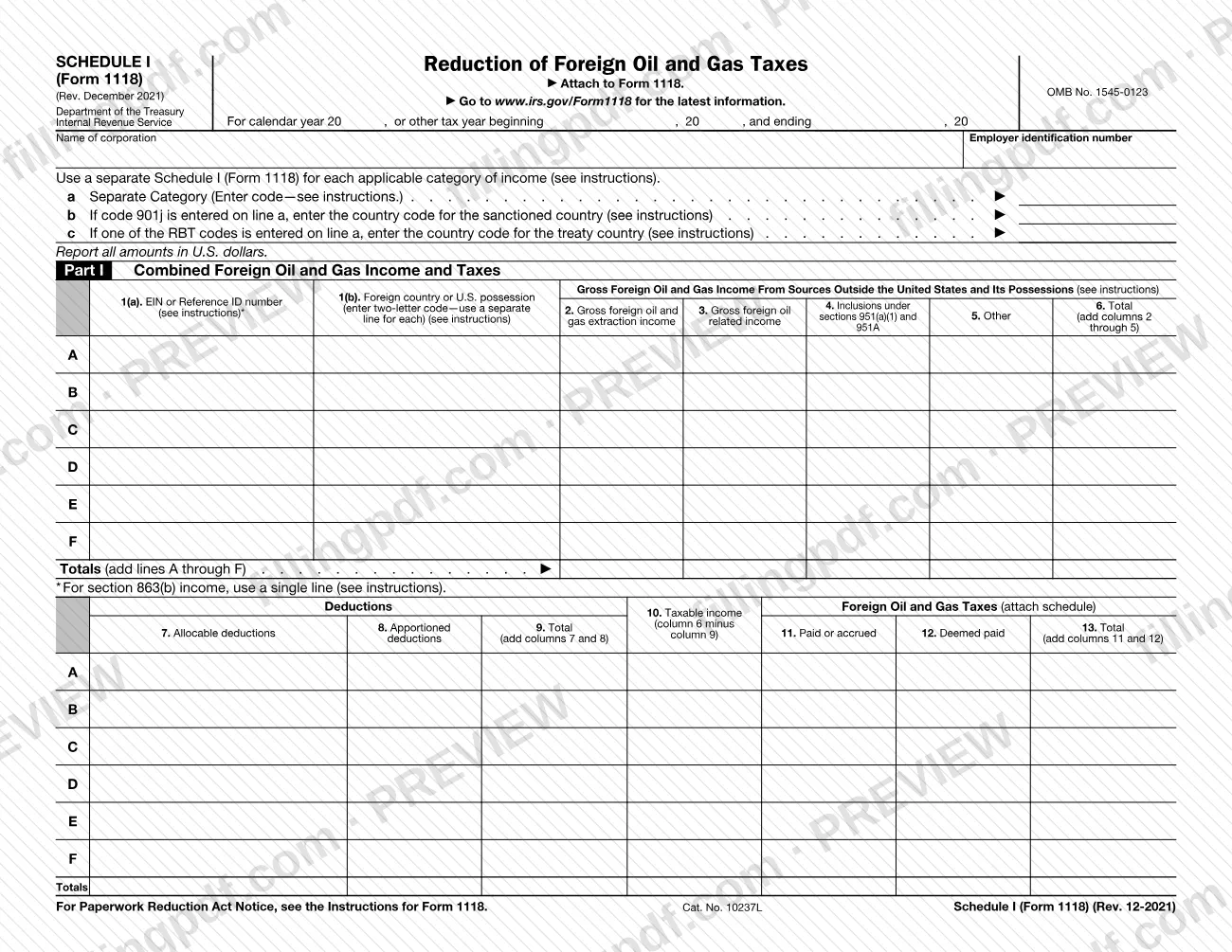
Schedule I (Form 1118), Reduction of Foreign Oil and Gas Taxes, is the IRS schedule, attached to Form 1118, that reports a corporation's combined foreign oil and gas income and taxes and computes the reduction under section 907(a) of those taxes.
The schedule has three parts:
- Part I, Combined Foreign Oil and Gas Income and Taxes. One line per foreign country or U.S. possession (lines A through F) shows gross foreign oil and gas extraction income, related income, section 951(a)(1) and 951A inclusions, other income, deductions, taxable income and the foreign oil and gas taxes paid, accrued or deemed paid.
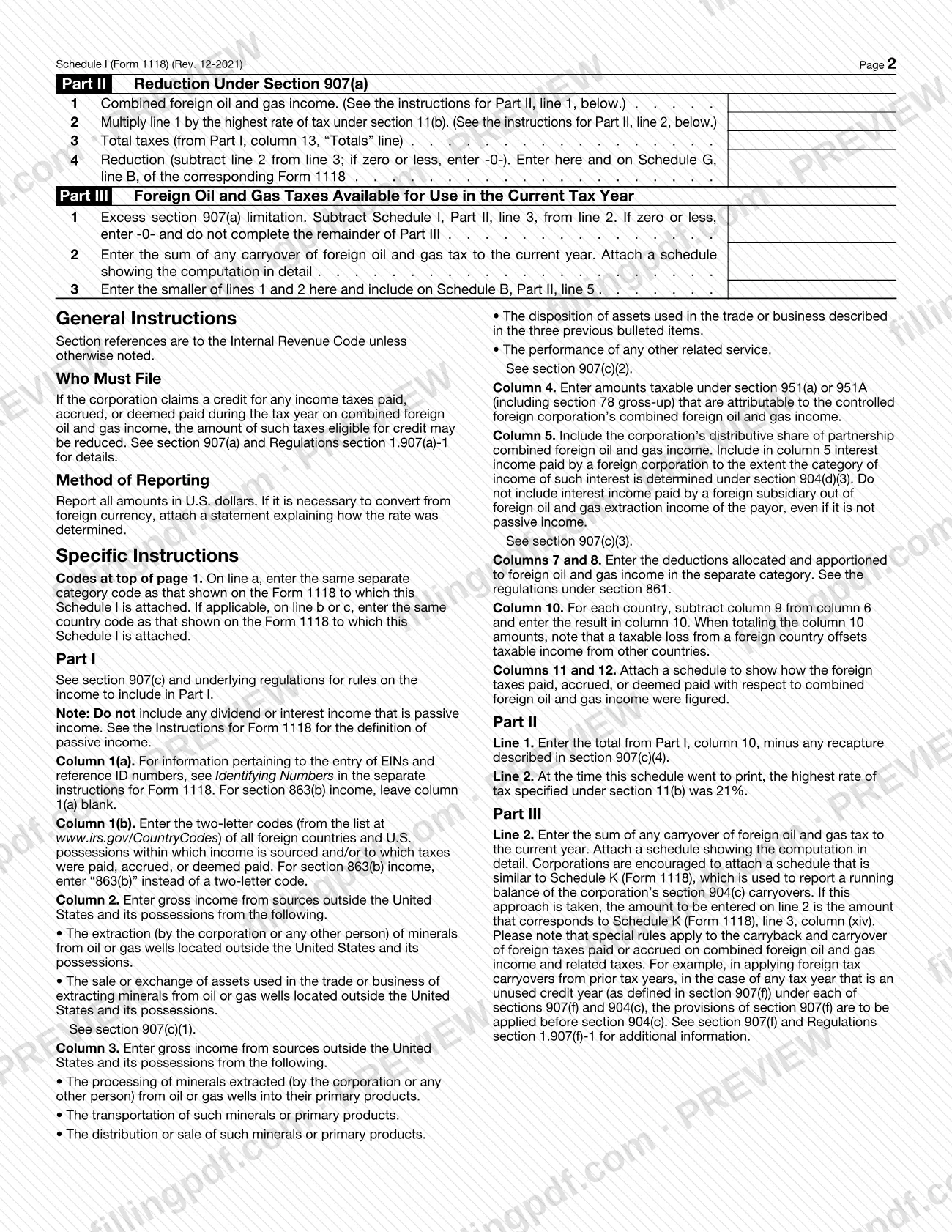
- Part II, Reduction Under Section 907(a). Line 1 takes the combined foreign oil and gas income, line 2 multiplies it by the highest rate of tax under section 11(b), line 3 brings in the total taxes from Part I, column 13, and line 4 is the reduction. The result goes on Schedule G, line B, of the corresponding Form 1118.
- Part III, Foreign Oil and Gas Taxes Available for Use in the Current Tax Year. It combines the excess section 907(a) limitation with any carryover, and the smaller amount goes on Schedule B, Part II, line 5.
The form is identified as OMB No. 1545-0123 and is a schedule of Form 1118, so it is not filed on its own. It is not a stand-alone credit claim: the IRS instructions point to section 907(a) and Regulations section 1.907(a)-1 for the rules behind the reduction. Other schedules of Form 1118, such as Schedule G, Schedule B and Schedule K, are separate documents.
Who needs to file Schedule I (Form 1118)?
A corporation files Schedule I (Form 1118) if it claims a credit for income taxes paid, accrued, or deemed paid during the tax year on combined foreign oil and gas income. In that case the amount of those taxes eligible for credit may be reduced, which is what the schedule computes. The IRS instructions refer to section 907(a) and Regulations section 1.907(a)-1 for details.
The form says to use a separate Schedule I for each applicable category of income. On line a you enter the separate category code, and on line b or c a country code when the instructions call for one, always the same codes shown on the Form 1118 to which the schedule is attached.
The schedule is attached to Form 1118 and asks for the name of the corporation and its employer identification number. The form does not say who may sign or act for the corporation; refer to the Instructions for Form 1118 for questions about identifying numbers and the main form.
When to file Schedule I (Form 1118)
Schedule I (Form 1118) is completed when you complete the Form 1118 it is attached to, for the same calendar year or other tax year entered at the top of the page. The schedule prints no due date of its own, so it travels with Form 1118 whenever that form is filed.
If you have more than one applicable category of income, prepare one Schedule I for each category at the same time. Part II line 4 carries into Schedule G of the corresponding Form 1118, and Part III line 3 carries into Schedule B, Part II, line 5, so complete this schedule before finishing those parts of Form 1118. For any deadline that applies to Form 1118, see the IRS instructions at www.irs.gov/Form1118.
Documents you need
- A schedule showing how the foreign oil and gas taxes paid, accrued, or deemed paid were figured, attached for columns 11 and 12 of Part I.
- A statement explaining how the exchange rate was determined, only if you had to convert amounts from foreign currency into U.S. dollars.
- A schedule showing the computation in detail of any carryover of foreign oil and gas tax to the current year, attached for Part III, line 2.
- Optionally, a schedule similar to Schedule K (Form 1118) for Part III, line 2; if you use it, enter the amount from Schedule K (Form 1118), line 3, column (xiv).
How to fill out Schedule I (Form 1118)
Enter the tax year and corporation
At the top, enter the calendar year or the beginning and ending dates of the other tax year, then the name of the corporation and its employer identification number.
Enter the category and country codes
On line a, enter the separate category code shown on the Form 1118 this schedule is attached to. On line b (code 901j) or line c (RBT codes), enter the matching country code only if the instructions apply, using the same code as on Form 1118.
List countries in Part I, columns 1(a) and 1(b)
Use a separate line (A through F) for each foreign country or U.S. possession. Enter the EIN or reference ID in column 1(a) and the two-letter code in column 1(b); for section 863(b) income use a single line, leave 1(a) blank and enter "863(b)".
Report gross income in columns 2 through 6
Enter gross foreign oil and gas extraction income in column 2, related income in column 3, section 951(a) or 951A inclusions in column 4 and other income in column 5. Column 6 is the total of columns 2 through 5.
Enter deductions and taxable income
Enter allocable deductions in column 7 and apportioned deductions in column 8, and add them in column 9. For each country subtract column 9 from column 6 and enter the result in column 10.
Enter foreign oil and gas taxes
Enter taxes paid or accrued in column 11 and taxes deemed paid in column 12, and add them in column 13. Attach a schedule showing how these taxes were figured, then complete the Totals line.
Complete Part II, lines 1 and 2
On line 1, enter the Part I, column 10 total minus any recapture described in section 907(c)(4). On line 2, multiply line 1 by the highest rate of tax under section 11(b); the form refers to the Part II instructions.
Figure the reduction on Part II, lines 3 and 4
Line 3 is the Part I, column 13 total. On line 4, subtract line 2 from line 3, entering -0- if zero or less, and carry the result to Schedule G, line B, of the corresponding Form 1118.
Complete Part III
On line 1, subtract Part II, line 3, from line 2; if zero or less enter -0- and stop. On line 2, enter any carryover of foreign oil and gas tax and attach the computation. On line 3, enter the smaller of lines 1 and 2 and include it on Schedule B, Part II, line 5.
Review, download and attach
Check that each category has its own schedule and that every amount is in U.S. dollars. Download or print the completed PDF from FillingPDF and attach it, with the supporting schedules, to Form 1118.
How to submit Schedule I (Form 1118)
Schedule I (Form 1118) is submitted as an attachment to Form 1118; the form prints no mailing address, portal or appointment rule of its own.
- With Form 1118: attach one completed Schedule I for each applicable category of income to the Form 1118 it supports, and send the package the way you submit Form 1118.
- Supporting schedules: attach the schedule showing how the taxes in columns 11 and 12 were figured, the schedule showing the carryover computation for Part III, line 2, and, if you converted from foreign currency, a statement explaining how the rate was determined.
- Instructions and updates: the form directs you to www.irs.gov/Form1118 for the latest information, and to the separate Instructions for Form 1118 for the Paperwork Reduction Act Notice and identifying numbers.
FillingPDF lets you fill out and download the PDF; submission follows the IRS channels that apply to Form 1118.
Common mistakes to avoid
- Combining several categories of income on one schedule; the form says to use a separate Schedule I for each applicable category of income.
- Entering a separate category code or country code on lines a, b or c that differs from the code on the Form 1118 the schedule is attached to.
- Including dividend or interest income that is passive income in Part I; the instructions say not to include it.
- Filling in column 1(a) for section 863(b) income; the instructions say to leave it blank, use a single line and enter "863(b)" in column 1(b) instead of a two-letter code.
- Leaving out the schedule behind columns 11 and 12, or the detailed carryover schedule behind Part III, line 2.
- Reporting amounts in foreign currency without a statement explaining how the rate was determined; all amounts must be in U.S. dollars.
- Entering a negative amount on Part II, line 4; the form says to enter -0- if the subtraction is zero or less.
- Adding a country's taxable loss separately in column 10 totals; the instructions say a taxable loss from one country offsets taxable income from other countries.
- Completing the rest of Part III when line 1 is zero or less; the form says to enter -0- and not complete the remainder.
Frequently asked questions
What is Schedule I (Form 1118)?
Schedule I (Form 1118), Reduction of Foreign Oil and Gas Taxes, is an IRS schedule attached to Form 1118. It reports combined foreign oil and gas income and taxes by country and computes the reduction under section 907(a) of the taxes eligible for credit.
Who has to file Schedule I (Form 1118)?
A corporation that claims a credit for income taxes paid, accrued, or deemed paid during the tax year on combined foreign oil and gas income. For those taxes, the amount eligible for credit may be reduced, and the schedule shows the computation.
Do I need a separate Schedule I for each category of income?
Yes. The form says to use a separate Schedule I (Form 1118) for each applicable category of income. The separate category code on line a must match the code on the Form 1118 the schedule is attached to.
Where do I send Schedule I (Form 1118)?
You attach it to Form 1118 and submit it with that form. Schedule I prints no address or portal of its own. See www.irs.gov/Form1118 and the Instructions for Form 1118 for the latest information.
What goes on Part II, line 4?
The reduction: subtract line 2 from line 3, and enter -0- if the result is zero or less. The form says to enter the amount here and on Schedule G, line B, of the corresponding Form 1118.
What do I attach to Schedule I besides the form?
Attach a schedule for columns 11 and 12 showing how the foreign oil and gas taxes were figured, and a detailed schedule of any carryover for Part III, line 2. If you converted foreign currency, add a statement explaining how the rate was determined.
How do I report section 863(b) income on Schedule I?
Use a single line. Leave column 1(a) blank and enter "863(b)" in column 1(b) instead of a two-letter country code, as the instructions direct.
Can I fill out Schedule I (Form 1118) online on FillingPDF?
Yes. You can fill out the PDF online on FillingPDF and download or print it. FillingPDF is an independent service and does not file the schedule with the IRS; you submit it with Form 1118 through the IRS channels.
Ready to fill out Schedule I (Form 1118)?
Fill out Schedule I (Form 1118) now