
Schedule I (Form 1120-F), Interest Expense Allocation Under Regulations Section 1.882-5, is the Internal Revenue Service (IRS) schedule on which a foreign corporation reports the interest expense allocable to effectively connected income (ECI) and the part of it that is deductible for the year. It is attached to Form 1120-F by foreign corporations that have interest expense allocable to ECI. On this page you can fill out the form online on FillingPDF and download or print the completed PDF; the IRS publishes the form and its instructions at www.irs.gov/Form1120F.
Last updated
What is Schedule I (Form 1120-F)?
Schedule I (Form 1120-F), Interest Expense Allocation Under Regulations Section 1.882-5, is the IRS schedule that reports the amount of a foreign corporation's interest expense allocable to effectively connected income (ECI) under section 882(c), and the deductible amount of that allocation for the tax year.
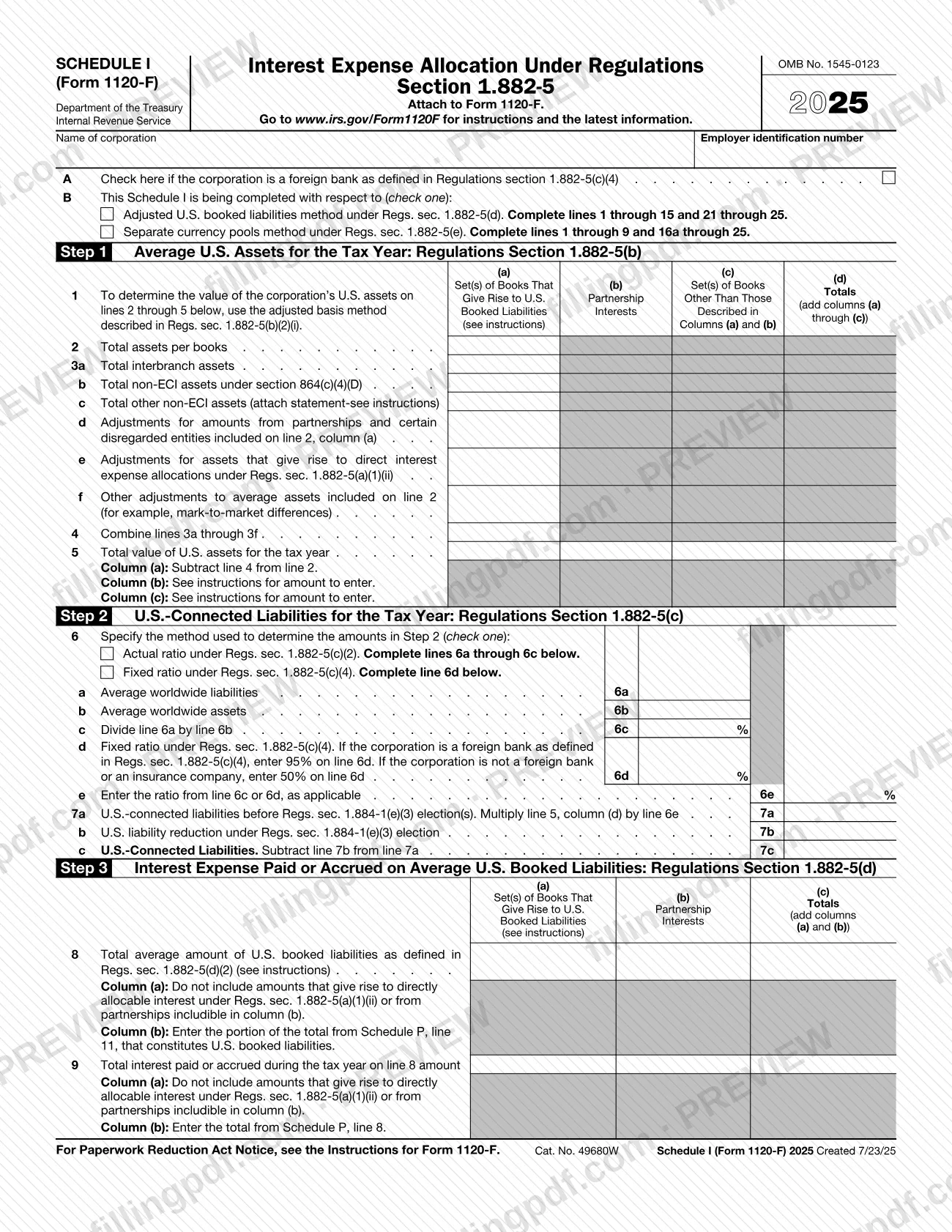
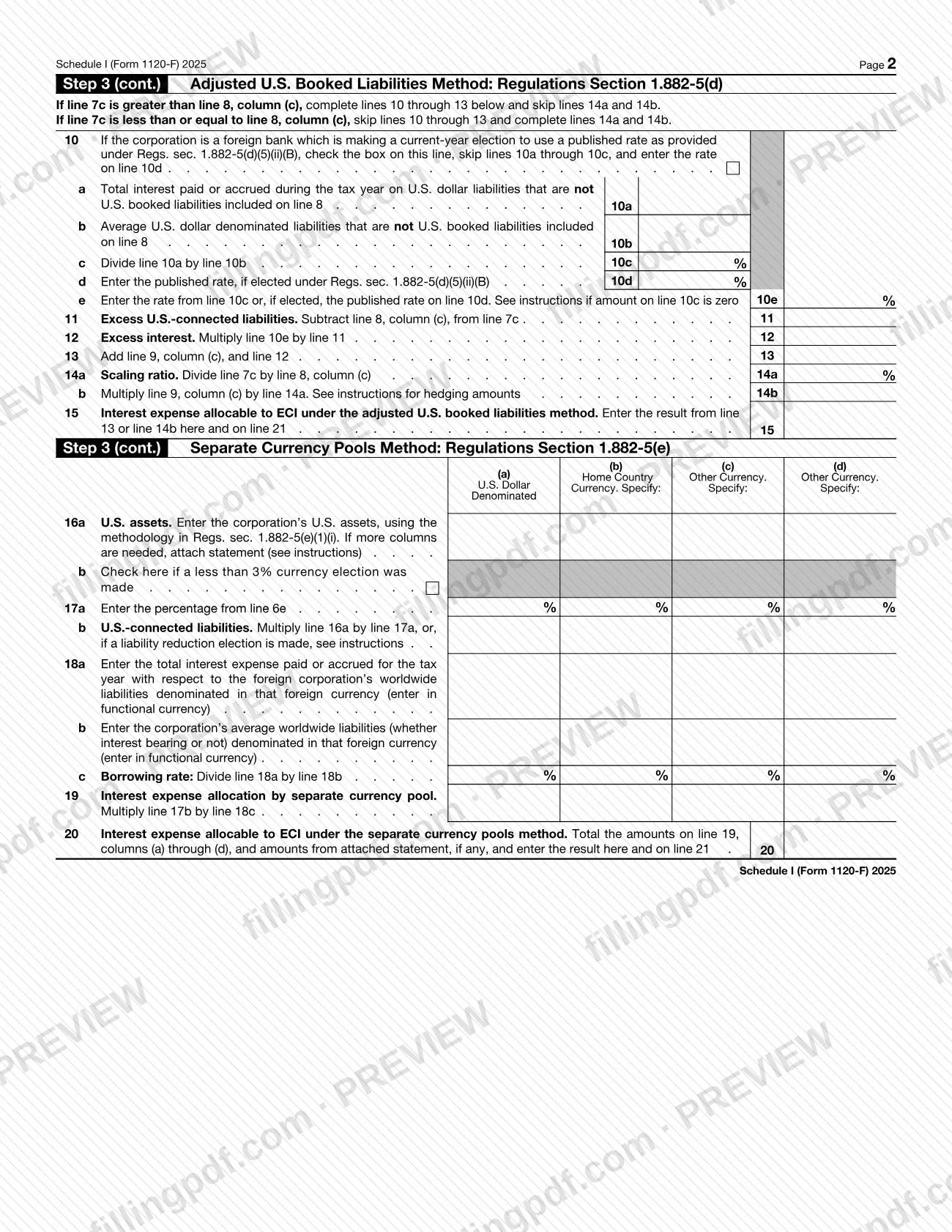
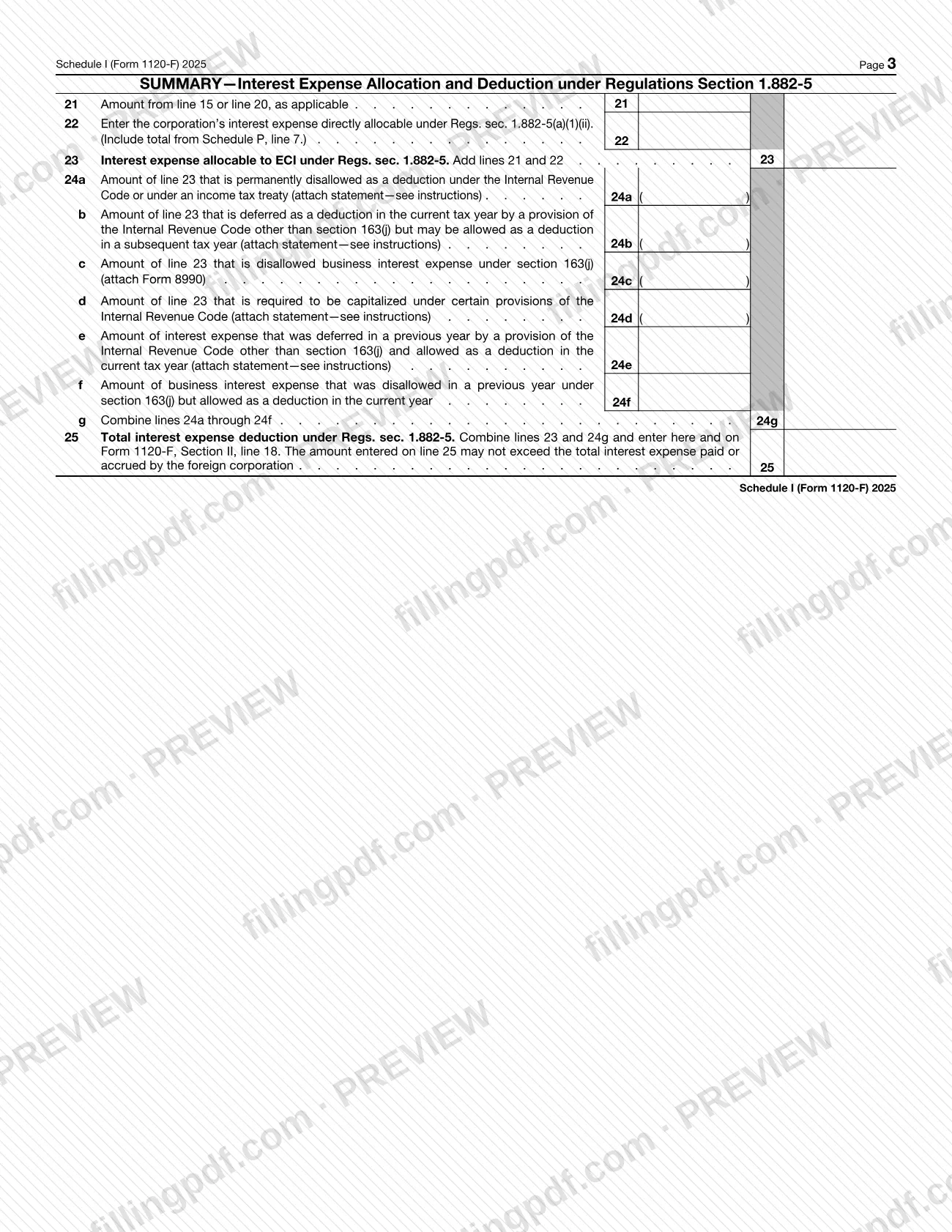
The schedule follows the three-step formula of Regulations section 1.882-5. Step 1 (lines 1 through 5) determines the average value of U.S. assets. Step 2 (lines 6 through 7c) determines U.S.-connected liabilities, using either the actual ratio or the fixed ratio. Step 3 allocates interest under one of two mutually exclusive methods: the Adjusted U.S. Booked Liabilities (AUSBL) method on lines 10 through 15, or the Separate Currency Pools method on lines 16a through 20. Lines 21 through 25 summarize the allocation, subtract deferrals and disallowances and give the interest expense deduction.
The schedule also discloses the elections the corporation uses under Regulations sections 1.882-5(a)(7) and (d)(5) and the liability reduction under Regulations section 1.884-1(e)(3). The information is also needed to complete Form 1120-F, Section III, the branch-level interest tax under section 884(f).
It is not a return. The form says to attach it to Form 1120-F. The IRS instructions say that the allocation is made before other Code sections, such as sections 163(j) or 263A, defer or disallow the deduction.
Who needs to file Schedule I (Form 1120-F)?
All foreign corporations that have interest expense allocable to ECI under section 882(c) must complete Schedule I to report the allocation. This applies whether the amount is deductible in the current year or is deferred or permanently disallowed under other sections of the Internal Revenue Code. The IRS instructions describe a reporting corporation as a foreign corporation engaged, or treated as engaged, in a trade or business within the U.S. at any time during the tax year. A reporting corporation that must file Form 1120-F must complete Schedule I and attach it.
Treaty-based positions. If the corporation determines the interest expense attributable to a U.S. permanent establishment under the express provisions of an applicable treaty, it still completes Schedule I using the treaty method and also attaches Form 8833, Treaty-Based Return Position Disclosure.
Exceptions. A foreign corporation is not required to file Schedule I if it:
- does not have a trade or business within the United States;
- has no worldwide interest expense for the tax year to allocate under Regulations section 1.882-5; or
- conducts limited U.S. activities that it determines do not give rise to ECI or to a U.S. permanent establishment, and files a protective income tax return under Regulations section 1.882-4(a)(3)(vi).
A corporation filing such a protective return may still file Schedule I voluntarily to preserve elections.
When to file Schedule I (Form 1120-F)
Schedule I is filed with Form 1120-F, so it follows that return's filing date; the schedule has no separate due date of its own. The elections it identifies carry their own timing rules.
- A corporation that files a protective return under Regulations section 1.882-4(a)(3)(vi) may file Schedule I with it to preserve timely elections, but only if the return is filed by the original due date, including extensions. Protective elections are not effective if made during the additional extended period under Regulations section 1.882-4(a)(3).
- If the corporation is subject to Regulations section 1.882-5 for the first time, its elections are due with an original, timely filed return.
- An election for the AUSBL method or the Separate Currency Pools method generally must be kept for a minimum 5-year period.
- The foreign bank published rate election on line 10 must be made every year.
- No interest expense allocation election may be made on an amended return, and relief for late elections under Regulations section 301.9100-1 is not available.
Documents you need
- Statement describing each type of "other" non-ECI asset on line 3c, with the calculation and a total for each type, if you enter an amount on line 3c.
- Statement showing how interest was allocated between exempt and nonexempt ECI, plus the amount disallowed for each provision or treaty, if you enter an amount on line 24a.
- Statement showing the current-year deferral for each applicable Code provision, if you enter an amount on line 24b.
- Form 8990, Limitation on Business Interest Expense Under Section 163(j), if you enter an amount on line 24c or line 24f.
- Statement describing how the allocation was made, if you enter capitalized interest on line 24d.
- Statement showing the current-year deduction of a prior-year deferral for each applicable provision, if you enter an amount on line 24e.
- Statement explaining how the interest rate on line 10e was derived, if line 10b is zero and you have no eligible published rate election.
- Statement showing the computation and allocation of the liability reduction to each separate currency pool, if you make a liability reduction election under the Separate Currency Pools method.
- Separate sheets in the same format covering lines 16a through 19, if you have U.S. assets in more than four currencies not subject to a 3% currency election.
- Form 8833, Treaty-Based Return Position Disclosure, if you determine interest expense under the express provisions of a treaty.
How to fill out Schedule I (Form 1120-F)
Enter corporation details and item A
Write the name of the corporation and its employer identification number at the top. Check item A only if the corporation is a foreign bank as defined in Regulations section 1.882-5(c)(4).
Choose the Step 3 method in item B
Check one box: Adjusted U.S. booked liabilities method (complete lines 1 through 15 and 21 through 25) or Separate currency pools method (complete lines 1 through 9 and 16a through 25).
Determine U.S. assets in Step 1
On lines 2 through 5, enter total assets per books, the adjustments on lines 3a through 3f, the combined result on line 4 and total U.S. assets on line 5. Column (a) is line 2 minus line 4; columns (b) and (c) follow the instructions, and column (d) totals (a) through (c).
Pick the ratio on line 6
Check the actual ratio or the fixed ratio. For the actual ratio, complete lines 6a through 6c; for the fixed ratio, enter 95% on line 6d for a foreign bank or 50% if the corporation is not a foreign bank or an insurance company.
Figure U.S.-connected liabilities
Enter the ratio from line 6c or 6d on line 6e. Multiply line 5, column (d) by line 6e for line 7a, enter any Regulations section 1.884-1(e)(3) reduction on line 7b (-0- if none) and subtract line 7b from line 7a for line 7c.
Report U.S. booked liabilities and interest
On line 8, enter average U.S. booked liabilities in columns (a) and (b), and on line 9 the interest paid or accrued on them. Column (c) totals each line; exclude directly allocable interest from column (a).
Complete AUSBL lines 10 through 15
If line 7c is greater than line 8, column (c), complete lines 10 through 13 (excess interest) and skip 14a and 14b. Otherwise skip lines 10 through 13 and complete the scaling ratio on 14a and 14b; then enter the result on line 15.
Complete separate currency pools lines 16a to 20
For each currency column, enter U.S. assets on line 16a, the line 6e percentage on 17a and U.S.-connected liabilities on 17b. Enter interest and average liabilities on 18a and 18b, divide for the borrowing rate on 18c, multiply for line 19 and total line 19 on line 20.
Complete the summary on lines 21 to 23
Enter the amount from line 15 or line 20 on line 21, directly allocable interest under Regulations section 1.882-5(a)(1)(ii) on line 22 (including Schedule P, line 7) and add them on line 23.
Report deferrals and disallowances
Enter lines 24a through 24d as negative amounts and lines 24e and 24f as positive amounts, each with its statement or Form 8990 where the line requires one. Combine lines 24a through 24f on line 24g.
Enter the total deduction on line 25
Combine lines 23 and 24g and enter the result, which may not exceed the total interest expense paid or accrued by the corporation. Carry it to Form 1120-F, Section II, line 18.
Review and download the completed PDF
Check that only the lines for your chosen method are completed and that every required statement is ready. Download or print the completed PDF from FillingPDF and attach it to Form 1120-F.
How to submit Schedule I (Form 1120-F)
Schedule I has no filing channel of its own: you attach it to Form 1120-F and submit it with that return. The schedule prints no mailing address, portal or appointment rule.
- With Form 1120-F: attach the completed schedule, plus any statements and forms the lines call for, and file the return the way the Instructions for Form 1120-F direct. The IRS publishes both sets of instructions at www.irs.gov/Form1120F.
- With a protective return: a corporation that files a protective return under Regulations section 1.882-4(a)(3)(vi) may attach Schedule I voluntarily to preserve elections, and then needs to complete only the portions that identify those elections: item B, the line 6 checkboxes, the line 10 checkbox and the line 16b checkbox.
- Liability reduction election: identifying it on Schedule I does not make the election. Under Regulations section 1.884-1(e)(3)(iv), the time, place and manner for it, and the separate disclosures to attach to Form 1120-F, are set by that regulation.
The amount on line 25 is also reported on Form 1120-F, Section II, line 18. FillingPDF lets you fill out and download the PDF; submission follows the channels above.
Common mistakes to avoid
- Completing lines 10 through 20 for both Step 3 methods; the AUSBL and Separate Currency Pools methods are mutually exclusive and cannot both apply in the same year.
- Skipping lines 1 through 9 because you use the Separate Currency Pools method; all corporations required to file Schedule I must complete them.
- Completing lines 10 through 13 when line 7c is less than or equal to line 8, column (c); you complete lines 14a and 14b instead.
- Entering amounts on lines 24a through 24d as positive numbers; the instructions say to enter them as negative amounts. Lines 24e and 24f are positive.
- Letting line 23 exceed the total interest expense paid or accrued; enter the lesser amount, and line 25 may not exceed that total either.
- Putting directly allocable interest into line 9 or column (a) of line 8; it belongs on line 22 and is excluded from those lines.
- Trying to make or change an interest allocation election on an amended return; the instructions say amended returns cannot carry these elections.
- Assuming that checking a box makes the election under Regulations section 1.884-1(e)(3); identifying it on Schedule I does not effectuate it.
- Attaching Form 8990 or the required statements to lines 24a through 24f only in part; each line says whether a statement or Form 8990 must accompany the amount.
Frequently asked questions
What is Schedule I (Form 1120-F) used for?
Schedule I (Form 1120-F) reports the interest expense of a foreign corporation that is allocable to effectively connected income under Regulations section 1.882-5, and the deductible amount for the year. It also identifies the allocation elections the corporation uses and feeds the branch-level interest tax on Form 1120-F, Section III.
Who has to file Schedule I with Form 1120-F?
All foreign corporations with interest expense allocable to ECI under section 882(c) must complete it, whether or not the amount is deductible this year. It is not required if the corporation has no U.S. trade or business, has no worldwide interest expense to allocate, or meets the limited-activity exception with a protective return.
Should I use the AUSBL method or the separate currency pools method?
You choose one in item B; the two methods are mutually exclusive and cannot both apply in the same year. AUSBL filers complete lines 1 through 15 and 21 through 25. Separate currency pools filers complete lines 1 through 9 and 16a through 25. The election generally must be kept for a minimum 5-year period.
What fixed ratio do I enter on line 6d?
A foreign bank as defined in Regulations section 1.882-5(c)(4) enters 95%. A corporation that is not a foreign bank or an insurance company enters 50%. The fixed ratio must be timely elected and be one the corporation is eligible to use.
Do I need to file Schedule I with a protective return?
Not necessarily. A corporation filing a protective return under Regulations section 1.882-4(a)(3)(vi) need not enter amounts to preserve an allocation method, but may file Schedule I voluntarily to preserve timely elections if the return is filed by its original due date, including extensions.
Can I fill out Schedule I (Form 1120-F) online?
Yes. You can fill out the fillable PDF online on FillingPDF and download or print it. FillingPDF is an independent service and does not file anything with the IRS; the schedule goes to the IRS attached to Form 1120-F.
What attachments does Schedule I require?
It depends on the lines you use. Examples: a statement for line 3c, Form 8990 for lines 24c and 24f, statements for lines 24a, 24b, 24d and 24e, and a statement explaining the rate on line 10e when it applies. Treaty-based positions also require Form 8833.
Is there a limit on the interest deduction on line 25?
Yes. The amount on line 25 may not exceed the total interest expense paid or accrued by the foreign corporation. Line 23 is likewise limited: if total interest paid or accrued is less than lines 21 plus 22, enter the lesser amount on line 23.
Ready to fill out Schedule I (Form 1120-F)?
Fill out Schedule I (Form 1120-F) now