
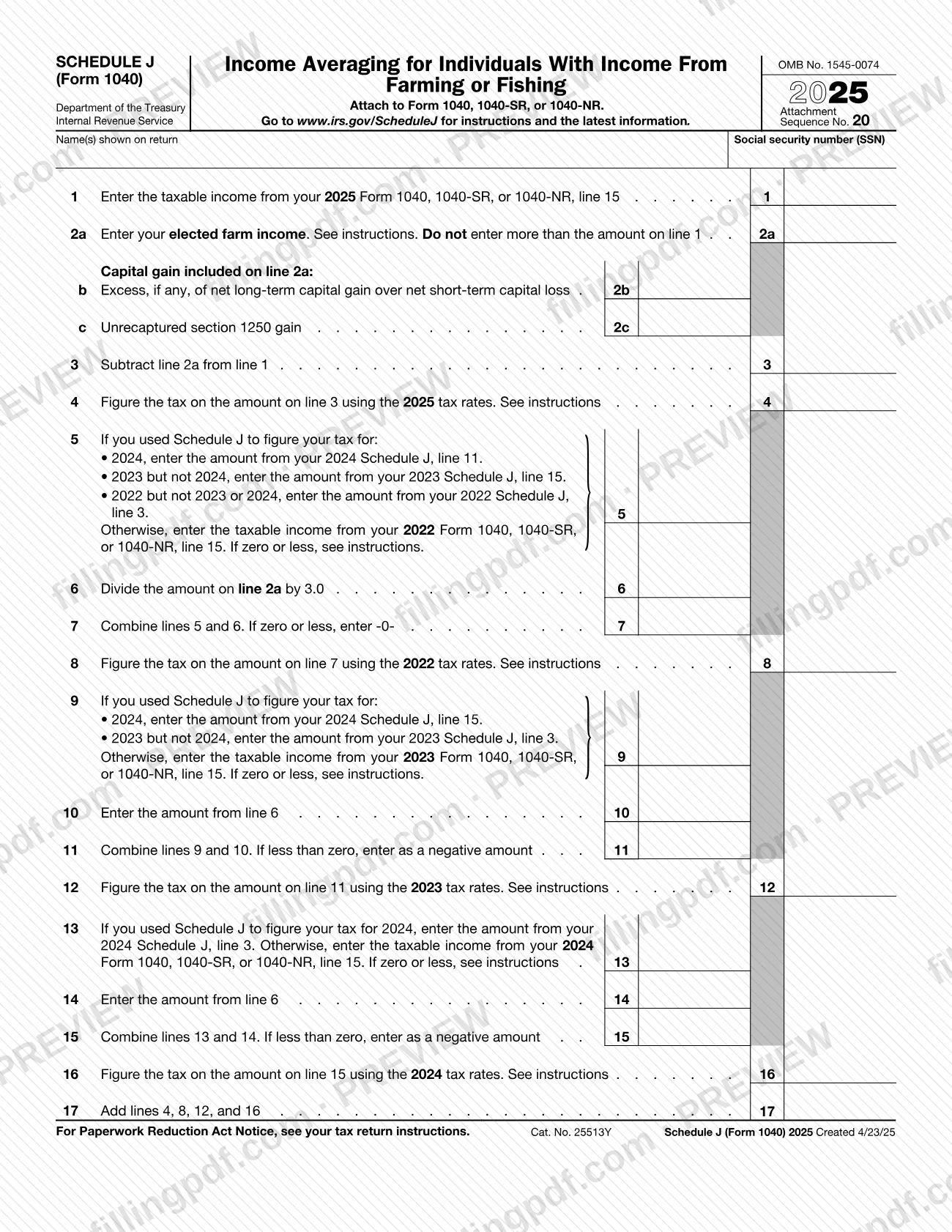
Schedule J (Form 1040), Income Averaging for Individuals With Income from Farming or Fishing, is the Internal Revenue Service (IRS) schedule you use to elect to figure your 2025 income tax by averaging all or part of your farming or fishing income over the 3 prior years, called base years. The election can lower your tax when your 2025 farm or fishing income is high and your taxable income in one or more base years was low. On this page you can fill out the form online on FillingPDF and download or print the completed PDF. The schedule is attached to your Form 1040, 1040-SR, or 1040-NR, and the IRS publishes the instructions at www.irs.gov/ScheduleJ.
Last updated
What is Schedule J (Form 1040)?
Schedule J (Form 1040), Income Averaging for Individuals With Income from Farming or Fishing, is the IRS schedule on which an individual elects to figure 2025 income tax by averaging, over the previous 3 base years, all or part of the 2025 taxable income from a farming or fishing trade or business.
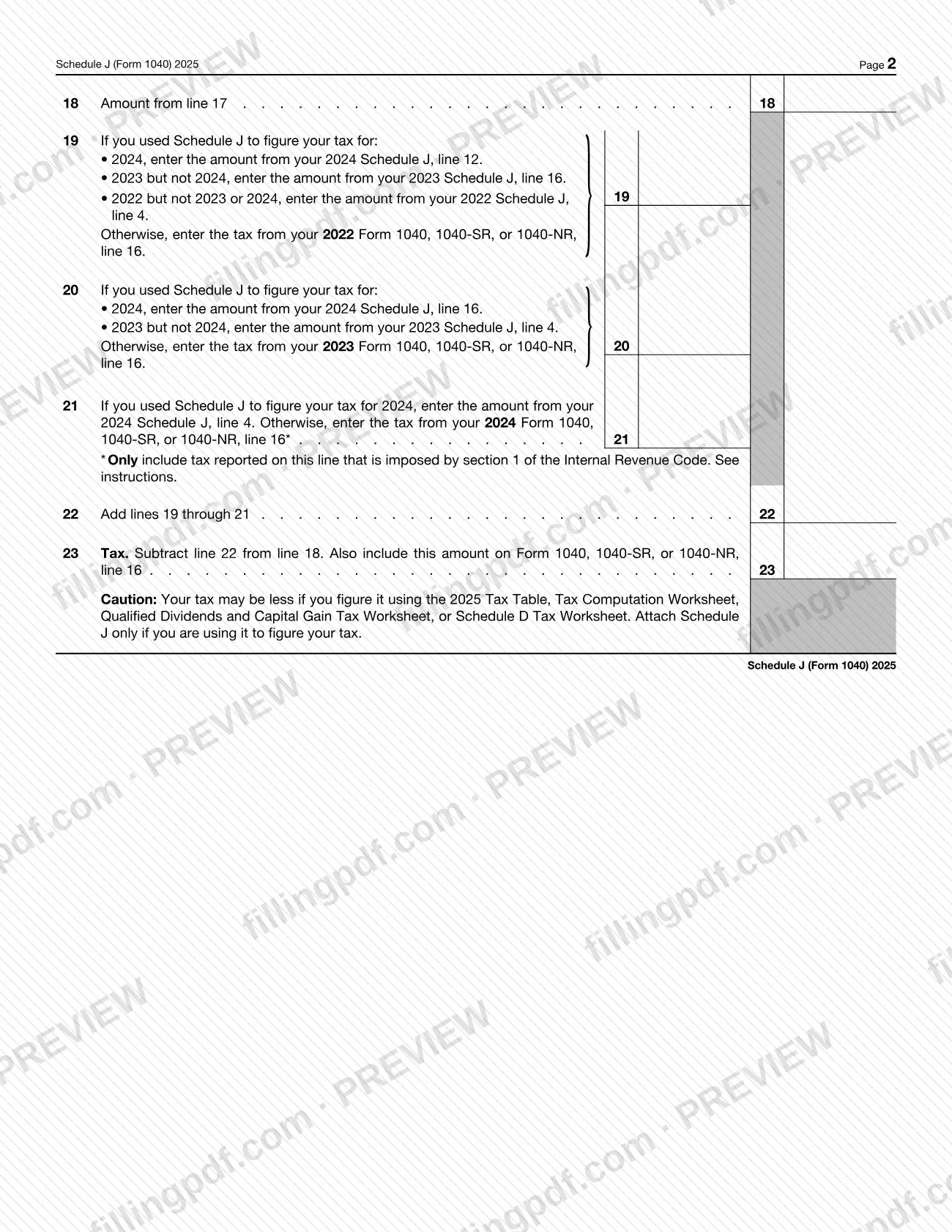
The schedule works in three blocks. Lines 1 to 4 take your 2025 taxable income and your elected farm income (line 2a) and figure the tax on the rest. Lines 5 to 16 spread one-third of the elected farm income onto each of 2022, 2023 and 2024 and figure the tax for each base year using that year's tax rates. Lines 17 to 23 add those amounts, subtract the tax you already figured for the base years and produce your tax, which goes on line 16 of Form 1040, 1040-SR, or 1040-NR.
The form is OMB No. 1545-0074, Attachment Sequence No. 20, and is printed for 2025. The IRS instructions explain that the title was changed from "Income Averaging For Farmers and Fishermen" to the current one.
Schedule J does not apply when figuring alternative minimum tax on Form 6251, and the election does not require you to refigure the tax of any minor child who had to use your tax rates in the prior years. The IRS points to Pub. 225 and Regulations section 1.1301-1 for more information.
Who needs to file Schedule J (Form 1040)?
Individuals who have taxable income from a farming business or a fishing business and want to average it over the 3 prior years use Schedule J (Form 1040). The IRS instructions say the election may give a lower tax if your 2025 farm or fishing income is high and your taxable income in one or more of the 3 prior years was low.
- You do not need to have been in farming or fishing during any of the base years.
- Your filing status may differ from the one you used in the base years.
- Farming includes, for example, operating a nursery or sod farm, raising or harvesting trees that bear fruits or nuts, raising animals, and leasing land to a tenant under a share-of-production lease that meets the instructions' conditions.
- Fishing includes catching, taking or harvesting fish, certain operations at sea, qualifying vessel leases, and crew compensation based on a share of the catch.
The instructions exclude contract harvesting of a commodity grown by someone else, merely buying or reselling plants or animals, and scientific research activity on a scientific research vessel. Elected farm income also does not include income, gain or loss from selling land, development rights or grazing rights. Choose the amount carefully: you may elect less than all of your farm or fishing income, and the amount cannot exceed your taxable income. The caution printed on the form says to attach Schedule J only if you are using it to figure your tax.
When to file Schedule J (Form 1040)
Schedule J (Form 1040) is completed with your 2025 income tax return, in the year you choose to average, because the form says to attach it to Form 1040, 1040-SR, or 1040-NR. No separate due date is printed on it, so it travels with the return and follows that return's filing date.
Before you start, gather your 2022, 2023 and 2024 figures. The IRS instructions say to keep your records for each of those years until at least 3 years after April 15, 2026 (or the date you file your 2025 return, if later). They also tell you to keep a copy of your 2025 return, because you will need it to use income averaging in 2026, 2027 or 2028.
If you used Schedule J in a base year, line 5, 9 or 13 asks for amounts from that earlier Schedule J rather than from the earlier return.
Documents you need
- Form 1040, 1040-SR, or 1040-NR for 2025: Schedule J is attached to it, and line 1 takes the taxable income from line 15 of that return.
- Copies of your 2022, 2023 and 2024 income tax returns (original or amended), when you did not use Schedule J in those years. Order them with Form 4506; a fee applies per return, shown on that form.
- A free transcript of a tax return or account, as an alternative to copies: request it with Form 4506-T.
- Your 2022, 2023 or 2024 Schedule J, when you used income averaging in those years: lines 5, 9, 13 and 19 to 21 draw on amounts from them.
- The 2022 Taxable Income Worksheet, 2023 Taxable Income Worksheet or 2024 Taxable Income Worksheet, only if the taxable income for that base year was zero or less; the result is entered as a negative amount.
- Prior-year Schedule D and Form 2555 figures, only if elected farm income includes net capital gain or you claimed the foreign earned income exclusion in a base year; the instructions then require the matching Schedule D Tax Worksheet or Foreign Earned Income Tax Worksheet.
How to fill out Schedule J (Form 1040)
Enter your name and SSN
At the top, write the name(s) shown on your return and your Social Security number (SSN). Schedule J (Form 1040) is attached to Form 1040, 1040-SR, or 1040-NR.
Enter your 2025 taxable income
Line 1: enter the taxable income from line 15 of your 2025 Form 1040, 1040-SR, or 1040-NR.
Enter your elected farm income
Line 2a: enter the part of your taxable income from farming or fishing that you elect to average; it cannot be more than line 1, and you may elect less than all of it. If it includes net capital gain, complete line 2b (excess of net long-term capital gain over net short-term capital loss) and line 2c (unrecaptured section 1250 gain).
Figure the tax on the remainder
Line 3: subtract line 2a from line 1. Line 4: figure the tax on line 3 using the 2025 tax rates, with the Tax Table, Tax Computation Worksheet or another worksheet the instructions list.
Complete the 2022 base-year lines
Line 5: enter your 2022 taxable income, or the amount from the earlier Schedule J the form lists. Line 6: divide line 2a by 3.0. Line 7: combine lines 5 and 6, entering -0- if zero or less. Line 8: figure the tax on line 7 using the 2022 tax rates.
Complete the 2023 base-year lines
Line 9: enter your 2023 taxable income, or the amount from the earlier Schedule J the form lists. Line 10: enter the amount from line 6. Line 11: combine lines 9 and 10, entering a negative amount if less than zero. Line 12: figure the tax on line 11 using the 2023 tax rates.
Complete the 2024 base-year lines
Line 13: enter the 2024 Schedule J, line 3 if you used it, otherwise your 2024 taxable income. Line 14: enter the amount from line 6. Line 15: combine lines 13 and 14. Line 16: figure the tax on line 15 using the 2024 tax rates.
Use the worksheets where required
If a base-year taxable income was zero or less, complete that year's Taxable Income Worksheet and enter the result as a negative amount. If your elected farm income includes net capital gain, or you filed Form 2555 for a base year, follow the Schedule D Tax Worksheet or Foreign Earned Income Tax Worksheet instructions.
Add the four tax amounts
Line 17: add lines 4, 8, 12 and 16. On page 2, line 18 repeats the amount from line 17.
Enter the tax already figured
Lines 19, 20 and 21: enter the tax for 2022, 2023 and 2024 from the earlier Schedule J lines the form lists, or from line 16 of the earlier Form 1040, 1040-SR or 1040-NR. On line 21, include only tax imposed by section 1 of the Internal Revenue Code. Line 22: add lines 19 through 21.
Figure your tax on line 23
Line 23: subtract line 22 from line 18, and enter this amount also on line 16 of Form 1040, 1040-SR, or 1040-NR. Compare it with the tax from the standard computation; attach Schedule J only if you are using it to figure your tax.
Review and download the completed PDF
Check every line against your base-year records and the worksheets. Download or print the completed PDF from FillingPDF and attach it to your return as described under How to submit.
How to submit Schedule J (Form 1040)
Schedule J (Form 1040) is not filed on its own: you attach it to Form 1040, 1040-SR, or 1040-NR and submit it with that return.
- With your tax return: include the completed schedule in the same package or electronic filing as your return. The schedule prints no separate address, portal or appointment rule; use the filing channels in the instructions for your return.
- Carry the result to your return: the tax on line 23 is also entered on line 16 of Form 1040, 1040-SR, or 1040-NR.
- Check first whether you need it: the form cautions that your tax may be less using the 2025 Tax Table, Tax Computation Worksheet, Qualified Dividends and Capital Gain Tax Worksheet, or Schedule D Tax Worksheet, and that Schedule J should be attached only if you are using it to figure your tax.
The 2022, 2023 and 2024 worksheets in the instructions are marked "Keep for Your Records," so they stay with your files. The latest information is at www.irs.gov/ScheduleJ. FillingPDF lets you fill out and download the PDF; submission follows the channels above.
Common mistakes to avoid
- Entering more on line 2a than the taxable income on line 1; the form says not to enter more than line 1.
- Attaching Schedule J when you are not using it to figure your tax; the form says to attach it only if you are.
- Entering a zero or negative base-year taxable income on line 5, 9 or 13 without first completing the matching Taxable Income Worksheet.
- Putting more on line 2b than the smaller of your total net capital gain or the net capital gain attributable to your farming or fishing business.
- Including income, gain or loss from the sale of land, development rights or grazing rights in elected farm income.
- Using the 2025 rates on lines 8, 12 or 16 instead of the 2022, 2023 and 2024 tax rates the lines specify.
- Entering tax on lines 19 to 21 that is not imposed by section 1 of the Internal Revenue Code, such as amounts from Form 8814 or 4972, which the footnote tells you not to include.
- Using a base-year amount from your original return after you amended it or the IRS changed it; the instructions say to enter the corrected amount.
- Not allocating 1/3 of line 2b (and line 2c) to each base year when completing a Schedule D Tax Worksheet.
Frequently asked questions
What is Schedule J (Form 1040)?
Schedule J (Form 1040) is the IRS schedule for electing to figure 2025 income tax by averaging all or part of your farming or fishing income over the previous 3 base years. It can lower your tax when your 2025 income from farming or fishing is high and your taxable income in a base year was low.
Do I have to be a farmer or fisher in the prior 3 years to use Schedule J?
No. The IRS instructions say you are not required to have been in the business of farming or fishing during any of the base years. You may also elect income averaging even if your filing status in the election year differs from the one in the base years.
Do I attach Schedule J to Form 1040?
Yes, but only if you use it to figure your tax. The form says to attach it to Form 1040, 1040-SR, or 1040-NR, and cautions that your tax may be less using the Tax Table, Tax Computation Worksheet or another standard worksheet. The line 23 amount is also entered on line 16 of your return.
What do I enter on line 2a (elected farm income)?
Enter the part of your taxable income from farming or fishing that you choose to average, not more than line 1. The instructions say you need not include all of it, and it may help to include less. It excludes income, gain or loss from selling land, development rights or grazing rights.
What if my taxable income for a base year was zero or less?
Complete that year's Taxable Income Worksheet in the IRS instructions (2022 for line 5, 2023 for line 9, 2024 for line 13) and enter the result as a negative amount on Schedule J. The instructions include worked examples for each year.
How long should I keep my base-year records for Schedule J?
Keep your records for 2022, 2023 and 2024 until at least 3 years after April 15, 2026, or the date you file your 2025 return if later. The instructions also say to keep a copy of your 2025 return for income averaging in 2026, 2027 or 2028.
Does Schedule J apply to the alternative minimum tax?
No. The IRS instructions say the income averaging election does not apply when figuring alternative minimum tax on Form 6251. You also do not have to refigure the tax of a minor child who had to use your tax rates in the prior years.
Can I fill out Schedule J (Form 1040) online?
Yes. You can fill out the PDF online on FillingPDF and download or print it. FillingPDF is an independent service and does not file the schedule with the IRS; you attach it to your return and submit that return through the IRS channels.
Why is the title different from Income Averaging for Farmers and Fishermen?
The IRS changed the title of Schedule J (Form 1040) from "Income Averaging For Farmers and Fishermen" to "Income Averaging for Individuals With Income from Farming or Fishing." It is the same schedule for averaging farm or fishing income.
Ready to fill out Schedule J (Form 1040)?
Fill out Schedule J (Form 1040) now