
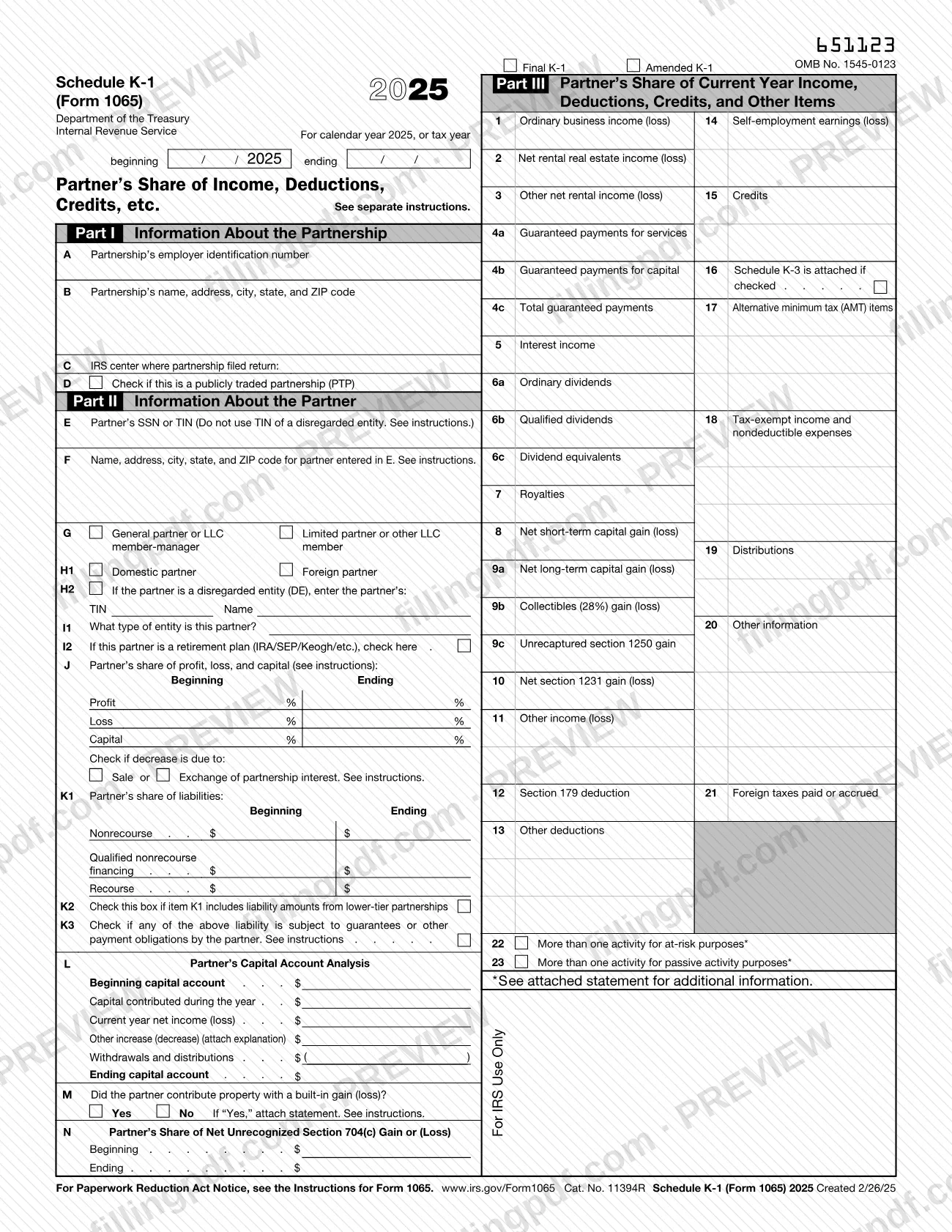
Schedule K-1 (Form 1065), Partner's Share of Income, Deductions, Credits, etc., is the Internal Revenue Service (IRS) schedule that a partnership prepares for each partner to report that partner's share of the partnership's income, deductions, credits and other items. Partners use it to complete their own tax returns, and partnerships use it to report the year's results to each partner. On FillingPDF you can fill out the 2025 form online and download or print the completed PDF; the form and the Partner's Instructions are published by the IRS, and the form points to www.irs.gov/Form1065.
Last updated
What is Schedule K-1 (Form 1065)?
Schedule K-1 (Form 1065), Partner's Share of Income, Deductions, Credits, etc. is the IRS schedule on which a partnership reports one partner's share of its income, deductions, credits and other items for the calendar year 2025 or for its tax year, and on which the partner relies to prepare a tax return.
The partnership prepares the schedule and keeps its own copy for the IRS; the Partner's Instructions say the partnership files a copy with the IRS and that you keep your copy for your records. The partnership generally is not subject to income tax, but you may be liable for tax on your share of the partnership income whether or not it was distributed.
The form has three parts:
- Part I, information about the partnership (items A to D): the employer identification number, name and address, the IRS center where the return was filed, and a box for a publicly traded partnership (PTP).
- Part II, information about the partner (items E to N): identifying number, partner type, share of profit, loss and capital, share of liabilities, capital account analysis, built-in gain or loss on contributed property and net unrecognized section 704(c) gain or loss.
- Part III, the partner's share of current year income, deductions, credits and other items (boxes 1 to 23).
The amounts in boxes 1 through 21 are shown without regard to basis, at-risk, passive activity and excess business loss limitations, so the amount you may claim can be smaller than the amount shown. The form carries OMB No. 1545-0123 and has check boxes for a Final K-1 and an Amended K-1. When box 16 is checked, Schedule K-3 is attached.
Who needs to file Schedule K-1 (Form 1065)?
The partnership that files Form 1065 uses Schedule K-1 to report each partner's share, and each partner receives a copy. The partner uses it, with the IRS Partner's Instructions, to report the items on a tax return if a return is required.
Others the instructions address:
- Partners who sell or exchange an interest. A partner in a section 751(a) exchange must notify the partnership in writing within 30 days of the exchange or, if earlier, by January 15 of the following calendar year. Item J has Sale and Exchange boxes for a decrease.
- Executors. An executor who receives a decedent's Schedule K-1 must give the partnership the name and taxpayer identification number (TIN) of the decedent's estate.
- Nominees. A person who holds a partnership interest as a nominee for another person must furnish a written statement to the partnership.
- Partners that are disregarded entities (DEs). The partnership enters the TIN of the beneficial owner in item E; do not enter the TIN of the DE there.
Do not file your copy of Schedule K-1 with your tax return unless you are specifically required to do so. If both spouses are partners, each completes and files their own Schedule SE (Form 1040) for box 14.
When to file Schedule K-1 (Form 1065)
Schedule K-1 has no due date printed on it; it is prepared by the partnership as part of its Form 1065 reporting for the year, and the form header gives the calendar year 2025 or the partnership's tax year with beginning and ending dates. For partners, the triggering event is preparing a tax return: if you file on a calendar-year basis but the partnership has a fiscal year, report the amounts on the return for the year in which the partnership's fiscal year ends. For example, a partnership year ending in February 2026 is reported on the 2026 return.
Other timing rules in the Partner's Instructions:
- A partner in a section 751(a) exchange must notify the partnership within 30 days of the exchange, or by January 15 of the next calendar year if that is earlier.
- A nominee must furnish a written statement to the partnership by the last day of the month following the end of the partnership's tax year.
Documents you need
- Statement for boxes marked with an asterisk (*) after the code: the partnership attaches it for any item that needs additional information, with "STMT" in the amount space.
- Statement attached when box 22 (more than one activity for at-risk purposes) or box 23 (more than one activity for passive activity purposes) is checked.
- Statement for item M when the answer is "Yes" to contributing property with a built-in gain (loss).
- Explanation for the item L line "Other increase (decrease)" when an amount is entered there.
- Schedule K-3, attached when the box 16 check box is marked.
How to fill out Schedule K-1 (Form 1065)
Mark final or amended and enter the year
At the top, check Final K-1 or Amended K-1 if either applies. Enter the calendar year 2025, or the tax year beginning and ending dates.
Complete Part I partnership information
Enter the partnership's employer identification number (item A) and its name, address, city, state and ZIP code (item B). In item C give the IRS center where the partnership filed its return, and check item D for a publicly traded partnership.
Enter the partner's identifying details
In item E enter the partner's SSN or TIN; for an individual use the SSN or ITIN, for all others the EIN. In item F give the partner's name and address, then mark item G, H1, H2 for a disregarded entity, I1 for entity type and I2 for a retirement plan.
Fill in profit, loss and capital (item J)
Enter beginning and ending percentages for Profit, Loss and Capital based on the partnership agreement. Check Sale or Exchange if the decrease is due to a sale or exchange of the partnership interest.
Report the partner's liabilities (K1 to K3)
Item K1 shows beginning and ending Nonrecourse, Qualified nonrecourse financing and Recourse amounts. Check K2 for lower-tier partnership liabilities and K3 for guarantees or other payment obligations.
Complete the capital account analysis (item L)
Enter the beginning capital account, capital contributed, current year net income (loss), other increase (decrease) with an attached explanation, withdrawals and distributions, and the ending capital account, using the tax-basis method.
Answer items M and N
For item M check Yes or No for contributed property with a built-in gain (loss), and attach a statement if Yes. In item N enter the partner's beginning and ending net unrecognized section 704(c) gain or (loss).
Enter income and loss in boxes 1 to 11
Complete the income boxes: ordinary business income (1), rental income (2, 3), guaranteed payments (4a to 4c), interest (5), dividends (6a to 6c), royalties (7), capital gains (8, 9a to 9c), section 1231 (10) and other income (11).
Enter deductions, credits and other items
Use boxes 12 and 13 for the section 179 deduction and other deductions, 14 for self-employment earnings, 15 for credits, and 17 for AMT items. Where a box uses a code, enter the code in the column to the left of the amount.
Complete boxes 16 and 18 to 23
Check box 16 if Schedule K-3 is attached. Enter tax-exempt income (18), distributions (19), other information (20) and foreign taxes (21). Check boxes 22 and 23 if a statement on more than one activity is attached.
Review, download and give copies
Check each entry against the partnership's records, then download or print the completed PDF from FillingPDF. Furnish it to the partner and report it as described under How to submit.
How to submit Schedule K-1 (Form 1065)
Schedule K-1 (Form 1065) is not submitted by the partner as a stand-alone filing. The channels are:
- Partnership to partner. The partnership furnishes each partner a copy of the completed schedule.
- Partnership to the IRS. The partnership files a copy of Schedule K-1 with the IRS; the form refers to the Instructions for Form 1065 at www.irs.gov/Form1065 for the partnership's filing details.
- Partner's tax return. You keep your copy for your records and report the items on your own return. Do not attach it to your return unless you are specifically required to do so.
If you think the partnership made an error, notify the partnership and ask for a corrected Schedule K-1; do not change your copy. If your treatment differs from the partnership's, file Form 8082 with your original or amended return. FillingPDF lets you fill out and download the PDF; submission follows the channels above.
Common mistakes to avoid
- Changing amounts on your copy of Schedule K-1 because you believe it is wrong; the instructions say to ask the partnership for a corrected Schedule K-1 instead.
- Attaching your Schedule K-1 to your tax return when you are not specifically required to file it.
- Deducting the full loss shown in Part III without applying the basis, at-risk, passive activity and excess business loss limitations.
- Treating the ending capital account in item L as your adjusted basis; item L is tax-basis capital and excludes partnership liabilities.
- Reporting an item differently from the partnership without filing Form 8082 to explain the inconsistency.
- Entering the TIN of a disregarded entity in item E instead of the TIN of its beneficial owner.
- Not notifying the partnership in writing of a section 751(a) sale or exchange within the 30-day or January 15 deadline.
- Reporting a fiscal-year partnership's amounts on the wrong year's return instead of the year in which the partnership's year ends.
Frequently asked questions
What is Schedule K-1 (Form 1065)?
Schedule K-1 (Form 1065) is the IRS schedule a partnership uses to report a partner's share of its income, deductions, credits and other items. The partner uses it to prepare a tax return and keeps it for their records.
Do I file my Schedule K-1 with my tax return?
No, not unless you are specifically required to. The Partner's Instructions say to keep it for your records. The partnership files a copy with the IRS, and you report the items on the appropriate lines of your own return.
What should I do if my Schedule K-1 has an error?
Notify the partnership and ask for a corrected Schedule K-1. Do not change any items on your copy. Make sure the partnership sends a copy of the corrected Schedule K-1 to the IRS.
Where do I report box 1 ordinary business income on Form 1040?
On Schedule E (Form 1040), line 28. Material participation income or loss goes in column (i) or (k). Passive income goes in column (h), and a passive loss in column (g) after applying the Instructions for Form 8582. A PTP follows its own rules.
Is the capital account in item L my tax basis?
Not necessarily. Item L is tax-basis capital as the partnership reports it and excludes your share of partnership liabilities, so it can differ from your adjusted basis. You must keep your own annual record of adjusted basis.
What is the difference between a final and an amended Schedule K-1?
The form has two check boxes at the top: Final K-1 and Amended K-1. The instructions describe a corrected Schedule K-1 as the way a partnership fixes an error on a partner's copy.
What do I do if my spouse and I are both partners?
Each of you must complete and file your own Schedule SE (Form 1040), Self-Employment Tax, to report your partnership net earnings (loss) from self-employment shown in box 14.
What must I do if I sell my partnership interest?
In a section 751(a) exchange you must notify the partnership in writing within 30 days of the exchange, or by January 15 of the following year if earlier. Include both parties' names and addresses, identifying numbers and the exchange date.
Can I fill out Schedule K-1 (Form 1065) online?
Yes. You can fill out the fillable PDF online on FillingPDF and download or print it. FillingPDF is an independent service and does not file the schedule with the IRS or send it to partners.
Ready to fill out Schedule K-1 (Form 1065)?
Fill out Schedule K-1 (Form 1065) now