
Schedule K-3 (Form 1065), Partner's Share of Income, Deductions, Credits, etc. - International, is the Internal Revenue Service (IRS) schedule on which a partnership reports to each partner the items of international tax relevance from the partnership's operations. Partners use it to complete forms such as Form 1116, Form 1118, Form 8993 and Form 1040-NR, and a partnership that is itself a partner uses it to prepare its own Schedules K-3. On this page you can fill out the 2025 form online on FillingPDF and download or print the completed PDF; the form and its instructions are published by the IRS.
Last updated
What is Schedule K-3 (Form 1065)?
Schedule K-3 (Form 1065), Partner's Share of Income, Deductions, Credits, etc. - International, is the IRS schedule that reports a partner's share of a partnership's international tax items, such as foreign-source income, foreign taxes, and amounts needed for the foreign tax credit and other international computations.
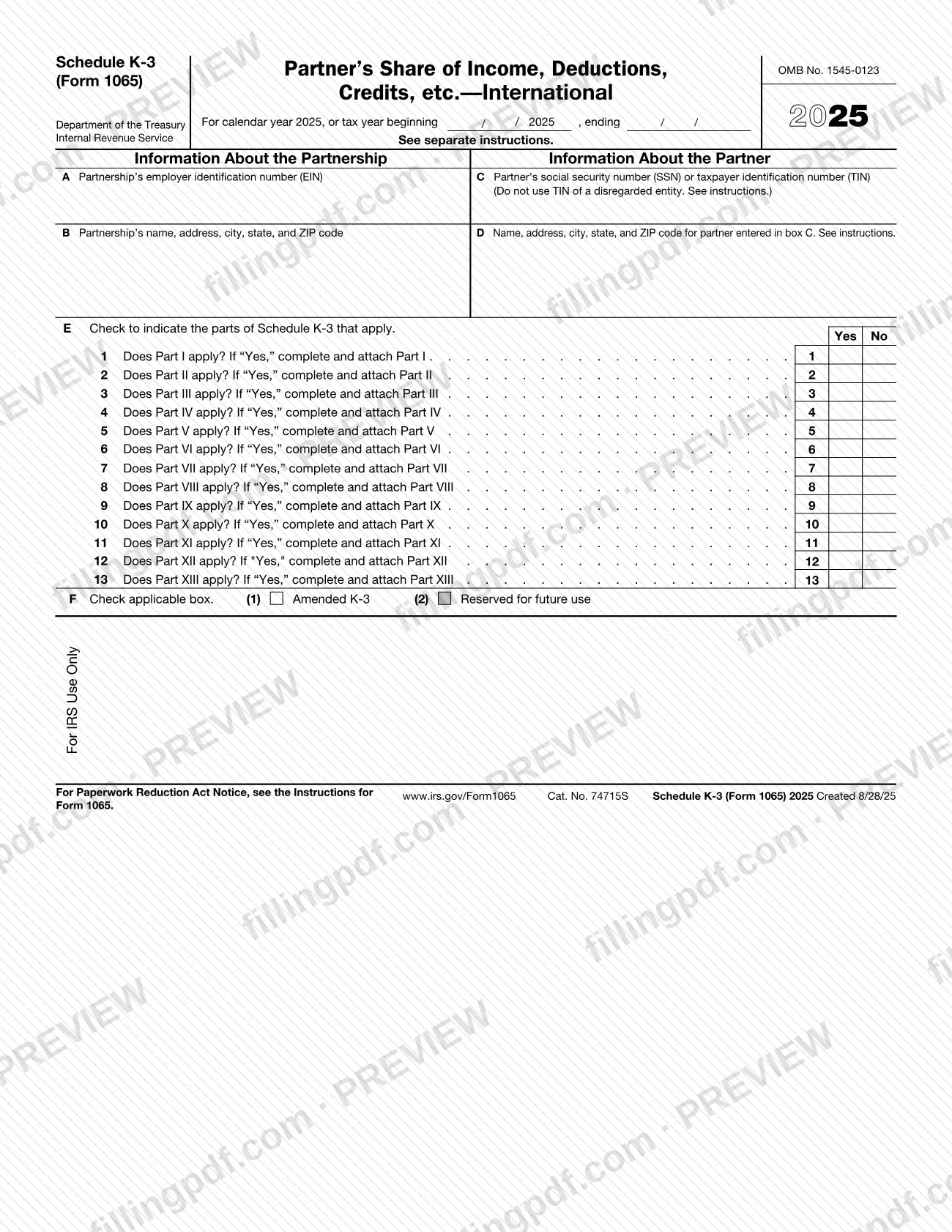
The form carries OMB No. 1545-0123 and is issued by the Department of the Treasury, Internal Revenue Service. This edition is for calendar year 2025, or a tax year beginning and ending in 2025. The partnership identifies itself in boxes A and B, the partner in boxes C and D, and answers Yes or No in item E for each of 13 parts, so only the parts that apply are completed and attached.
The parts are:
- Part I: other current year international information, with boxes for attachments.
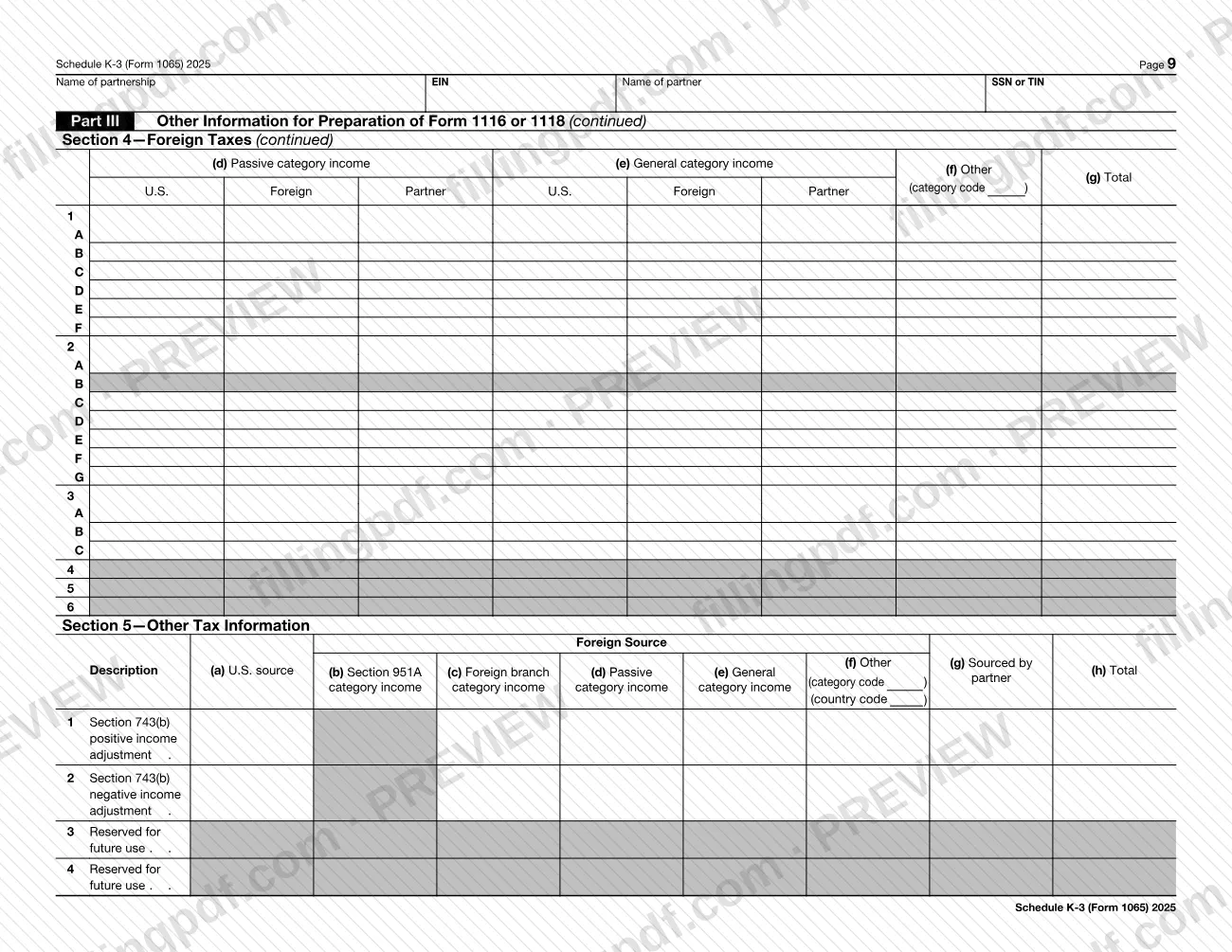
- Parts II and III: foreign tax credit limitation and other information for Form 1116 or 1118.
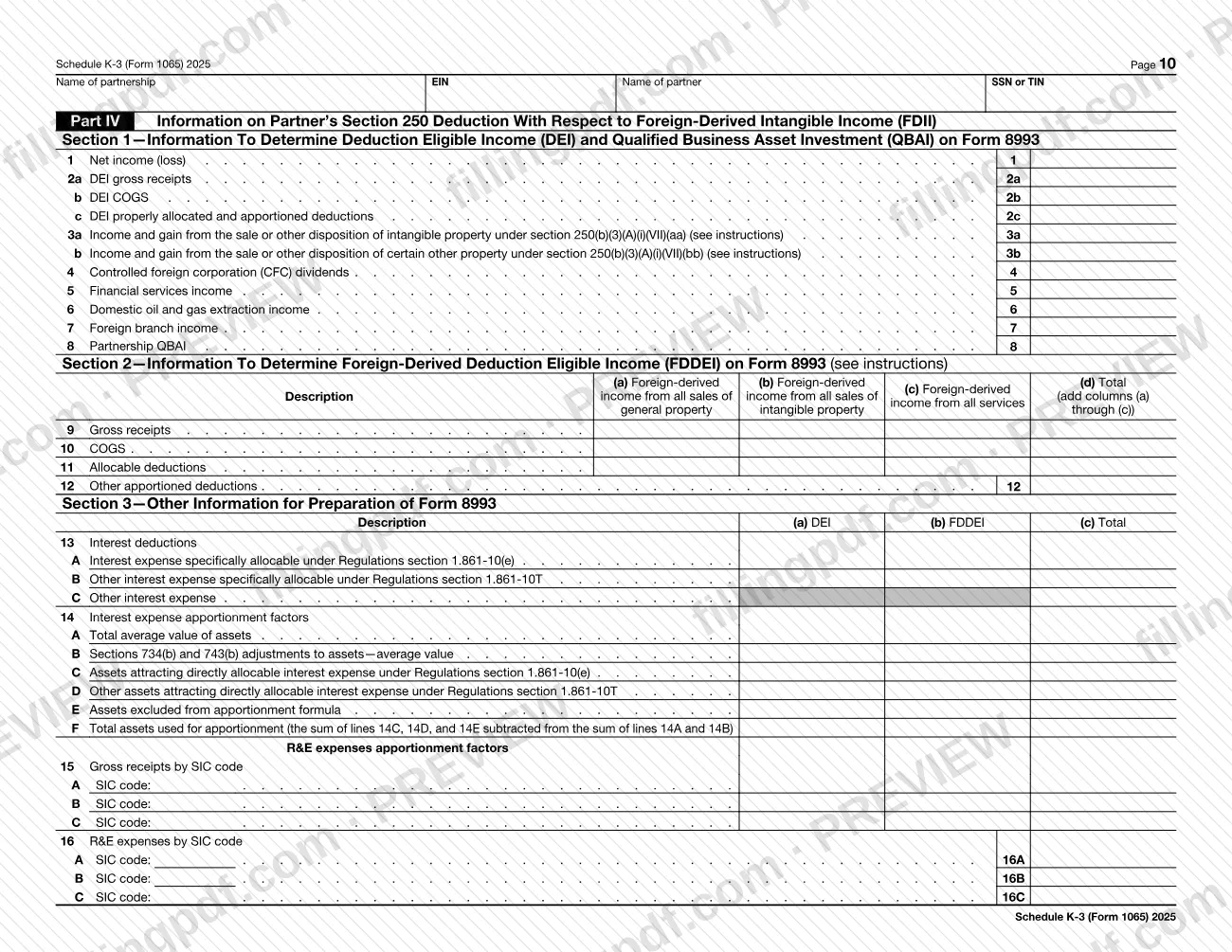
- Part IV: section 250 deduction for foreign-derived intangible income (FDII), used on Form 8993.
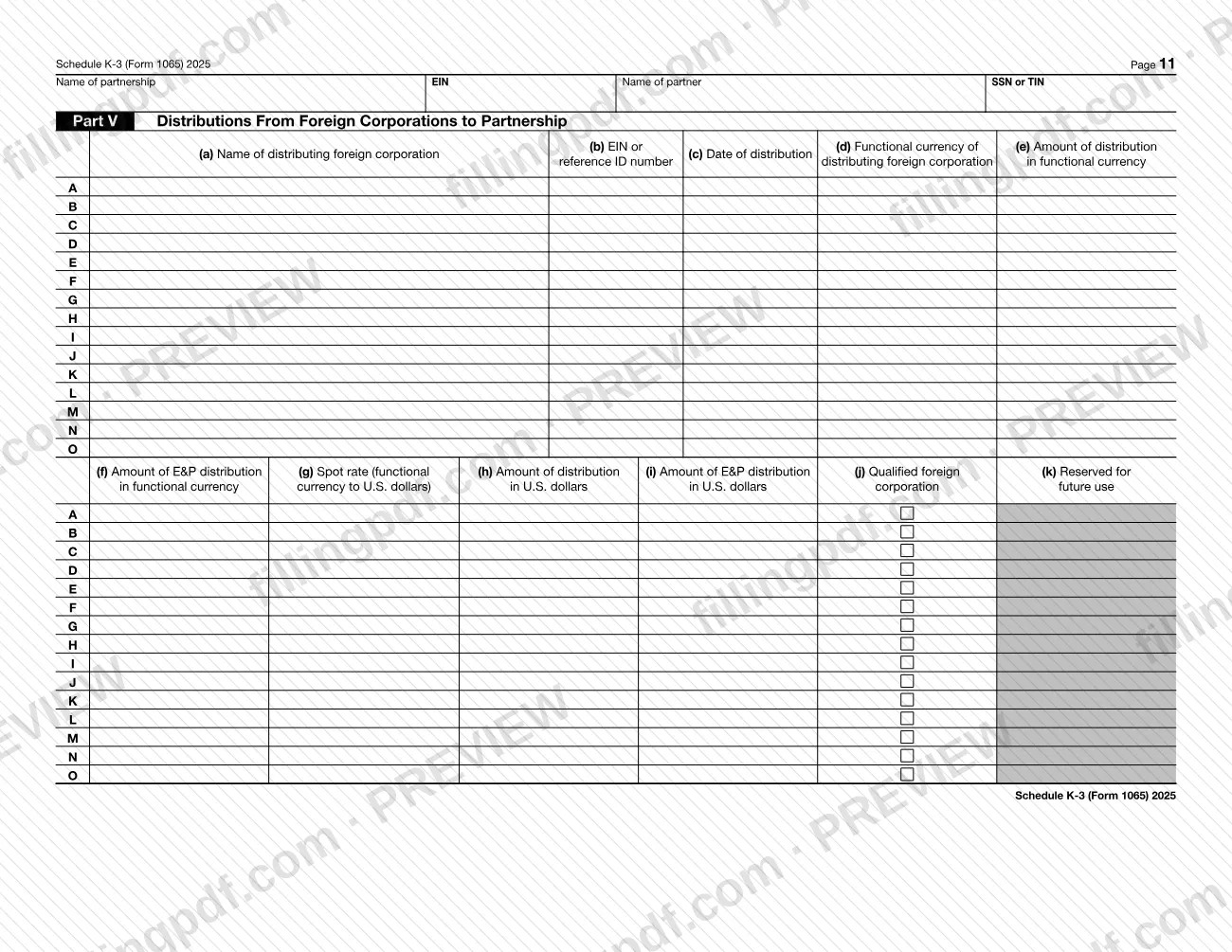
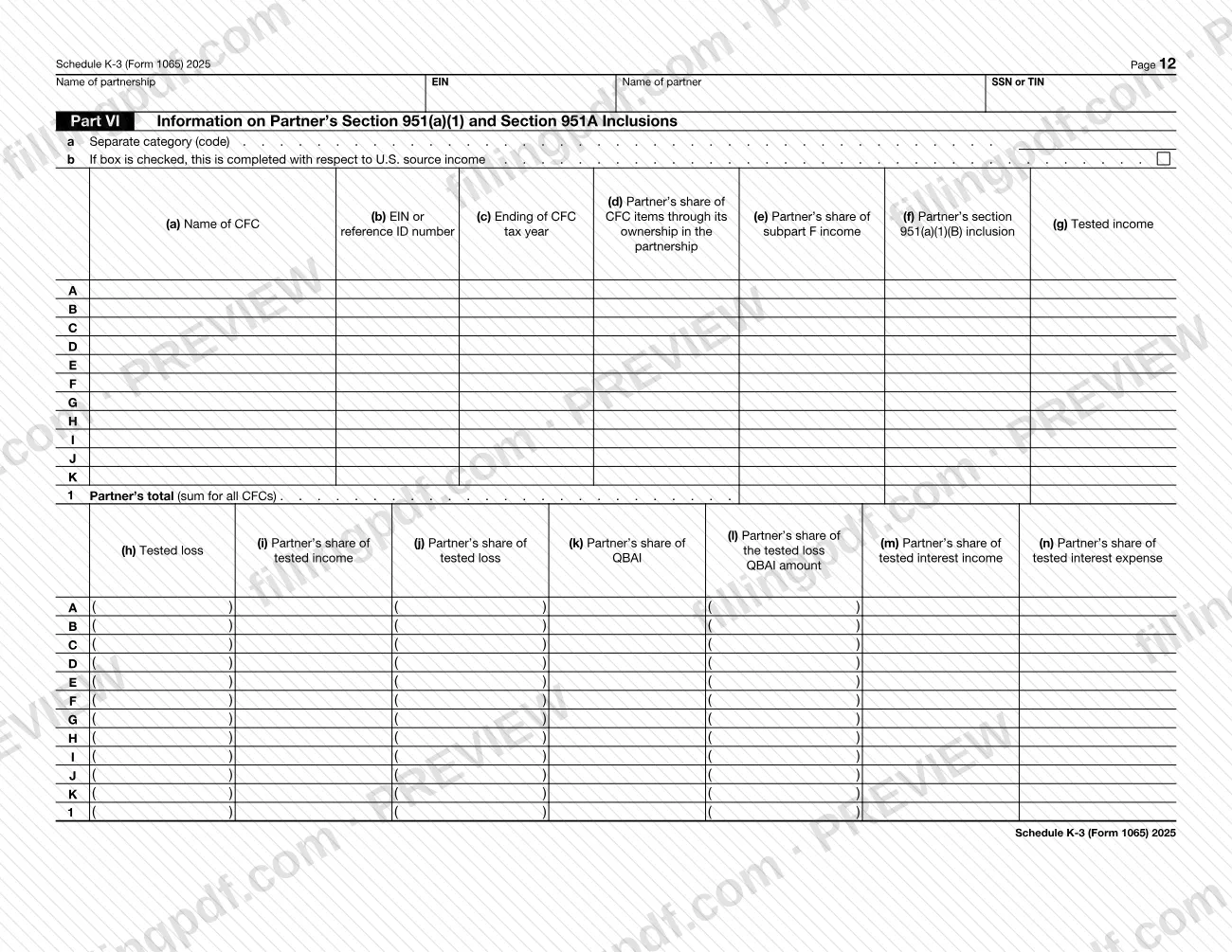
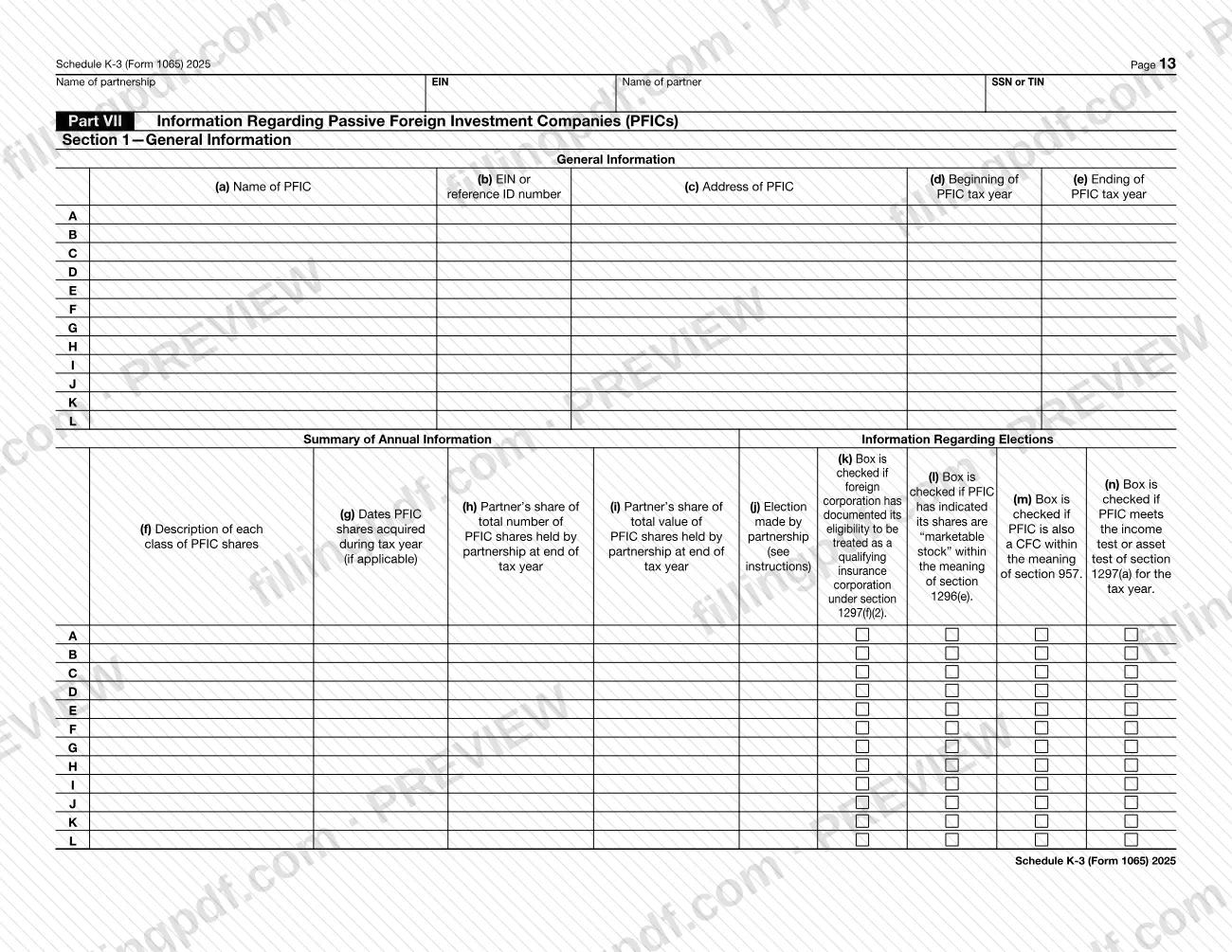
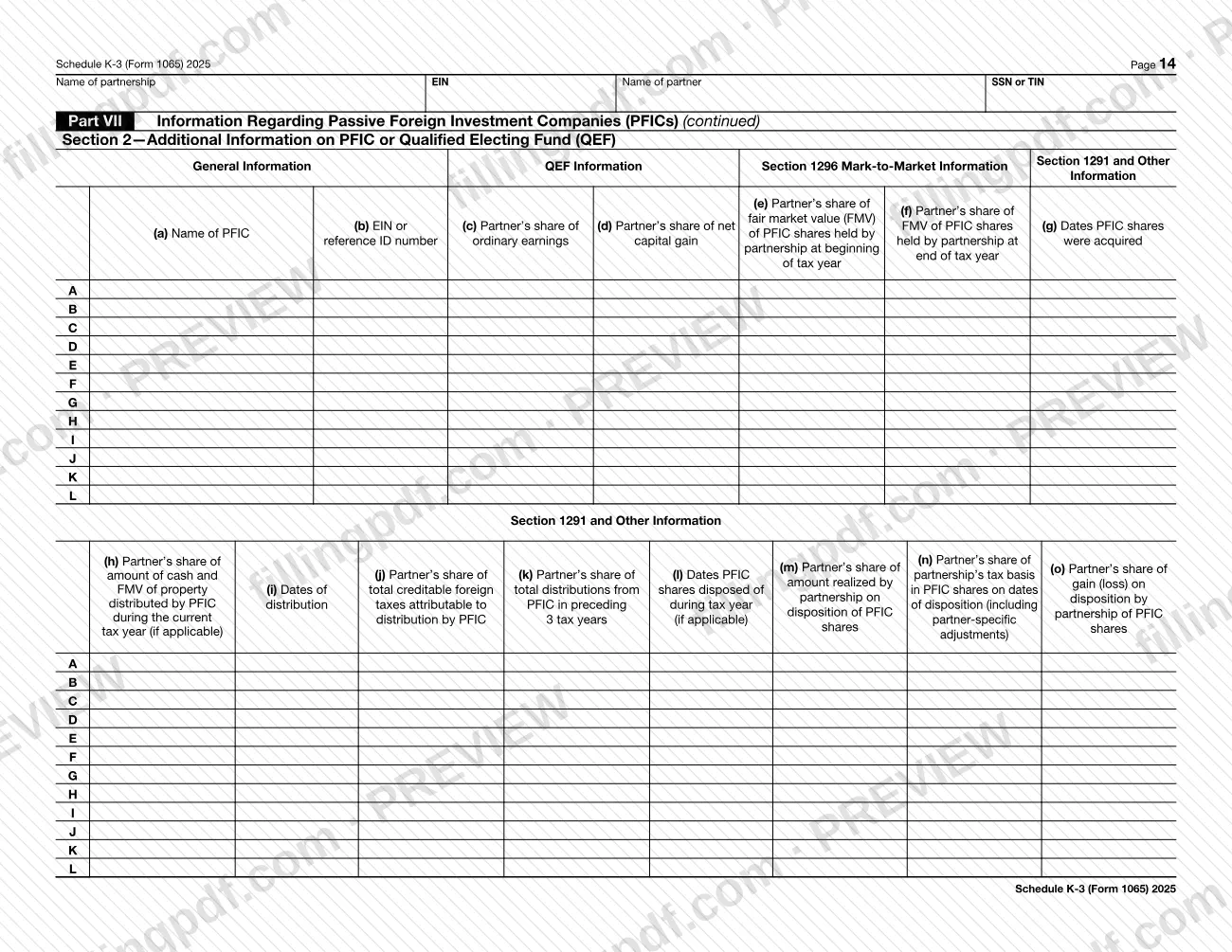
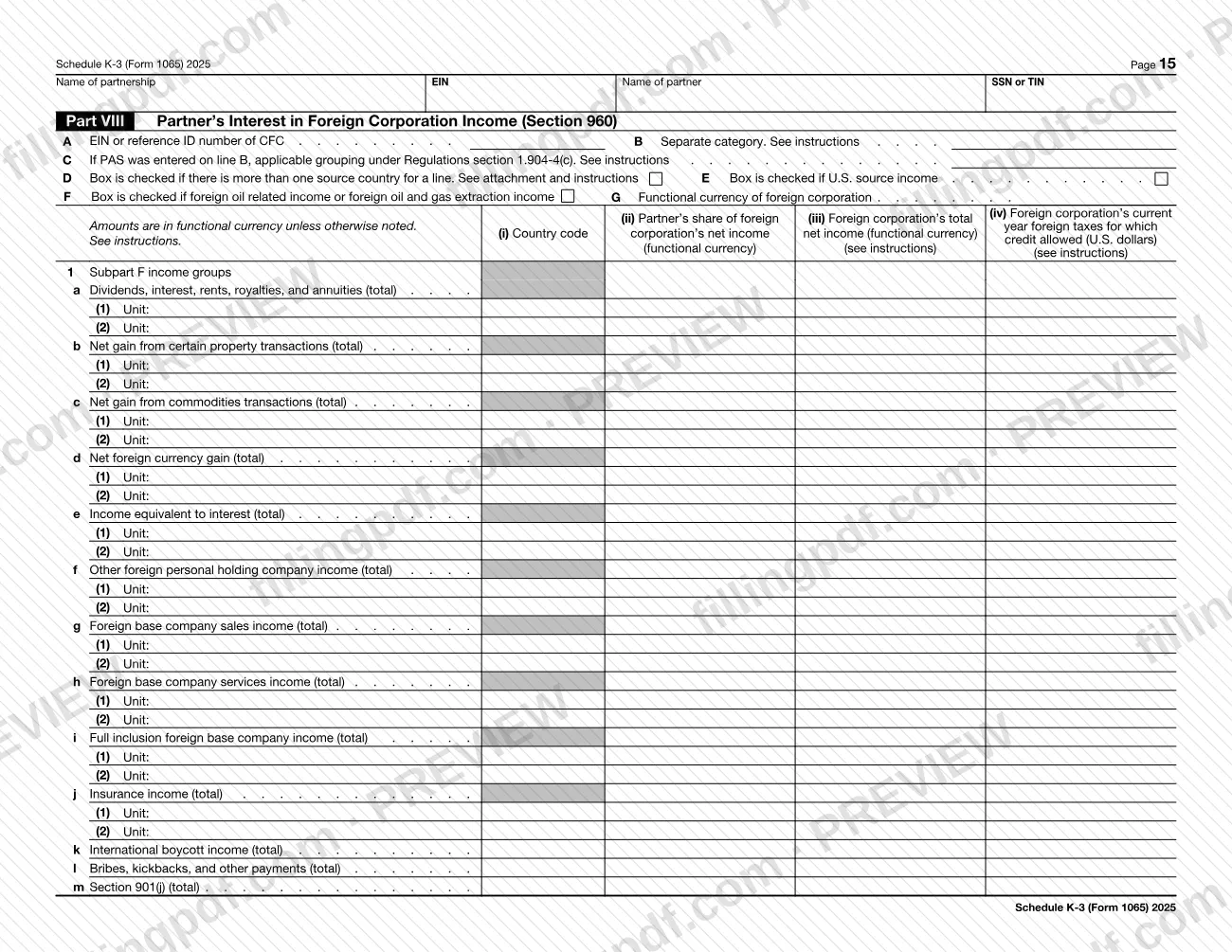
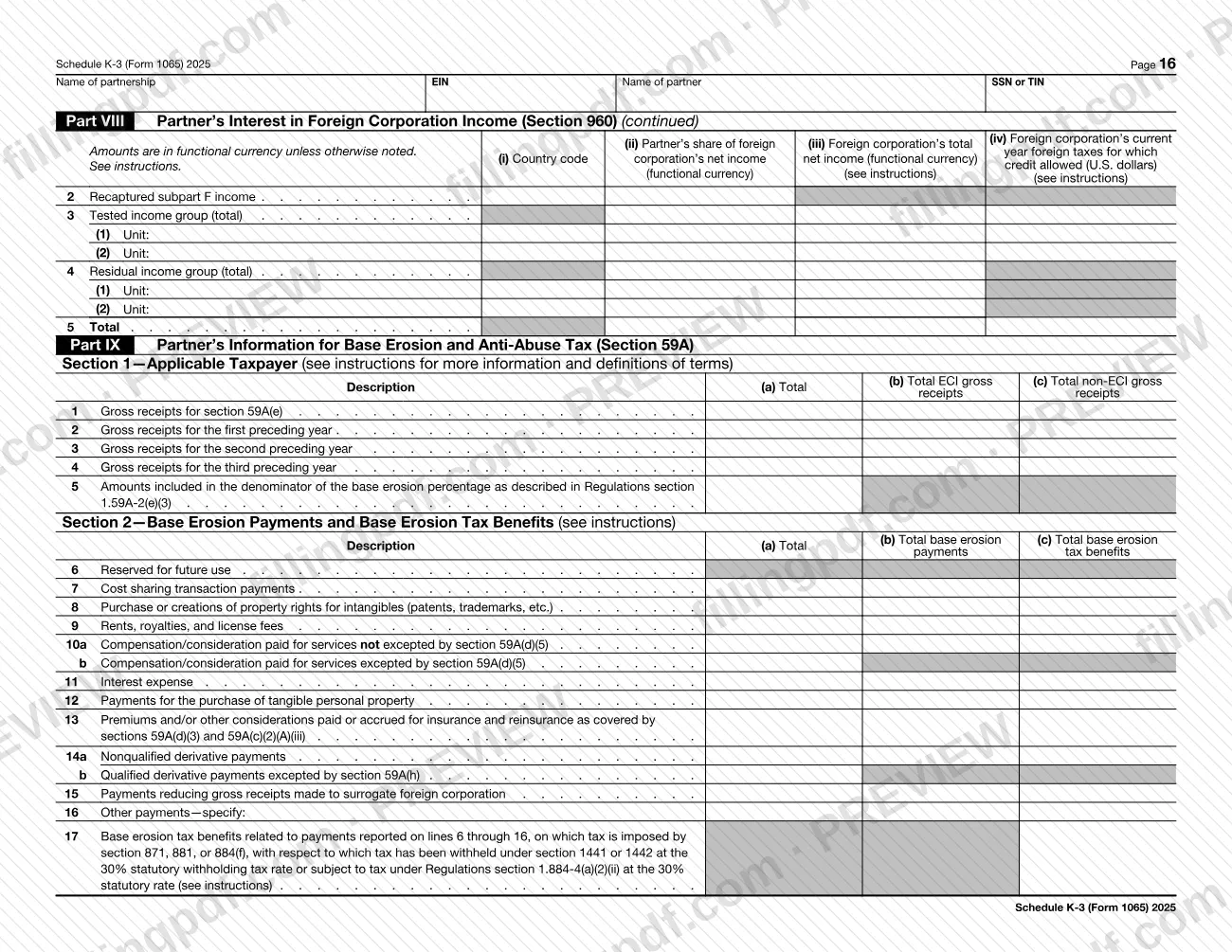
- Parts V to VIII: foreign corporation distributions, section 951(a)(1) and 951A inclusions, PFICs, and section 960 income.
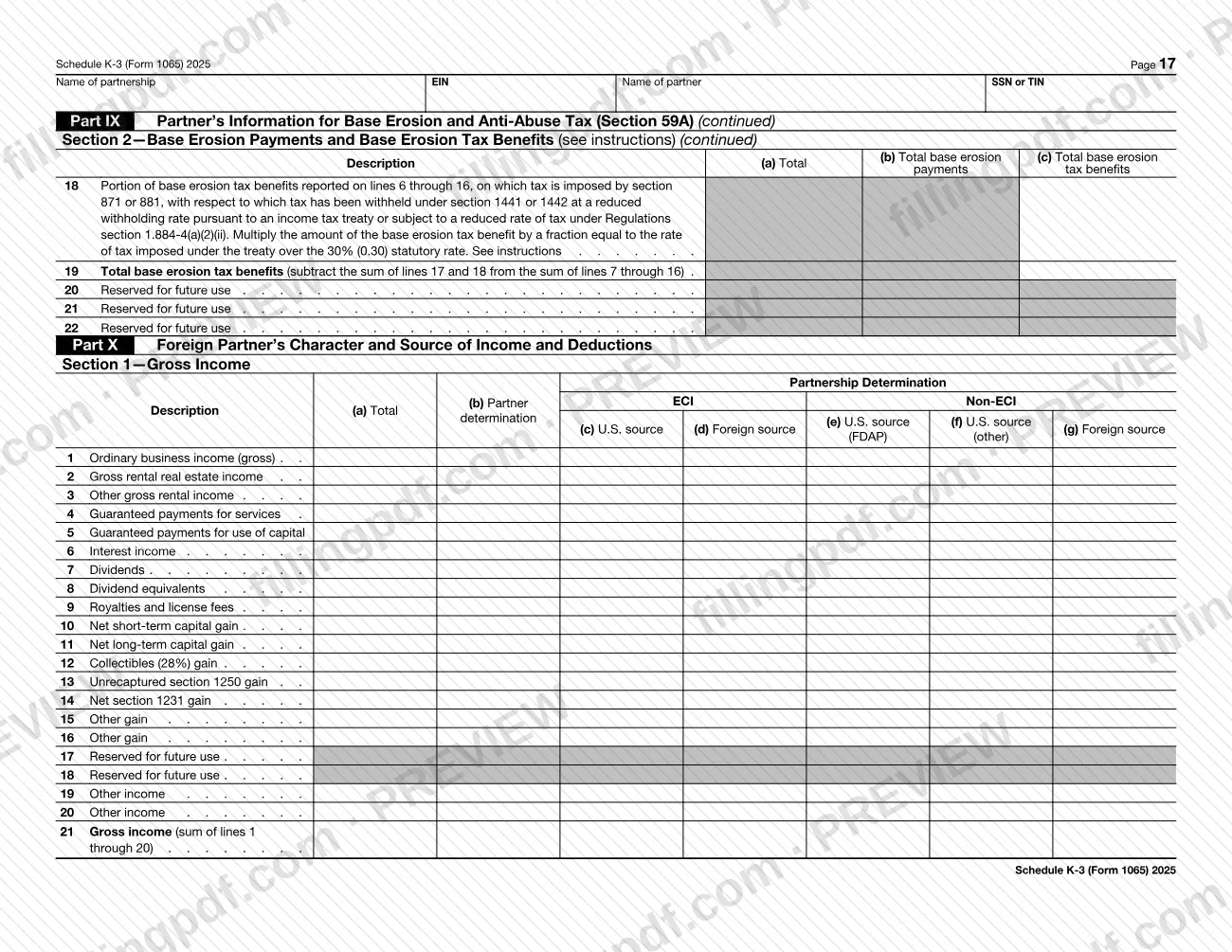
- Part IX: base erosion and anti-abuse tax (BEAT) information.
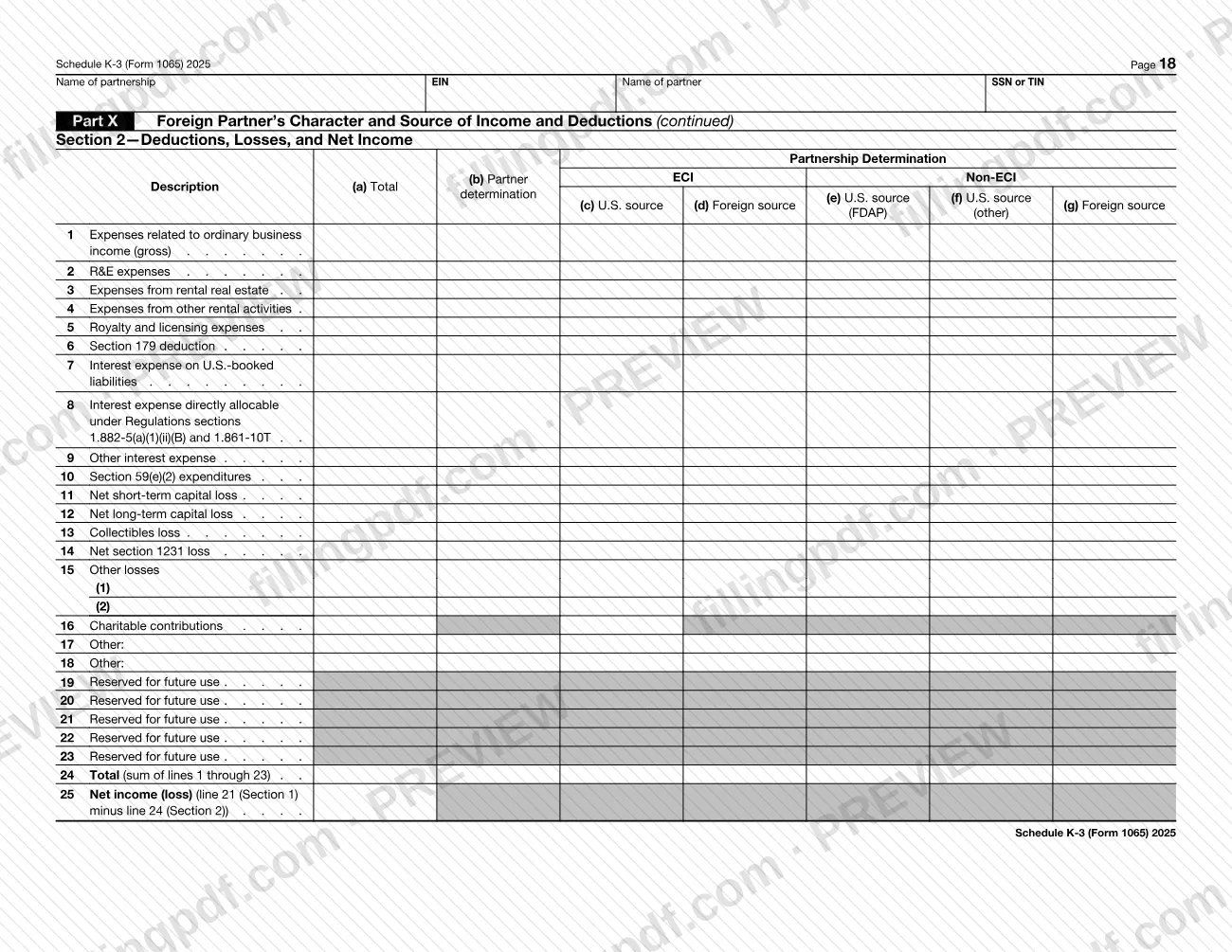
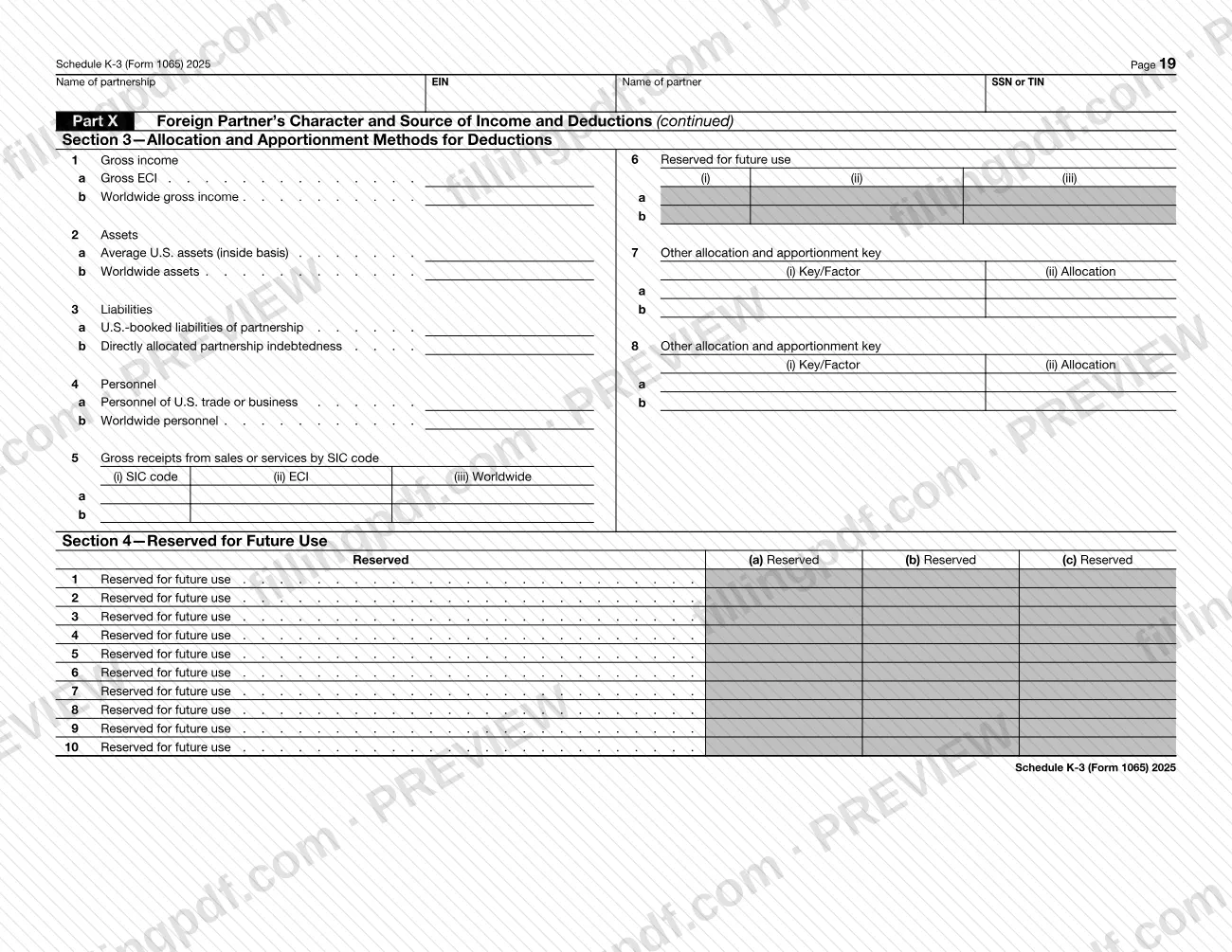
- Part X: a foreign partner's character and source of income and deductions.
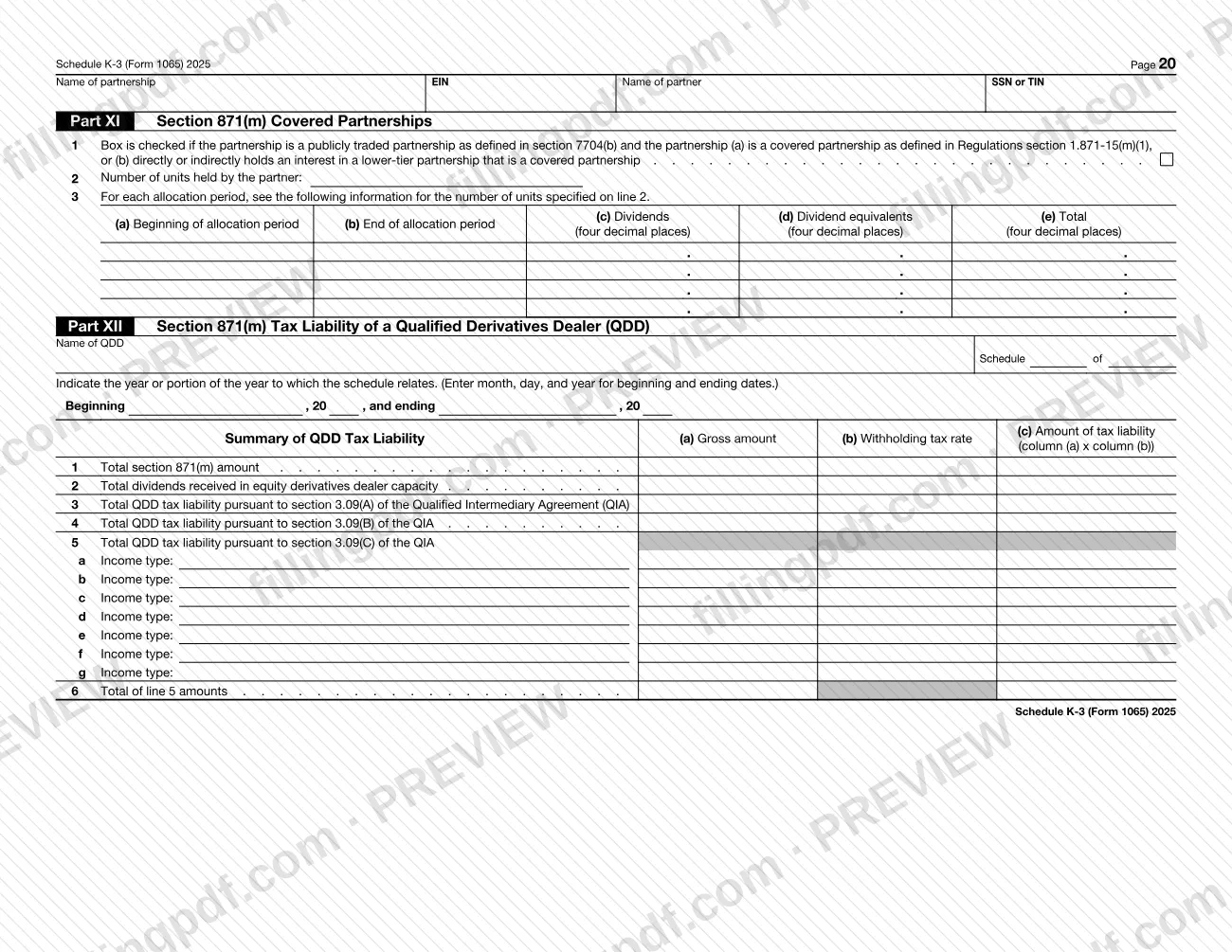
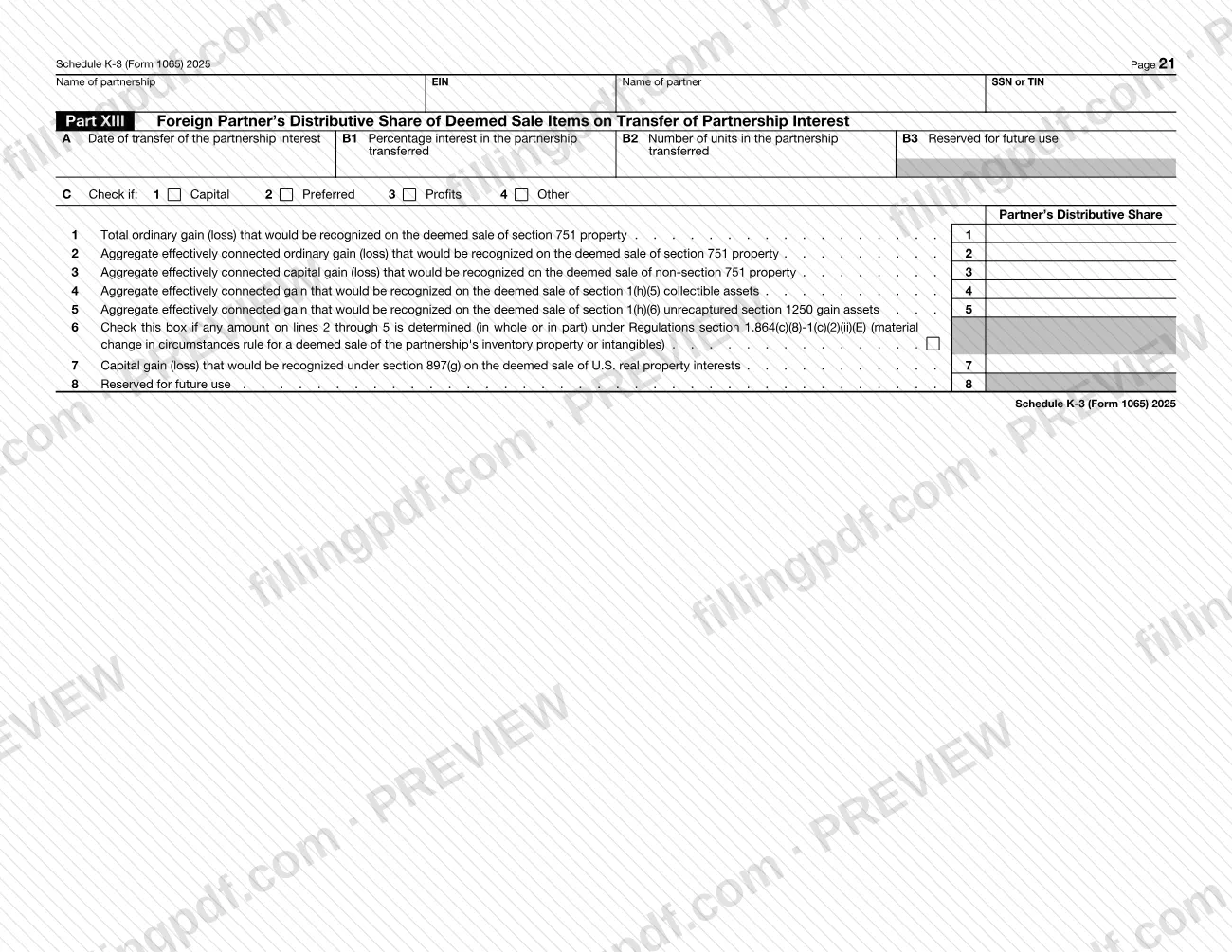
- Parts XI to XIII: section 871(m) covered partnerships, QDD tax liability, and deemed sale items on a transfer of a partnership interest.
It goes with Schedule K-1 (Form 1065): the IRS Partner's Instructions for Schedule K-1 generally apply to Schedule K-3 as well. The IRS publishes separate Partner's Instructions for Schedule K-3 (Form 1065) and Partnership Instructions for Schedules K-2 and K-3 (Form 1065).
Who needs to file Schedule K-3 (Form 1065)?
The partnership is the main group: it completes Schedule K-3 (Form 1065) for each partner and answers Yes in item E for each part that applies to that partner. Partners are the users of the information. A partner uses only the parts that apply to it.
Who uses which part, according to the IRS Partner's Instructions:
- Partners claiming a foreign tax credit use Parts II and III for Form 1116 or Form 1118.
- Domestic corporate partners use Part IV for Form 8993 and Part IX for Form 8991.
- Foreign partners, and pass-through partners with a foreign owner, use Part X for Form 1040-NR, Form 1120-F or other forms. Part X is generally not completed for a domestic corporation partner.
- A partner that is itself a partnership uses the information to complete the Schedules K-3 it gives its own partners.
A partnership with no foreign activity may still report on Schedule K-3. A partnership that meets the domestic filing exception may not issue it. In that case, a partner that must complete Form 1116 to claim a foreign tax credit can request it from the partnership.
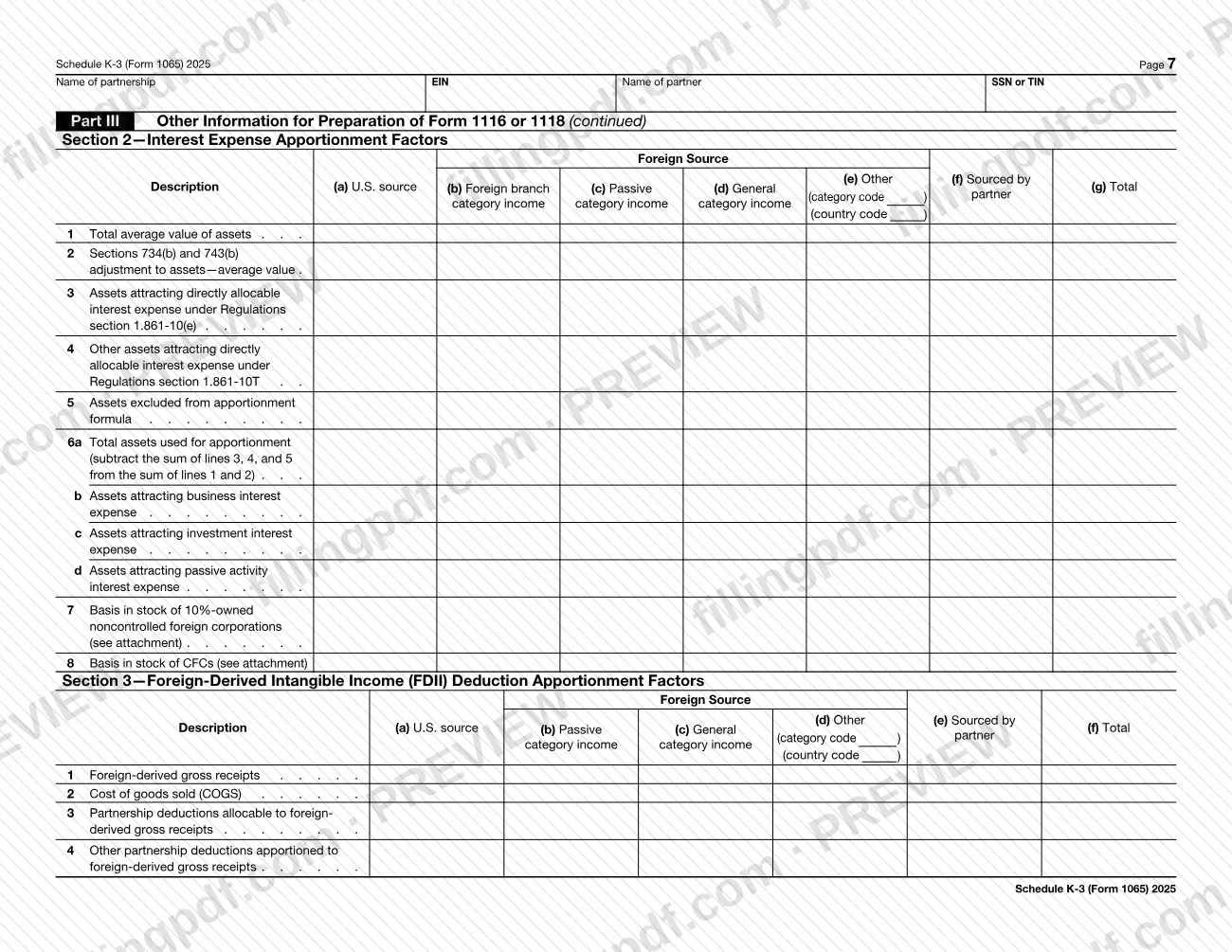
Less-than-10% limited partners may not receive every section: Part III, Section 2 is not completed for a limited partner owning less than 10% of a capital and profits interest.
When to file Schedule K-3 (Form 1065)
Schedule K-3 (Form 1065) is prepared for the partnership's tax year, which this edition prints as calendar year 2025 or a tax year beginning and ending in 2025. It has no due date of its own: it is completed along with the partnership's Form 1065 and its Schedules K-1, and the Instructions for Form 1065 at IRS.gov/Form1065 govern timing.
A partner takes its distributive share of the partnership's foreign income taxes into account in the partner's tax year with or within which the partnership's tax year ends.
If the partnership qualified for the domestic filing exception, it notifies partners on an attachment to Schedule K-1 that they will not receive Schedule K-3 unless they request it. A partner that needs it for Form 1116 should request it from the partnership by the date the IRS instructions set; the Partner's Instructions refer to a "1-month date" and to the Partnership Instructions for Schedules K-2 and K-3 for the exception.
Documents you need
- Each part of Schedule K-3 that item E marks Yes: complete it and attach it; parts marked No are not attached.
- A partially completed Schedule I (Form 1118), Reduction of Foreign Oil and Gas Taxes, if the partnership checked Part I, box 2 for foreign oil and gas taxes.
- A statement identifying any splitter arrangement and your share of related taxes, if the partnership checked Part I, box 3.
- A statement of foreign tax translation, if the partnership checked Part I, box 4; it gives the dates taxes were paid or accrued, the exchange rates used, and amounts in foreign currency and U.S. dollars.
- Worksheets 1 and/or 2 from the Partnership Instructions for Schedules K-2 and K-3 (Form 1065), if the partnership checked Part I, box 5 for high-taxed income.
- A statement titled "Section 267A Disallowed Deduction", if the partnership checked Part I, box 6.
- The relevant portions of Form 5471, Form 5713 and other international tax forms, if the partnership attached them under Part I, boxes 8 and 9.
- A statement of other international items, if the partnership checked Part I, box 13.
- A statement adding countries, if a type of Part II income is sourced from more than three countries.
How to fill out Schedule K-3 (Form 1065)
Enter partnership and partner details
Fill in boxes A and B (partnership's EIN, name and address) and boxes C and D (partner's SSN or TIN and the name and address for the partner entered in box C). Do not use the TIN of a disregarded entity in box C.
Mark which parts apply
In item E, check Yes or No on lines 1 through 13 to show whether each of Parts I through XIII applies. Complete and attach every part marked Yes.
Check the amended box if needed
In item F, check box (1) if this is an amended Schedule K-3. Box (2) is reserved for future use.
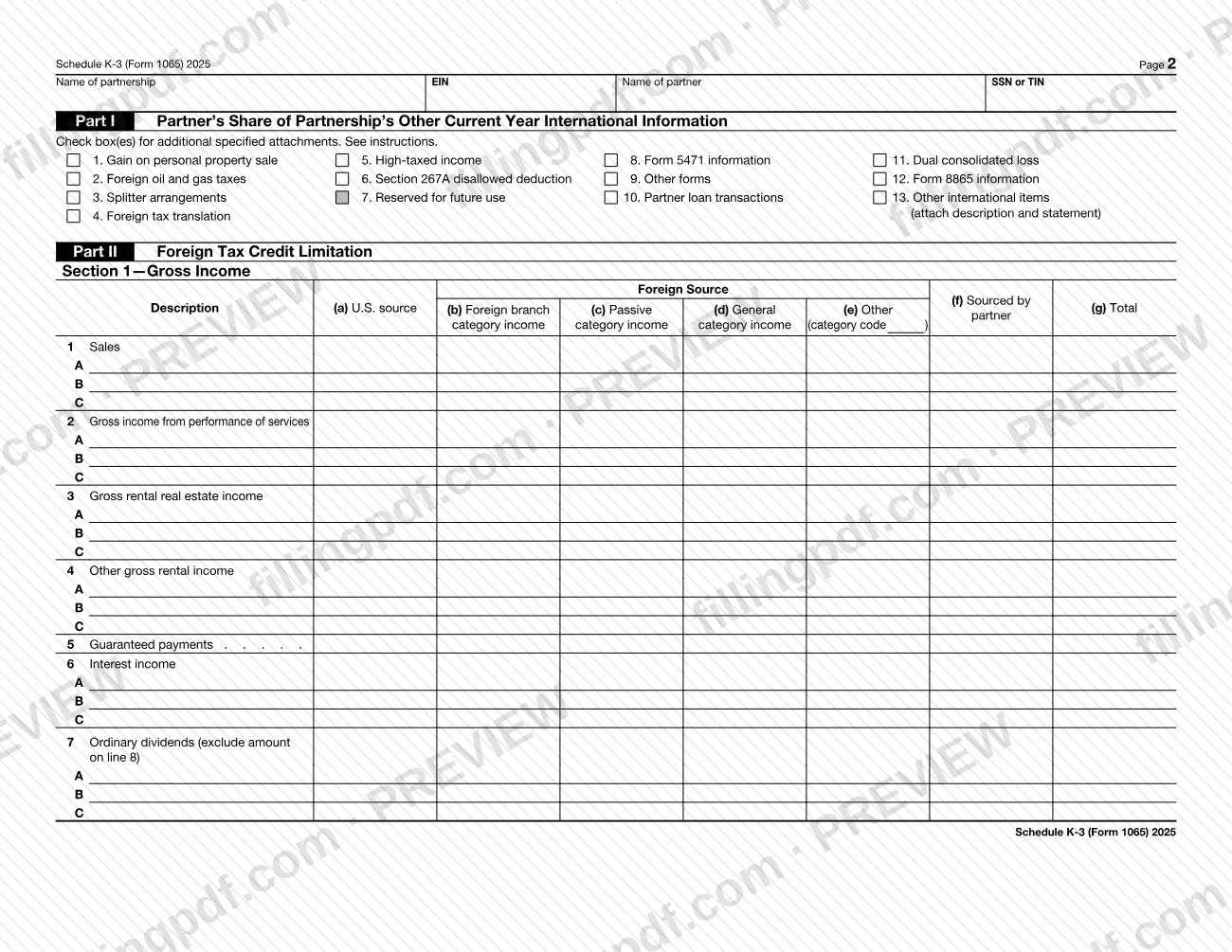
Complete Part I attachments
Check the boxes for boxes 1 through 13 that call for additional attachments, such as gain on personal property sale, foreign oil and gas taxes, splitter arrangements, or foreign tax translation. Box 7 is reserved for future use.
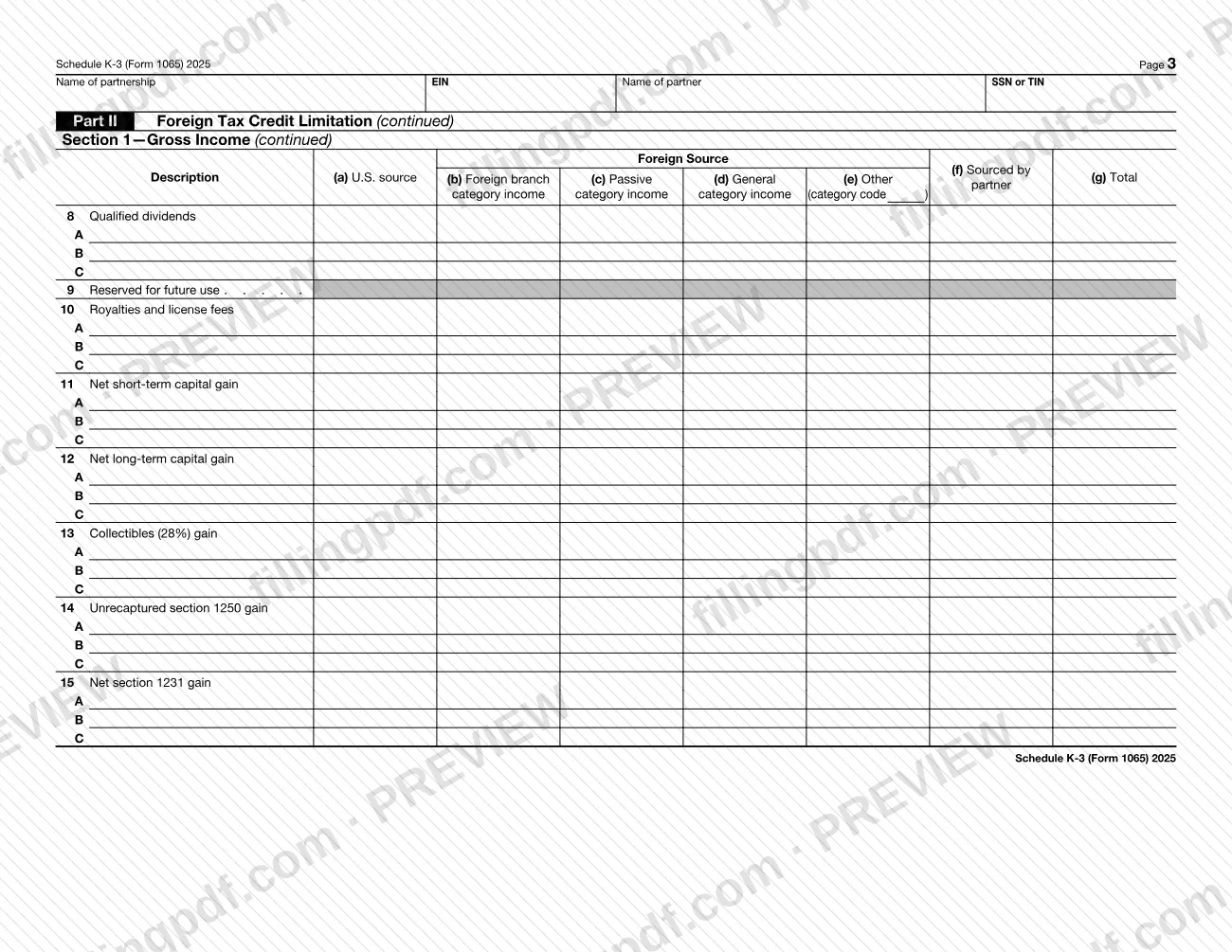
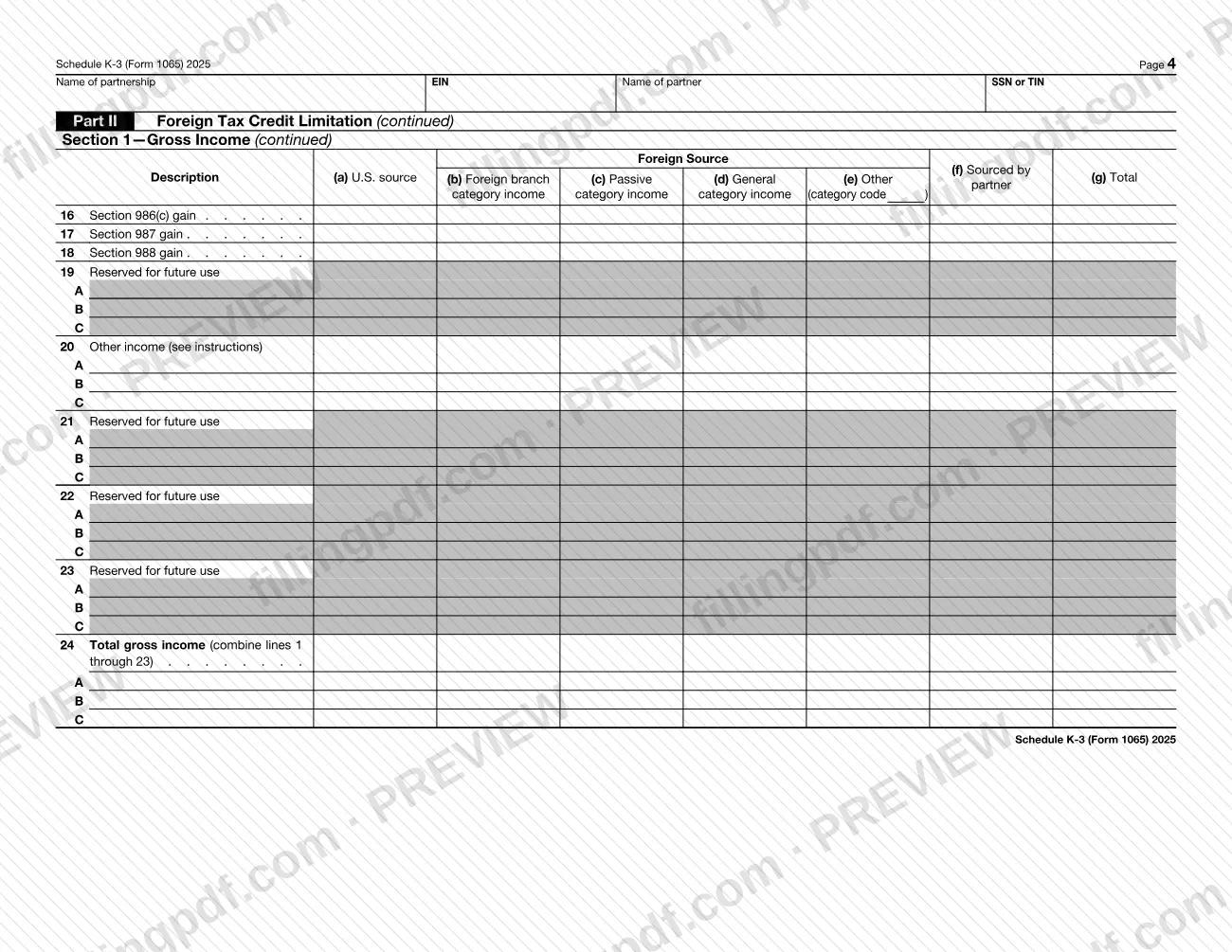
Report gross income in Part II
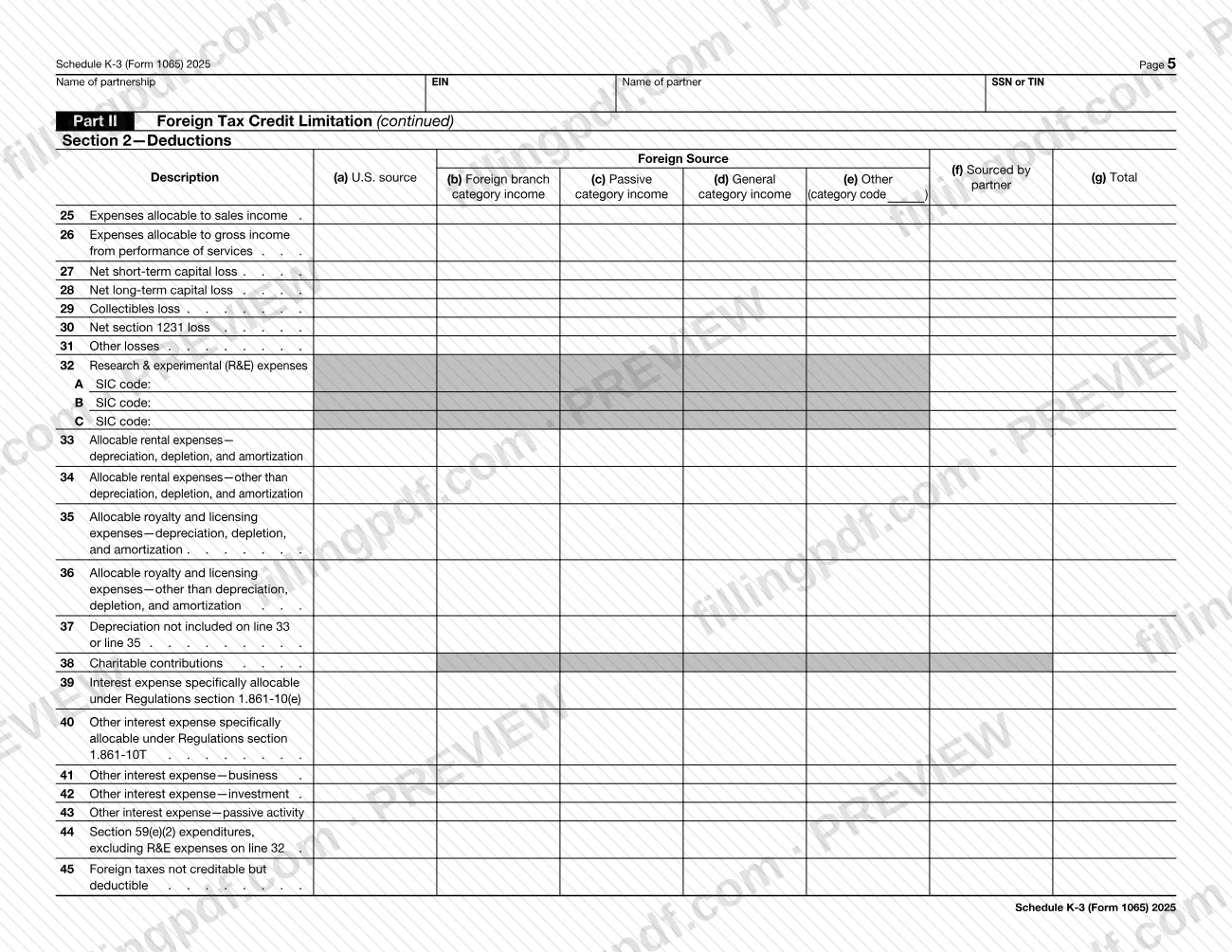
In Section 1, lines 1 through 24, use lines A, B and C for each country code and columns (a) through (g) for U.S. source and foreign-source amounts by separate category. Line 24 totals lines 1 through 23.
Report deductions in Part II
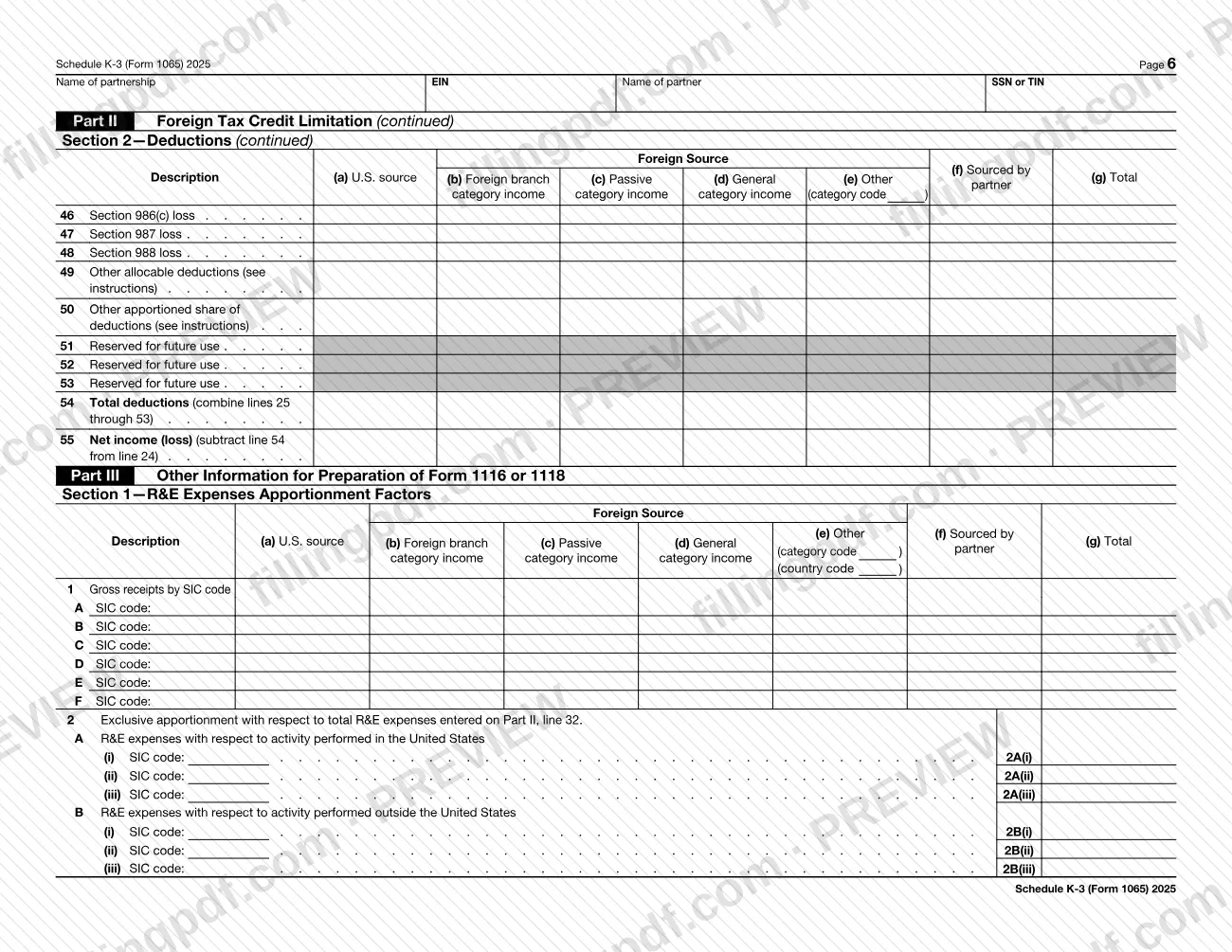
In Section 2, enter lines 25 through 53 by the same columns, including SIC codes on line 32. Line 54 totals lines 25 through 53, and line 55 is line 24 minus line 54.
Complete Part III apportionment factors
Section 1 covers gross receipts by SIC code and R&E expenses, Section 2 covers interest expense apportionment, and Section 3 covers FDII deduction factors. Use the columns printed on each section.
Enter foreign taxes and other tax information
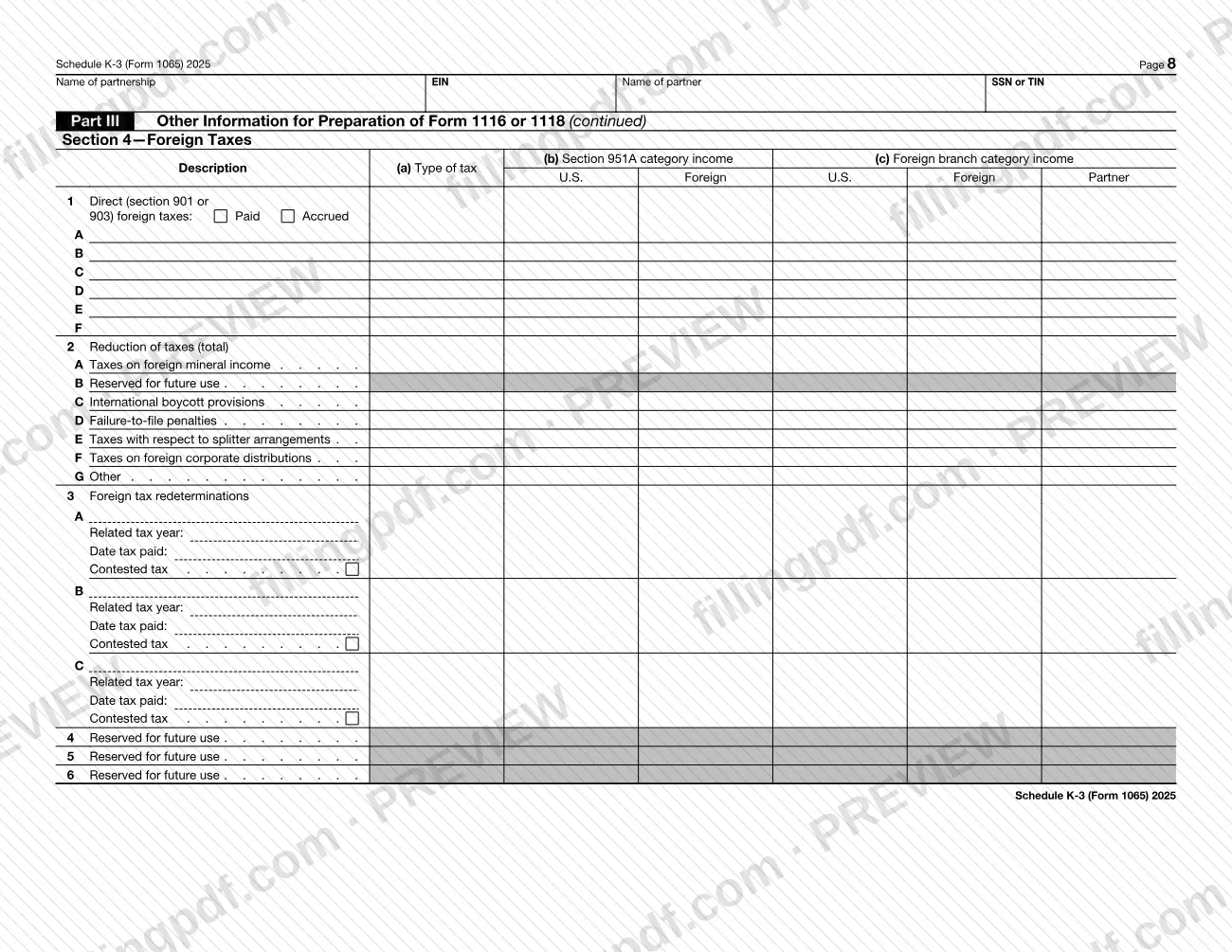
In Part III, Section 4, report direct foreign taxes on line 1 as paid or accrued, reductions of taxes on line 2, and redeterminations on line 3 with the related tax year and date tax paid. Section 5 covers section 743(b) income adjustments.
Complete Parts IV and V
Part IV, Sections 1 through 3, reports FDII deduction information on lines 1 through 16. Part V lists each distributing foreign corporation, its EIN or reference ID number, date and amounts of distribution.
Complete Parts VI through VIII
Part VI lists each CFC and the partner's share of subpart F, tested income and related items. Part VII reports PFIC information and Part VIII reports section 960 foreign corporation income by country code.
Complete Part IX if applicable
Section 1 reports gross receipts for section 59A(e) on lines 1 through 5. Section 2 reports base erosion payments and tax benefits on lines 6 through 22.
Complete Part X for foreign partners
Sections 1 and 2 report gross income and deductions by partnership determination, ECI and non-ECI columns. Section 3 gives allocation and apportionment keys.
Complete Parts XI through XIII
Part XI covers section 871(m) covered partnerships, Part XII covers QDD tax liability, and Part XIII covers deemed sale items on a transfer of a partnership interest, with the date of transfer in item A.
Review and download the PDF
Check that every part answered Yes in item E is completed and that all required attachments are included. Download or print the completed PDF from FillingPDF; the form itself has no signature block.
How to submit Schedule K-3 (Form 1065)
Schedule K-3 (Form 1065) has no separate filing channel printed on it. The partnership reports it with Form 1065 and gives each partner the schedule for that partner.
- Partnership return: the form directs readers to the Instructions for Form 1065 (www.irs.gov/Form1065) for the Paperwork Reduction Act notice and filing details. It prints no mailing address, portal or appointment rule.
- To each partner: the partnership completes a Schedule K-3 for the partner, answering Yes in item E for each applicable part and attaching each part marked Yes, along with the statements and forms the Part I boxes call for.
- Partner use: partners do not file Schedule K-3 on its own. They use it to complete their own forms, such as Form 1116, Form 1118, Form 8992, Form 8993, Form 8621, Form 8991, Form 1040-NR, Form 1120-F, or Form 1042-S, as the IRS Partner's Instructions describe. A partner that finds the partnership's assumptions were incorrect treats the items according to its actual facts and, if appropriate, files Form 8082.
FillingPDF lets you fill out and download the PDF; submission follows the IRS channels that apply to Form 1065.
Common mistakes to avoid
- Entering Part II, column (a) U.S. source amounts on Form 1116 or 1118; the instructions say not to unless you elect to re-source the income under an applicable U.S. income tax treaty.
- Assuming there is no splitter arrangement or partner loan transaction because box 3 or box 10 of Part I is unchecked; the instructions say you must identify them even if the partnership did not.
- Skipping the section 267A test because Part I, box 6 is unchecked; you must apply section 267A to your share of interest or royalty regardless of the box.
- Reporting gain that is both unrecaptured section 1250 gain and net section 1231 gain on line 15; it goes on line 14 only.
- Including gains from lines 13 through 15 in line 12, or losses from line 29 in line 28; those lines exclude them.
- Reporting charitable contributions (line 38) on Form 1116 or 1118; the instructions say they are allocable to U.S. source income.
- Claiming a foreign tax credit on Form 1116 or 1118 for foreign taxes on line 45, which are deductible but not creditable.
- Leaving a part's Yes/No answer in item E unmarked or attaching a part answered No.
Frequently asked questions
What is Schedule K-3 (Form 1065)?
Schedule K-3 (Form 1065) is the IRS schedule that reports a partner's share of a partnership's international tax items. Partners use it for the foreign tax credit, the section 250 deduction for FDII, subpart F and GILTI inclusions, BEAT and other international reporting.
Who completes Schedule K-3 (Form 1065) and who uses it?
The partnership completes it for each partner, answering Yes in item E for the parts that apply. The partner then uses those parts to complete its own forms, such as Form 1116, 1118, 8993 or 1040-NR, or, if it is a partnership, to prepare its own Schedules K-3.
Do I have to receive Schedule K-3 if my partnership has no foreign activity?
Not always. A partnership that qualifies for the domestic filing exception may not issue it and tells partners on an attachment to Schedule K-1 that they won't receive it unless they request it. If you must complete Form 1116, you can request Schedule K-3.
What do Part II and Part III of Schedule K-3 do?
Part II gives your share of gross income and deductions by source and separate category for the foreign tax credit limitation. Part III gives R&E, interest expense and FDII apportionment factors, your share of foreign taxes, and section 743(b) adjustments. You use both for Form 1116 or Form 1118.
What does country code XX mean in Part II, column (f)?
XX means the partnership could not determine the country or U.S. territory that sources the gross income because the source is determined by your residence, or for pass-through entities, the residence of the first non-pass-through partner. You must determine the source and category.
What if the partnership's information on Schedule K-3 is wrong for me?
The partnership may have used assumptions that do not match your facts. The instructions say to treat the items according to your actual facts and, if appropriate, file Form 8082, Notice of Inconsistent Treatment or Administrative Adjustment Request (AAR), to identify and explain the inconsistency.
Can I fill out Schedule K-3 (Form 1065) online?
Yes. You can fill out the PDF online on FillingPDF and download or print it. FillingPDF is an independent service and does not file the schedule with the IRS; it follows the Form 1065 filing channels the IRS instructions describe.
Which part of Schedule K-3 is for foreign partners?
Part X, Foreign Partner's Character and Source of Income and Deductions. Foreign partners, or pass-through partners with a foreign owner, use it to figure U.S. tax or reporting for ECI and FDAP income on Form 1040-NR, Form 1120-F or other forms; it is generally not completed for a domestic corporation partner.
Ready to fill out Schedule K-3 (Form 1065)?
Fill out Schedule K-3 (Form 1065) now