
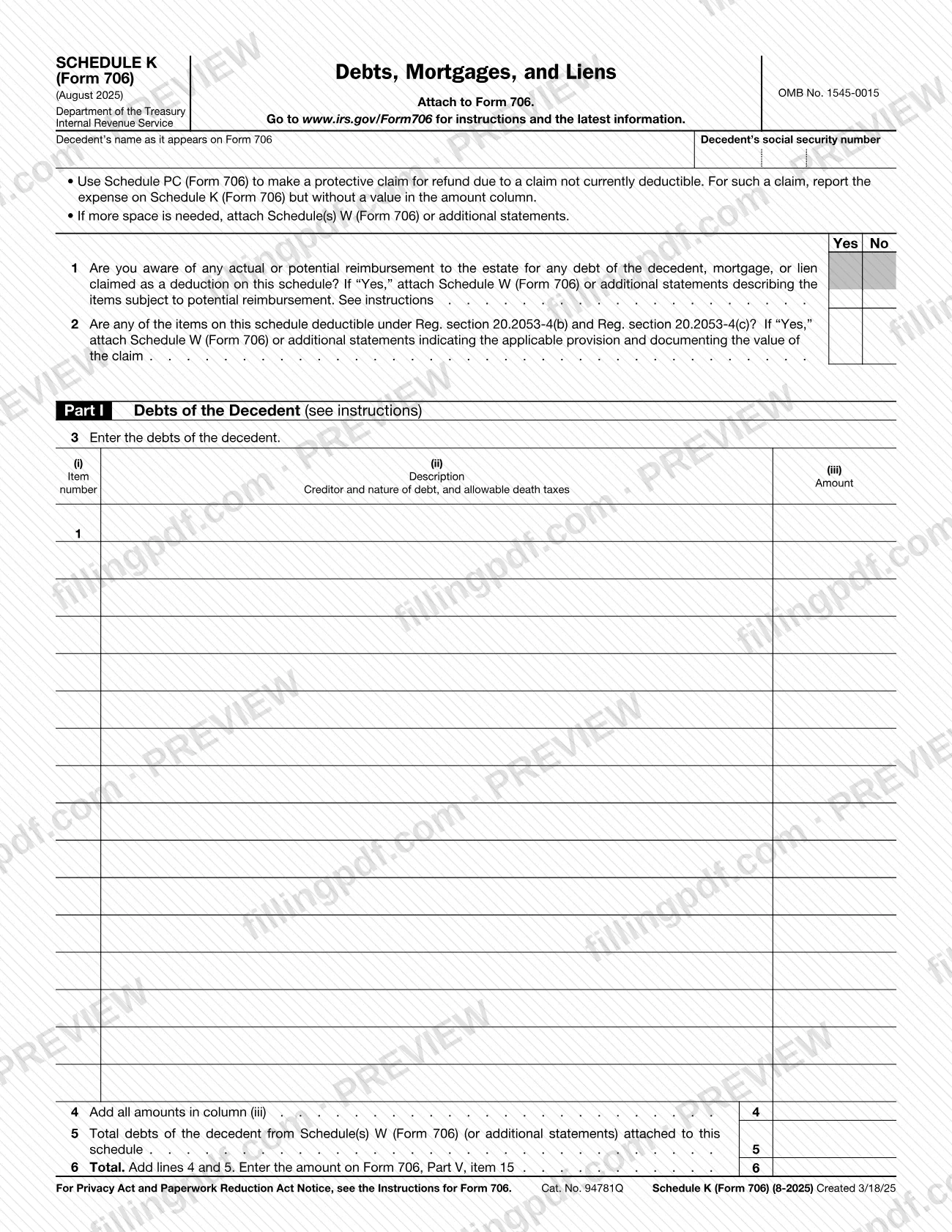
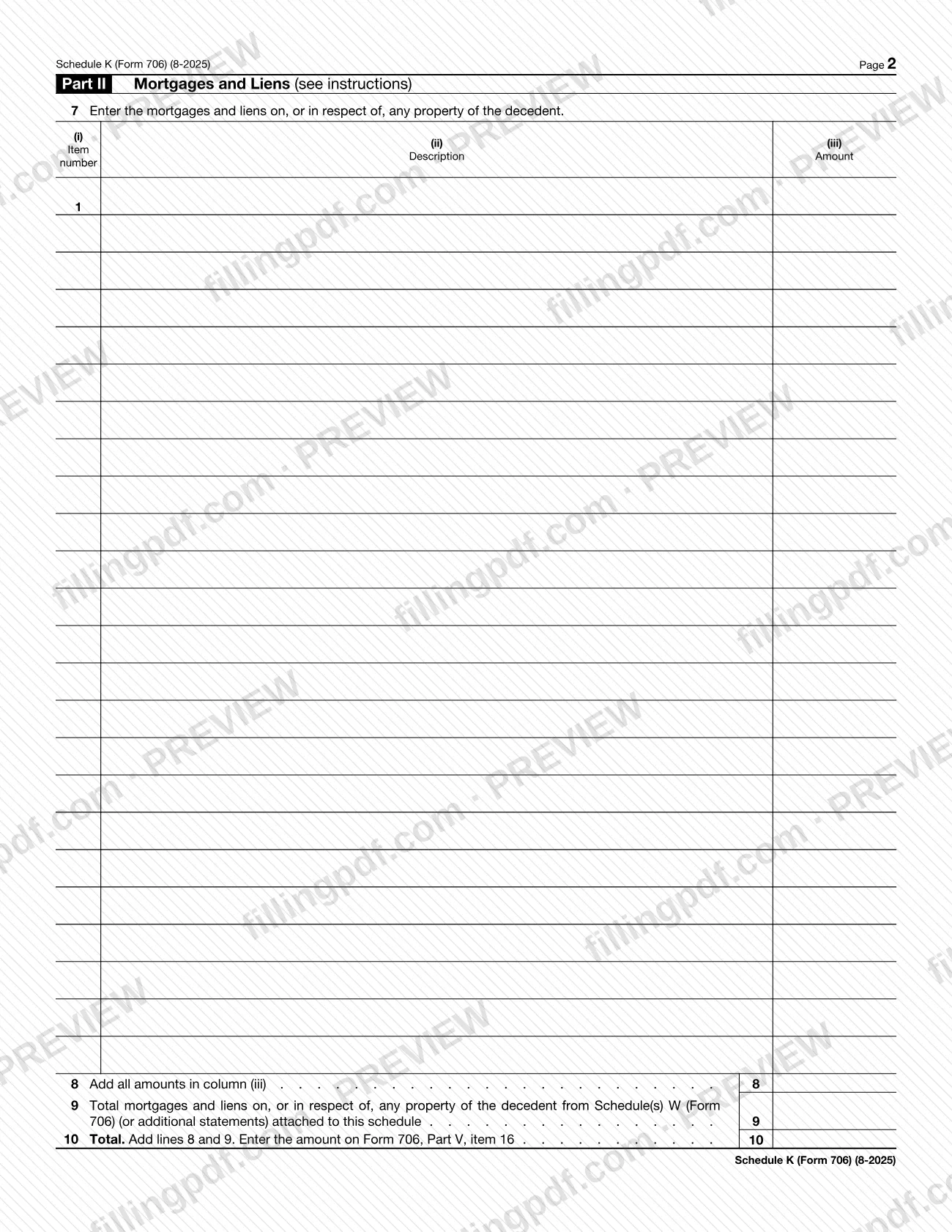
Schedule K (Form 706), Debts, Mortgages, and Liens, is an Internal Revenue Service (IRS) schedule that you attach to Form 706. It lists the decedent's debts in Part I and the mortgages and liens on, or in respect of, the decedent's property in Part II, and it carries the two totals to Form 706, Part V. On this page you can fill out the schedule online on FillingPDF and download or print the completed PDF; the form and its instructions are published by the IRS at www.irs.gov/Form706.
Last updated
What is Schedule K (Form 706)?
Schedule K (Form 706), Debts, Mortgages, and Liens, is the IRS schedule attached to Form 706 on which the debts of a decedent, and the mortgages and liens on, or in respect of, the decedent's property, are itemized and totaled for the return.
The schedule has two parts. Part I, Debts of the Decedent, lists each debt by item number, description (creditor and nature of debt, and allowable death taxes) and amount. Line 4 adds the listed amounts, line 5 brings in debts reported on Schedule(s) W (Form 706) or additional statements, and line 6 is the total, which you enter on Form 706, Part V, item 15. Part II, Mortgages and Liens, works the same way on lines 7 through 10, and line 10 is entered on Form 706, Part V, item 16.
Two questions at the top ask whether the estate may be reimbursed for any item claimed (line 1) and whether any item is deductible under Reg. section 20.2053-4(b) and Reg. section 20.2053-4(c) (line 2).
The form carries OMB No. 1545-0015 and the printed date August 2025. It is not filed on its own: it is a schedule of Form 706. A claim that is not currently deductible is handled on Schedule PC (Form 706), a protective claim for refund, while the expense is still reported on this schedule without a value in the amount column.
Who needs to file Schedule K (Form 706)?
The person preparing Form 706 for a decedent's estate completes Schedule K (Form 706) when the return claims debts of the decedent, or mortgages and liens on, or in respect of, the decedent's property, as deductions. The schedule starts with the decedent's name as it appears on Form 706 and the decedent's social security number.
Other situations the form addresses:
- If you are aware of any actual or potential reimbursement to the estate for an item claimed, you answer Yes on line 1 and attach Schedule W (Form 706) or additional statements.
- If any item is deductible under Reg. section 20.2053-4(b) and Reg. section 20.2053-4(c), you answer Yes on line 2 and attach Schedule W (Form 706) or additional statements showing the applicable provision and documenting the value of the claim.
- If you are making a protective claim for refund because a claim is not currently deductible, you use Schedule PC (Form 706) and still report the expense here, without a value in the amount column.
The form itself does not say who is authorized to prepare or sign Form 706. Refer to the IRS instructions for Form 706 for that.
When to file Schedule K (Form 706)
You complete Schedule K (Form 706) when you prepare Form 706, because the form says to attach it to Form 706. No separate due date is printed on the schedule, so it is submitted whenever the Form 706 it belongs to is submitted. For the deadline that applies to Form 706, check the IRS instructions at www.irs.gov/Form706. If a claim is not currently deductible, the form points to Schedule PC (Form 706) for a protective claim for refund; the schedule itself gives no timing for that claim.
Documents you need
- Form 706, to which Schedule K (Form 706) is attached; the schedule is not submitted on its own.
- Schedule(s) W (Form 706) or additional statements describing the items subject to potential reimbursement, only if you answer Yes on line 1.
- Schedule(s) W (Form 706) or additional statements indicating the applicable provision and documenting the value of the claim, only if you answer Yes on line 2.
- Schedule(s) W (Form 706) or additional statements for any debts or any mortgages and liens that do not fit on the schedule, reported on line 5 and line 9 respectively.
- Schedule PC (Form 706), only if you are making a protective claim for refund because a claim is not currently deductible.
How to fill out Schedule K (Form 706)
Enter the decedent's name and SSN
At the top, write the decedent's name exactly as it appears on Form 706 and the decedent's social security number.
Answer the reimbursement question
On line 1, check Yes or No on whether you are aware of any actual or potential reimbursement to the estate for any debt, mortgage or lien claimed on this schedule. If Yes, attach Schedule W (Form 706) or additional statements describing the items.
Answer the Reg. section 20.2053-4 question
On line 2, check Yes or No on whether any item is deductible under Reg. section 20.2053-4(b) and Reg. section 20.2053-4(c). If Yes, attach Schedule W (Form 706) or additional statements showing the provision and documenting the value of the claim.
List the decedent's debts in Part I
On line 3, enter each debt on its own row with an item number in column (i), the creditor and nature of the debt, and allowable death taxes, in column (ii), and the amount in column (iii).
Total the debts on lines 4 to 6
Line 4: add all amounts in column (iii). Line 5: enter total debts from attached Schedule(s) W (Form 706) or additional statements. Line 6: add lines 4 and 5 and enter the result on Form 706, Part V, item 15.
List mortgages and liens in Part II
On line 7, enter each mortgage or lien on, or in respect of, any property of the decedent, with an item number, a description and the amount in columns (i) to (iii).
Total the mortgages and liens
Line 8: add all amounts in column (iii). Line 9: enter totals from attached Schedule(s) W (Form 706) or additional statements. Line 10: add lines 8 and 9 and enter the result on Form 706, Part V, item 16.
Handle protective claims separately
If a claim is not currently deductible and you are making a protective claim for refund, use Schedule PC (Form 706) and report the expense here without a value in the amount column.
Review and download the completed PDF
Check that the totals on lines 6 and 10 match what you entered on Form 706, Part V, items 15 and 16. Download or print the completed PDF from FillingPDF and attach it to Form 706.
How to submit Schedule K (Form 706)
Schedule K (Form 706) is submitted as an attachment to Form 706; the schedule prints no mailing address, portal or appointment rule of its own.
- With Form 706: attach the completed schedule to Form 706 and send the package through the channel that applies to Form 706. Find the instructions and the latest information at www.irs.gov/Form706, as the form directs.
- With supporting pages: if you answer Yes on line 1 or line 2, or need more space, attach Schedule(s) W (Form 706) or additional statements to this schedule.
- With a protective claim: if you are making a protective claim for refund, it is made on Schedule PC (Form 706).
Carry the line 6 total to Form 706, Part V, item 15, and the line 10 total to Form 706, Part V, item 16, before you submit. FillingPDF lets you fill out and download the PDF; submission follows the IRS channels that apply to Form 706.
Common mistakes to avoid
- Submitting Schedule K (Form 706) without attaching it to Form 706; the form says to attach it to Form 706.
- Answering Yes on line 1 or line 2 without attaching Schedule W (Form 706) or additional statements, which the form requires for a Yes answer.
- Entering the line 6 total anywhere other than Form 706, Part V, item 15, or the line 10 total anywhere other than Form 706, Part V, item 16.
- Listing a mortgage or lien in Part I, or a debt in Part II, instead of using the part that matches the item.
- Skipping line 5 or line 9 when debts, mortgages or liens are reported on an attached Schedule W or additional statements, so line 6 or line 10 is understated.
- Entering a value for an expense claimed through a protective claim for refund; the form says to report it on this schedule without a value in the amount column.
- Leaving out the decedent's name as it appears on Form 706 or the decedent's social security number at the top.
Frequently asked questions
What is Schedule K (Form 706)?
Schedule K (Form 706), Debts, Mortgages, and Liens, is the IRS schedule attached to Form 706. Part I lists the decedent's debts and Part II lists mortgages and liens on, or in respect of, the decedent's property, with totals carried to Form 706, Part V, items 15 and 16.
Is Schedule K (Form 706) filed on its own?
No. The form says to attach it to Form 706, so it is submitted with that return. No separate address or due date is printed on the schedule; the IRS instructions are at www.irs.gov/Form706.
Where do the totals on Schedule K (Form 706) go?
The line 6 total from Part I goes on Form 706, Part V, item 15. The line 10 total from Part II goes on Form 706, Part V, item 16. Both are on the schedule's own total lines.
What do I do if I run out of space on Schedule K?
Attach Schedule(s) W (Form 706) or additional statements. Enter the totals from those pages on line 5 for debts and line 9 for mortgages and liens, then add them to the line 4 and line 8 totals on lines 6 and 10.
When must I attach Schedule W to Schedule K (Form 706)?
When you answer Yes on line 1 (possible reimbursement to the estate) or Yes on line 2 (items deductible under Reg. section 20.2053-4(b) and (c)), and whenever you need more space. Schedule W or additional statements can be used in each case.
How do I make a protective claim for refund with Schedule K?
Use Schedule PC (Form 706) for the protective claim when a claim is not currently deductible. On Schedule K (Form 706) you still report the expense, but without a value in the amount column.
Can I fill out Schedule K (Form 706) online?
Yes. You can fill out the PDF online on FillingPDF and download or print it. FillingPDF is an independent service and does not file the schedule with the IRS; you submit it with Form 706 through the IRS channels.
Ready to fill out Schedule K (Form 706)?
Fill out Schedule K (Form 706) now