
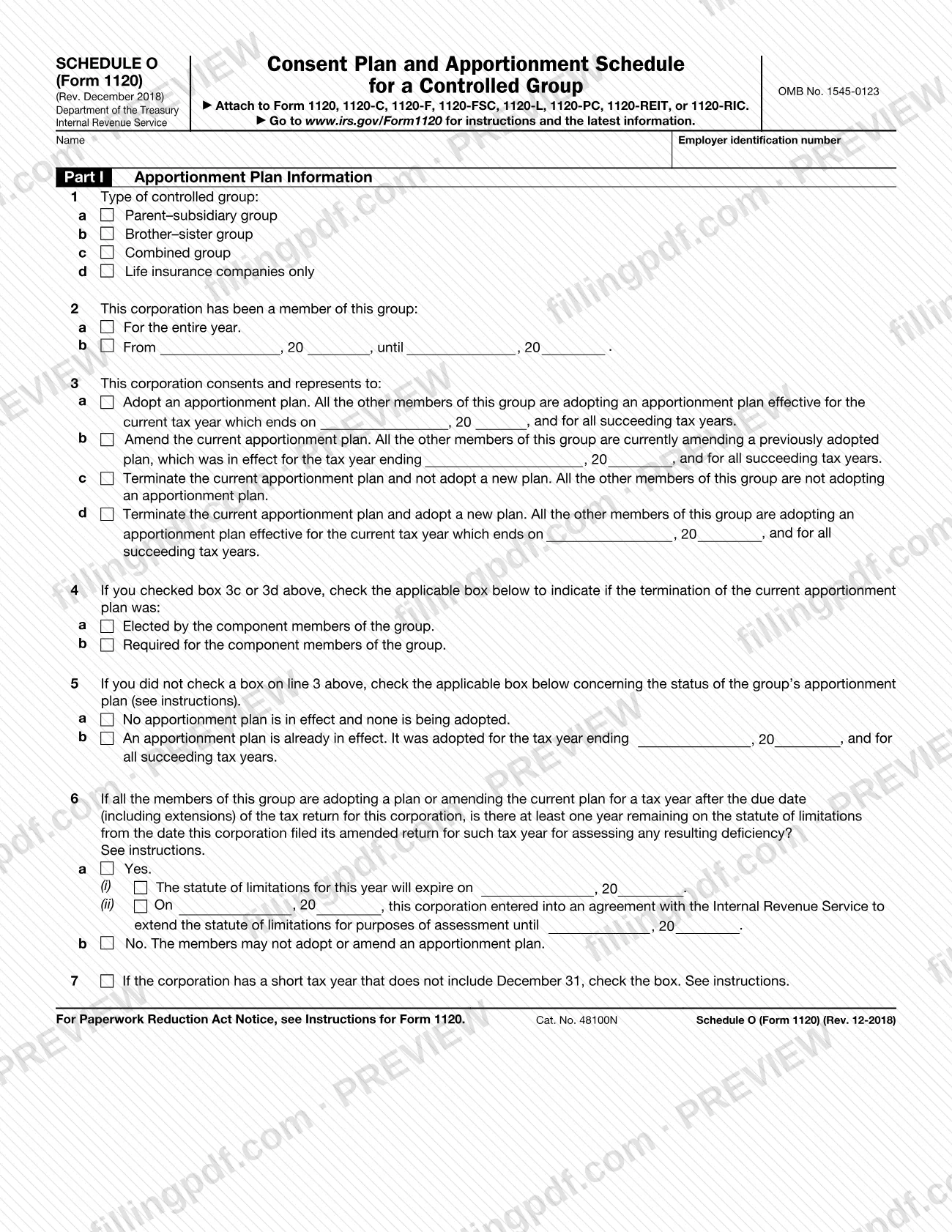
Schedule O (Form 1120), Consent Plan and Apportionment Schedule for a Controlled Group, is the Internal Revenue Service (IRS) schedule that a corporation in a controlled group attaches to its corporate income tax return to report how certain tax benefits are split among the group's members. It also records whether this corporation consents to adopting, amending or terminating the group's apportionment plan. On this page you can fill out the form online on FillingPDF and download or print the completed PDF; the IRS publishes the form and its instructions, and the form points to www.irs.gov/Form1120 for both.
Last updated
What is Schedule O (Form 1120)?
Schedule O (Form 1120), Consent Plan and Apportionment Schedule for a Controlled Group, is the Internal Revenue Service (IRS) schedule on which a corporation in a controlled group reports how certain tax benefits are apportioned among the group's component members.
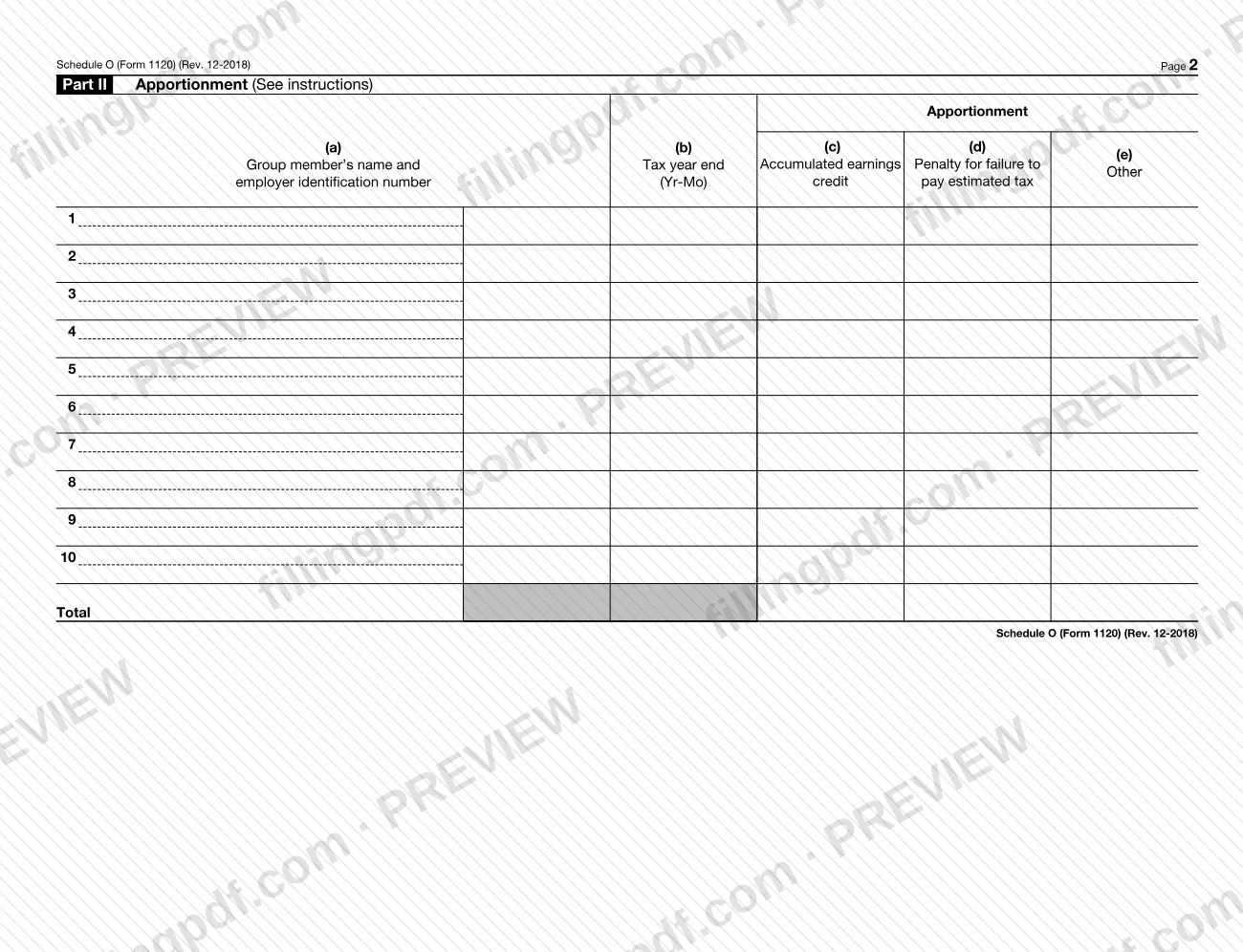
The schedule does two jobs. In Part I, the corporation checks the type of controlled group (parent–subsidiary, brother–sister, combined, or life insurance companies only), states how long it has been a member, and consents and represents that all the other component members are adopting, amending or terminating an apportionment plan, or it reports the status of the group's plan. In Part II, it lists each group member with its tax year end and the amounts apportioned to it: the accumulated earnings credit in column (c), the penalty for failure to pay estimated tax in column (d), and other tax-benefit items in column (e).
An apportionment plan is an agreement among the component members for splitting these benefits. The IRS instructions distinguish it from a tax-sharing agreement, which is a compensation arrangement among members of an affiliated group that files a consolidated return. If no plan is in effect or adopted, the instructions say the members divide the tax-benefit items equally.
The form is Rev. December 2018, OMB No. 1545-0123, and is attached to Form 1120, 1120-C, 1120-F, 1120-FSC, 1120-L, 1120-PC, 1120-REIT or 1120-RIC. The instructions say to use the Rev. December 2012 version of Schedule O (Form 1120) to amend an existing plan for tax years beginning before January 1, 2018.
Who needs to file Schedule O (Form 1120)?
A corporation that is a component member of a controlled group must file Schedule O (Form 1120) with its income tax return, amended return or claim for refund for each tax year it is a component member. The duty applies even if no apportionment plan is in effect, or the amounts apportioned have not changed from the previous tax year.
- Consolidated groups: if component members of the controlled group are also members of one consolidated group, the common parent files a single Schedule O as part of the consolidated return on behalf of those members. No subsidiary of that consolidated group files its own.
- Exception: if all members of a parent–subsidiary controlled group that must file a U.S. tax return join in filing the same consolidated return, the parent does not have to file Schedule O for the group.
- Excluded members: an excluded member is a member of the controlled group but not a component member, and no tax-benefit items are apportioned to it. The instructions list who is excluded, for example a member for less than half the days of its testing period, or an S corporation.
Written agreements about a plan must be signed by a person authorized to sign for each component member. Tax years beginning before January 1, 2018 are amended on the earlier Rev. December 2012 schedule.
When to file Schedule O (Form 1120)
File Schedule O (Form 1120) with the corporation's income tax return, amended return or claim for refund for every tax year in which it is a component member of a controlled group. The form prints no separate due date, so its timing follows the return it is attached to.
A plan becomes effective when all component members adopt it for tax years subject to the same December 31 testing date, and it stays in effect until terminated. If all members adopt or amend a plan for a tax year after the due date (including extensions) of the corporation's return, line 6 applies: at least one year must remain on the statute of limitations for assessing a deficiency, counted from the date the amended return was filed, or the corporation must have an agreement with the IRS extending it. Without that, the members may not adopt or amend the plan for that year.
Documents you need
- Signed written agreement among the component members setting out the adopted or amended apportionment plan, or ending a previous plan, with the group's methodology (for example, percentages) for each tax-benefit item. Keep it in your records; do not attach it.
- Agreement with the IRS extending the statute of limitations for assessment, only if less than one year remains and the members are adopting or amending a plan for a tax year after the return's due date (line 6a(ii)).
- Additional sheets with the same Part II information for each member, only if the group has more members than the lines on the form allow.
- The income tax return, amended return or claim for refund that this schedule is attached to (Form 1120, 1120-C, 1120-F, 1120-FSC, 1120-L, 1120-PC, 1120-REIT or 1120-RIC).
How to fill out Schedule O (Form 1120)
Enter your name and EIN
At the top of page 1, enter the name and employer identification number (EIN) of the component member filing this Schedule O. If a consolidated group's common parent files, it enters its own.
Check the type of controlled group
Line 1: check a (Parent–subsidiary group), b (Brother–sister group), c (Combined group) or d (Life insurance companies only). For a brother–sister group, check box 1b whether the group is tested under the 50% test only or under both the 80% and 50% tests.
State your membership period
Line 2: check 2a if the corporation was a member for the entire year. Otherwise check 2b and enter the from and until dates; a special allocation rule applies if your tax year has no December 31 date.
Check one consent box
Line 3: check only one box: 3a adopt a plan, 3b amend the current plan, 3c terminate it without adopting a new one, or 3d terminate it and adopt a new one, entering the tax year end date each box asks for. If none applies, skip line 3 and go to line 5.
Give the reason for termination
Line 4, only if you checked 3c or 3d: check 4a if the component members elected the termination, or 4b if it was required, for example because the group ceased to exist or a member joined or left.
Report the status of the plan
Line 5, only if you left line 3 blank: check 5a if no plan is in effect and none is being adopted, or 5b if a plan is already in effect, entering the tax year it was adopted for.
Answer the statute of limitations question
Line 6 applies when all members adopt or amend a plan for a tax year after the return's due date. Check 6a (Yes) and enter the expiration date and any extension agreement dates, or 6b (No), in which case the members may not adopt or amend a plan.
Mark a short tax year
Line 7: check the box if the corporation has a short tax year that does not include December 31. If you check it, give only identifying information for the other members in Part II.
Enter your own row in Part II
In Part II, line 1, column (a), enter the filing member's name and EIN, and in column (b) its tax year end in Yr-Mo format. A consolidated group's common parent is entered alone for the group.
List the other component members
On lines 2 through 10, enter each other component member's name, EIN and tax year end. Add the notation (50) after a brother–sister member that qualifies only under the 50% test, and (E) after an excluded member joining or leaving; attach additional sheets if needed.
Enter the apportioned amounts
For each member, enter the accumulated earnings credit in column (c), the penalty for failure to pay estimated tax in column (d), and other tax-benefit items in column (e), giving the Internal Revenue Code section and the amount. Enter -0- in columns for an excluded member, then complete the Total line.
Review and download the completed PDF
Check that only one line 3 box is marked, that Part II matches the group's plan, and that every member row is complete. Download or print the completed PDF from FillingPDF and attach it to the return as described under How to submit.
How to submit Schedule O (Form 1120)
You submit Schedule O (Form 1120) by attaching it to the corporation's federal income tax return, amended return or claim for refund; the form lists no channel, address or portal of its own.
- Which return: attach it to Form 1120, 1120-C, 1120-F, 1120-FSC, 1120-L, 1120-PC, 1120-REIT or 1120-RIC, as printed at the top of the form.
- Consolidated groups: the common parent files one Schedule O as part of the consolidated income tax return.
- More than 10 members: if Part II needs more space, attach additional sheets.
- Written agreement: do not attach the signed apportionment agreement or a copy; each component member keeps it with its records.
Send the package through the same channel and to the same address as the return it accompanies; the instructions are at www.irs.gov/Form1120. FillingPDF lets you fill out and download the PDF; submission follows the channels above.
Common mistakes to avoid
- Attaching the signed apportionment agreement or a copy of it to the return; the instructions say no component member should attach it and each must keep it with its records.
- Checking more than one box on line 3; if the corporation is not adopting, amending or terminating a plan, skip line 3 and go to line 5.
- Skipping Schedule O because no plan is in effect or the amounts did not change; it is required for every tax year the corporation is a component member.
- Having a subsidiary of a consolidated group file its own Schedule O instead of the common parent filing one for all consolidated members.
- Checking box 3b to amend a plan when the group's component-member composition changed from the previous tax year; both conditions in the instructions must be met.
- Adopting or amending a plan for a year after the return's due date with less than one year left on the statute of limitations and no extension agreement with the IRS.
- Using this revision to amend a plan for a tax year beginning before January 1, 2018; the instructions call for the Rev. December 2012 schedule.
- Listing every member of a consolidated group separately in Part II instead of only the common parent's name, EIN and tax year end.
- Including a section 179 expense apportionment on Schedule O; it is reported as required under section 179.
Frequently asked questions
What is Schedule O (Form 1120)?
Schedule O (Form 1120) is the IRS schedule where a corporation in a controlled group reports how certain tax benefits are apportioned among the component members and states whether the group is adopting, amending, terminating or keeping an apportionment plan. It is attached to the corporation's income tax return.
Do I have to file Schedule O if my controlled group has no apportionment plan?
Yes. A component member files Schedule O for each tax year even if no apportionment plan is in effect, or if the amounts apportioned have not changed from the prior year. With no plan in effect, you check box 5a on line 5 and the members share the tax benefits equally.
Who files Schedule O for a consolidated group?
The common parent of the consolidated group files one Schedule O as part of the consolidated return, covering all of that group's members. No subsidiary files its own. In Part II, only the common parent's information is entered for the consolidated members.
Do I attach the written apportionment agreement to Schedule O?
No. The agreement must be signed by a person authorized to sign for each component member, but it is retained, not attached. Each member keeps the original or a copy in its records. It must state the group's apportionment methodology, such as percentages, for each tax-benefit item.
Which returns does Schedule O (Form 1120) attach to?
The form says to attach it to Form 1120, 1120-C, 1120-F, 1120-FSC, 1120-L, 1120-PC, 1120-REIT or 1120-RIC. The instructions also allow it to accompany an amended return or a claim for refund for the tax year concerned.
What if less than one year remains on the statute of limitations?
Line 6 covers this. When members adopt or amend a plan for a tax year after the return's due date, at least one year must remain for assessing a deficiency, unless the corporation signed an agreement with the IRS extending the period. Otherwise check 6b, and the members may not adopt or amend the plan.
How do I amend an apportionment plan on Schedule O?
Check box 3b on line 3. To amend, the group must already have a plan in effect and there must be no change in the component-member composition since the previous tax year. To amend a plan for a tax year before 2018, use the Rev. December 2012 version.
What is the difference between boxes 4a and 4b?
Box 4a means the component members elected to terminate the plan. Box 4b means the termination was required, for example because the group ceased to exist or a member joined or left the group. Both apply only if you checked box 3c or 3d.
Can I fill out Schedule O (Form 1120) online?
You can fill out the PDF online on FillingPDF and download or print it. FillingPDF is an independent service and does not file the schedule with the IRS; you attach it to the corporation's return and submit it through the return's channels.
Ready to fill out Schedule O (Form 1120)?
Fill out Schedule O (Form 1120) now