
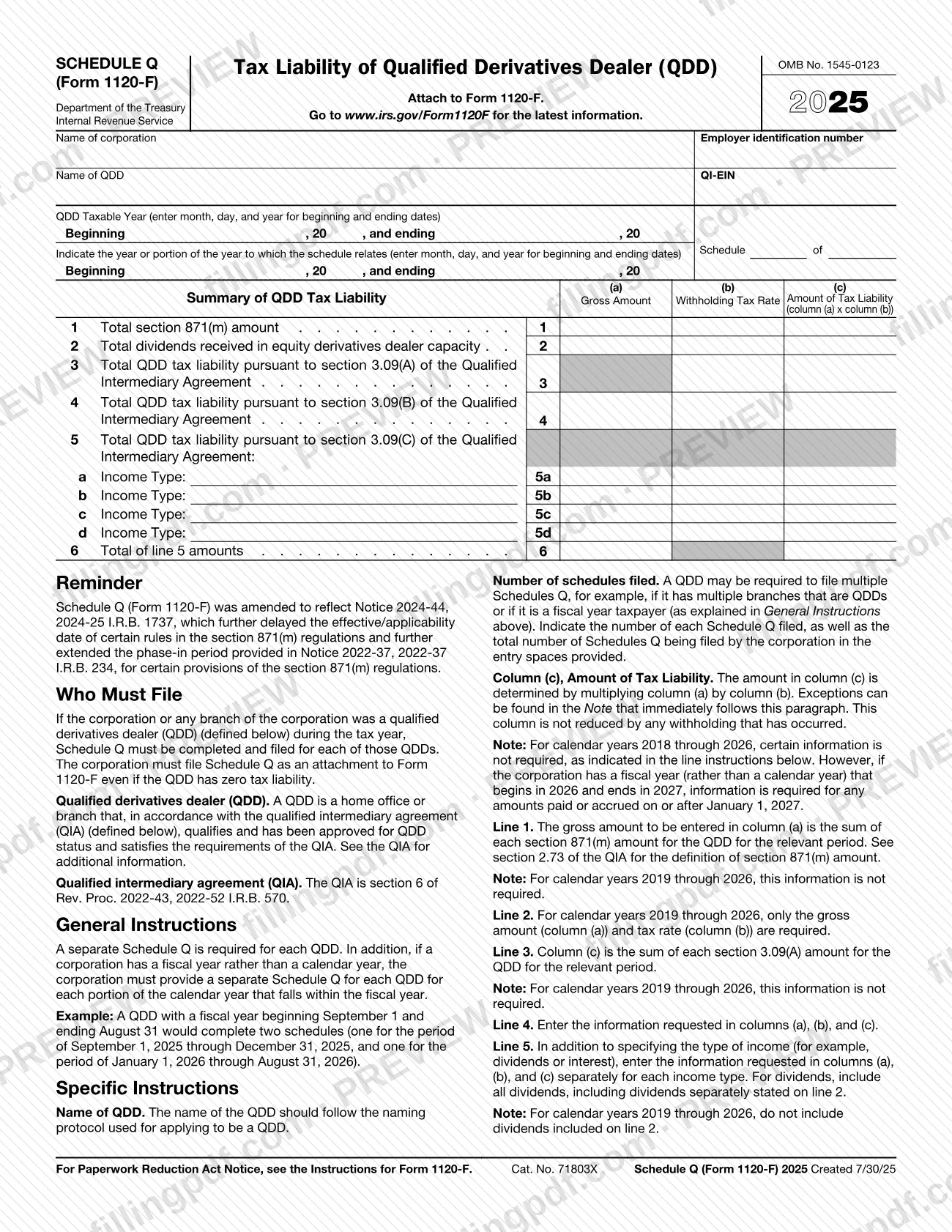
Schedule Q (Form 1120-F), Tax Liability of Qualified Derivatives Dealer (QDD), is the Internal Revenue Service (IRS) schedule that a corporation attaches to Form 1120-F to report the tax liability of each home office or branch that was a qualified derivatives dealer (QDD) during the tax year. A separate schedule is needed for each QDD, and it is filed even when the tax liability is zero. On this page you can fill out the form online on FillingPDF and download or print the completed PDF; the form and the latest information are published by the IRS at www.irs.gov/Form1120F.
Last updated
What is Schedule Q (Form 1120-F)?
Schedule Q (Form 1120-F), Tax Liability of Qualified Derivatives Dealer (QDD) is the IRS schedule attached to Form 1120-F that reports the tax liability of each home office or branch that was a qualified derivatives dealer (QDD) during the tax year.
The IRS instructions define a QDD as a home office or branch that, under the qualified intermediary agreement (QIA), qualifies and has been approved for QDD status and meets the requirements of the QIA. The QIA is section 6 of Rev. Proc. 2022-43, 2022-52 I.R.B. 570.
The schedule is a summary of QDD tax liability in three columns: (a) Gross Amount, (b) Withholding Tax Rate and (c) Amount of Tax Liability, which is column (a) multiplied by column (b). Its lines cover:
- Line 1: the total section 871(m) amount.
- Line 2: total dividends received in equity derivatives dealer capacity.
- Lines 3 and 4: total QDD tax liability under sections 3.09(A) and 3.09(B) of the QIA.
- Line 5: total QDD tax liability under section 3.09(C) of the QIA, listed by income type on lines 5a to 5d, with the total on line 6.
The 2025 schedule was amended to reflect Notice 2024-44, 2024-25 I.R.B. 1737, which further delayed the effective date of certain rules in the section 871(m) regulations and extended the phase-in period set by Notice 2022-37. For calendar years 2018 through 2026, the line instructions say that some of the information is not required.
Schedule Q is not a return on its own. It is an attachment to Form 1120-F, and the IRS publishes the latest information at www.irs.gov/Form1120F.
Who needs to file Schedule Q (Form 1120-F)?
A corporation files Schedule Q (Form 1120-F) if the corporation, or any branch of it, was a qualified derivatives dealer (QDD) during the tax year. One Schedule Q must be completed and filed for each of those QDDs.
- Corporations with several QDD branches: a corporation with multiple branches that are QDDs may have to file multiple Schedules Q, one per QDD.
- Fiscal-year corporations: a corporation with a fiscal year rather than a calendar year provides a separate Schedule Q for each QDD for each portion of the calendar year that falls within the fiscal year.
- QDDs with no tax liability: the corporation must still file Schedule Q as an attachment to Form 1120-F even if the QDD has zero tax liability.
A QDD is a home office or branch that qualifies and has been approved for QDD status under the qualified intermediary agreement and satisfies its requirements. The instructions place no filing duty on the schedule unless the corporation or a branch was a QDD during the tax year. The form does not describe who may sign or file for someone else; see the Instructions for Form 1120-F.
When to file Schedule Q (Form 1120-F)
File Schedule Q (Form 1120-F) with Form 1120-F for any tax year in which the corporation or one of its branches was a qualified derivatives dealer (QDD). The schedule is an attachment, has no separate due date printed on it and travels with Form 1120-F; check the Instructions for Form 1120-F for that return's deadline.
A fiscal-year corporation completes one schedule for each portion of the calendar year within its fiscal year. The IRS example: a QDD with a fiscal year from September 1 to August 31 completes two schedules, one for September 1, 2025 through December 31, 2025 and one for January 1, 2026 through August 31, 2026.
For calendar years 2018 through 2026, certain information is not required, as the line instructions indicate. A corporation with a fiscal year that begins in 2026 and ends in 2027 must give information for any amounts paid or accrued on or after January 1, 2027.
How to fill out Schedule Q (Form 1120-F)
Enter the corporation's name and EIN
At the top, enter the Name of corporation and its Employer identification number. Use the same corporation that files the Form 1120-F to which the schedule is attached.
Enter the QDD name and QI-EIN
Enter the Name of QDD, following the naming protocol used when applying to be a QDD, and its QI-EIN.
Enter the QDD taxable year
Give the beginning and ending dates of the QDD Taxable Year, with month, day and year for each.
Enter the period the schedule covers
On the line for the year or portion of the year to which the schedule relates, enter the beginning and ending dates. A fiscal-year corporation completes a separate schedule for each portion of the calendar year within its fiscal year.
State how many schedules you file
In the Schedule of entry spaces, indicate the number of this Schedule Q and the total number of Schedules Q the corporation is filing, for example when several branches are QDDs.
Complete line 1, section 871(m) amount
Column (a) is the sum of each section 871(m) amount for the QDD for the relevant period; see section 2.73 of the QIA for the definition. For calendar years 2019 through 2026 this information is not required.
Complete line 2, dividends
Enter total dividends received in equity derivatives dealer capacity. For calendar years 2019 through 2026, only column (a), the gross amount, and column (b), the tax rate, are required.
Complete lines 3 and 4
On line 3, column (c) is the sum of each section 3.09(A) amount for the relevant period; for 2019 through 2026 it is not required. On line 4, enter the information requested in columns (a), (b) and (c).
List line 5 amounts by income type
On lines 5a to 5d, specify each income type, such as dividends or interest, and fill columns (a), (b) and (c) separately for each. For dividends include all dividends, but for 2019 through 2026 leave out those already on line 2.
Figure column (c) and line 6
Column (c) is column (a) multiplied by column (b), without reducing it for any withholding. Enter the total of the line 5 amounts on line 6.
Review and download the completed PDF
Check names, identification numbers, dates and the number of schedules, then download or print the completed PDF from FillingPDF and attach it to Form 1120-F as described under How to submit.
How to submit Schedule Q (Form 1120-F)
Schedule Q (Form 1120-F) is submitted as an attachment to Form 1120-F; it has no filing channel, address or portal of its own.
- With Form 1120-F: attach the completed schedule to the corporation's Form 1120-F and send it by whatever method applies to that return.
- Multiple schedules: if you file more than one Schedule Q, attach all of them and enter the number of each schedule and the total number being filed in the spaces at the top of the form.
- Where to look: the form directs you to www.irs.gov/Form1120F for the latest information, and its Paperwork Reduction Act notice refers to the Instructions for Form 1120-F.
FillingPDF lets you fill out and download the PDF; submission follows the channels above.
Common mistakes to avoid
- Skipping Schedule Q because the QDD has zero tax liability; the instructions require it to be filed with Form 1120-F even then.
- Combining several QDDs or branches on one schedule; a separate Schedule Q is required for each QDD.
- Using one schedule for a whole fiscal year; a fiscal-year corporation needs a separate schedule for each portion of the calendar year within its fiscal year.
- Reducing column (c) by withholding that has already occurred; the instructions say the column is not reduced by any withholding.
- Including on line 5 the dividends already reported on line 2 for calendar years 2019 through 2026, when the instructions say not to.
- Entering a line 5 amount without naming the income type, such as dividends or interest, on lines 5a to 5d.
- Leaving out the number of each Schedule Q filed and the total number being filed when the corporation files more than one.
- Writing the QDD's name in a form other than the naming protocol used when applying to be a QDD.
Frequently asked questions
What is Schedule Q (Form 1120-F)?
Schedule Q (Form 1120-F), Tax Liability of Qualified Derivatives Dealer (QDD), is an IRS schedule attached to Form 1120-F. It reports the tax liability of each home office or branch that was a qualified derivatives dealer during the tax year, using columns for gross amount, withholding tax rate and amount of tax liability.
Who has to file Schedule Q with Form 1120-F?
A corporation whose home office or any branch was a qualified derivatives dealer (QDD) during the tax year. Schedule Q must be completed and filed for each of those QDDs, so a corporation with several QDD branches may file several schedules.
Do I file Schedule Q if the QDD owes no tax?
Yes. The IRS instructions say the corporation must file Schedule Q as an attachment to Form 1120-F even if the QDD has zero tax liability. The requirement depends on having been a QDD during the year, not on the amount of tax.
How many Schedules Q do I file with a fiscal year?
One for each QDD for each portion of the calendar year that falls within the fiscal year. The IRS example is a fiscal year from September 1 to August 31, which needs two schedules: September 1 to December 31, 2025 and January 1 to August 31, 2026.
How is the amount in column (c) calculated?
Column (c), Amount of Tax Liability, is column (a), the gross amount, multiplied by column (b), the withholding tax rate. The IRS instructions say this column is not reduced by any withholding that has already occurred.
Which lines are not required for 2019 through 2026?
The instructions say line 1 information and line 3 column (c) information are not required for calendar years 2019 through 2026, and line 2 needs only columns (a) and (b). For those years, do not repeat line 2 dividends on line 5.
Where do I send Schedule Q (Form 1120-F)?
You do not send it separately. It is an attachment to Form 1120-F and goes with that return. The form points to www.irs.gov/Form1120F for the latest information and to the Instructions for Form 1120-F for the return itself.
Can I fill out Schedule Q (Form 1120-F) online?
You can fill out the PDF online on FillingPDF and download or print it. FillingPDF is an independent service and does not file the schedule with the IRS; you attach it to Form 1120-F and submit it through the IRS channels for that return.
Ready to fill out Schedule Q (Form 1120-F)?
Fill out Schedule Q (Form 1120-F) now