
The HUD-1 is the Settlement Statement published by the U.S. Department of Housing and Urban Development (HUD) to show the actual settlement costs of a transaction covered by section 4 of RESPA and 12 CFR part 1024 (Regulation X). The settlement agent completes it to list what the borrower and the seller pay and receive, line by line, and it is given to the parties in connection with the settlement. On this page you can fill out the form online on FillingPDF and download or print the completed PDF; the form is published by HUD at hud.gov, and the line instructions appear in Appendix A to Part 1024.
Last updated
What is HUD-1?
The Settlement Statement (HUD-1) is the form on which a settlement agent itemizes the actual charges and adjustments paid by the borrower and the seller in a settlement, required under section 4 of RESPA.
The form states that it gives you a statement of actual settlement costs. Amounts paid to and by the settlement agent are shown, and items marked "(p.o.c.)" were paid outside the closing: they appear for information only and are not included in the totals. It carries OMB Approval No. 2502-0265, and each page is marked "Previous edition are obsolete".
It has three pages:
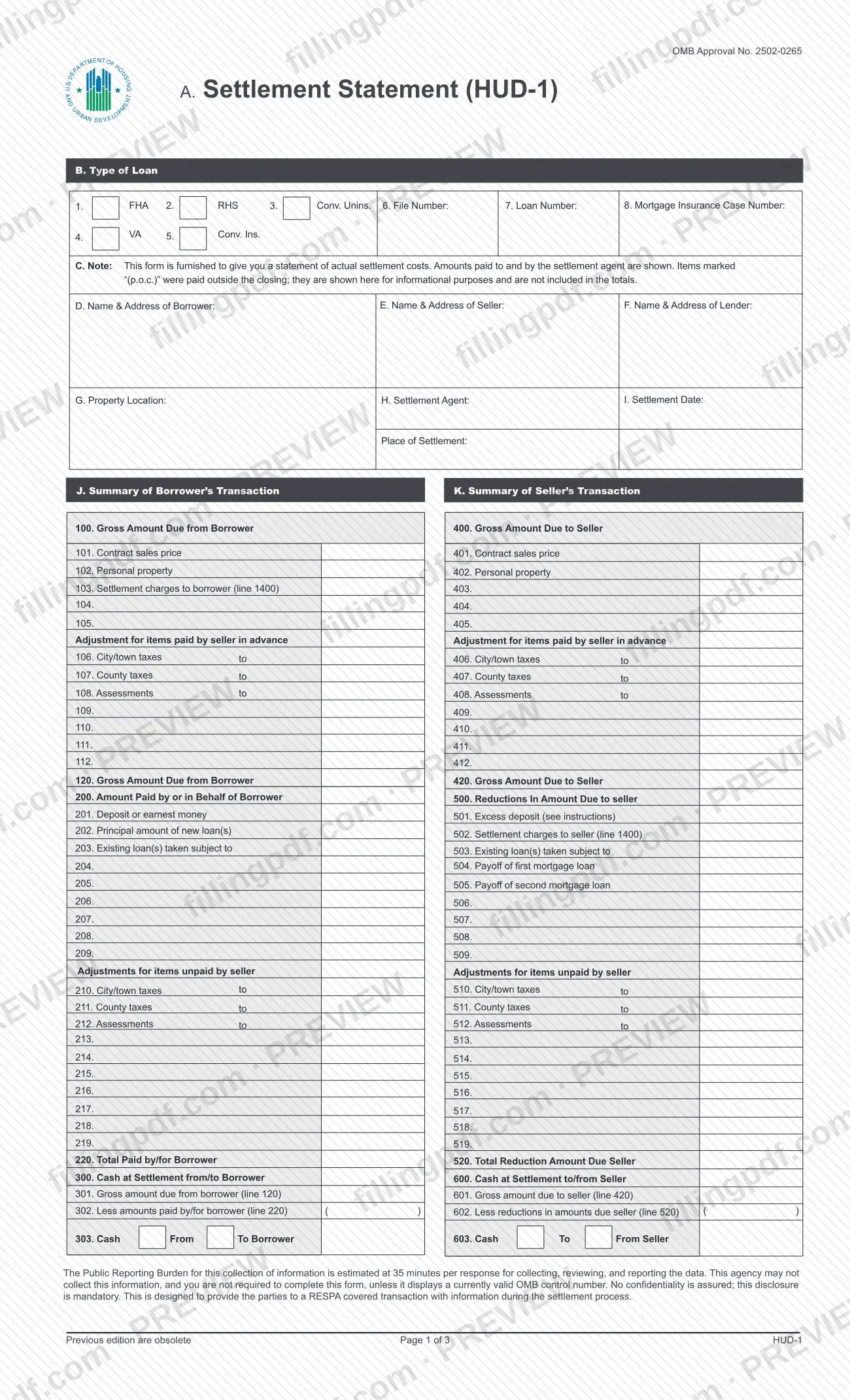
- Page 1: identification blocks A to I, then Section J (Summary of Borrower's Transaction, lines 100 to 303) and Section K (Summary of Seller's Transaction, lines 400 to 603).
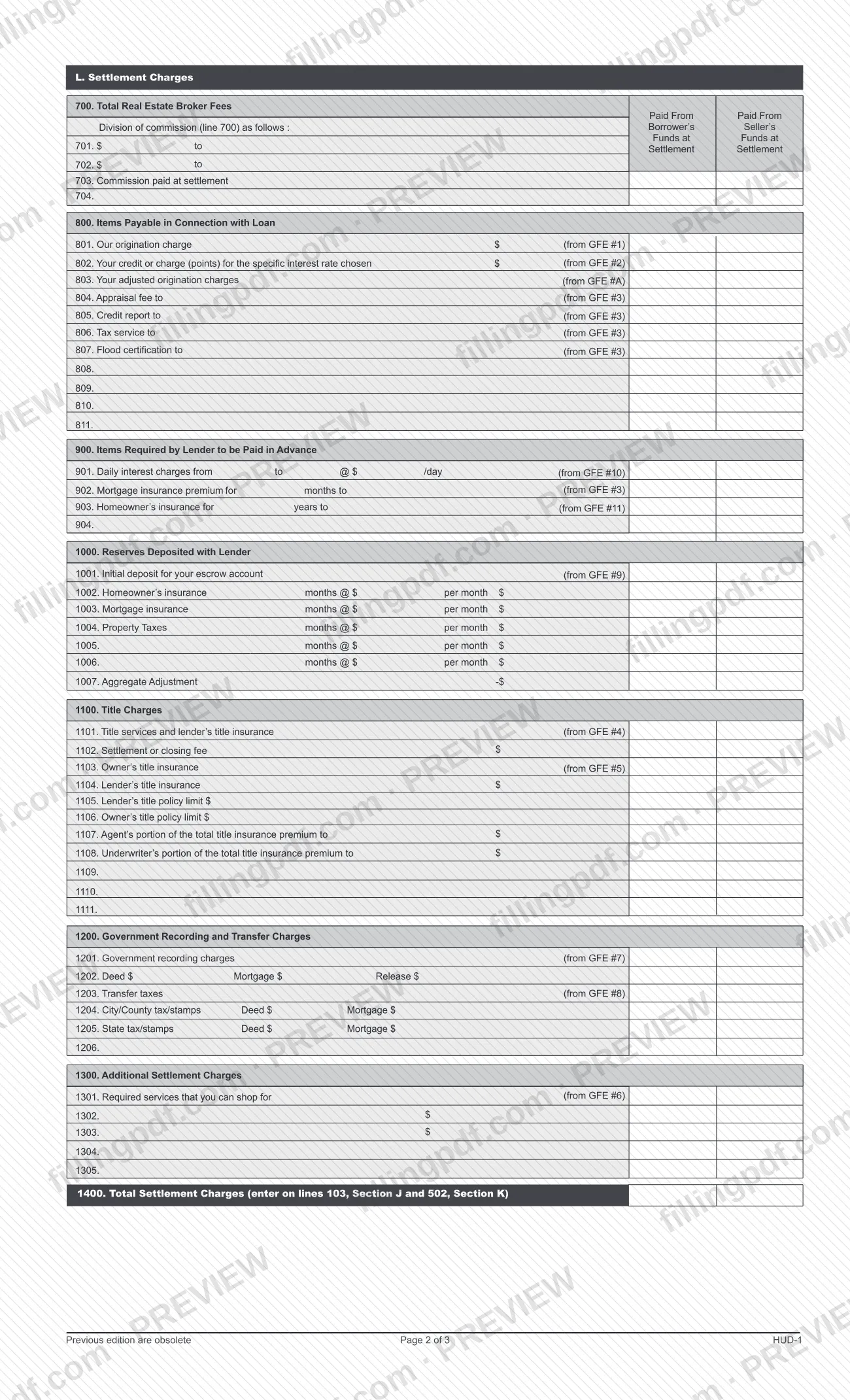
- Page 2: Section L, Settlement Charges, lines 700 to 1400.
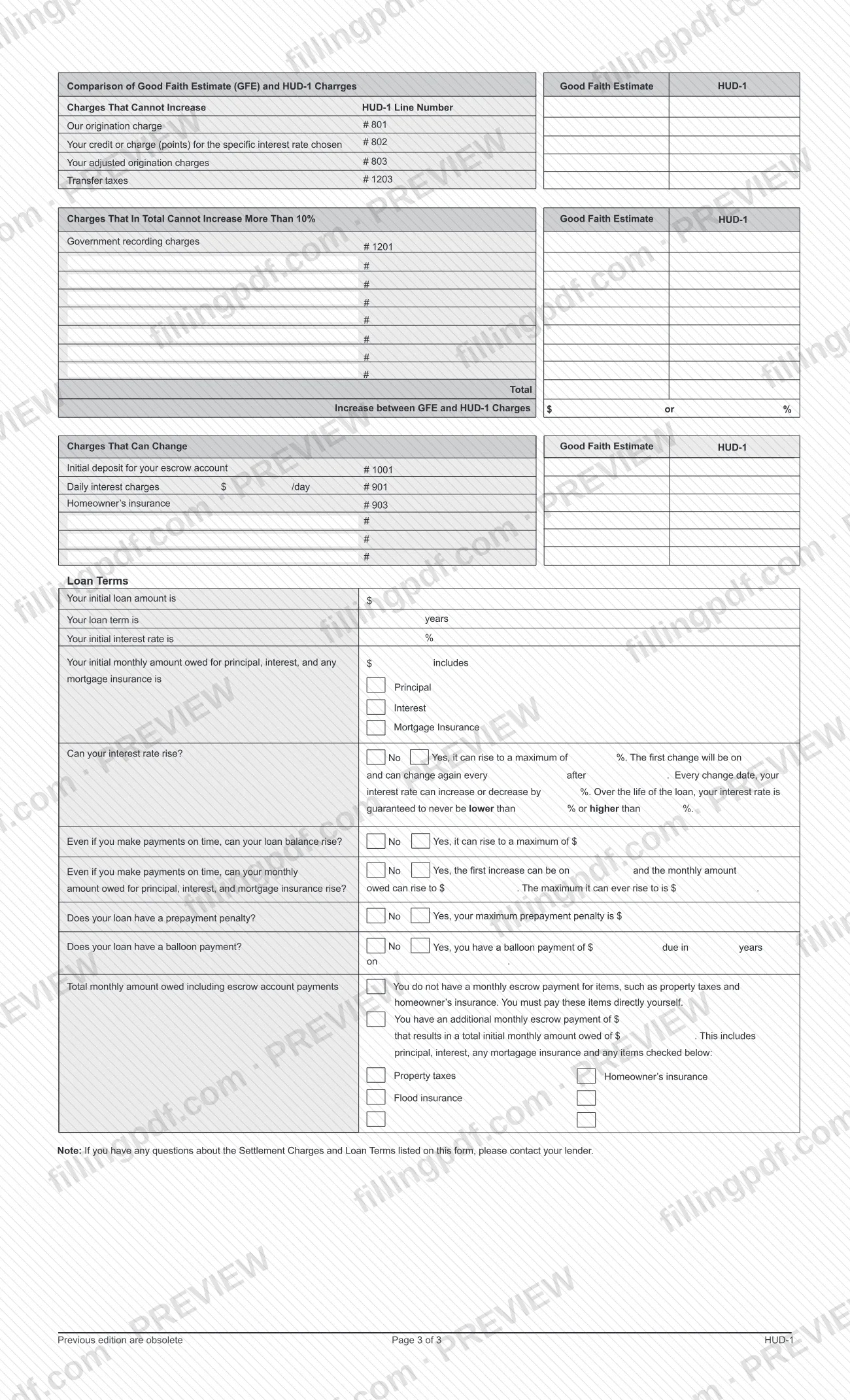
- Page 3: the comparison of the Good Faith Estimate (GFE) and HUD-1 charges, and the Loan Terms.
The HUD-1 is for transactions with a borrower and a seller. The companion form, the HUD-1A, is optional and is used for refinancings, subordinate-lien loans and other one-party transactions that do not transfer title to residential real property. It may not replace a HUD-1 in any transaction that has a seller.
Who needs to file HUD-1?
The settlement agent is the person who completes the HUD-1. The instructions are written mainly for settlement agents who prepare the statements, and they need not be passed to the parties as part of the form.
- Borrowers and sellers receive the statement. The settlement agent may leave the Section J lines blank on the copy furnished to the seller, and the Section K lines blank on the copy furnished to the borrower.
- Lenders supply the Loan Terms information on page 3 in a format that lets the settlement agent enter it without consulting the loan documents.
- Parties in other transactions: the instructions state there is no objection to using the HUD-1 where its use is not legally required. It may also be used for one-party transactions by completing only the borrower's side.
Do not use the HUD-1A in place of the HUD-1 when the transaction has a seller. For open-end lines of credit (home-equity plans), use of the HUD-1 or HUD-1A is not mandatory as long as the provisions of Regulation Z are followed.
When to file HUD-1
The HUD-1 is prepared for the settlement itself: it records the actual charges and adjustments of the transaction and the date of settlement entered in block I. The form and its instructions print no separate due date, so the statement is completed with the final figures as the settlement takes place.
Charges paid outside the closing do not wait for a later form. They are shown on the HUD-1 and marked "P.O.C." so that they are visible but left out of the totals. Items that depend on amounts not yet known at settlement, such as certain utility bills, may be handled with funds held by the settlement agent on lines 506 to 509; reporting the final amount afterward is optional.
Documents you need
- Borrower's Good Faith Estimate (GFE): its blocks supply the amounts for the page 3 comparison chart, and the page 2 lines refer to GFE block numbers.
- Loan terms information from the lender: the lender provides it so the settlement agent can complete the Loan Terms section on page 3.
- Supplementary page: attach one if there is more than one borrower or seller, so each name and address can be listed.
How to fill out HUD-1
Complete loan type and identifiers
In block B, check the appropriate loan type (FHA, RHS, Conv. Unins., VA or Conv. Ins.) and complete the file number, loan number and mortgage insurance case number as applicable. Sections A and C need no entry.
Enter parties, property and settlement
In blocks D, E and F, give the current mailing address and ZIP code of the borrower, seller and lender; list every borrower or seller, using a supplementary page if needed. In G, give the property's street address or a brief legal description plus ZIP code. In H, give the settlement agent's name, address, ZIP code and phone, and the place of settlement; in I, the settlement date.
Fill the borrower's amounts due
In Section J, line 101 is the contract sales price, line 102 personal property sold at a separate price, and line 103 the total from line 1400. Use lines 104-105 and 106-112 for added charges and seller prepaid adjustments, then total lines 101-112 on line 120.
Fill amounts paid by the borrower
Line 201 is the deposit, line 202 the new loan, line 203 existing loans taken subject to, and lines 204-209 other financing or seller credits. Lines 210-219 are items unpaid by the seller; total lines 201-219 on line 220.
Calculate cash from or to borrower
Enter line 120 on line 301 and line 220 on line 302. Subtract line 302 from 301 on line 303 and check the box for cash from or to the borrower.
Complete the seller's side
In Section K, lines 401-412 follow the Section J rules and line 420 totals them. For reductions, use lines 501-519 (excess deposit, line 1400 charges on 502, payoffs on 504-505, adjustments on 510-519) and total them on line 520.
Calculate cash to or from seller
Enter line 420 on line 601 and line 520 on line 602, subtract 602 from 601 on line 603 and check the box for cash to or from the seller.
Enter broker commissions
On line 700 enter the total sales commission. Use lines 701-702 for the split between brokers, line 703 for the commission disbursed at settlement and line 704 for added broker charges.
Record loan and advance charges
In the 800 series, enter origination (801), points or credit (802) and adjusted origination (803), then appraisal, credit report, tax service and flood certification on lines 804-807. In the 900 series, list daily interest (901), mortgage insurance (902) and homeowner's insurance (903).
Record reserves, title and recording charges
In the 1000 series, put the line 1001 deposit in the columns, itemize 1002-1007 outside them and add the aggregate adjustment. Complete the 1100 title charges, 1200 recording and transfer charges and 1300 additional charges, following the column rules in the instructions.
Total the settlement charges
On line 1400, add the amounts within each column. Carry the totals to line 103 in Section J and line 502 in Section K.
Complete page 3 comparison and terms
Enter the GFE amounts and the matching HUD-1 amounts and line numbers in the three comparison sections, adding P.O.C. amounts paid by the borrower. Complete the Loan Terms from the information the lender supplies.
Review and download the completed PDF
Check that the line totals tie together, P.O.C. items are marked and outside the totals, and both boxes for cash due are checked. Download or print the completed PDF from FillingPDF.
How to submit HUD-1
The HUD-1 is not mailed to an agency address. The form prints no filing address, portal or appointment rule; instead, the settlement agent gives the completed statement to the parties in connection with the settlement.
- Delivery to the parties: the borrower and the seller each receive a copy. The Section J lines may be left blank on the seller's copy, and the Section K lines on the borrower's copy.
- Format: the instructions allow amounts to be entered by typewriter, hand printing, computer printing or any other method producing clear and legible results.
- Added information: customary local recitals, such as a breakdown of payoff figures, check disbursements or the date funds are transferred, may be included according to the Regulation X rules on reproducing the form.
- Questions: page 3 tells the borrower to contact the lender about the settlement charges and loan terms.
FillingPDF lets you fill out and download the PDF; submission follows the channels above.
Common mistakes to avoid
- Including P.O.C. items in the totals. Charges paid outside closing must be shown but marked "P.O.C." and left out of the computed totals.
- Placing P.O.C. items in the borrower or seller column instead of on the line outside the columns, or omitting the payer, such as "P.O.C. (seller)".
- Entering the line 801 or line 802 amount in a borrower or seller column. Line 801 must not be listed in either column, and line 802 must not appear in either column or on page 1.
- Showing a seller-paid GFE charge in the seller's column. It belongs in the borrower's column on page 2, offset by a borrower credit on lines 204-209 and a seller charge on lines 506-509.
- Itemizing lines 1002 to 1007 inside the columns. Only line 1001 goes in the columns; the itemizations go outside.
- Entering a positive aggregate adjustment at the end of the 1000 series. Apart from rounding, it is a negative number or zero.
- Including earnest money applied to a settlement service in line 303. It belongs on that service's line marked "P.O.C. (Borrower)".
- Counting a GFE estimate for a service that was not obtained in the page 3 comparison chart, or leaving an amount for it on pages 1 and 2.
- Using the HUD-1A in a transaction that has a seller, where the HUD-1 is needed.
Frequently asked questions
What is the HUD-1 settlement statement?
The HUD-1 is the Settlement Statement that itemizes the actual charges and adjustments paid by the borrower and the seller at settlement. It is required under section 4 of RESPA and 12 CFR part 1024 (Regulation X), and the settlement agent completes it.
Who fills out the HUD-1?
The settlement agent completes it. The instructions are written for settlement agents, who itemize all charges imposed on the borrower and the seller, while the lender supplies the Loan Terms information for page 3. The borrower and seller receive the finished statement.
What is the difference between the HUD-1 and the HUD-1A?
The HUD-1 covers transactions with a borrower and a seller. The optional HUD-1A is for refinancings, subordinate-lien loans and other one-party transactions with no title transfer, and it may not replace a HUD-1 where there is a seller.
What does P.O.C. mean on the HUD-1?
P.O.C. means "Paid Outside of Closing." Charges paid outside settlement are still listed but marked P.O.C., with the payer in parentheses, such as P.O.C. (borrower). They go outside the borrower and seller columns and are not added into totals.
How do I calculate line 303, cash from or to borrower?
Subtract line 302 from line 301. Line 301 is the total from line 120 and line 302 is the total from line 220. Check the box showing whether cash is due from or to the borrower, as when earnest money exceeds the borrower's obligations.
Where does the total settlement charges amount go?
Line 1400 is the total of each column of Section L. The form directs it to line 103 in Section J (the borrower's side) and line 502 in Section K (the seller's side).
How are seller-paid GFE charges shown on the HUD-1?
If the seller pays a charge listed on the GFE, it goes in the borrower's column on page 2. Offset it with a credit to the borrower on lines 204-209 and a charge to the seller on lines 506-509 on page 1.
Can I fill out the HUD-1 online?
You can fill out the HUD-1 PDF online on FillingPDF and download or print it. FillingPDF is an independent service and does not file or deliver the statement; the settlement agent gives it to the parties as part of the settlement.
Ready to fill out HUD-1?
Fill out HUD-1 now