
The SF 180 form, Standard Form 180, Request Pertaining to Military Records, is the form prescribed by the National Archives and Records Administration (NARA) for requesting information from military records, such as a DD Form 214, the Official Military Personnel File (OMPF) or medical records. Veterans, their legal representatives and next-of-kin of deceased veterans use it. On this page you can fill out the form online on FillingPDF and download or print the completed PDF. The official form and instructions are published by NARA, and the address you mail it to depends on the record-location table printed in the form.
Last updated
What is SF 180?
Standard Form 180, Request Pertaining to Military Records (SF 180), is the form used to request information from military records. It gives the record custodian the identifying details needed to find a person's record of military service and to decide what can be released.
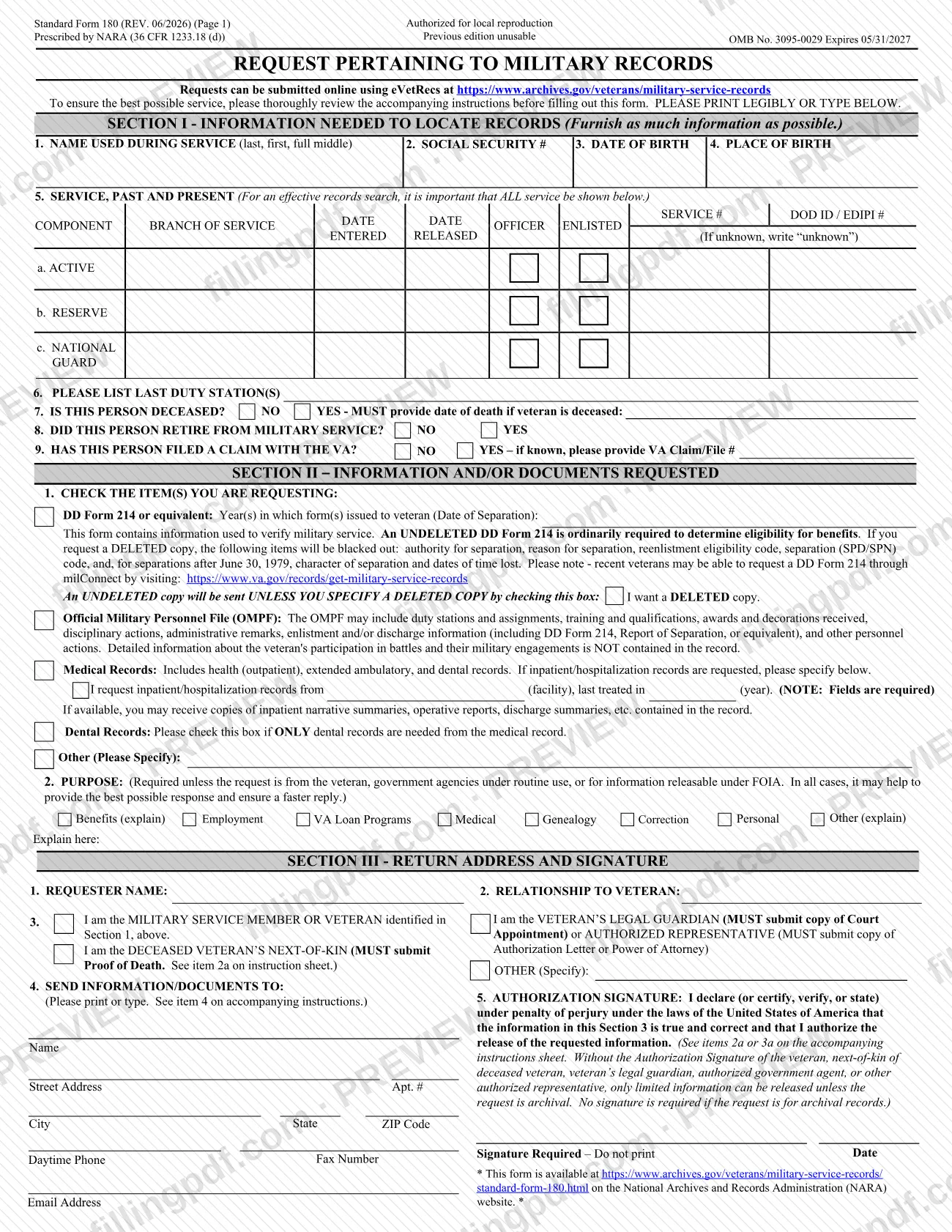
The form has three parts. Section I collects the information needed to locate the records: name used during service, Social Security number, date and place of birth, service history, last duty stations, and whether the person is deceased, retired or has a VA claim. Section II is where you check what you are requesting: a DD Form 214 or equivalent, the OMPF, medical records, dental records only, or something else, along with the purpose. Section III holds the return address, your relationship to the veteran and the authorization signature.
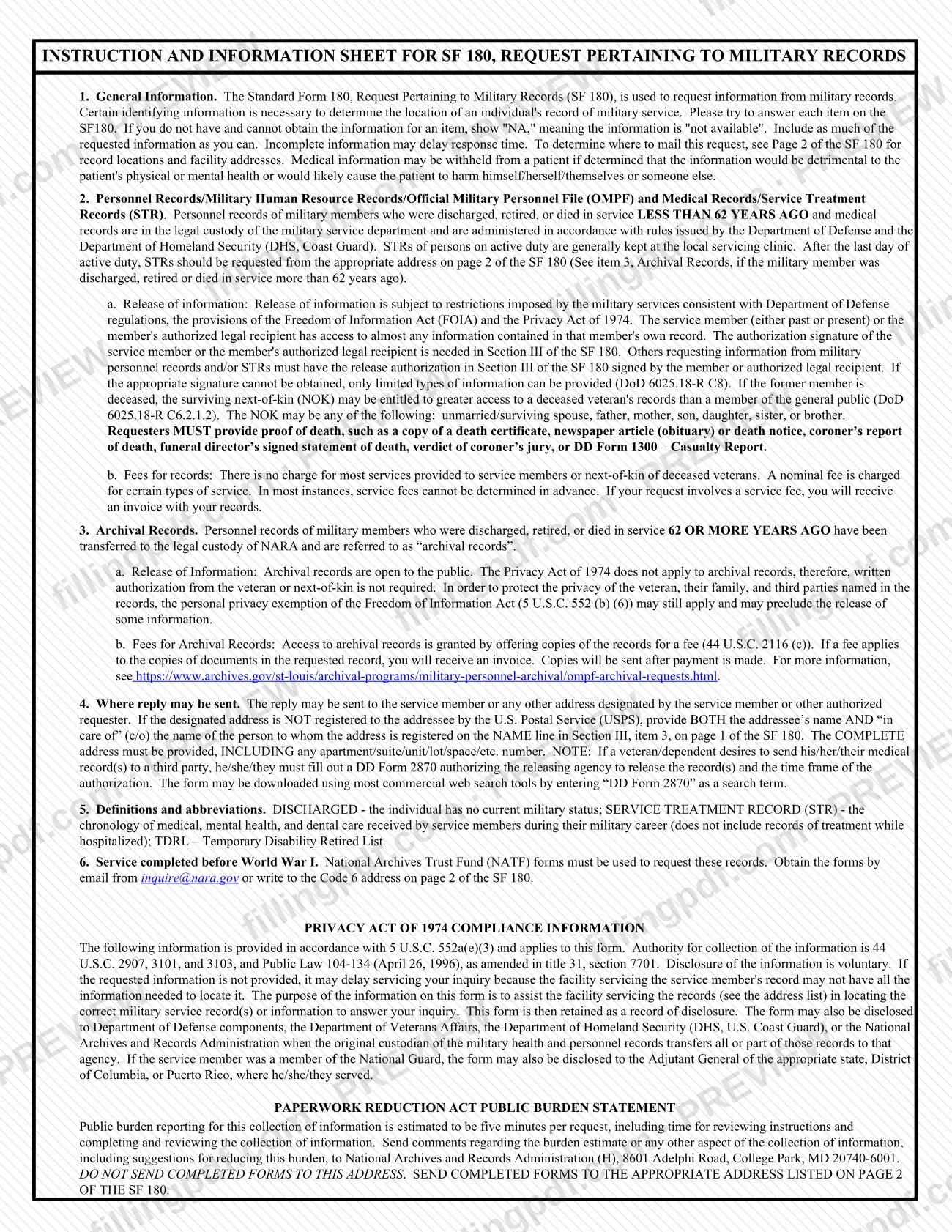
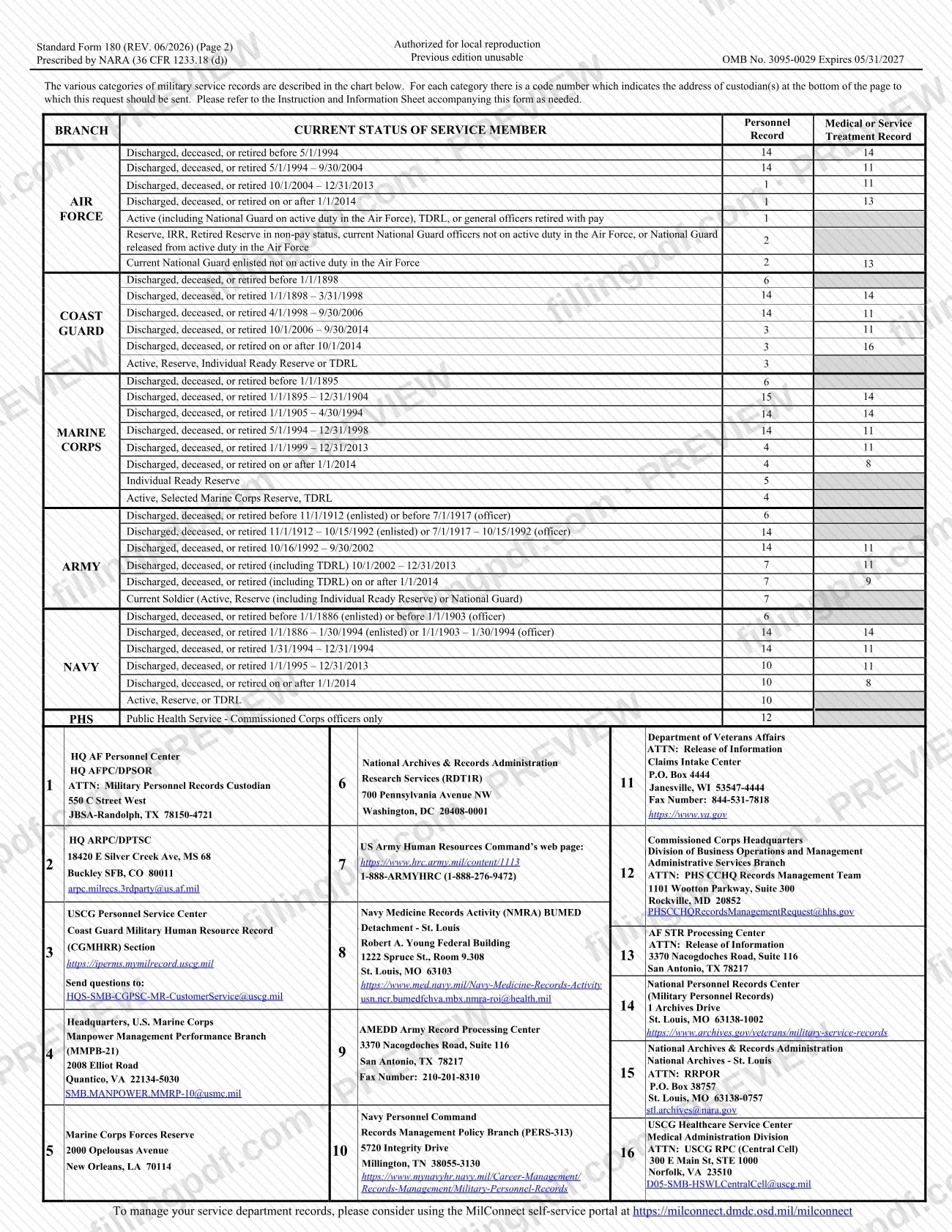
The form is accompanied by an instruction and information sheet and by a chart of record locations. The chart assigns a code number to each combination of branch of service, status and separation date, and the code tells you which custodian address receives the request. The form is marked OMB No. 3095-0029 and carries the revision REV. 06/2026.
NARA also offers online ordering through eVetRecs as an alternative to this paper form. The SF 180 does not cover service completed before World War I: for those records the instructions require National Archives Trust Fund (NATF) forms instead.
Who needs to file SF 180?
The main group is the service member or veteran, past or present, who wants information from their own military record. The instructions say the member or the member's authorized legal recipient has access to almost any information in that record.
Others may also use the form:
- Next-of-kin of a deceased veteran. The NOK may be the unmarried or surviving spouse, father, mother, son, daughter, sister or brother. Requesters must provide proof of death.
- A veteran's legal guardian, who must submit a copy of the court appointment.
- An authorized representative, who must submit an authorization letter or a power of attorney.
- Other requesters, who need the release authorization in Section III signed by the member or the authorized legal recipient. Without the right signature, only limited types of information can be provided.
Requests for archival records, meaning service that ended 62 or more years ago, are open to the public and need no signature from the veteran or next-of-kin.
Do not use the SF 180 for service completed before World War I; NATF forms are required for those. Submit a separate request for each individual whose records you are requesting.
When to file SF 180
The form has no filing deadline: you submit it whenever you need information or documents from a military record. The triggering event is your need for a record, for example a DD Form 214 to verify service for benefits.
For federal (non-archival) records, NARA says written requests must be signed and dated within the last year, so a form signed long before mailing may be refused. Archival requests need no signature.
If your request is urgent, such as upcoming surgery or a funeral, NARA says to select Emergency Request in eVetRecs or to state the emergency in the Purpose section of the SF 180 and fax it to the Customer Service Team. Requests that involve reconstructing records damaged in the 1973 fire at the National Personnel Records Center, which affected Army and Air Force records for service members discharged from 1912 to 1964, may take longer.
Documents you need
- Proof of death, such as a death certificate, obituary or death notice, coroner's report, funeral director's signed statement or DD Form 1300 (Casualty Report): required when you are next-of-kin of a deceased veteran.
- A copy of the court appointment: required when you are the veteran's legal guardian.
- An authorization letter or power of attorney: required when you are an authorized representative of the veteran.
- DD Form 2870: needed when a veteran or dependent wants medical records sent to a third party; it authorizes the release and sets the time frame of the authorization.
- Copies of any supporting documents, not originals: documents sent with a request are not returned.
How to fill out SF 180
Identify the veteran in Section I
Items 1 to 4: enter the name used during service (last, first, full middle), Social Security number, date of birth and place of birth. Show "NA" for anything you do not have and cannot obtain.
List all service in item 5
Enter the service number and DoD ID / EDIPI number, then for Active, Reserve and National Guard give the branch of service, date entered, date released and officer or enlisted status. Write "unknown" where you do not know.
Add duty stations and status
Item 6: list the last duty station(s). Item 7: check whether the person is deceased and, if yes, give the date of death. Item 8: check whether the person retired.
Answer the VA claim question
Item 9: check whether the person has filed a claim with the VA and, if known, provide the VA Claim/File number.
Check what you are requesting
Section II, item 1: check DD Form 214 or equivalent (with the year of separation), OMPF, Medical Records, Dental Records, or Other. An UNDELETED DD Form 214 is sent unless you check I want a DELETED copy.
Complete the inpatient fields if needed
If you request inpatient or hospitalization records, enter the facility and the year last treated; both fields are required.
State the purpose
Section II, item 2: check the purpose, such as Benefits, Employment, VA Loan Programs, Medical, Genealogy, Correction, Personal or Other, and explain where asked. It is required unless the request is from the veteran, government agencies under routine use, or for information releasable under FOIA.
Enter requester name and relationship
Section III, items 1 and 2: enter your name and your relationship to the veteran.
Check your status
Item 3: check veteran, deceased veteran's next-of-kin, legal guardian, authorized representative or Other (specify). Next-of-kin must submit proof of death; guardians a court appointment; representatives an authorization letter or power of attorney.
Enter the return address
Item 4: print the name and the complete address, including apartment or unit number, plus daytime phone, fax and email. If the address is not registered to the addressee, add "c/o" the person to whom it is registered.
Review, sign and download the PDF
Item 5: sign and date the authorization; no signature is required for archival records. Check the form against the instructions, then download or print the completed PDF from FillingPDF and send it to the address matching your code.
How to submit SF 180
You can send the SF 180 by mail or by fax, or you can request records online through eVetRecs instead of using the paper form.
- By mail: Send the signed and dated form to the custodian address that matches the code in the record-location chart. For records held at the National Personnel Records Center, the address is National Personnel Records Center, 1 Archives Drive, St. Louis, MO 63138.
- By fax: NARA lists 314-801-9195 for faxing an SF 180 to the National Personnel Records Center. For emergencies, fax the Customer Service Team at 314-801-0764; questions go to 314-801-0800.
- Online: eVetRecs, at https://www.archives.gov/veterans/military-service-records.
Do not mail completed forms to the National Archives address at 8601 Adelphi Road in College Park; that address is only for comments on the burden estimate. Do not send original documents: documents submitted are not returned. You may put more than one request in an envelope or fax, but each person needs a separate form.
Most services for service members and next-of-kin of deceased veterans carry no charge, but a fee applies to certain services. If one applies you receive an invoice, with the records for non-archival requests, or before copies are sent for archival records. Contact NARA for amounts. NARA usually replies electronically if you give an email, otherwise by U.S. Mail. FillingPDF lets you fill out and download the PDF; submission follows the channels above.
Common mistakes to avoid
- Mailing the completed form to the National Archives address at 8601 Adelphi Road, College Park; the instructions say to use the address listed in the record-location chart.
- Sending the form unsigned or with a signature dated more than a year earlier when the records are federal (non-archival).
- Leaving items blank instead of writing "NA" when information is not available and cannot be obtained.
- Asking for a deceased veteran's records as next-of-kin without proof of death, or leaving out the date of death in Section I, item 7.
- Mailing original documents; NARA does not return them.
- Using one SF 180 for several people; a separate request is required for each individual.
- Listing only some of the person's service in item 5; all service, past and present, should be shown for an effective search.
- Requesting inpatient or hospitalization records without the facility and the year last treated, which are required fields.
- Giving a return address not registered to the addressee without the "in care of" (c/o) name, or leaving out the apartment, suite or unit number.
Frequently asked questions
What is the SF 180 form used for?
The SF 180 is the standard form for requesting information from military records, such as a DD Form 214, the Official Military Personnel File (OMPF), or medical and dental records. NARA says the DD Form 214 is the document most often needed to obtain veterans' benefits.
Where do I send the SF 180?
Send it to the address in the form's record-location chart, chosen by branch, status and separation date. Records held at the National Personnel Records Center go to 1 Archives Drive, St. Louis, MO 63138. Never use the 8601 Adelphi Road address printed in the Paperwork Reduction Act statement.
Can I fax the SF 180?
Yes. NARA lists 314-801-9195 for faxing an SF 180 to the National Personnel Records Center. For urgent requests, the Customer Service Team fax is 314-801-0764. Records held at other custodians use the fax numbers or addresses printed in the chart.
Can I fill out the SF 180 online?
You can fill out the PDF online on FillingPDF and download it, but you must still print, sign and send it through the agency's channels. FillingPDF does not submit the form to NARA. NARA also takes requests through eVetRecs.
Who can request a deceased veteran's records with the SF 180?
Next-of-kin: the unmarried or surviving spouse, father, mother, son, daughter, sister or brother. You must provide proof of death, such as a death certificate, obituary or funeral director's statement. Archival records, 62 or more years after separation, are open to the public.
Do I need to sign the SF 180?
Yes for federal (non-archival) records: the authorization signature in Section III, item 5 is needed, and NARA says requests must be signed and dated within the last year. No signature is required if the request is for archival records.
Is there a fee for requesting military records?
There is no charge for most services to service members or next-of-kin of deceased veterans, but a fee applies to certain services. If one applies you receive an invoice, and archival copies are sent after payment. Ask NARA for the current amount.
What if I need the records urgently?
State the emergency in the Purpose section of the SF 180, such as upcoming surgery or a funeral, and fax it to the Customer Service Team at 314-801-0764. NARA also lists 314-801-0800 for questions, though hold times are often long.
Ready to fill out SF 180?
Fill out SF 180 now