
The Exempt Affidavit, printed on the form as the Affidavit for Exempt Transfers, is the sworn statement a responsible person signs before a notary to explain why a deed is exempt from the deed recording fee. It is used with deeds recorded at the Anderson County Register of Deeds in South Carolina. If you searched for Anderson County property tax paperwork, note that this affidavit concerns the deed recording fee, not a property tax bill. On this page you can fill out the form online on FillingPDF and download or print the completed PDF; the county publishes the original at andersoncountysc.org.
Last updated
What is Exempt Affidavit – Anderson County, SC?
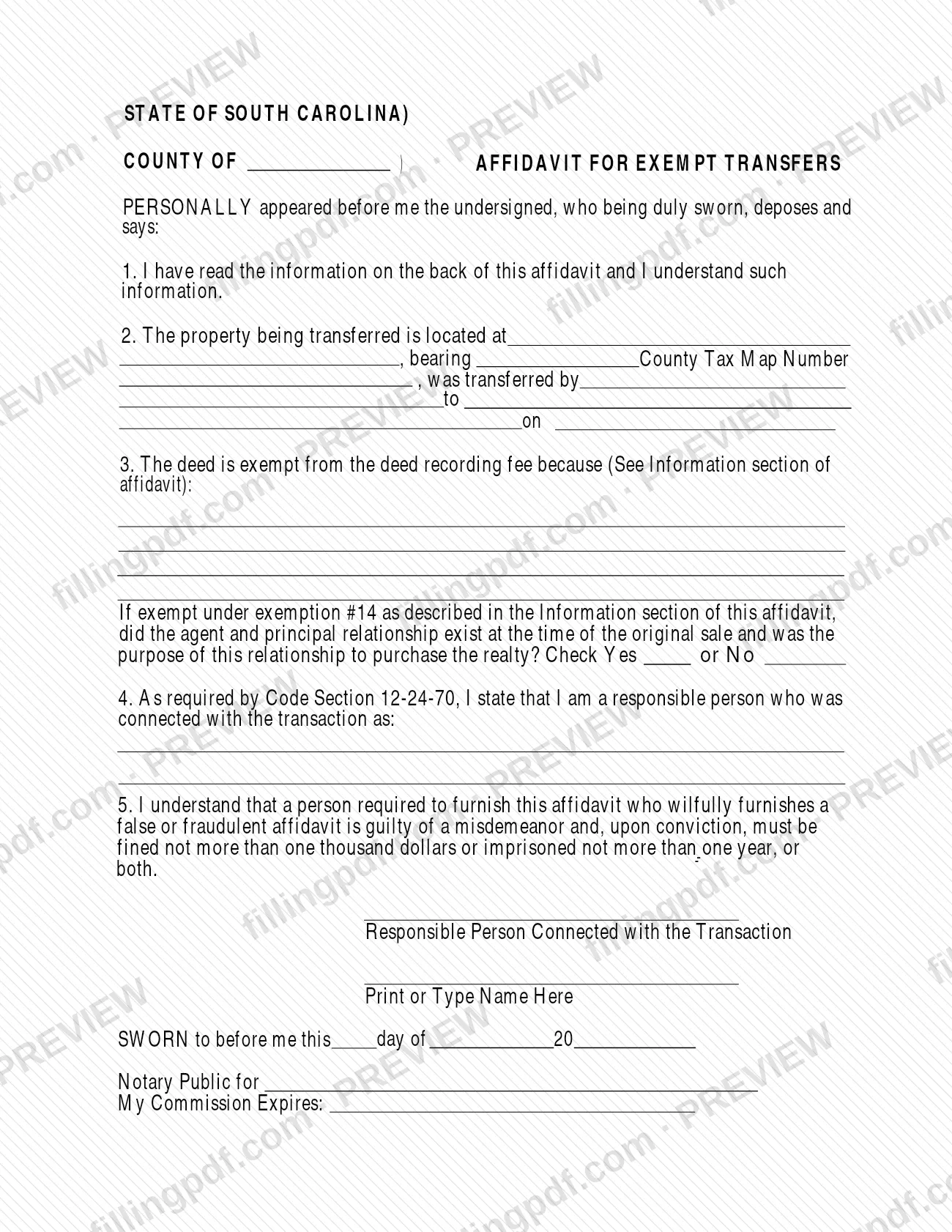
The Exempt Affidavit, titled Affidavit for Exempt Transfers on the form, is a notarized statement in which a person connected with a real estate transfer swears that the deed is exempt from the deed recording fee and names the exemption that applies.
The form is a State of South Carolina affidavit published by the Anderson County Register of Deeds. The Register of Deeds records, indexes and maintains the legal documents that establish ownership of real and personal property in Anderson County. The affidavit identifies the property, its County Tax Map Number, who transferred it, to whom and on what date. It then states the reason for the exemption, asks the signer to state, as required by Code Section 12-24-70, how they were connected with the transaction, and warns that willfully furnishing a false or fraudulent affidavit is a misdemeanor.
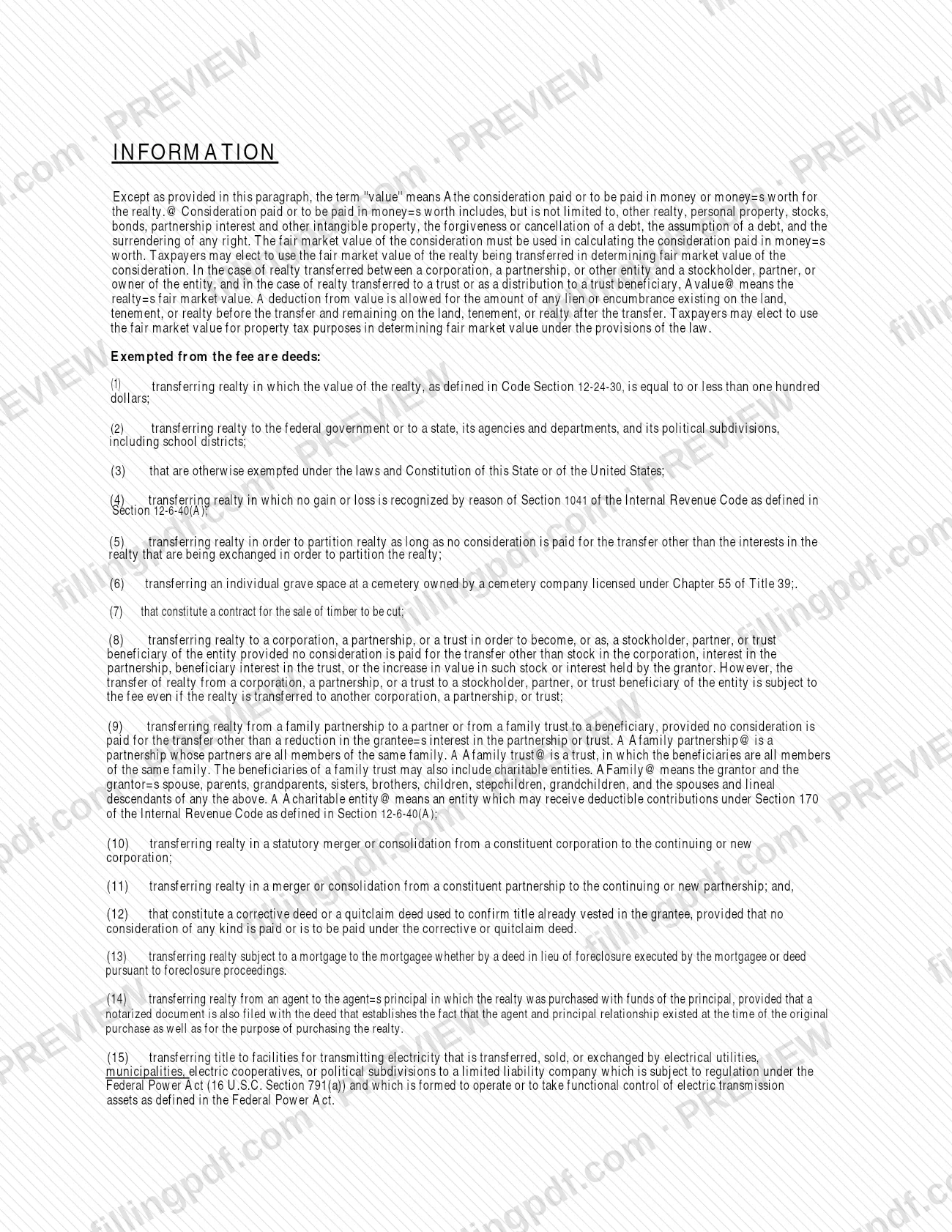
An Information section printed on the form lists the exemptions, numbered (1) to (15). They include:
- transfers of nominal value as defined in Code Section 12-24-30;
- transfers to the federal government, a state or its political subdivisions, including school districts;
- transfers between spouses under Section 1041 of the Internal Revenue Code, and partition transfers with no other consideration;
- timber-to-be-cut contracts and individual cemetery grave spaces;
- certain transfers into or out of corporations, partnerships and trusts, including family partnerships and family trusts;
- corrective or quitclaim deeds confirming title already vested;
- deeds to a mortgagee in lieu of foreclosure or under foreclosure;
- transfers from an agent to the agent's principal (exemption 14);
- certain electric transmission facility transfers (exemption 15).
The form is not a property tax return or bill. It supports the exemption of one deed from the recording fee.
Who needs to file Exempt Affidavit – Anderson County, SC?
A responsible person connected with the transaction signs this affidavit when a deed is claimed to be exempt from the deed recording fee. Item 4 asks you to state, as required by Code Section 12-24-70, the capacity in which you were connected with the transaction.
The form applies only to deeds that fit one of the exemptions numbered (1) to (15) in its Information section, such as transfers to a government body, partition transfers with no consideration, corrective or quitclaim deeds that only confirm title already vested, or deeds in lieu of foreclosure. Read that section first: the form requires you to confirm in item 1 that you have read and understood it.
Special condition for agents and principals: if you claim exemption 14, the form asks whether the agent and principal relationship existed at the time of the original sale and whether its purpose was to purchase the realty. The Information section also requires a notarized document filed with the deed establishing that relationship.
Do not use this affidavit if no listed exemption applies to your deed. The signer must swear to the statements before a notary public, so the form cannot be completed as a plain, unsworn declaration.
When to file Exempt Affidavit – Anderson County, SC
Complete the affidavit when a deed that claims an exemption from the deed recording fee is prepared for recording at the Anderson County Register of Deeds. No separate due date is printed on the form, so it travels with the deed it supports.
The Register of Deeds page asks that all documents be in for recording no later than 4:30pm. The page also notes that a new recording fee list applies to documents received on August 1st; it points to the fee list under document recording for current amounts.
The signature must be sworn before a notary public, so schedule the notary visit before you bring the deed in. The form leaves the date of the oath blank to be filled in at that meeting.
Documents you need
- For exemption 14 (agent to principal): a notarized document filed with the deed establishing that the agent and principal relationship existed at the time of the original purchase and for the purpose of purchasing the realty.
How to fill out Exempt Affidavit – Anderson County, SC
Enter the county
At the top, the form already reads STATE OF SOUTH CAROLINA. Enter the county in the COUNTY OF space, which is the county of the notarization.
Read the Information section
Item 1 states that you have read the information on the back of the affidavit and understand it. Review the definition of value and exemptions (1) to (15) before continuing.
Describe the property and transfer
In item 2, enter the location of the property, its County Tax Map Number, the name of who transferred it, the name of who received it and the date of the transfer.
State the exemption reason
In item 3, enter why the deed is exempt from the deed recording fee, citing the exemption number from the Information section.
Answer the exemption 14 question
Only if you claim exemption 14, check Yes or No: did the agent and principal relationship exist at the time of the original sale, and was its purpose to purchase the realty? Otherwise leave it unmarked.
State your connection to the transaction
In item 4, enter the capacity in which you, as a responsible person under Code Section 12-24-70, were connected with the transaction.
Print your name and sign
Type or print your name under Responsible Person Connected with the Transaction. Item 5 warns that willfully furnishing a false or fraudulent affidavit is a misdemeanor. Sign only in front of the notary.
Complete the notary section
The notary fills in the SWORN to before me date and year, the Notary Public for entry and the My Commission Expires date.
Review and download the completed PDF
Check that items 2 to 4 match the deed and that the exemption number is correct. Download or print the completed PDF from FillingPDF, have it sworn before a notary and take it with the deed as described under How to submit.
How to submit Exempt Affidavit – Anderson County, SC
The form itself names no filing channel; the affidavit goes to the Anderson County Register of Deeds together with the deed it supports. The Register of Deeds lists these details:
- In person: Register of Deeds, 401 East River Street, Anderson, SC 29624. Hours of service are Monday–Friday, 8:30 a.m.–5:00 p.m.
- Mailing address listed by the office: PO Box 8002, Anderson, SC 29622.
The office asks that all documents for recording be in no later than 4:30pm. A recording fee list is posted on the Register of Deeds page under document recording; the form does not give amounts. Before you go, make sure the affidavit is signed and sworn before a notary public, and, if you claim exemption 14, that the required notarized document establishing the agent and principal relationship is filed with the deed. FillingPDF lets you fill out and download the PDF; submission follows the Register of Deeds' channels above.
Common mistakes to avoid
- Signing the affidavit without having it sworn before a notary public; the form contains an oath section with the notary's county and commission expiration date.
- Claiming an exemption without reading the Information section, which item 1 says you have read and understood.
- Citing no exemption in item 3, or citing one that does not match the deed, such as a transfer that involves consideration other than the interests exchanged.
- Claiming exemption 14 without answering the Yes or No question about the agent and principal relationship at the time of the original sale and its purpose.
- Claiming exemption 14 without filing the separate notarized document establishing the agent and principal relationship with the deed.
- Leaving the County Tax Map Number, the transferor, the transferee or the transfer date blank in item 2.
- Having someone not connected with the transaction sign; item 4 requires a responsible person to state how they were connected.
- Including a Social Security, driver's license, bank account or card number in a document for recording unless the law expressly requires it, as the Register of Deeds warns.
Frequently asked questions
What is the Exempt Affidavit for Anderson County, SC?
It is the Affidavit for Exempt Transfers, a notarized statement explaining why a deed is exempt from the deed recording fee. It identifies the property, the transfer and the exemption number, and is signed by a responsible person connected with the transaction.
Is the Exempt Affidavit an Anderson County property tax form?
No. It concerns the deed recording fee, handled by the Register of Deeds when a deed is recorded. Property tax records are separate; the county's ACPASS system holds tax records, real estate information and property taxes.
Does the Exempt Affidavit have to be notarized?
Yes. The form is an affidavit with a SWORN to before me section, a Notary Public for entry and a commission expiration date, so you must sign it before a notary public. Do not sign in advance.
Which transfers are exempt from the deed recording fee?
The form's Information section lists exemptions (1) to (15), including transfers to government bodies, corrective or quitclaim deeds confirming title already vested, deeds in lieu of foreclosure, agent-to-principal transfers and certain transfers involving corporations, partnerships and trusts. Your deed must fit one of them.
What is needed for exemption 14, agent to principal?
Answer the Yes or No question on the affidavit about whether the agent and principal relationship existed at the original sale and was meant to purchase the realty. A notarized document establishing that must also be filed with the deed.
Where do I take the Exempt Affidavit?
Take it with the deed to the Anderson County Register of Deeds, 401 East River Street, Anderson, SC 29624, open Monday–Friday, 8:30 a.m.–5:00 p.m. The office lists documents for recording must be in by 4:30pm; its mailing address is PO Box 8002, Anderson, SC 29622.
What happens if the affidavit is false?
Item 5 states that a person required to furnish the affidavit who willfully furnishes a false or fraudulent one is guilty of a misdemeanor and, on conviction, may be fined or imprisoned for up to one year, or both.
Can I fill out the Exempt Affidavit online on FillingPDF?
Yes, you can fill out the PDF online on FillingPDF and download or print it. FillingPDF is independent of Anderson County and does not file or record anything; you still need a notary and must deliver the affidavit to the Register of Deeds.
Ready to fill out Exempt Affidavit – Anderson County, SC?
Fill out Exempt Affidavit – Anderson County, SC now