
The Complaint for Foreclosure of Mortgage is the court document a mortgage holder uses to ask for the foreclosure of a mortgage on real estate in Charleston County, South Carolina, and the Charleston County Master In Equity publishes it among its forms. It identifies the Note and Mortgage, states the default and the amount claimed, and asks the court to order a sale of the property. It is signed by the attorney for the plaintiff and ends with a Fair Debt Collection Practices Act notice. On FillingPDF you can fill out the form online and download or print the completed PDF; the county publishes the original PDF at the address linked on this page.
Last updated
What is Complaint for Foreclosure of Mortgage – Charleston County, SC?
The Complaint for Foreclosure of Mortgage is a South Carolina court form, published by the Charleston County Master In Equity, in which a plaintiff alleges default on a Note and Mortgage and asks the court to foreclose and sell the mortgaged real estate.
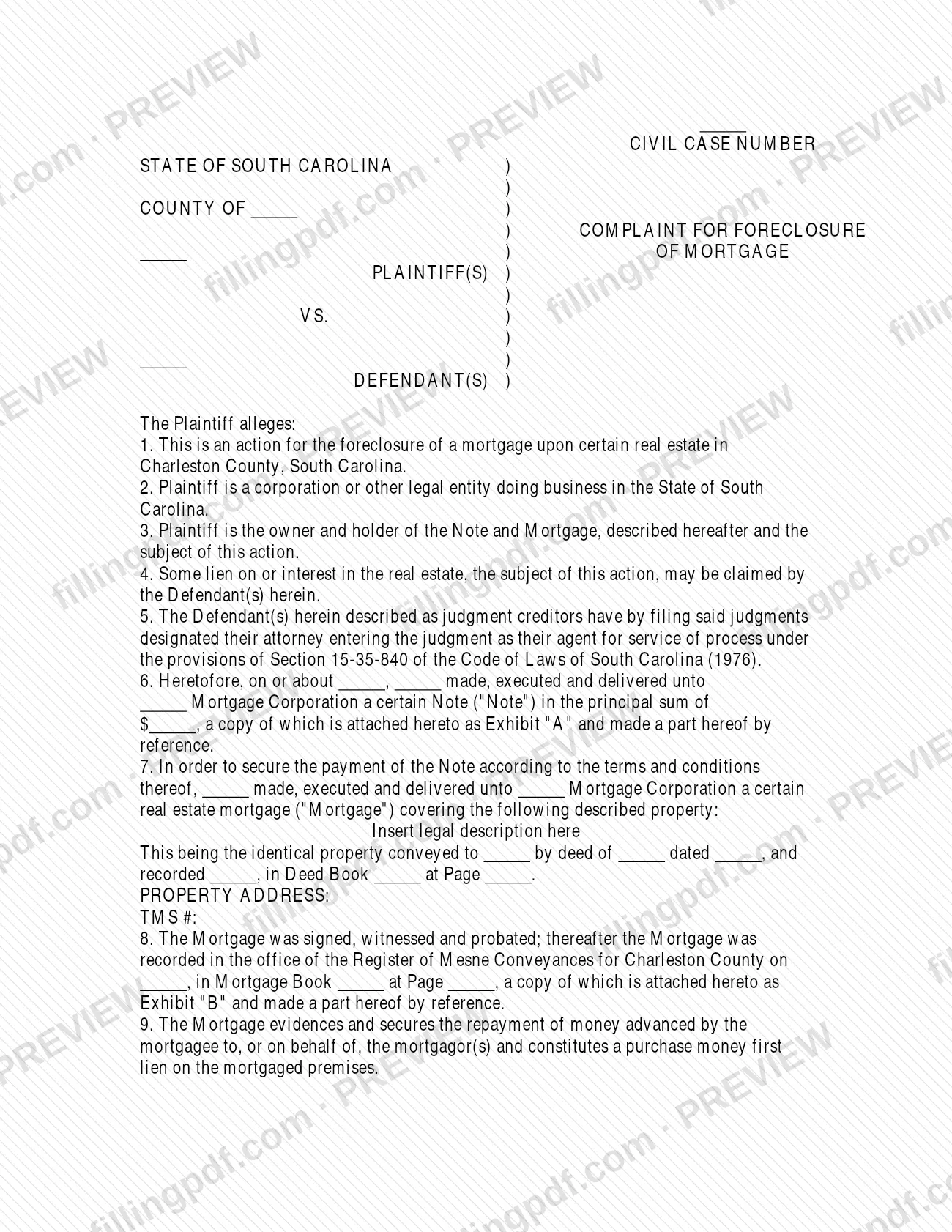
The printed text is a caption (civil case number, State of South Carolina, county, plaintiff(s) versus defendant(s)) followed by numbered allegations. The plaintiff states that the action concerns a mortgage on real estate in Charleston County, that it owns and holds the Note and Mortgage, and that a defendant may claim a lien or interest in the property. Paragraphs 6 to 8 identify the Note (with a copy as Exhibit "A"), the Mortgage and the property, including its legal description, property address and TMS #, and the recording of the Mortgage with the Register of Mesne Conveyances (with a copy as Exhibit "B"). Paragraph 11 declares the default and the balance due.
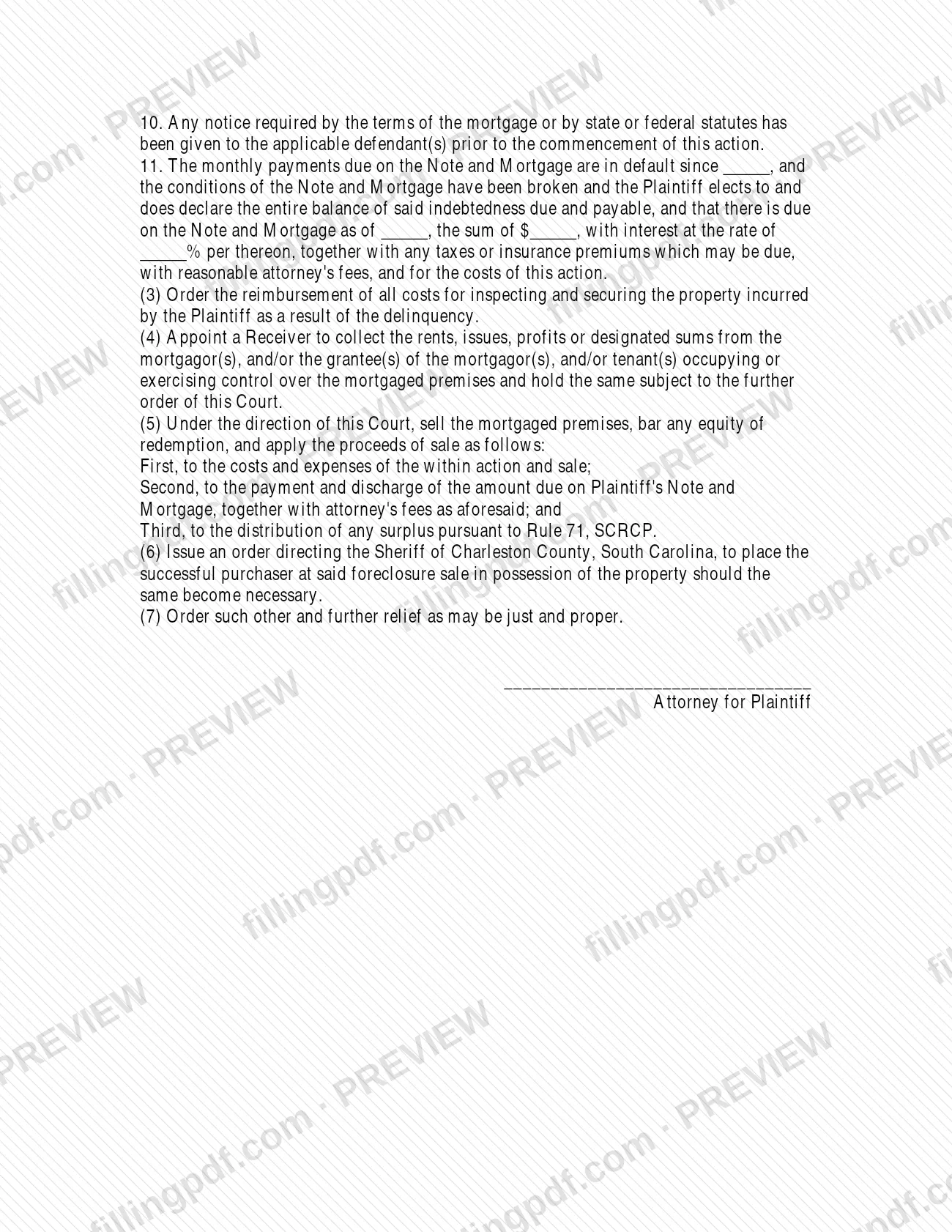
The requests for relief printed on the form include reimbursement of costs for inspecting and securing the property, appointment of a Receiver to collect rents, a court-directed sale that bars any equity of redemption, distribution of the proceeds, and an order directing the Sheriff of Charleston County to place the purchaser in possession if necessary.
The Master In Equity's forms page lists this complaint next to separate documents, such as the Summons, Lis Pendens, Complaint for Quiet Title After Tax Sale and Complaint for Subrogation Claim. Each of those is a different form with a different purpose.
Who needs to file Complaint for Foreclosure of Mortgage – Charleston County, SC?
The main user is a plaintiff that owns and holds a Note and Mortgage on real estate in Charleston County, South Carolina, and wants to foreclose after default. The form is signed on the line for the Attorney for Plaintiff, and its Fair Debt Collection Practices Act notice directs written requests to the creditor's law firm, so it is drafted for counsel acting for the plaintiff.
The form fits a case with these features:
- The mortgaged property is in Charleston County (paragraph 1).
- The plaintiff is a corporation or other legal entity doing business in South Carolina (paragraph 2).
- The mortgage is described as a purchase money first lien (paragraph 9).
- A defendant may claim a lien or interest in the property, and some defendants may be judgment creditors who designated their attorney as agent for service of process under Section 15-35-840 of the Code of Laws of South Carolina (1976) (paragraphs 4 and 5).
Defendants and debtors do not file this form. They receive it with a Summons and may respond to the notice on its last page. Other proceedings, such as quiet title after a tax sale or a subrogation claim, have their own complaints on the county's forms page.
When to file Complaint for Foreclosure of Mortgage – Charleston County, SC
You use the complaint after the monthly payments due on the Note and Mortgage are in default, because paragraph 11 has the plaintiff declare the entire balance due and payable. Paragraph 10 also states that any notice required by the mortgage or by state or federal statutes was given to the applicable defendants before the action began, so that notice comes first.
The form prints no filing deadline of its own. The only period it sets is the debtor's: under the Fair Debt Collection Practices Act notice, a debtor has thirty (30) days after receiving the notice to dispute the debt in writing or to ask in writing for the name and address of the original creditor. Check the Charleston County Master In Equity's forms page for current filing procedures.
Documents you need
- Exhibit "A": a copy of the Note described in paragraph 6, attached to the complaint and made part of it by reference.
- Exhibit "B": a copy of the Mortgage described in paragraph 8, as recorded with the Register of Mesne Conveyances for Charleston County.
- Summons: the Fair Debt Collection Practices Act notice on the form refers to an attached Summons and Complaint, so the complaint is accompanied by a Summons.
How to fill out Complaint for Foreclosure of Mortgage – Charleston County, SC
Complete the case caption
Enter the civil case number, the county, and the names of the plaintiff(s) and defendant(s) in the caption at the top of the form.
Review paragraphs 1 through 5
These allegations cover the foreclosure of a mortgage on real estate in Charleston County, the plaintiff's status and ownership of the Note and Mortgage, possible defendant liens, and judgment creditors' agents under Section 15-35-840. Confirm that each statement fits your case.
Describe the Note in paragraph 6
Enter the date, the maker of the Note, the name of the mortgage corporation it was delivered to and the principal sum. Attach a copy of the Note as Exhibit "A".
Describe the Mortgage and property
In paragraph 7, enter who executed the Mortgage, replace "Insert legal description here" with the legal description, and give the deed reference, PROPERTY ADDRESS and TMS #.
Enter the recording details
In paragraph 8, enter the date the Mortgage was recorded with the Register of Mesne Conveyances for Charleston County, plus the Mortgage Book and page. Attach a copy as Exhibit "B".
Confirm paragraphs 9 and 10
Paragraph 9 describes the Mortgage as a purchase money first lien, and paragraph 10 states that required notices were given before the action. Check that both statements are true for your case.
Enter the default and amount due
In paragraph 11, enter the date the monthly payments went into default, the as-of date, the sum due, and the interest rate with its period.
Review the requests for relief
Check the relief items printed on the form: costs of inspecting and securing the property, a Receiver, a court-directed sale with the stated order of payment, an order to the Sheriff, and other proper relief.
Sign as attorney for the plaintiff
The attorney for the plaintiff signs on the line above "Attorney for Plaintiff".
Complete the debt collection notice
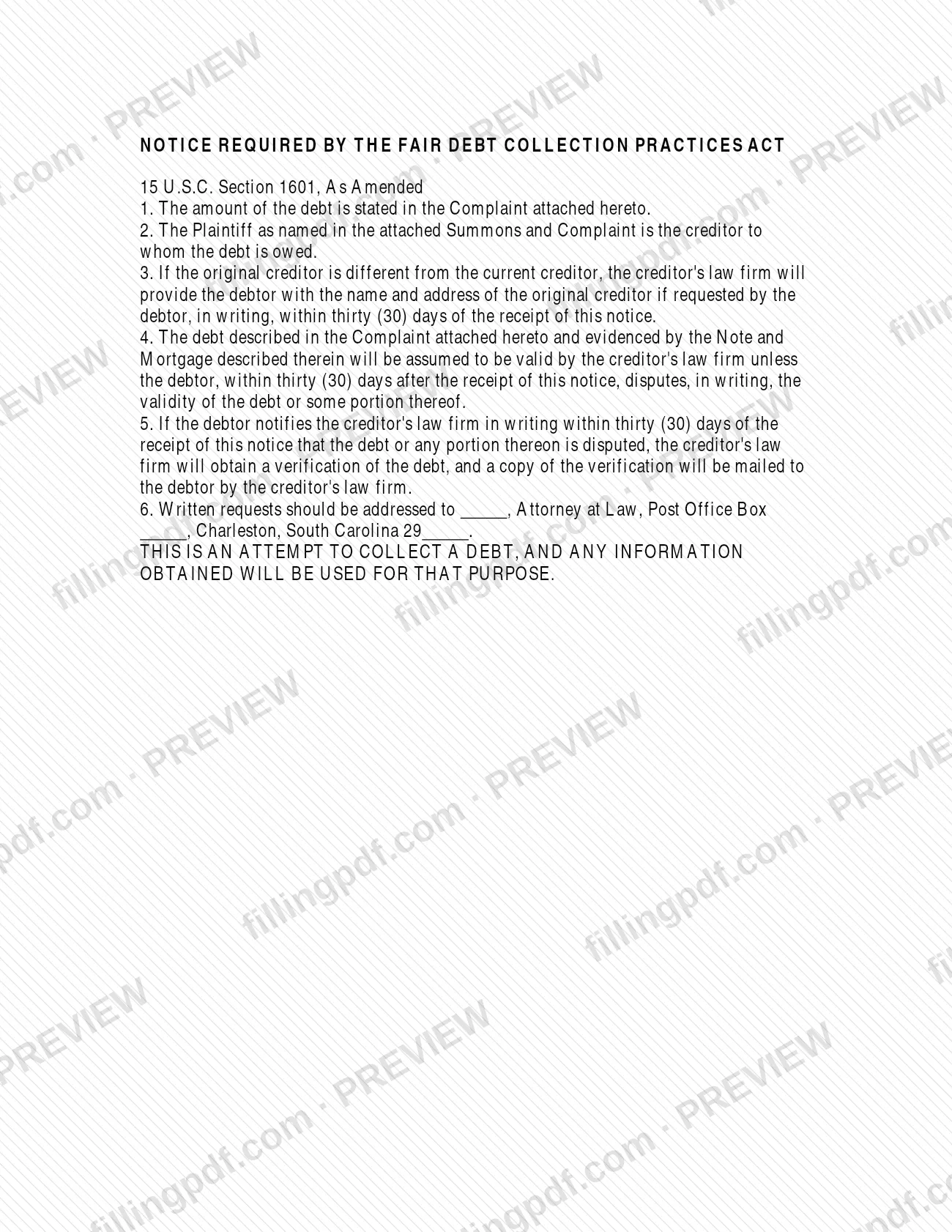
In item 6 of the Fair Debt Collection Practices Act notice, enter the attorney's name, the Post Office Box number and the Charleston, South Carolina ZIP code where written requests are to be sent.
Review and download the PDF
Check the names, dates, amounts and exhibit references, then download or print the completed PDF from FillingPDF and assemble the filing as described under How to submit.
How to submit Complaint for Foreclosure of Mortgage – Charleston County, SC
The form names no filing channel, address or fee; it is filed with the court under the procedures the Charleston County Master In Equity publishes.
- Forms page: https://www.charlestoncounty.gov/departments/master-in-equity/forms.php lists this complaint together with an E-Filing Procedures document, the Summons and the Lis Pendens. Read the E-Filing Procedures for how filings are made.
- With the Summons: the notice on the last page refers to the "attached Summons and Complaint", so the complaint goes out together with a Summons.
- Exhibits: attach the copy of the Note as Exhibit "A" and the copy of the Mortgage as Exhibit "B".
- Debtor correspondence: the only address on the form is the one you enter in the notice, where written requests are sent to the attorney at a P.O. box in Charleston, South Carolina.
FillingPDF lets you fill out and download the PDF; submission follows the agency's channels above.
Common mistakes to avoid
- Leaving the placeholder "Insert legal description here" in paragraph 7 instead of entering the legal description of the mortgaged property.
- Omitting Exhibit "A" (copy of the Note) or Exhibit "B" (copy of the Mortgage), both of which the complaint says are attached.
- Leaving the property address or TMS # blank in paragraph 7, or the book and page of the recorded Mortgage in paragraph 8.
- Leaving blanks in paragraph 11: the default date, the as-of date, the sum due, the interest rate or the period the rate applies to.
- Filing without the notice required by the mortgage or by state or federal statutes, although paragraph 10 states it was given before the action began.
- Leaving the attorney's name, P.O. box and ZIP code blank in item 6 of the Fair Debt Collection Practices Act notice, so the debtor has no address for written requests.
- Submitting the complaint unsigned on the Attorney for Plaintiff line.
- Using this complaint for a tax-sale quiet title or subrogation claim, which have separate complaints on the Master In Equity's forms page.
Frequently asked questions
What is the Complaint for Foreclosure of Mortgage?
It is the court form on which a plaintiff alleges default on a Note and Mortgage covering real estate in Charleston County, South Carolina, and asks the court to order the property sold. The Charleston County Master In Equity publishes it on its forms page.
Is this a Charleston County property tax form?
No. This complaint concerns a defaulted mortgage, although paragraph 11 also claims any taxes or insurance premiums that may be due. For property taxes in Charleston County, use the county's tax resources. The Master In Equity lists a separate Complaint for Quiet Title After Tax Sale.
Who signs the Complaint for Foreclosure of Mortgage?
The attorney for the plaintiff signs on the line labeled "Attorney for Plaintiff". The form has no signature block for a defendant, and the notice at the end names the creditor's law firm as the contact for written requests.
What must I attach to the foreclosure complaint?
Attach a copy of the Note as Exhibit "A" and a copy of the recorded Mortgage as Exhibit "B". The complaint refers to both as part of it. The notice on the last page also refers to an attached Summons and Complaint.
What property details does the form ask for?
Paragraph 7 asks for the legal description, the deed reference, the PROPERTY ADDRESS and the TMS #. Paragraph 8 asks for the date and Mortgage Book and page where the Mortgage was recorded with the Register of Mesne Conveyances for Charleston County.
Is there a deadline to file this complaint?
The form prints no filing deadline. It is used after the monthly payments are in default, and paragraph 10 says required notices were given before the action began. The 30-day period in the notice runs for the debtor, after receipt.
What is the notice at the end of the form?
It is the notice required by the Fair Debt Collection Practices Act. It says the debt is assumed valid unless the debtor disputes it in writing within thirty (30) days of receipt, and that the law firm will then obtain and mail a verification of the debt.
Can I fill out the foreclosure complaint online?
Yes. You can fill out the PDF online on FillingPDF and download or print it. FillingPDF does not file the complaint with the court; filing follows the Master In Equity's procedures.
Ready to fill out Complaint for Foreclosure of Mortgage – Charleston County, SC?
Fill out Complaint for Foreclosure of Mortgage – Charleston County, SC now