
Standard Form 24 (SF24), Bid Bond, is the form, prescribed by the General Services Administration (GSA), that binds a bidder (the Principal) and one or more sureties to the United States of America when a bid guaranty is required. It is void if the bidder signs the further contract documents and gives the required bonds after its bid is accepted. On this page you can fill out the form online on FillingPDF and download or print the completed PDF. The agency publishes the original PDF at gsa.gov.
Last updated
What is SF 24?
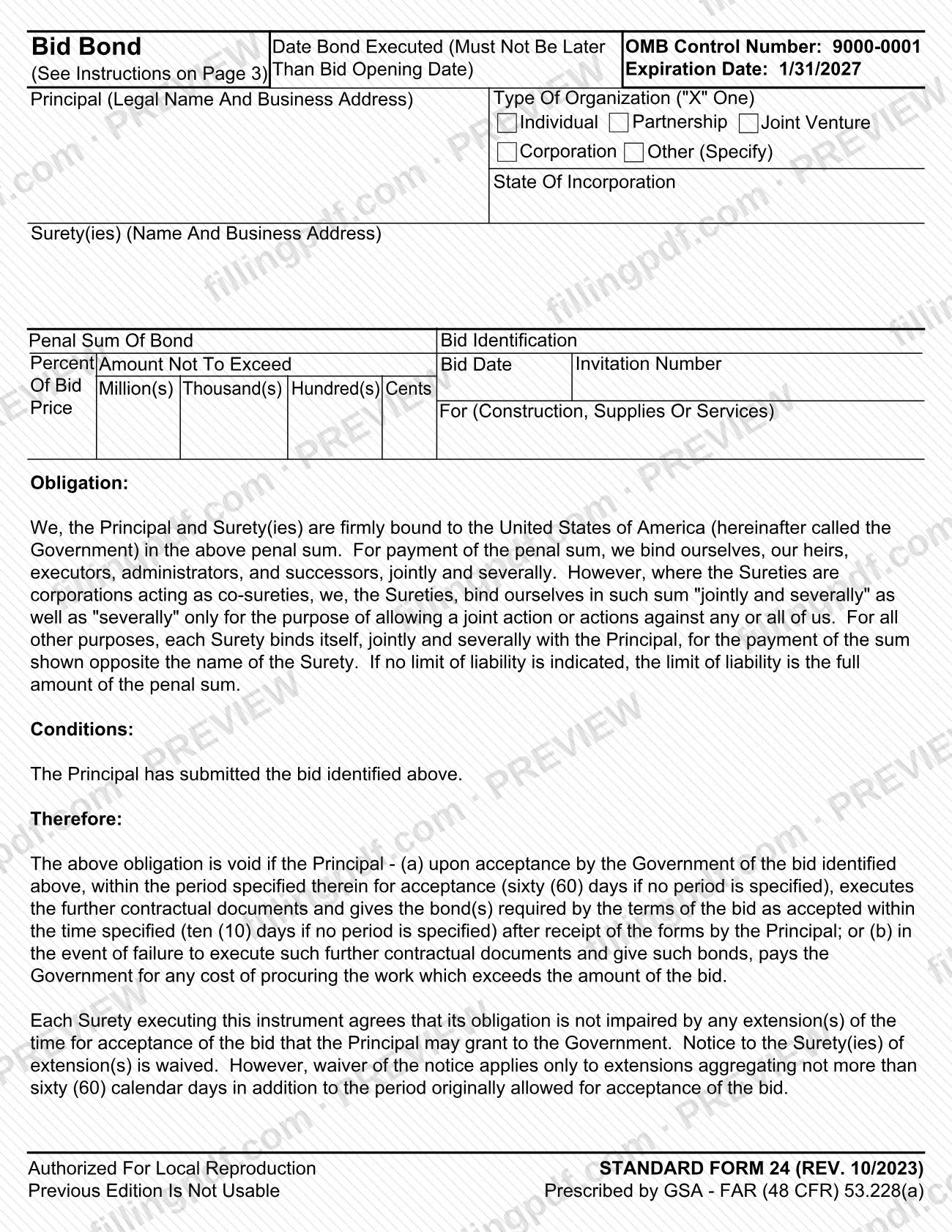
Standard Form 24 (SF 24), Bid Bond, is the federal form that serves as a bid guaranty: the Principal (the bidder) and its surety or sureties bind themselves to the United States of America (the Government) for a stated penal sum if the bidder fails to follow through on its bid.
The bond identifies the bid by its bid date, invitation number and the construction, supplies or services it covers. Under its conditions, the obligation is void if, once the Government accepts the bid within the acceptance period, the Principal executes the further contractual documents and gives the bonds the bid requires. If the Principal fails to do so, it pays the Government any cost of procuring the work that exceeds the amount of the bid.
The form is prescribed by GSA under FAR (48 CFR) 53.228(a), carries OMB Control Number 9000-0001 (expiration date printed as 1/31/2027) and is marked "Authorized For Local Reproduction." The printed edition is REV. 10/2023, and the form states that the previous edition is not usable. In negotiated contracts, the terms "bid" and "bidder" include "proposal" and "offeror."
SF 24 covers the bid guaranty only. It does not replace Standard Form 28, the Affidavit of Individual Surety, which must accompany the bond when individual sureties are involved.
Who needs to file SF 24?
A bidder (the Principal) uses SF 24 when the solicitation requires a bid guaranty. The form says it is authorized for use when a bid guaranty is required. Offerors responding to negotiated contracts are covered too, because "bid" includes "proposal" and "bidder" includes "offeror."
Others who take part in executing the bond:
- Corporate sureties. They must appear on the Department of the Treasury's list of approved sureties and act within the limitations listed there.
- Individual sureties. Each one needs a completed Affidavit of Individual Surety (Standard Form 28) accompanying the bond.
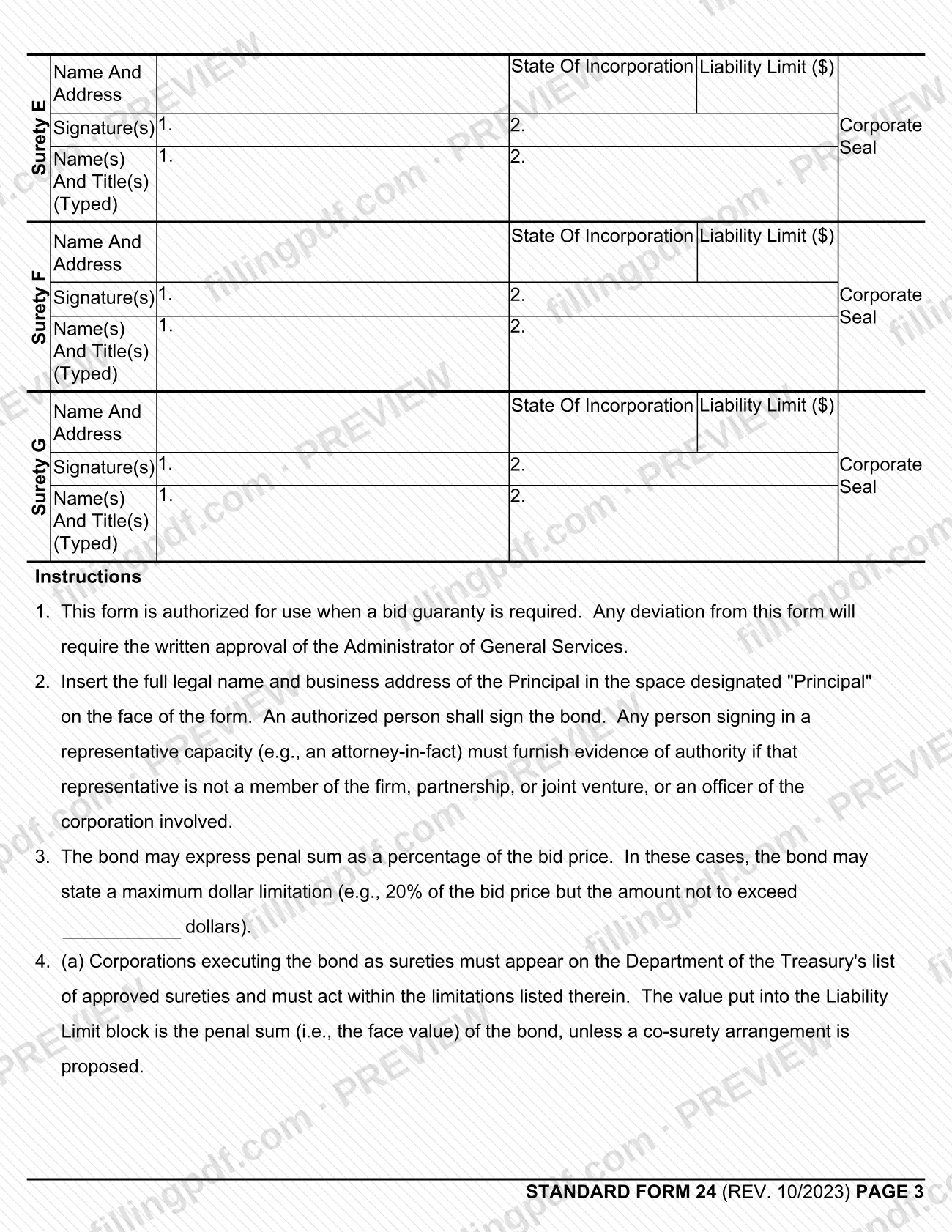
- Co-sureties. Where several sureties share the bond, they may allocate their limits of liability, provided the total equals 100% of the penal sum.
- Representatives. An authorized person must sign. A person signing in a representative capacity, such as an attorney-in-fact, must furnish evidence of authority unless that person is a member of the firm, partnership or joint venture, or an officer of the corporation involved.
Do not use an earlier edition: the form states the previous edition is not usable. Any deviation from the form requires the written approval of the Administrator of General Services.
When to file SF 24
The date in the Date Bond Executed box must not be later than the bid opening date, so the bond is completed and signed before bids are opened for the bid it guarantees.
The form's conditions set default periods that matter for the bond. The Government's acceptance period is sixty (60) days if the bid specifies none. The Principal has ten (10) days after receiving the contract forms to execute them and give the required bonds, if no period is specified. Each surety agrees that its obligation is not impaired if the Principal extends the acceptance period, and notice of extensions is waived, but only for extensions aggregating no more than sixty (60) calendar days beyond the original period.
Documents you need
- Standard Form 28, Affidavit of Individual Surety: one completed form for each individual surety, to accompany the bond; the Government may also require further information on the surety's financial capability.
- Evidence of authority, such as a power of attorney: needed only when a person signs in a representative capacity (for example, an attorney-in-fact) and is not a member of the firm, partnership or joint venture, or an officer of the corporation.
How to fill out SF 24
Enter the bond execution date
In Date Bond Executed, enter the date the bond is signed. It must not be later than the bid opening date.
Identify the Principal
Under Principal (Legal Name And Business Address), insert the full legal name and business address of the Principal. Mark one Type Of Organization (Individual, Partnership, Joint Venture, Corporation or Other, specified) and give the State Of Incorporation if it applies.
Name the surety or sureties
In the Surety(ies) (Name And Business Address) space, enter the name and address of a single surety. When multiple corporate sureties are involved, insert only their letter identifiers here.
Set the penal sum
Under Penal Sum Of Bond, the bond may express the sum as a Percent Of Bid Price with an Amount Not To Exceed limit in the Million(s), Thousand(s), Hundred(s) and Cents columns.
Complete the bid identification
Enter the Bid Date, the Invitation Number and what the bid is For (Construction, Supplies Or Services). These identify the bid the bond guarantees.
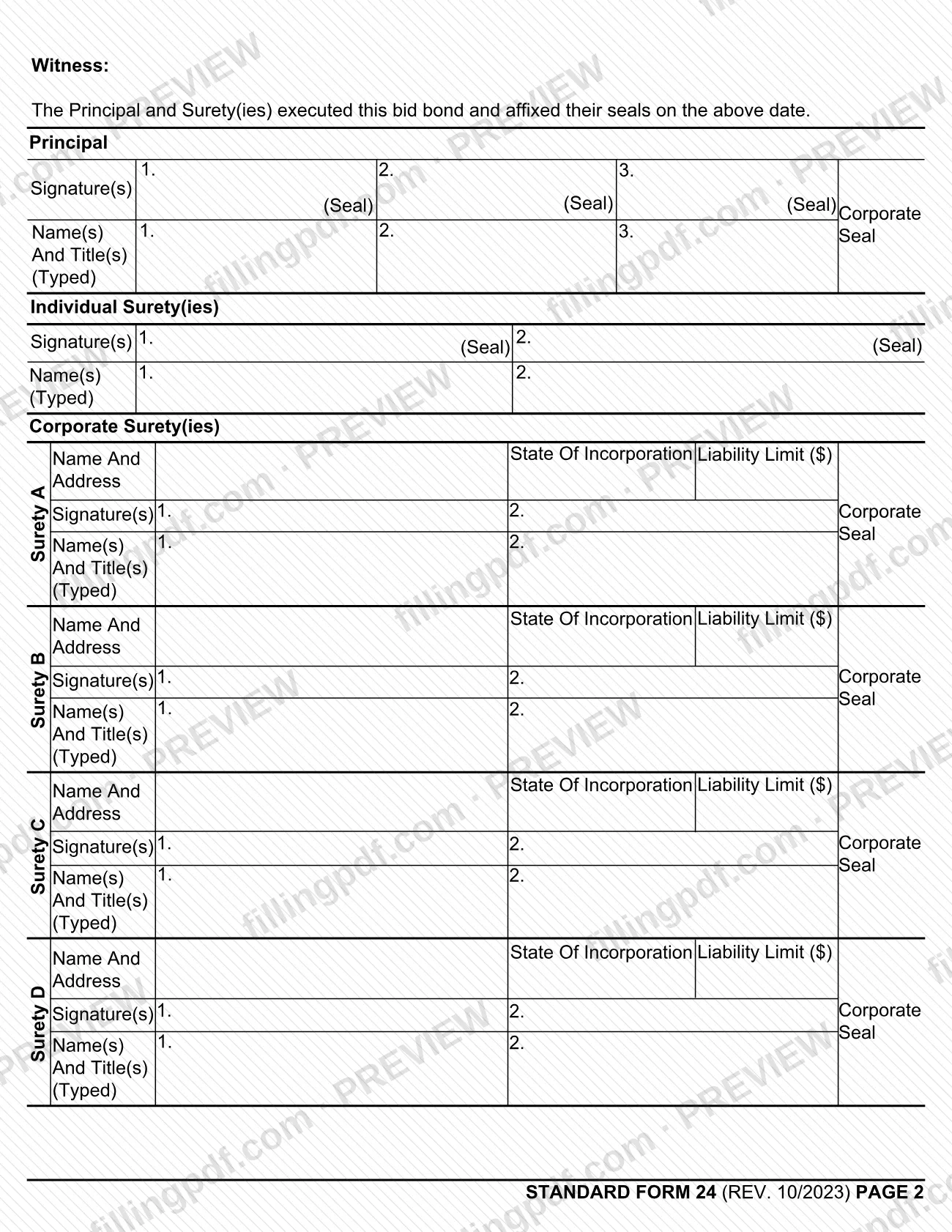
Sign for the Principal
In the Principal block, each signer signs, adds a (Seal) and types name and title; a corporate Principal also affixes its Corporate Seal. A representative who is not a firm member or corporate officer must furnish evidence of authority.
Complete individual surety blocks
If individual sureties sign, each signs and types a name opposite the seal and attaches a completed Standard Form 28. Use an adhesive seal if executing in Maine, New Hampshire or another jurisdiction requiring one.
Complete corporate surety blocks
In each Surety block (A to G), enter the corporation's name and state of incorporation, address and Liability Limit ($), then the signatures, typed names and titles and the corporate seal. The limit is the bond's penal sum unless a co-surety arrangement is proposed.
Review, sign and download the PDF
Check that the dates match, co-surety limits total 100% of the penal sum and all seals, signatures and typed names are in place. Download or print the completed PDF from FillingPDF and keep it for use with the bid.
How to submit SF 24
SF 24 prints no mailing address, portal or appointment rule of its own. It is tied to the bid it identifies by bid date and invitation number, and the bond must be executed no later than the bid opening date.
- With the bid guaranty. The form is authorized for use when a bid guaranty is required; the form itself names no delivery channel.
- Attachments. When individual sureties sign, a completed Standard Form 28 for each individual surety must accompany the bond. A representative who is not a member of the firm, partnership or joint venture, or an officer of the corporation, must furnish evidence of authority.
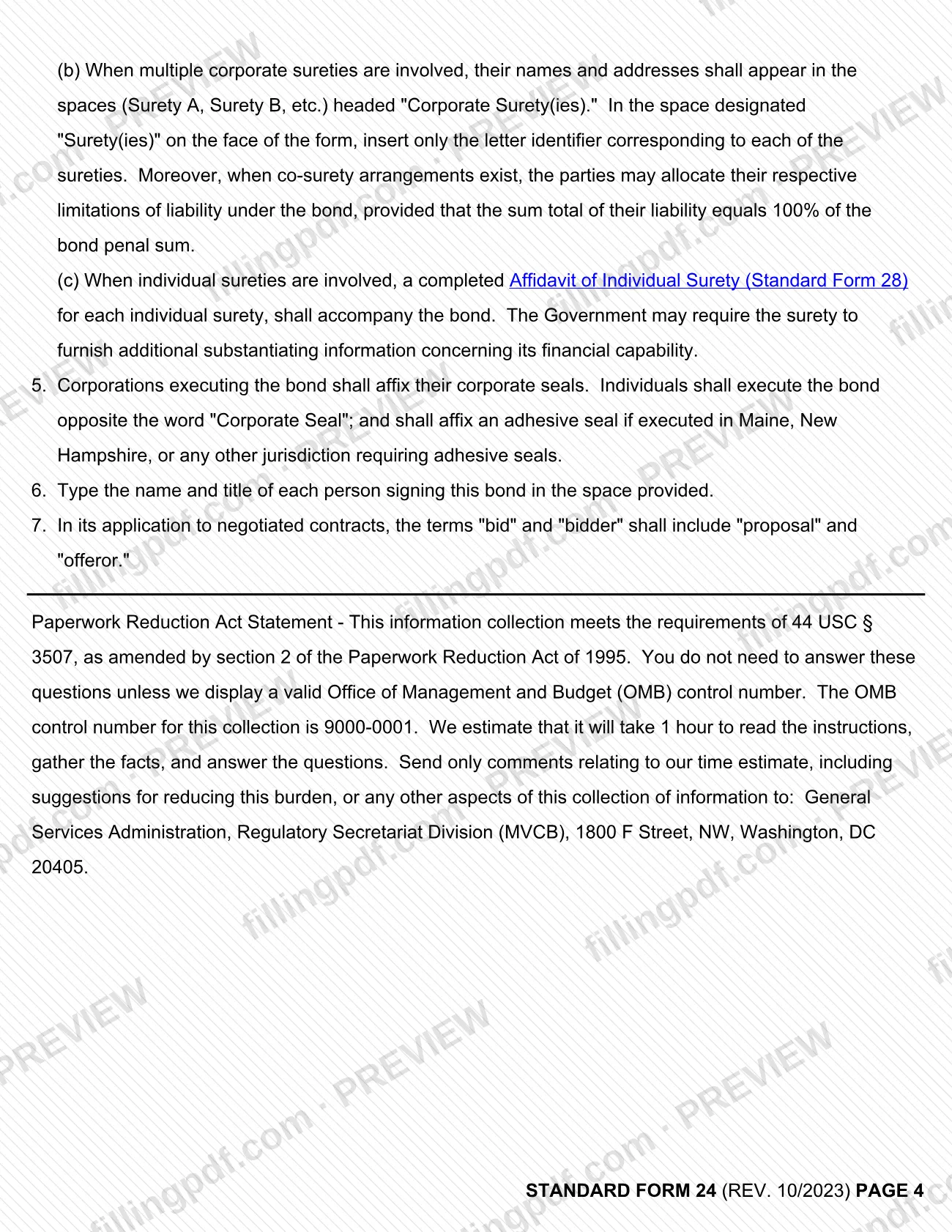
- Comments on the form. The only address printed is for comments on the time estimate or burden of the collection, not for sending the bond: General Services Administration, Regulatory Secretariat Division (MVCB), 1800 F Street, NW, Washington, DC 20405.
FillingPDF lets you fill out the form online and download the PDF; submission follows the agency's channels, not FillingPDF.
Common mistakes to avoid
- Entering a Date Bond Executed that is later than the bid opening date; the form says it must not be.
- Writing full surety names in the face "Surety(ies)" space when several corporate sureties sign; insert only the letter identifiers (A, B, etc.) and list names and addresses in the Corporate Surety(ies) blocks.
- Allocating co-surety liability limits that do not total 100% of the bond penal sum.
- Using an individual surety without attaching a completed Standard Form 28 for that surety.
- Using a corporate surety that is not on the Department of the Treasury's list of approved sureties or exceeds the limits listed there.
- Omitting the corporate seal, or failing to affix an adhesive seal when the bond is executed in Maine, New Hampshire or another jurisdiction requiring adhesive seals.
- Having an attorney-in-fact sign without furnishing evidence of authority, when that person is not a member of the firm, partnership or joint venture, or an officer of the corporation.
- Leaving off the typed name and title of each person signing the bond.
- Using the previous edition of the form or altering its text; the previous edition is not usable and deviations need written approval of the Administrator of General Services.
Frequently asked questions
What is the SF24 bid bond?
SF24, or Standard Form 24, is the Bid Bond prescribed by GSA for use when a bid guaranty is required. The Principal and its surety or sureties bind themselves to the United States for a stated penal sum if the Principal does not execute the contract documents and required bonds after its bid is accepted.
Can I fill out SF 24 online?
Yes. You can fill out the SF 24 PDF online on FillingPDF and download or print it. FillingPDF is an independent service and does not file the bond; it reaches the Government only through the channels that apply to your bid.
When must the bid bond be signed?
The date in the Date Bond Executed box must not be later than the bid opening date. The bond is therefore completed and signed before bids are opened for the bid it guarantees.
Who can be a surety on SF 24?
Corporate sureties must appear on the Department of the Treasury's list of approved sureties and act within its limitations. Individuals can also act as sureties, but each needs a completed Standard Form 28, Affidavit of Individual Surety, accompanying the bond.
How do I list more than one surety on SF 24?
Put each corporate surety's name, address and liability limit in its own block (Surety A, Surety B, and so on). In the Surety(ies) space on the face, insert only the matching letters. Co-sureties may allocate liability as long as the total equals 100% of the penal sum.
Who can sign the bid bond for a company?
An authorized person must sign. A representative such as an attorney-in-fact must furnish evidence of authority unless that person is a member of the firm, partnership or joint venture, or an officer of the corporation. Type each signer's name and title.
Does the bond need a seal?
Yes. Corporations affix their corporate seals. Individuals execute the bond opposite the word Corporate Seal and affix an adhesive seal if signing in Maine, New Hampshire or any other jurisdiction requiring adhesive seals.
Can the penal sum be a percentage of the bid price?
Yes. The instructions allow the penal sum to be expressed as a percentage of the bid price, and the bond may state a maximum dollar limit, using the Amount Not To Exceed columns on the form.
Can I still use an older edition of Standard Form 24?
No. The form printed REV. 10/2023 states that the previous edition is not usable. Any deviation from the form needs the written approval of the Administrator of General Services.
Ready to fill out SF 24?
Fill out SF 24 now