
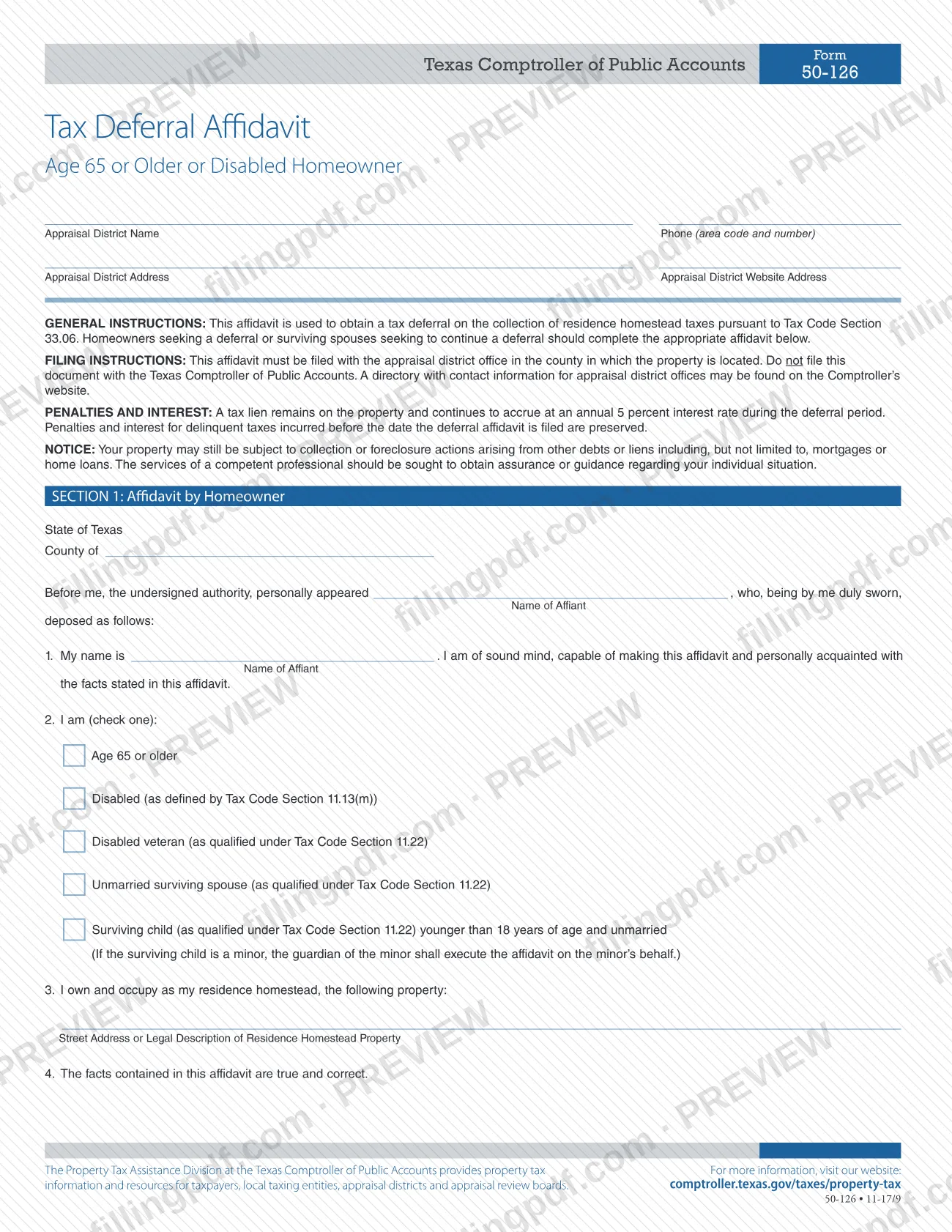
Form 50-126, Tax Deferral Affidavit (Age 65 or Older or Disabled Homeowner), is the Texas Comptroller of Public Accounts form a homeowner swears to in order to defer collection of residence homestead taxes under Tax Code Section 33.06. For homeowners dealing with Bexar County property tax, it is the statewide affidavit filed with the appraisal district in the county where the home is located, not with the Comptroller. On this page you can fill out the form online on FillingPDF and download or print the completed PDF; the form and the Comptroller's property tax resources are published at comptroller.texas.gov/taxes/property-tax.
Last updated
What is 50-126?
Form 50-126, Tax Deferral Affidavit, titled Age 65 or Older or Disabled Homeowner, is the Texas Comptroller of Public Accounts form that a homeowner swears before a notary to defer collection of residence homestead taxes under Tax Code Section 33.06.
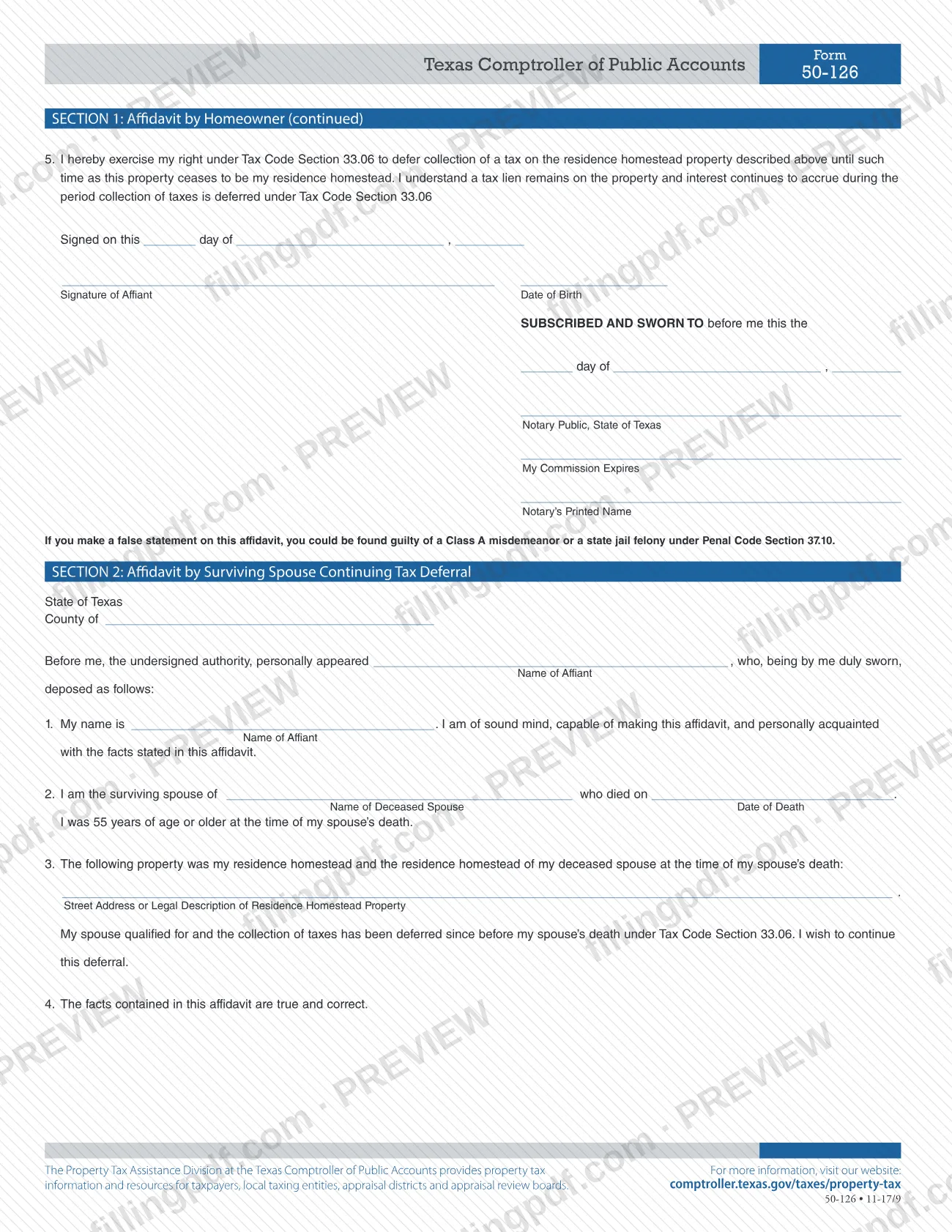
The form holds two affidavits. Section 1: Affidavit by Homeowner is for a homeowner who is seeking a deferral. Section 2: Affidavit by Surviving Spouse Continuing Tax Deferral is for a surviving spouse who wants to continue a deferral. You complete only the affidavit that fits your situation.
In either affidavit, the affiant states a right to defer collection of the tax on the residence homestead until the property ceases to be the affiant's residence homestead. The deferral does not remove the debt. The form says a tax lien remains on the property, interest continues to accrue during the deferral period, and penalties and interest on taxes that were delinquent before the date the affidavit is filed are preserved.
The form also warns that the property may still face collection or foreclosure over other debts or liens, such as a mortgage or home loan, and recommends seeking a competent professional for your own situation. A false statement can be prosecuted as a Class A misdemeanor or a state jail felony under Penal Code Section 37.10.
The Comptroller publishes the form, but the Comptroller does not receive it: the affidavit is filed with the appraisal district office.
Who needs to file 50-126?
Homeowners who own and occupy the property as their residence homestead and want to defer collection of its taxes complete Section 1. In item 2 of that section you check one status:
- age 65 or older;
- disabled, as defined by Tax Code Section 11.13(m);
- disabled veteran, as qualified under Tax Code Section 11.22;
- unmarried surviving spouse, as qualified under Tax Code Section 11.22;
- surviving child younger than 18 and unmarried, as qualified under Tax Code Section 11.22.
If the surviving child is a minor, the guardian of the minor executes the affidavit on the minor's behalf.
A surviving spouse who wants to continue a deferral completes Section 2. It states that the spouse was 55 years of age or older when the spouse died and that the property was the residence homestead of both spouses at the time of death.
The deferral covers collection of residence homestead taxes only. The form notes that your property may still be subject to collection or foreclosure actions from other debts or liens, including mortgages or home loans.
When to file 50-126
File the affidavit when you want collection of your residence homestead taxes deferred, or, for a surviving spouse, when you want to continue a deferral. The form prints no filing deadline. Timing still matters in one respect: penalties and interest on taxes that were already delinquent before the date you file the affidavit are preserved, so filing does not erase them.
Once filed, the deferral runs until the property ceases to be your residence homestead, according to the statement you swear to in item 5 of either section. Interest continues to accrue throughout that period.
How to fill out 50-126
Choose Section 1 or Section 2
Complete Section 1, Affidavit by Homeowner, if you are seeking a deferral. Complete Section 2, Affidavit by Surviving Spouse Continuing Tax Deferral, if you are a surviving spouse continuing one.
Enter the appraisal district details
At the top of the form, fill in the appraisal district name, its phone number, address and website address for the district in the county where the property is located. The Comptroller's directory lists these offices.
Enter the county and affiant name
Under State of Texas, write the county in the County of line and the affiant's name where the form says the affiant personally appeared. Repeat the name in item 1.
Check your status in Section 1
In item 2, check one box: age 65 or older, disabled, disabled veteran, unmarried surviving spouse, or surviving child younger than 18 and unmarried. A guardian executes the affidavit for a minor child.
Describe the homestead property
In item 3, enter the street address or legal description of the residence homestead property you own and occupy.
Complete the signature block
Items 4 and 5 are statements you swear to. Enter the day, month and year on the Signed on this line, then the signature of affiant and your date of birth.
Enter the deceased spouse's details
In Section 2, item 2, write the name of the deceased spouse and the date of death. The item states that you were 55 years of age or older when your spouse died.
Describe the property in Section 2
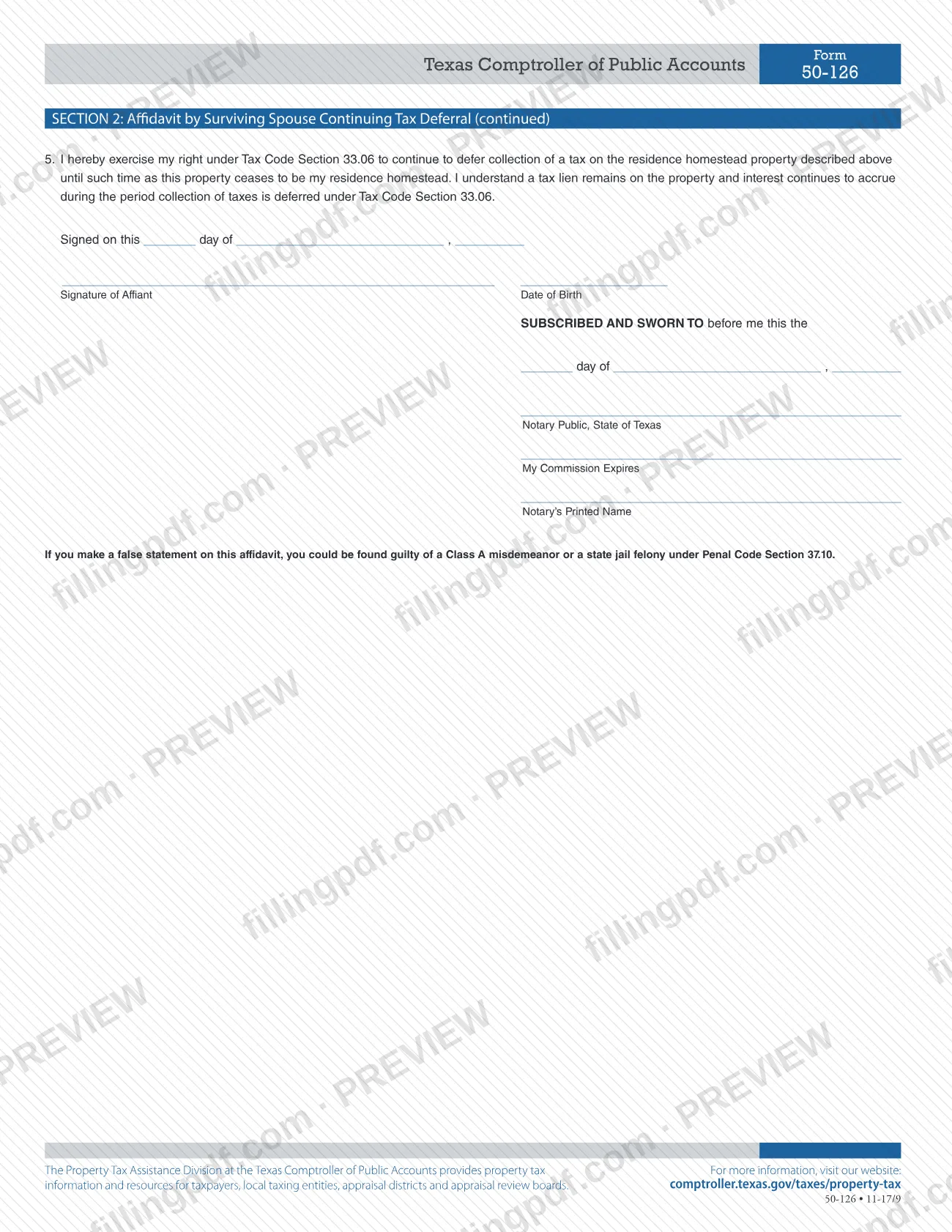
In item 3, enter the street address or legal description of the property that was the residence homestead of you and your deceased spouse at the time of death. Then sign, date and give your date of birth under item 5.
Have the notary complete the jurat
The notary fills in the Subscribed and Sworn To day, month and year, signs as Notary Public, State of Texas, and enters the commission expiration and printed name.
Review, sign and download the PDF
Check every entry against the section you used, then download or print the completed PDF from FillingPDF. Sign it as the form directs, have it notarized, and file it as described under How to submit.
How to submit 50-126
File the sworn and notarized affidavit with the appraisal district office in the county where the property is located. Do not file it with the Texas Comptroller of Public Accounts.
- Appraisal district office: the form does not print an address. The top of the page has lines for the appraisal district's name, phone number, address and website, and the form says a directory of appraisal district offices is on the Comptroller's website at comptroller.texas.gov/taxes/property-tax. Contact the district for how it accepts the affidavit.
- Notary: the form includes a notary block (day, notary public, commission expiration and printed name), so the affidavit is sworn before a notary public before it is filed.
For a home in Bexar County, that means the appraisal district office for that county. Do not send it to the Tax Assessor-Collector's payment channels unless that office tells you to.
FillingPDF lets you fill out and download the PDF; submission follows the channels above.
Common mistakes to avoid
- Filing the affidavit with the Texas Comptroller of Public Accounts; the form says to file it with the appraisal district office in the county where the property is located.
- Checking more than one status in item 2 of Section 1; the form asks you to check one.
- Completing Section 1 when you are a surviving spouse continuing an existing deferral; that case has its own affidavit in Section 2.
- Swearing the affidavit without a notary; both sections include a notary public block that must be completed.
- Leaving the date of birth blank next to the signature of affiant.
- Assuming the deferral cancels the tax: the form says a tax lien remains, interest continues to accrue, and earlier delinquent penalties and interest are preserved.
- Expecting the deferral to protect the home from foreclosure over a mortgage or other lien; the form warns that other debts can still lead to collection or foreclosure.
- Signing for a surviving child who is a minor; the guardian of the minor must execute the affidavit on the minor's behalf.
- Making a false statement on the affidavit, which the form says can be a Class A misdemeanor or a state jail felony under Penal Code Section 37.10.
Frequently asked questions
What is Form 50-126?
Form 50-126 is the Texas Comptroller of Public Accounts Tax Deferral Affidavit for an age 65 or older or disabled homeowner. It is used to defer collection of residence homestead taxes under Tax Code Section 33.06 and includes a separate affidavit for surviving spouses continuing a deferral.
Is Form 50-126 a Bexar County property tax form?
It is a statewide Texas Comptroller form, not a county form. For a home in Bexar County, you file it with the appraisal district office in that county, and you do not file it with the Comptroller. The form says a directory of appraisal districts is on the Comptroller's website.
Who can use the Tax Deferral Affidavit?
Homeowners who are age 65 or older, disabled, disabled veterans, unmarried surviving spouses or unmarried surviving children under 18 can use Section 1, if they own and occupy the home as their residence homestead. A surviving spouse who was 55 or older at the spouse's death can use Section 2.
Does the affidavit need to be notarized?
Yes. Both affidavits are sworn statements and each ends with a notary block: day, Notary Public, State of Texas, commission expiration date and the notary's printed name. Complete the form and have it sworn before a notary public before you file it.
Do I still owe interest if I defer my property taxes?
Yes. The form states that a tax lien remains on the property and interest continues to accrue during the deferral period. Penalties and interest on taxes that were delinquent before the affidavit was filed are preserved. Ask your appraisal district or taxing office about amounts.
Where do I file Form 50-126?
File it with the appraisal district office in the county where the property is located. Do not send it to the Texas Comptroller of Public Accounts. The Comptroller's website has a directory with contact information for the appraisal district offices.
How long does the tax deferral last?
The affidavit states that collection is deferred until the property ceases to be your residence homestead. A surviving spouse's affidavit uses the same wording to continue the deferral. The form prints no separate expiration date.
Can I fill out Form 50-126 online on FillingPDF?
Yes, you can fill out the PDF online on FillingPDF and download or print it. FillingPDF is an independent service and does not file the affidavit; you have it notarized and file it with the appraisal district yourself.
Ready to fill out 50-126?
Fill out 50-126 now