
Form CCAD-114, Residential Homestead Exemption Application, is the Collin Central Appraisal District (CCAD) application for claiming a residence homestead exemption on property you own and occupy as your principal residence. It is the form behind any Collin County homestead exemption listed in Section 1, from the general exemption to the age 65 or older, disabled person, disabled veteran and surviving spouse exemptions. On this page you can fill out the form online on FillingPDF and download or print the completed PDF; the original PDF is published by CCAD, and the application is returned to the appraisal district.
Last updated
What is CCAD-114?
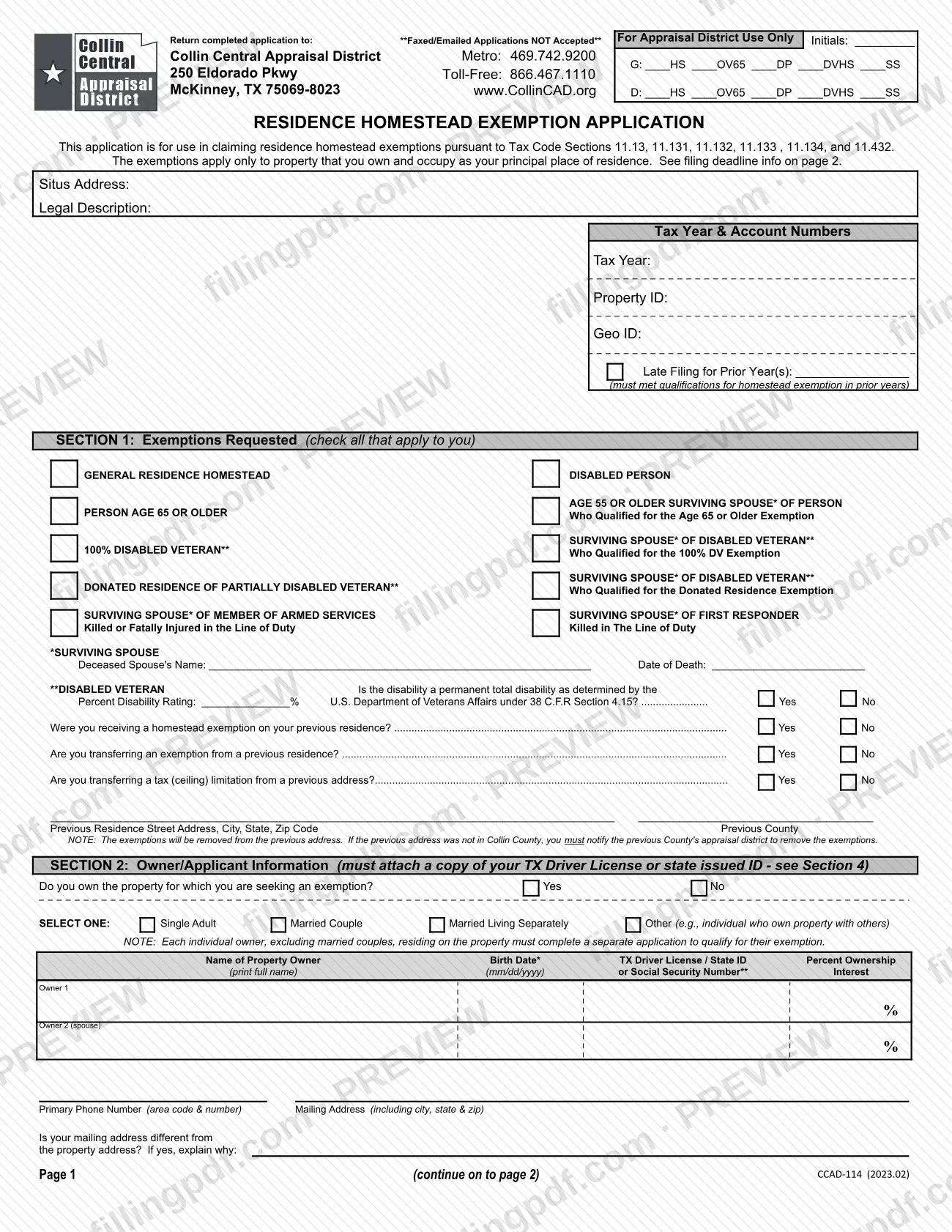
Form CCAD-114, Residential Homestead Exemption Application, is the Collin Central Appraisal District (CCAD) form used to claim residence homestead exemptions under Texas Tax Code Sections 11.13, 11.131, 11.132, 11.133, 11.134 and 11.432 for property you own and occupy as your principal place of residence. The first page of the PDF prints the title as Residence Homestead Exemption Application, and the footer shows the code CCAD-114 (2023.02).
One application covers every exemption you request. Section 1 lets you check all that apply: general residence homestead, age 55 or older surviving spouse, person age 65 or older, disabled person, 100% disabled veteran, donated residence of a partially disabled veteran, and the surviving spouses of people who qualified for those exemptions, of a member of the armed services killed or fatally injured in the line of duty, or of a first responder killed in the line of duty.
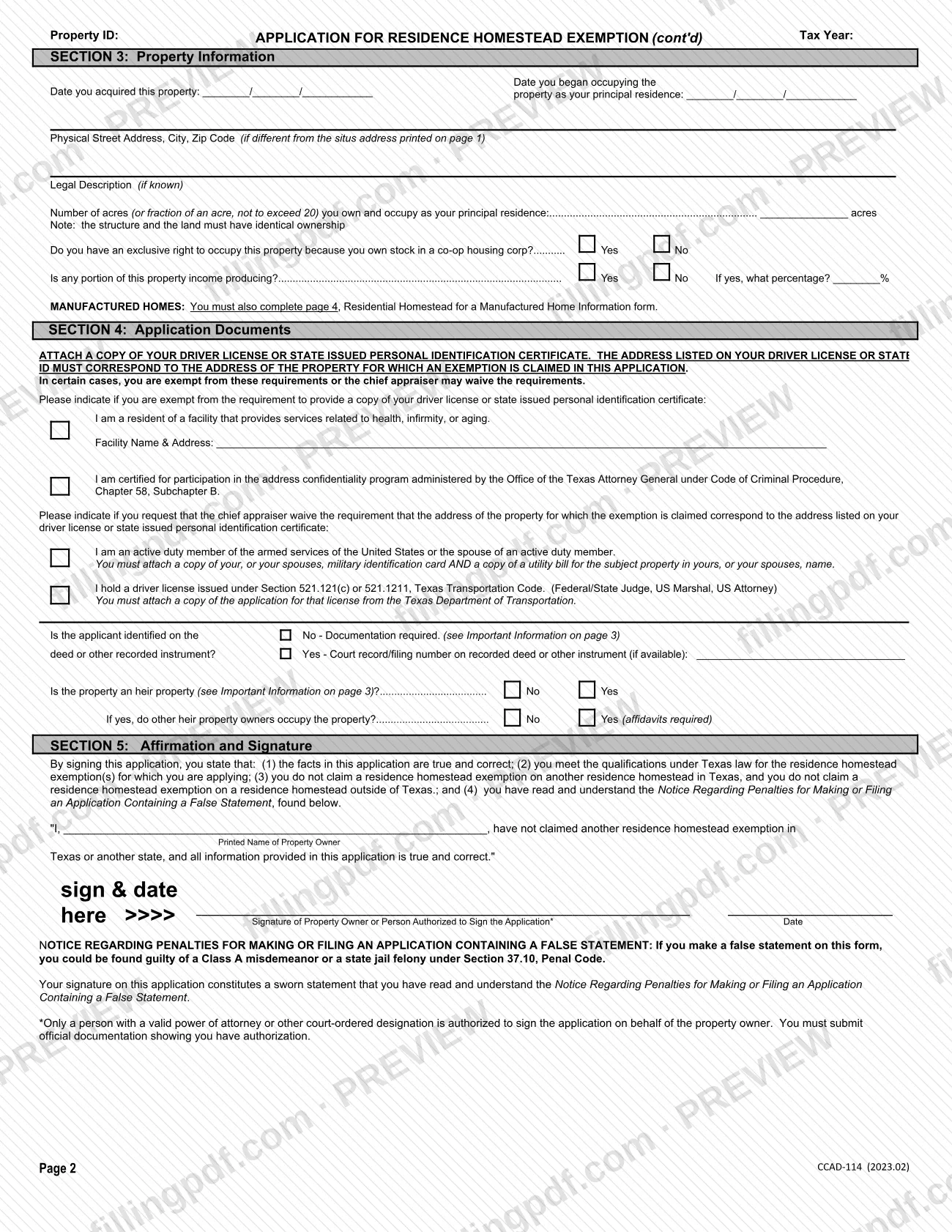
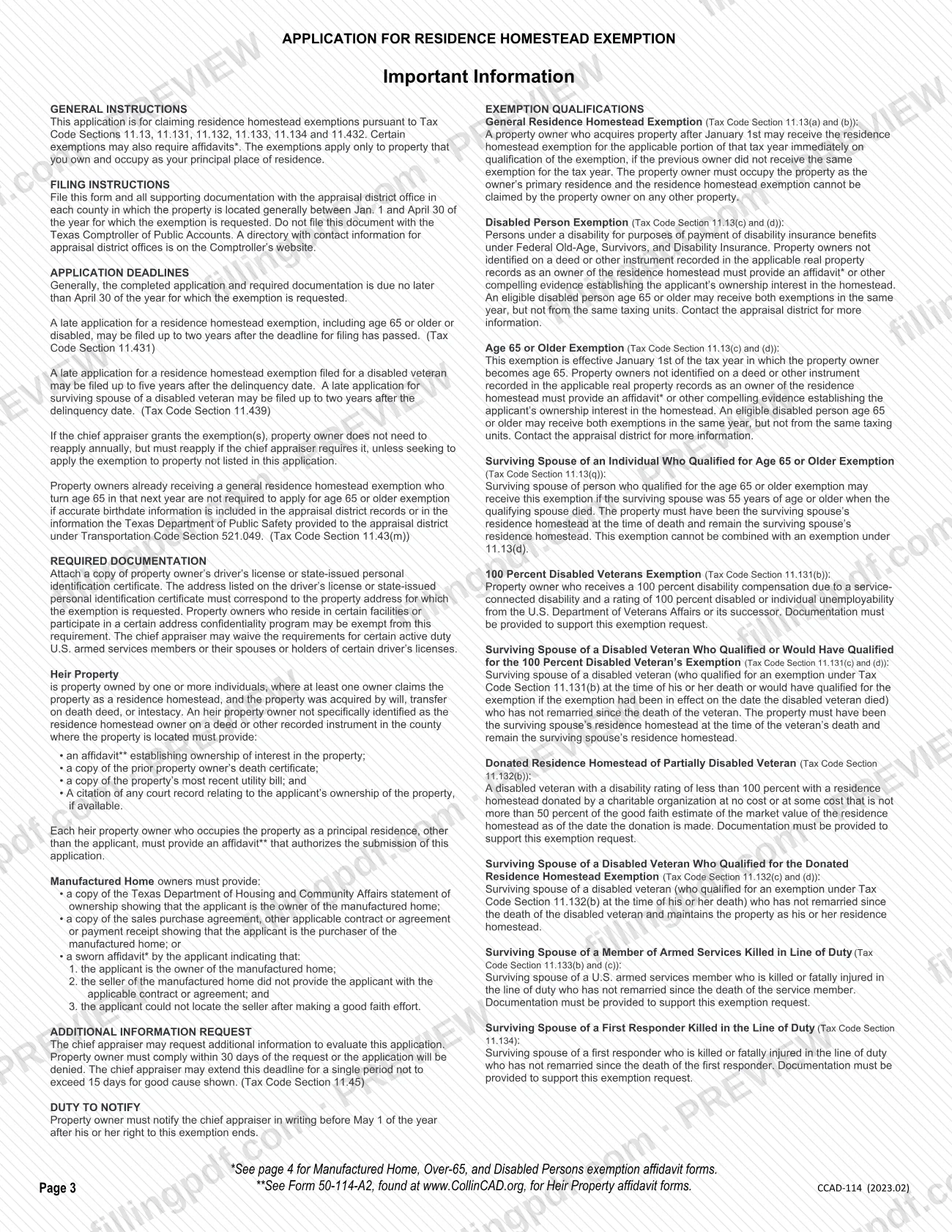
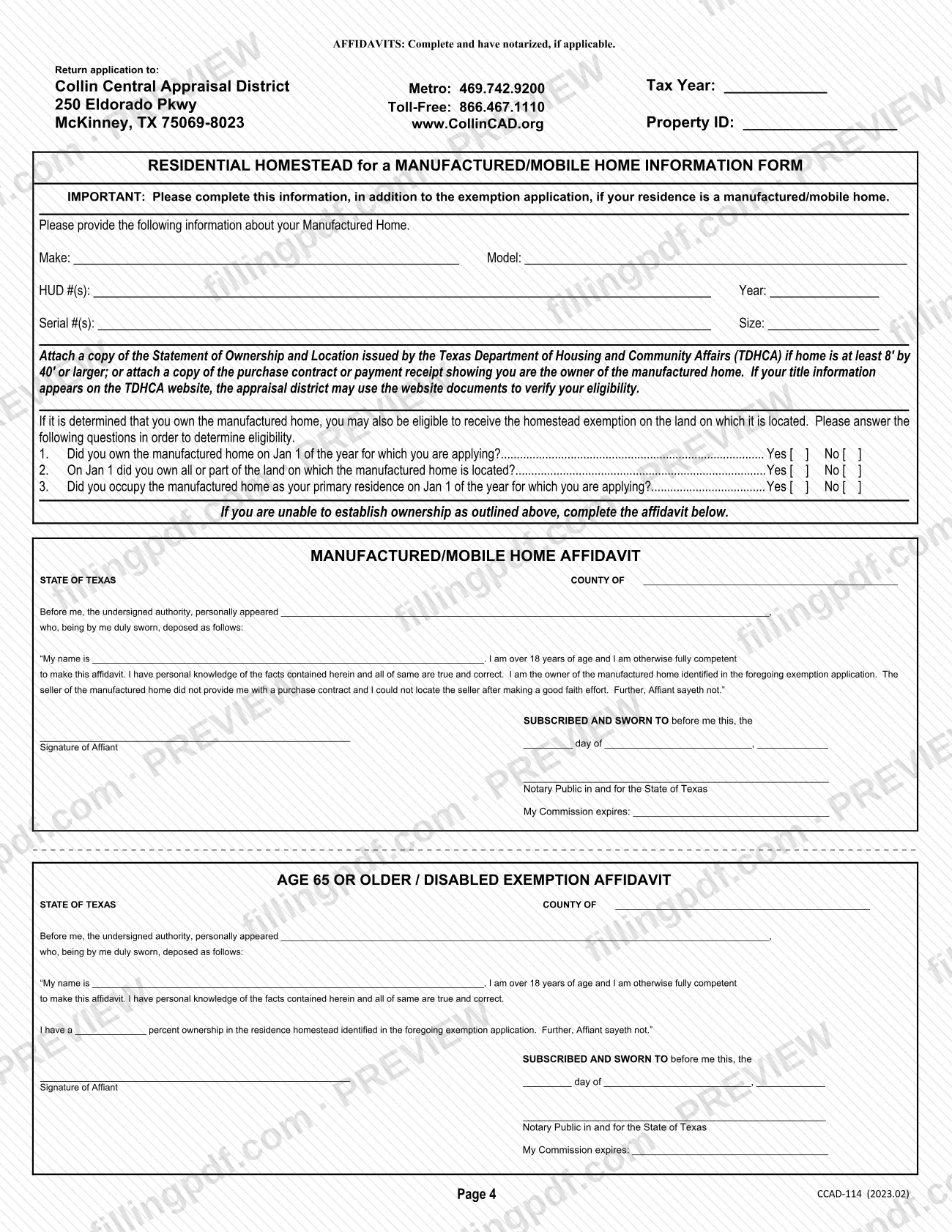
The form has five sections: exemptions requested, owner and applicant information, property information, application documents, and the affirmation and signature. Page 3 summarizes the qualifications for each exemption and the required documentation. Page 4 holds the Residential Homestead for a Manufactured/Mobile Home Information Form and two notarized affidavits, one for manufactured homes and one for the age 65 or older and disabled exemptions. Heir property affidavits use Form 50-114-A2, available at www.CollinCAD.org.
The form is not filed with the Texas Comptroller of Public Accounts. It goes to the appraisal district office in the county where the property is located. The Collin County Tax Assessor-Collector lists it among its forms for applying for the residential homestead exemption.
Who needs to file CCAD-114?
Property owners who own and occupy a home as their principal place of residence and want a residence homestead exemption use Form CCAD-114. The exemption cannot be claimed on any other property.
Section 1 recognizes these groups:
- owners seeking the general residence homestead exemption, including age 55 or older surviving spouses;
- persons age 65 or older;
- disabled persons, meaning persons under a disability for purposes of disability insurance benefits under Federal Old-Age, Survivors, and Disability Insurance;
- owners who receive 100 percent disability compensation as a disabled veteran;
- disabled veterans with a rating below 100 percent whose residence homestead was donated by a charitable organization;
- surviving spouses of people who qualified for the age 65 or older, 100% disabled veteran or donated residence exemption, of armed services members killed or fatally injured in the line of duty, and of first responders killed in the line of duty. They must not have remarried, and the property must remain their residence homestead.
Each individual owner living on the property, other than married couples, must complete a separate application. Owners with an ownership interest not shown on a recorded deed, heir property owners and manufactured home owners must provide additional documents. Only a person with a valid power of attorney or other court-ordered designation may sign for the owner, and that person must submit documentation of the authority.
When to file CCAD-114
File Form CCAD-114 generally between January 1 and April 30 of the year for which you request the exemption; the completed application and documents are generally due no later than April 30 of that year. A property owner who acquires property after January 1 may receive the general exemption for the applicable part of that tax year, if the previous owner did not receive the same exemption.
Late applications are allowed. A late application for a residence homestead exemption, including age 65 or older or disabled, may be filed up to two years after the filing deadline. For a disabled veteran, a late application may be filed up to five years after the delinquency date; for the surviving spouse of a disabled veteran, up to two years after the delinquency date. Enter the prior years on the Late Filing for Prior Year(s) line.
If the chief appraiser grants the exemption, you do not need to reapply each year unless the chief appraiser requires it. If the chief appraiser asks for more information, you must respond within 30 days or the application is denied. You must notify the chief appraiser in writing before May 1 of the year after your right to the exemption ends.
Documents you need
- A copy of your Texas driver license or state-issued personal identification certificate, showing the address of the property for which you claim the exemption. Residents of care facilities and address confidentiality program participants may be exempt.
- For a resident of a health, infirmity or aging services facility: indicate the exemption in Section 4 and give the facility name and address instead of the ID copy.
- For participants in the Texas Attorney General's address confidentiality program: check the box in Section 4 instead of attaching the ID copy.
- For active duty armed services members or their spouses requesting a waiver of the address match: a copy of the military identification card and a copy of a utility bill for the property in your or your spouse's name.
- For holders of a driver license under Section 521.121(c) or 521.1211, Texas Transportation Code: a copy of the application for that license from the Texas Department of Transportation.
- For the disabled person or age 65 or older exemption when you are not named on a recorded deed or instrument: an affidavit or other compelling evidence of your ownership interest. The form provides an affidavit on page 4.
- For heir property when you are not identified on a recorded deed: an affidavit establishing ownership interest (Form 50-114-A2), the prior owner's death certificate, the property's latest utility bill and any court record citation, if available.
- For heir property: an affidavit from each other heir owner who occupies the property as a principal residence, authorizing submission of the application.
- For manufactured home owners: the Residential Homestead for a Manufactured/Mobile Home Information Form on page 4, completed in addition to the application.
- For manufactured home ownership: a TDHCA Statement of Ownership and Location, or a purchase contract or payment receipt. Without these, a sworn affidavit that the seller gave no contract and could not be found after a good faith effort.
- For the 100% disabled veteran, donated residence, armed services killed in line of duty and first responder surviving spouse exemptions: documentation supporting the request, as page 3 requires.
- For anyone signing for the owner: a valid power of attorney or other court-ordered designation showing authorization.
How to fill out CCAD-114
Enter tax year and account numbers
At the top of page 1, fill in the situs address, legal description, Tax Year, Property ID and Geo ID. Use the Late Filing for Prior Year(s) line only if you met the homestead qualifications in those earlier years.
Check the exemptions requested
In Section 1, check all that apply to you, such as General Residence Homestead, Person Age 65 or Older, Disabled Person or Disabled Veteran. For a surviving spouse exemption, enter the deceased spouse's name and date of death.
Answer the disabled veteran question
If you claim a disabled veteran exemption, enter the Percent Disability Rating and answer Yes or No on whether the disability is a permanent total disability as determined by the U.S. Department of Veterans Affairs under 38 C.F.R. Section 4.15.
Report your previous residence
Answer Yes or No on whether you were receiving a homestead exemption on your previous residence, and whether you are transferring an exemption or a tax (ceiling) limitation. Give the previous street address, city, state, ZIP code and county.
Complete owner and applicant information
In Section 2, say whether you own the property and select one: Single Adult, Married Couple, Married Living Separately or Other. For each owner enter the full name, birth date (mm/dd/yyyy), Texas driver license or state ID number or Social Security number, and percent ownership interest.
Add phone and mailing address
Enter your primary phone number and mailing address. If the mailing address differs from the property address, explain why in the space provided.
Complete the property information
In Section 3, enter the date you acquired the property and the date you began occupying it as your principal residence (mm/dd/yyyy). Add a different physical address if needed, and the acres you own and occupy, not to exceed 20.
Answer co-op and income questions
Answer Yes or No on whether you have an exclusive right to occupy the property through stock in a co-op housing corporation, and whether any portion is income producing; if yes, enter the percentage.
Complete the manufactured home page
If your residence is a manufactured or mobile home, complete page 4: make, model, HUD number(s), year, serial number(s), size and the three January 1 questions. Use the affidavit there if you cannot establish ownership otherwise.
Complete the Section 4 documents
Check any exemption or waiver box that applies to the driver license requirement. Answer whether you are identified on the deed or other recorded instrument and whether the property is heir property.
Review, sign and download the PDF
In Section 5, print the owner's name and sign and date; a person signing for the owner needs a valid power of attorney or court-ordered designation. Download or print the completed PDF from FillingPDF and assemble the attachments described under How to submit.
How to submit CCAD-114
Return the completed Form CCAD-114 and all supporting documents to the Collin Central Appraisal District. The form prints that faxed or emailed applications are not accepted.
- Return address: Collin Central Appraisal District, 250 Eldorado Pkwy, McKinney, TX 75069-8023.
- Phone and website: Metro 469.742.9200, toll-free 866.467.1110, www.CollinCAD.org.
- Where not to send it: do not file this application with the Texas Comptroller of Public Accounts. File it with the appraisal district office in each county where the property is located.
Include the copy of your driver license or state-issued ID, plus any affidavits or other documents for the exemptions you request. If you are moving from a home outside Collin County, you must notify that county's appraisal district to remove the exemptions there. The Collin County Tax Assessor-Collector's forms page says mailing instructions are included with each form. The form prints no fee. FillingPDF lets you fill out and download the PDF; submission follows the channels above.
Common mistakes to avoid
- Faxing or emailing the application; the form states that faxed or emailed applications are not accepted.
- Attaching a driver license or state ID whose address does not match the property address, without checking a Section 4 exemption or waiver box.
- Filing with the Texas Comptroller of Public Accounts instead of the appraisal district office for the county where the property is located.
- Letting a co-owner who is not a married couple rely on one application; each individual owner living on the property, excluding married couples, files a separate one.
- Leaving out the page 4 manufactured home information form when the residence is a manufactured or mobile home.
- Not responding to a chief appraiser's request for more information within 30 days, which results in denial of the application.
- Skipping the surviving spouse details (deceased spouse's name and date of death) when checking a surviving spouse exemption.
- Signing for the owner without a valid power of attorney or court-ordered designation and its documentation.
- Claiming a residence homestead exemption on another residence in Texas or outside Texas while signing the affirmation, which says you do not.
- Not notifying the chief appraiser in writing before May 1 of the year after your right to the exemption ends.
Frequently asked questions
What is Form CCAD-114 used for?
Form CCAD-114 is the Collin Central Appraisal District application for residence homestead exemptions on property you own and occupy as your principal residence. One form covers the general exemption plus age 65 or older, disabled person, disabled veteran and surviving spouse exemptions.
When is the Collin County homestead exemption application due?
Generally by April 30 of the year for which you request the exemption; the form says to file between January 1 and April 30. A late application may be filed up to two years after the deadline, with longer periods for disabled veterans.
Do I have to reapply for my homestead exemption every year?
Not usually. If the chief appraiser grants the exemption, you do not need to reapply annually unless the chief appraiser requires it or you want it applied to property not listed in your application.
Can I email or fax Form CCAD-114?
No. The form states that faxed or emailed applications are not accepted. Return the completed application and supporting documents to Collin Central Appraisal District, 250 Eldorado Pkwy, McKinney, TX 75069-8023.
What do I attach to the homestead exemption application?
Attach a copy of your Texas driver license or state-issued ID showing the property address. Exemptions apply for facility residents and address confidentiality program participants, and the chief appraiser may waive the match for certain active duty members. Other cases need affidavits or supporting documents.
Who can sign the application for the owner?
Only a person with a valid power of attorney or other court-ordered designation may sign for the property owner, and you must submit official documentation showing that authorization. Otherwise the owner prints their name, signs and dates Section 5.
Do co-owners file one application or separate ones?
Married couples file one application. Each other individual owner living on the property, such as someone who owns with others, must complete a separate application to qualify for their exemption.
Can I fill out Form CCAD-114 online on FillingPDF?
Yes. You can fill out the fillable PDF online on FillingPDF and download or print it. FillingPDF is independent of the appraisal district and does not file the form; you return it to CCAD yourself.
Ready to fill out CCAD-114?
Fill out CCAD-114 now