
The Certificate of Occupancy (CO) Checklist is the City of Dallas Planning & Development Department's application checklist and list of required documents for a Dallas certificate of occupancy, whether the use is the same as the previous use or a change of use. It tells you which plans, analyses and extra documents to prepare, including for personal services, assembly, storage, manufacturing, alcohol and food uses. The CO review can also lead to a building permit and other trade permits, which matters if you are researching a Dallas permit for a tenant space. On this page you can fill out the form online on FillingPDF and download or print the completed PDF; the checklist itself is published by the City of Dallas at dallascityhall.com.
Last updated
What is 25-001?
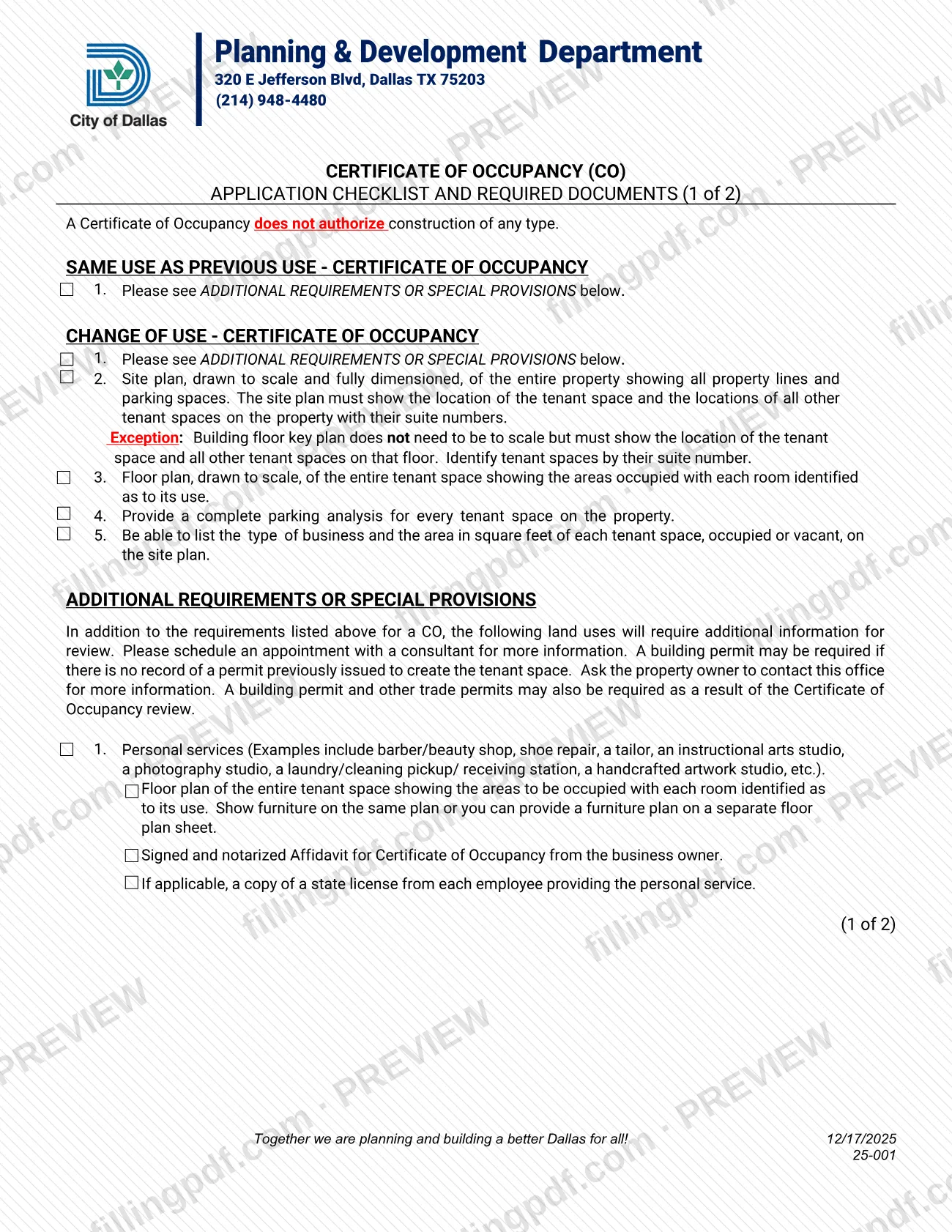
The Certificate of Occupancy (CO) Checklist is the two-page application checklist and required-documents list that the City of Dallas Planning & Development Department publishes for a Certificate of Occupancy, covering same-use and change-of-use applications and special land uses.
The checklist opens with a warning that a Certificate of Occupancy does not authorize construction of any type. It then sorts requirements into two groups. For a CO where the use is the same as the previous use, it sends you to the section on additional requirements or special provisions. For a change of use, it adds a site plan, a floor plan, a parking analysis and a list of the business type and square footage of each tenant space.
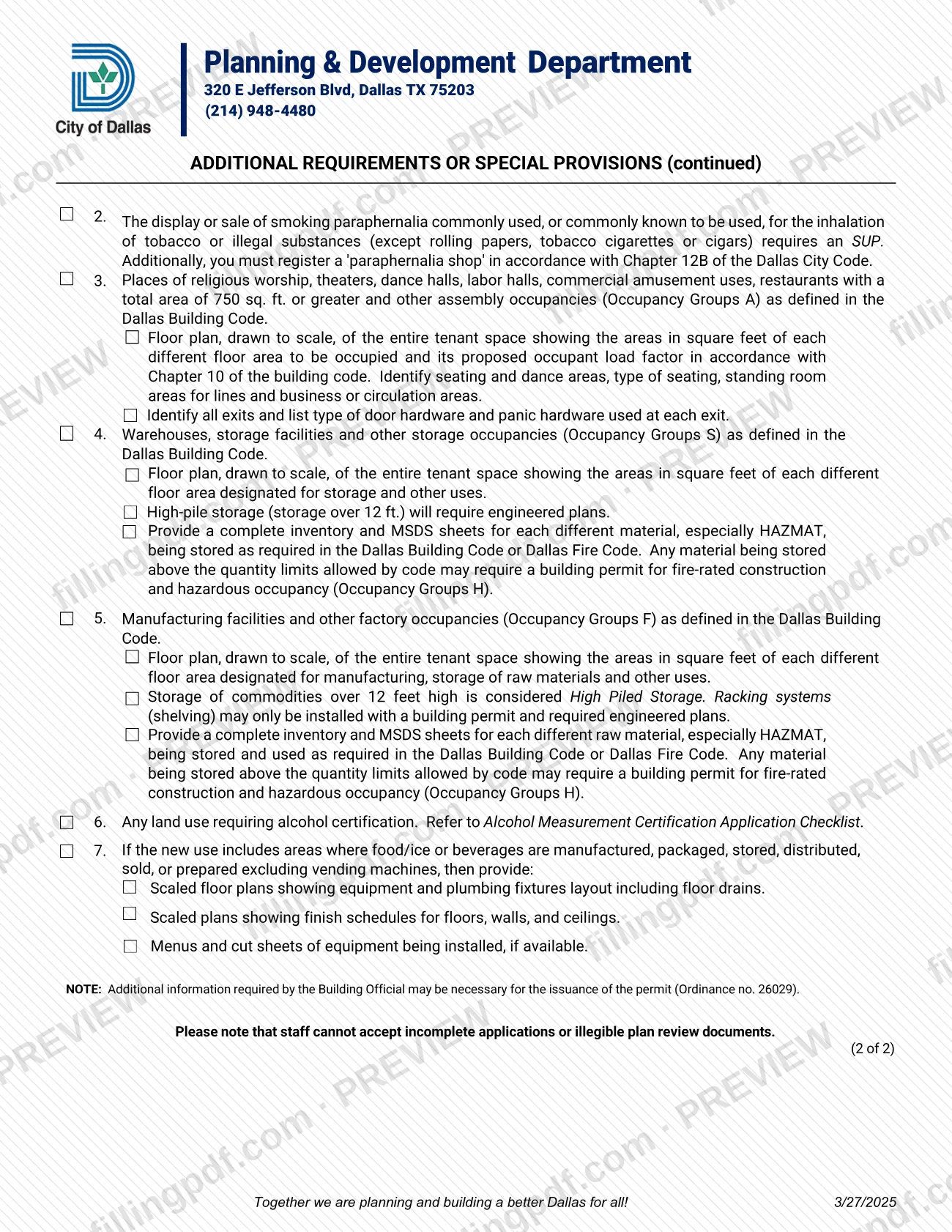
The second part, titled Additional Requirements or Special Provisions, lists land uses that need more information: personal services, smoking paraphernalia, assembly occupancies, storage, manufacturing, uses that need alcohol certification and food or beverage areas. It also warns that a building permit and other trade permits may be required as a result of the CO review.
The checklist is a list of what to prepare. It does not issue the certificate and does not replace the Affidavit for Certificate of Occupancy or the Alcohol Measurement Certification Application Checklist, which it mentions for certain uses.
Who needs to file 25-001?
Business owners, tenants and property owners who are applying for a Certificate of Occupancy for a tenant space in Dallas use this checklist to see what the application must contain. It applies in two situations:
- Same use as previous use: the use of the space is not changing. The checklist sends you to the additional requirements and special provisions for your land use.
- Change of use: the use of the space is changing. You also need the site plan, floor plan, parking analysis and tenant-space listing described on the checklist.
Some land uses carry extra requirements on top of either situation: personal services, shops that display or sell smoking paraphernalia, places of religious worship, theaters, dance halls, labor halls, commercial amusement uses, restaurants with a total area of 750 sq. ft. or greater and other assembly occupancies, warehouses and other storage, manufacturing and factory uses, uses requiring alcohol certification, and areas where food, ice or beverages are made, packaged, stored, distributed, sold or prepared (vending machines excluded).
Do not use a CO to authorize construction: the checklist states that it does not. If there is no record of a permit for creating the tenant space, the property owner is asked to contact the office.
When to file 25-001
Use the checklist when you apply for a Certificate of Occupancy, whether for the same use as the previous use or for a change of use. It prints no deadline or validity period. Because staff cannot accept incomplete applications or illegible plan review documents, gather every listed item before you apply. A building permit may be required if there is no record of a permit previously issued to create the tenant space, and the CO review can also lead to a building permit and other trade permits. For the uses with additional requirements, the checklist asks you to schedule an appointment with a consultant.
Documents you need
- Change of use: site plan, drawn to scale and fully dimensioned, of the entire property showing all property lines, parking spaces, the tenant space and all other tenant spaces with their suite numbers.
- Change of use, exception to the site plan: a building floor key plan, not necessarily to scale, showing the tenant space and all other tenant spaces on that floor by suite number.
- Change of use: floor plan, drawn to scale, of the entire tenant space showing the areas occupied, with each room identified by its use.
- Change of use: a complete parking analysis for every tenant space on the property.
- Change of use: the type of business and the area in square feet of each tenant space, occupied or vacant, listed on the site plan.
- Personal services: floor plan of the areas to be occupied with each room's use and furniture shown on it or on a separate furniture plan sheet.
- Personal services: signed and notarized Affidavit for Certificate of Occupancy from the business owner, plus a copy of a state license from each employee providing the service, if applicable.
- Assembly occupancies (Group A uses): scaled floor plan with square feet of each floor area, proposed occupant load factor per Chapter 10, seating and dance areas, all exits and door and panic hardware.
- Storage occupancies (Group S): scaled floor plan of storage and other areas; engineered plans for high-pile storage over 12 ft.; inventory and MSDS sheets for each material, especially HAZMAT.
- Manufacturing occupancies (Group F): scaled floor plan of manufacturing, raw-material storage and other areas; inventory and MSDS sheets for each raw material; engineered plans and a building permit for racking systems.
- Land uses requiring alcohol certification: the Alcohol Measurement Certification Application Checklist requirements.
- Food, ice or beverage areas (vending machines excluded): scaled floor plans with equipment, plumbing fixtures and floor drains, and scaled finish schedules for floors, walls and ceilings.
- Food, ice or beverage areas: menus and cut sheets of the equipment being installed, if available.
- Smoking paraphernalia display or sale (rolling papers, tobacco cigarettes and cigars excepted): an SUP, and registration as a paraphernalia shop under Chapter 12B of the Dallas City Code.
How to fill out 25-001
Confirm what a CO covers
Read the opening line: a Certificate of Occupancy does not authorize construction of any type. Plan for a building permit separately if the checklist's permit warnings apply.
Choose same use or change of use
Decide whether the use is the same as the previous use or a change of use. Same use points you to the additional requirements; change of use adds items 2 through 5.
Prepare the site plan
For a change of use, draw a scaled, fully dimensioned site plan of the entire property showing property lines, parking spaces, your tenant space and every other tenant space with its suite number. A floor key plan not to scale may be used where the exception applies.
Prepare the tenant floor plan
Draw a floor plan to scale of the entire tenant space showing occupied areas, with each room identified by its use.
Add parking analysis and tenant list
Provide a complete parking analysis for every tenant space on the property. On the site plan, list the type of business and area in square feet of each tenant space, occupied or vacant.
Check your land use's special provisions
Compare your use with the seven land uses under Additional Requirements or Special Provisions. If one applies, schedule an appointment with a consultant.
Add personal services documents
For personal services, show furniture on the floor plan or a separate sheet, attach the signed and notarized Affidavit for Certificate of Occupancy, and add each employee's state license if applicable.
Add occupancy-specific plans
For assembly, storage or manufacturing uses, add the scaled floor plan with the areas, occupant load, exits or inventory and MSDS sheets the checklist lists. Include engineered plans for high-pile storage over 12 ft.
Add alcohol and food documents
For alcohol uses, follow the Alcohol Measurement Certification Application Checklist. For food, ice or beverage areas, add scaled equipment and plumbing plans, finish schedules and, if available, menus and cut sheets.
Review, download and print the PDF
Check that every plan is legible and every item for your use is included. Download or print the completed PDF from FillingPDF and take it to the department as described under How to submit.
How to submit 25-001
The checklist names no portal, mailing address or drop-off rule for the application; the contact details printed on it are those of the department, and for certain uses it asks you to schedule an appointment with a consultant.
- Office: Planning & Development Department, 320 E Jefferson Blvd, Dallas TX 75203.
- Phone: (214) 948-4480.
- Appointment: for the land uses listed under Additional Requirements or Special Provisions, schedule an appointment with a consultant for more information.
Bring or provide complete documents. The checklist states that staff cannot accept incomplete applications or illegible plan review documents, and that the Building Official may require additional information (Ordinance no. 26029). For alcohol uses, refer to the Alcohol Measurement Certification Application Checklist. If a building permit may be needed for the tenant space, ask the property owner to contact the office. FillingPDF lets you fill out and download the PDF; submission follows the department's channels above.
Common mistakes to avoid
- Treating the Certificate of Occupancy as permission to build; the checklist states it does not authorize construction of any type.
- Submitting an incomplete application or illegible plan review documents, which staff cannot accept.
- Drawing the site plan without all other tenant spaces and their suite numbers, or without all property lines and parking spaces.
- Leaving out the parking analysis for every tenant space on the property when the application is a change of use.
- Not listing the type of business and square footage of each tenant space, occupied or vacant, on the site plan.
- Providing a personal services affidavit that is not both signed and notarized by the business owner.
- Planning storage or racking above 12 ft. without engineered plans; racking systems may be installed only with a building permit.
- Selling or displaying smoking paraphernalia without an SUP and without registering the paraphernalia shop under Chapter 12B.
- Assuming no building permit is needed when there is no record of a permit issued to create the tenant space.
Frequently asked questions
What is the Dallas Certificate of Occupancy (CO) Checklist?
It is the City of Dallas Planning & Development Department's application checklist and list of required documents for a Certificate of Occupancy. It separates same-use and change-of-use applications and lists extra requirements for certain land uses.
Does a Certificate of Occupancy let me start construction?
No. The checklist states that a Certificate of Occupancy does not authorize construction of any type. A building permit and other trade permits may also be required as a result of the CO review.
What do I need for a change of use CO in Dallas?
A scaled, fully dimensioned site plan of the whole property, a scaled floor plan of the tenant space with each room's use, a complete parking analysis for every tenant space, and the business type and square footage of each tenant space, plus any special provisions for your use.
Does the personal services affidavit have to be notarized?
Yes. For personal services such as barber or beauty shops, the checklist requires a signed and notarized Affidavit for Certificate of Occupancy from the business owner, plus a state license copy for each employee providing the service, if applicable.
Which uses need extra documents besides the basic CO items?
Personal services, smoking paraphernalia, assembly occupancies (including restaurants of 750 sq. ft. or greater), storage, manufacturing, alcohol-certified uses, and areas where food, ice or beverages are made or sold. For these, schedule an appointment with a consultant.
Do I need a building permit with my Dallas CO application?
Possibly. A building permit may be required if there is no record of a permit previously issued to create the tenant space, and building and other trade permits may result from the CO review. The checklist asks the property owner to contact the office.
Who do I contact about the CO checklist?
The checklist prints the Planning & Development Department at 320 E Jefferson Blvd, Dallas TX 75203, phone (214) 948-4480. For uses with additional requirements it asks you to schedule an appointment with a consultant.
Can I fill out the Dallas CO checklist online?
You can fill out the PDF online on FillingPDF and download or print it. FillingPDF is independent of the City of Dallas and does not submit anything to it; you deliver your application through the department's channels.
Ready to fill out 25-001?
Fill out 25-001 now