
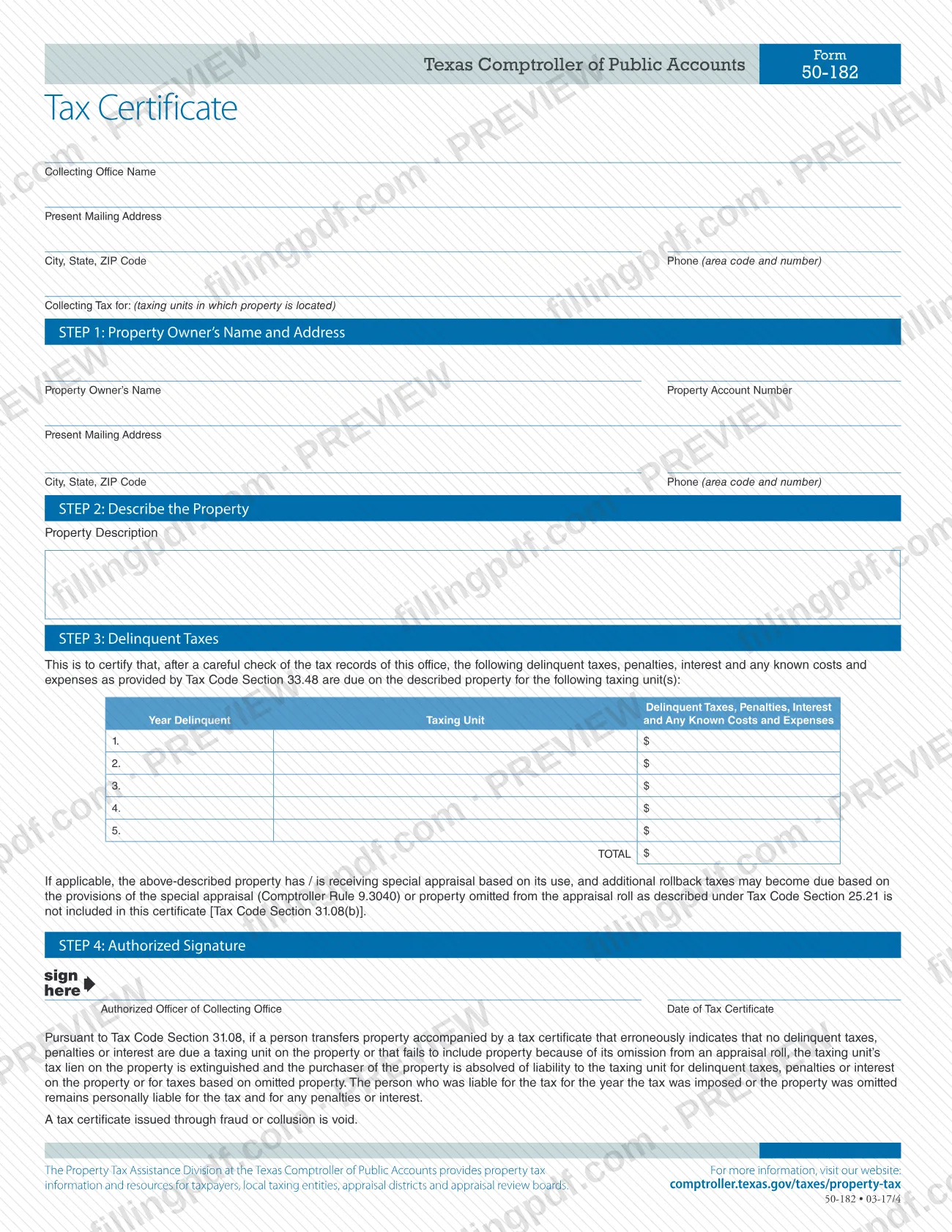
Form 50-182, Tax Certificate, is a property tax form published by the Texas Comptroller of Public Accounts. A collecting office uses it to certify the delinquent taxes, penalties, interest and known costs due on a described property, for each taxing unit it collects for. A tax certificate of this kind accompanies a transfer of property, so the people who rely on it are the owner, the buyer and the collecting office. On this page you can fill out the form online on FillingPDF and download or print the completed PDF; the original is published by the Comptroller at comptroller.texas.gov.
Last updated
What is 50-182?
Form 50-182, Tax Certificate, is the Texas Comptroller of Public Accounts form on which a collecting office certifies, after checking its tax records, the delinquent taxes, penalties, interest and any known costs and expenses due on a described property for the listed taxing units.
The form has four steps. Step 1 identifies the property owner and the property account number. Step 2 describes the property. Step 3 lists, line by line, each delinquent year and taxing unit with the amount due, and ends with a total. Step 4 carries the signature of an authorized officer of the collecting office and the date of the certificate. The header block at the top names the collecting office, its mailing address and phone, and the taxing units for which it collects.
The costs and expenses on Step 3 are those provided by Tax Code Section 33.48. The form also states two limits on what the certificate covers: additional rollback taxes may become due when the property receives special appraisal based on its use (Comptroller Rule 9.3040), and property omitted from the appraisal roll as described under Tax Code Section 25.21 is not included [Tax Code Section 31.08(b)].
Under Tax Code Section 31.08, a certificate that erroneously shows no delinquent taxes, penalties or interest, or that omits property because it was left off an appraisal roll, extinguishes the taxing unit's tax lien when the property is transferred with that certificate. A tax certificate issued through fraud or collusion is void. Form 50-182 is one of the Comptroller's property tax forms; it is separate from the allocation, school district value study and tax rate forms on the same agency page.
Who needs to file 50-182?
The collecting office completes and signs Form 50-182. The form asks for the Collecting Office Name, its present mailing address and phone, the taxing units for which it collects, and the signature of an authorized officer of the collecting office, so it is not a form a property owner fills out about their own property.
People who deal with the certificate:
- Collecting offices that need to certify delinquent taxes, penalties, interest and known costs on a described property.
- Property owners named in Step 1, whose name and property account number appear on the certificate.
- Purchasers and other transferees, because under Tax Code Section 31.08 a certificate that accompanies a transfer of property affects the taxing unit's lien and the purchaser's liability.
The form does not cover additional rollback taxes on property under special appraisal, or property omitted from the appraisal roll under Tax Code Section 25.21. The person who was liable for the tax for the year it was imposed, or the year the property was omitted, remains personally liable for the tax and any penalties or interest, even when the lien is extinguished.
When to file 50-182
The form sets no filing deadline. The triggering event is a transfer of property: Tax Code Section 31.08, quoted on the form, speaks of a person who transfers property accompanied by a tax certificate. The collecting office dates the certificate in the Date of Tax Certificate box next to the authorized officer's signature, so the figures on it are those the office certified from its tax records on that date.
The certificate states the delinquent taxes, penalties, interest and known costs and expenses due at the time it is completed. It does not include additional rollback taxes that may become due under special appraisal, or property omitted from the appraisal roll under Tax Code Section 25.21.
How to fill out 50-182
Enter the collecting office details
At the top, enter the Collecting Office Name, its Present Mailing Address, the City, State, ZIP Code and the Phone (area code and number).
Name the taxing units collected for
In the line Collecting Tax for, list the taxing units in which the property is located.
Complete Step 1 owner information
Enter the Property Owner's Name and the Property Account Number, then the owner's present mailing address, city, state, ZIP code and phone.
Describe the property in Step 2
Write the property description in the Property Description box so the property covered by the certificate can be identified.
List delinquent years and taxing units
In Step 3, use lines 1 to 5 to enter each delinquent year, the taxing unit, and the delinquent taxes, penalties, interest and any known costs and expenses under Tax Code Section 33.48.
Enter the total amount due
On the TOTAL line, enter the sum of the amounts on lines 1 to 5.
Review the special appraisal statement
Read the statement on special appraisal and rollback taxes (Comptroller Rule 9.3040) and on omitted property under Tax Code Section 25.21, and complete it where it applies to the property.
Sign and date in Step 4
The Authorized Officer of Collecting Office signs, and the Date of Tax Certificate is entered beside the signature.
Review and download the completed PDF
Check names, account number, property description, years, taxing units and the total against the office's tax records. Download or print the completed PDF from FillingPDF.
How to submit 50-182
Form 50-182 prints no mailing address, portal or filing office of its own. The collecting office completes and signs it, and under Tax Code Section 31.08 the certificate accompanies the transfer of the property; the form does not name an agency that receives it.
- From the collecting office: the office enters its name, present mailing address and phone at the top and issues the signed certificate.
- Questions about the form: the Property Tax Assistance Division of the Texas Comptroller of Public Accounts provides property tax information at comptroller.texas.gov/taxes/property-tax.
- Questions about a particular property: the Comptroller's property tax forms page says that taxing units answer questions about tax bills, and that its Local Property Information webpage lists taxing units and contact information for appraisal districts and county tax assessor-collectors.
FillingPDF lets you fill out and download the PDF; delivery of the signed certificate follows the practice of the collecting office and the transfer it accompanies.
Common mistakes to avoid
- Certifying that no delinquent taxes, penalties or interest are due when some are. Under Tax Code Section 31.08 the taxing unit's lien is extinguished on a transfer with that certificate.
- Leaving out known costs and expenses in Step 3; the certification covers delinquent taxes, penalties, interest and any known costs and expenses under Tax Code Section 33.48.
- Listing delinquent years without the taxing unit for each line, when the form asks for year, taxing unit and amount on lines 1 to 5.
- Leaving the TOTAL line unfilled or not matching the amounts entered on lines 1 to 5.
- Treating the certificate as covering rollback taxes or omitted property; the form says rollback taxes may become due and omitted property under Tax Code Section 25.21 is not included.
- Leaving Step 4 unsigned or without the Date of Tax Certificate; the form calls for an authorized officer of the collecting office.
- Using the certificate when it was obtained through fraud or collusion; the form says such a certificate is void.
Frequently asked questions
What is Form 50-182, Tax Certificate?
It is a Texas Comptroller of Public Accounts form on which a collecting office certifies, after checking its tax records, the delinquent taxes, penalties, interest and known costs and expenses due on a described property for the listed taxing units.
Who fills out a tax certificate on Form 50-182?
The collecting office. The form asks for the collecting office's name, address and phone, and for the signature of an authorized officer of that office and the date of the certificate. The property owner is only identified in Step 1.
What happens if a tax certificate wrongly shows no taxes due?
Under Tax Code Section 31.08, quoted on the form, if property is transferred with a certificate that erroneously shows no delinquent taxes, penalties or interest, the taxing unit's lien is extinguished and the purchaser is absolved. The person liable for the tax stays personally liable.
Does the tax certificate include rollback taxes?
No. The form states that additional rollback taxes may become due when property receives special appraisal based on its use (Comptroller Rule 9.3040), and that property omitted from the appraisal roll under Tax Code Section 25.21 is not included in the certificate.
Can a tax certificate be void?
Yes. The form states that a tax certificate issued through fraud or collusion is void. Nothing on the form changes that.
Can I fill out Form 50-182 online?
You can fill out the PDF online on FillingPDF and download or print it. FillingPDF is independent of the Texas Comptroller and does not issue, sign or deliver the certificate; the collecting office completes that part.
Where do I send Form 50-182?
The form prints no address or portal for it. The collecting office issues the signed certificate, which accompanies the property transfer under Tax Code Section 31.08. For questions, see comptroller.texas.gov/taxes/property-tax or contact the taxing unit.
Which revision of Form 50-182 is this?
The form prints 50-182 • 03-17/4 at the bottom, issued by the Texas Comptroller of Public Accounts. Check the Comptroller's property tax forms page for the current edition.
Ready to fill out 50-182?
Fill out 50-182 now