
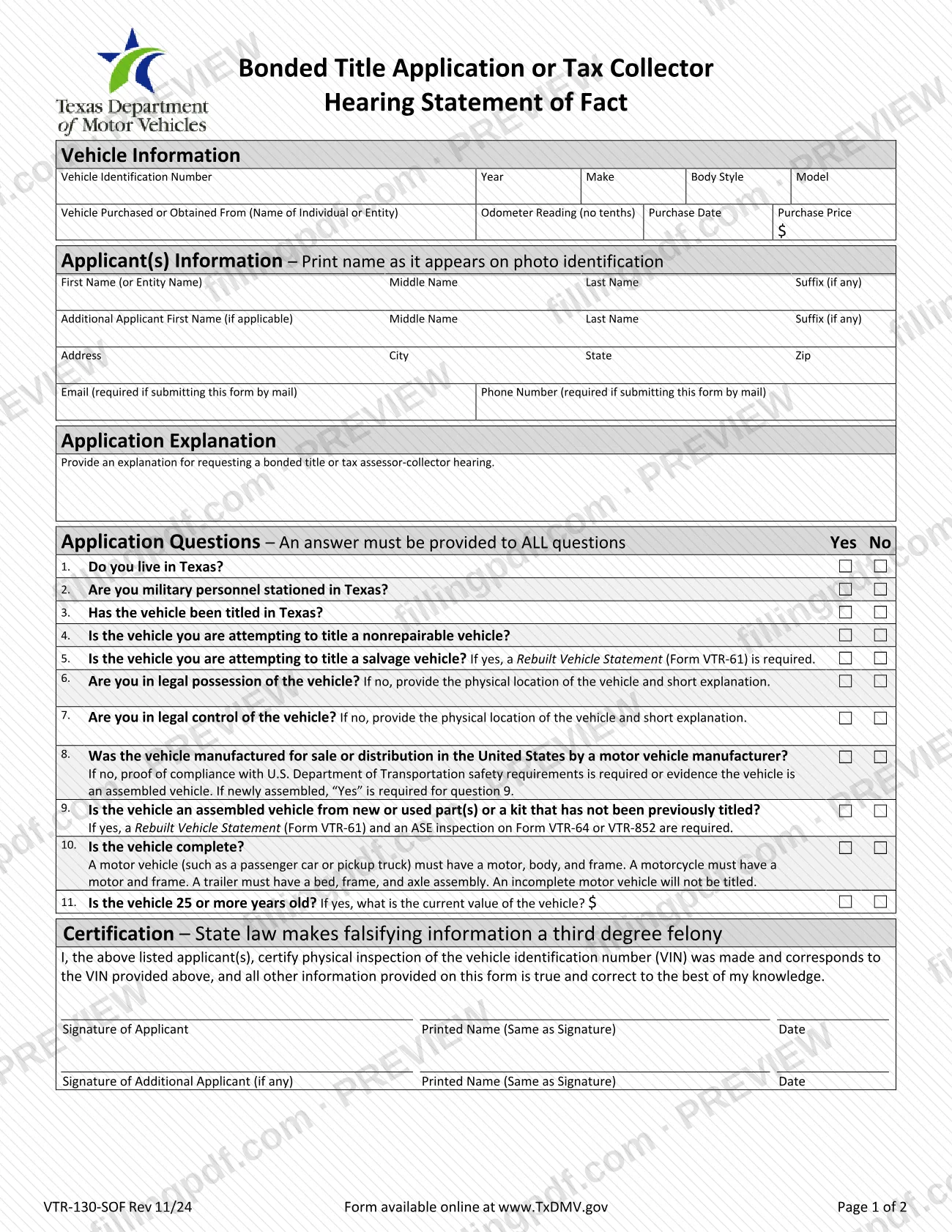
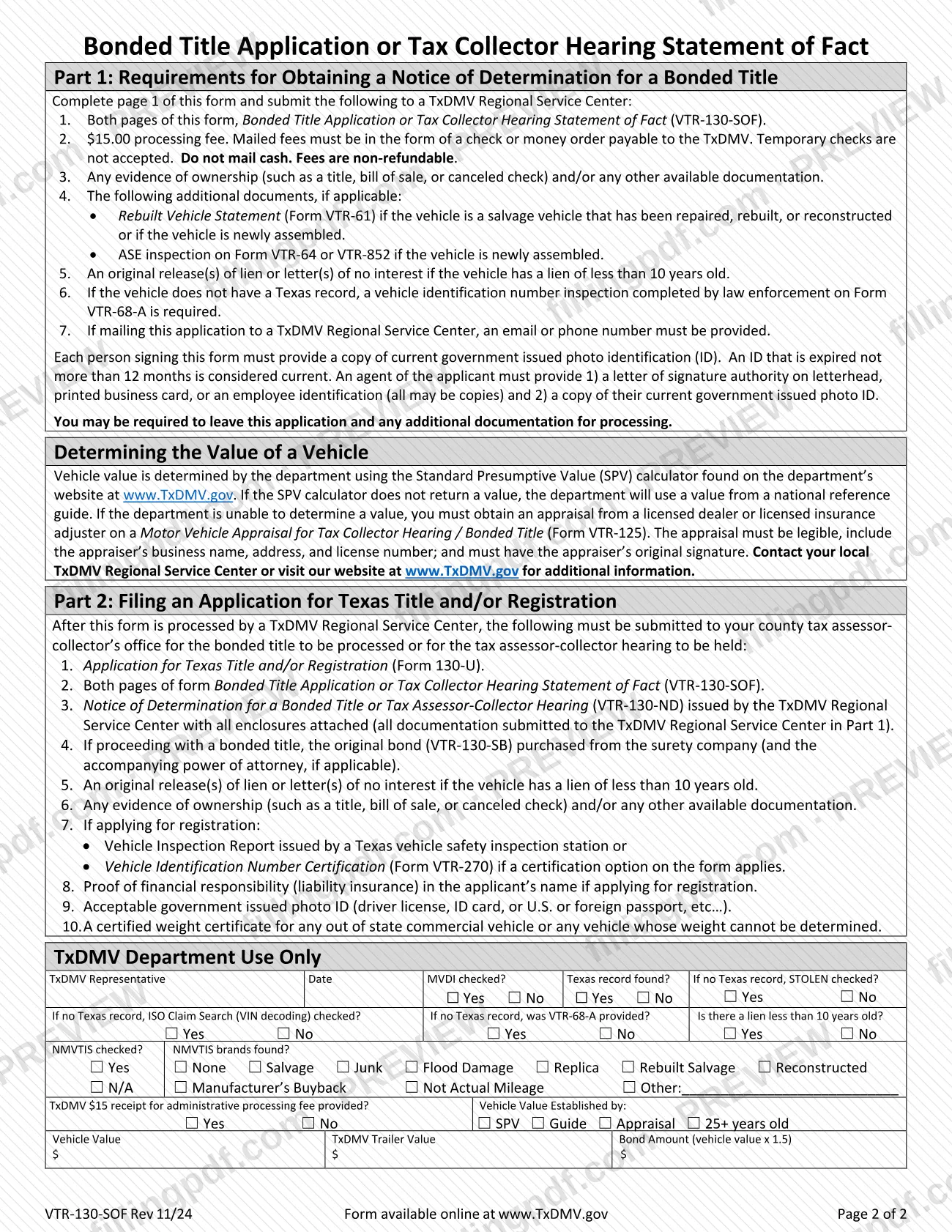
VTR-130-SOF is the Bonded Title Application or Tax Collector Hearing Statement of Fact, a two-page form from the Texas Department of Motor Vehicles (TxDMV). You complete page 1 to describe the vehicle, identify the applicant(s), explain why you need a bonded title or a tax assessor-collector hearing, and certify the answers. On FillingPDF you can fill out the form online and download or print the completed PDF; TxDMV publishes the original at txdmv.gov, and the form is submitted through the TxDMV and county channels described below.
Last updated
What is VTR-130-SOF?
Bonded Title Application or Tax Collector Hearing Statement of Fact (VTR-130-SOF) is the Texas Department of Motor Vehicles (TxDMV) form on which an applicant describes a vehicle and certifies the facts behind a request for a bonded title or a tax assessor-collector hearing.
Page 1 is the statement itself: vehicle information, applicant information, an application explanation, eleven yes/no application questions and a certification. The form warns that state law makes falsifying information a third degree felony. Page 2 holds two parts of instructions and a "TxDMV Department Use Only" block that the applicant does not complete.
The form works in two stages. In Part 1, you submit it to a TxDMV Regional Service Center to obtain a Notice of Determination for a Bonded Title. In Part 2, after the Regional Service Center has processed it, you file it with your county tax assessor-collector's office together with Form 130-U, the Notice of Determination (VTR-130-ND) and other documents, so that the bonded title can be processed or the hearing held.
Companion documents named on the form include the Rebuilt Vehicle Statement (Form VTR-61), the ASE inspection forms VTR-64 and VTR-852, the vehicle identification number inspection on Form VTR-68-A, the Motor Vehicle Appraisal for Tax Collector Hearing / Bonded Title (Form VTR-125), the bond (VTR-130-SB) and the Vehicle Identification Number Certification (Form VTR-270).
Who needs to file VTR-130-SOF?
Applicants who are asking TxDMV for a bonded title or a tax assessor-collector hearing for a vehicle use this form. An individual or an entity can be the applicant, and the form has room for one additional applicant.
Conditions tied to the form:
- Each person signing must provide a copy of current government-issued photo identification. An ID that expired not more than 12 months ago is considered current.
- An agent of the applicant must provide a letter of signature authority on letterhead, a printed business card or an employee identification (copies are allowed), plus a copy of the agent's current government-issued photo ID.
- If you mail the application to a TxDMV Regional Service Center, you must give an email address and a phone number.
The questions on the form flag situations that need extra paperwork: a salvage vehicle, a newly assembled vehicle, a vehicle not manufactured for sale in the United States, or a vehicle with no Texas record. The form also states that an incomplete motor vehicle will not be titled.
When to file VTR-130-SOF
Submit the form when you need a bonded title or a tax assessor-collector hearing for a vehicle and are starting the process. Part 1 comes first: you send it to a TxDMV Regional Service Center to obtain the Notice of Determination for a Bonded Title.
Part 2 follows only after the Regional Service Center has processed the form. You then take the form, with the Notice of Determination (VTR-130-ND) and the other listed documents, to your county tax assessor-collector's office so that the bonded title can be processed or the hearing held. No filing deadline is printed on the form.
Documents you need
- Both pages of Form VTR-130-SOF, submitted to the TxDMV Regional Service Center for Part 1.
- Any evidence of ownership, such as a title, bill of sale or canceled check, and any other available documentation.
- Copy of current government-issued photo ID for each person signing; an ID expired not more than 12 months is considered current.
- For an agent signing: a letter of signature authority on letterhead, printed business card or employee ID (copies allowed), plus a copy of the agent's current photo ID.
- Rebuilt Vehicle Statement (Form VTR-61), if the vehicle is a salvage vehicle that has been repaired, rebuilt or reconstructed, or is newly assembled.
- ASE inspection on Form VTR-64 or VTR-852, if the vehicle is newly assembled.
- Original release(s) of lien or letter(s) of no interest, if the vehicle has a lien less than 10 years old.
- Vehicle identification number inspection by law enforcement on Form VTR-68-A, if the vehicle does not have a Texas record.
- Motor Vehicle Appraisal for Tax Collector Hearing / Bonded Title (Form VTR-125), only if TxDMV cannot determine the vehicle's value.
- Part 2, at the county tax office: Form 130-U, the Notice of Determination (VTR-130-ND) with all enclosures, and the original bond (VTR-130-SB) with its power of attorney if applicable, when proceeding with a bonded title.
- Part 2, if applying for registration: a Vehicle Inspection Report from a Texas safety inspection station, or Form VTR-270 if a certification option applies, and proof of financial responsibility in the applicant's name.
- Part 2: a certified weight certificate for any out-of-state commercial vehicle or any vehicle whose weight cannot be determined.
How to fill out VTR-130-SOF
Enter the vehicle information
Under Vehicle Information, write the Vehicle Identification Number, year, make, body style and model. Add the odometer reading with no tenths.
Record the purchase details
Enter the name of the individual or entity the vehicle was purchased or obtained from, the purchase date and the purchase price.
Identify the applicant
Print the first name (or entity name), middle name, last name and suffix as they appear on your photo identification. Add an additional applicant in the next row if there is one.
Give address and contact details
Enter address, city, state and ZIP. Provide an email and phone number; both are required if you submit the form by mail.
Explain your request
In the Application Explanation box, explain why you are requesting a bonded title or a tax assessor-collector hearing.
Answer questions 1 through 8
Check Yes or No for each. Questions 6 and 7 need the vehicle's physical location and a short explanation if you answer No; question 5 points to Form VTR-61 for a salvage vehicle, and question 8 requires proof of U.S. Department of Transportation compliance or evidence of an assembled vehicle if No.
Answer questions 9 through 11
Question 9 on assembled vehicles requires Form VTR-61 and an ASE inspection (VTR-64 or VTR-852) if Yes. Answer question 10 on completeness, and for question 11 enter the current value if the vehicle is 25 or more years old.
Certify, sign and date
Confirm that you physically inspected the VIN. Sign, print your name the same as the signature and date it; an additional applicant signs on the next line.
Leave the department block blank
Do not write in the TxDMV Department Use Only section on page 2; TxDMV completes it.
Review and download the PDF
Check that all questions are answered and names match your ID. Download or print the completed PDF from FillingPDF and assemble the package under How to submit.
How to submit VTR-130-SOF
The form is submitted in two steps: first to a TxDMV Regional Service Center, then to your county tax assessor-collector's office.
- TxDMV Regional Service Center (Part 1): send both pages of VTR-130-SOF with the evidence and documents listed under required documents. The form does not print an address; contact your local TxDMV Regional Service Center or visit www.TxDMV.gov. If you mail it, give an email address and phone number. You may be required to leave the application and documentation for processing.
- County tax assessor-collector's office (Part 2): after the Regional Service Center processes the form, file the items listed in Part 2 of the form there.
A processing fee applies. Mailed fees must be a check or money order payable to the TxDMV; temporary checks are not accepted, cash must not be mailed and fees are non-refundable. Ask TxDMV for the current amount.
FillingPDF lets you fill out and download the PDF; submission follows the channels above.
Common mistakes to avoid
- Leaving any of the eleven Application Questions unanswered; the form requires an answer to all of them.
- Submitting only page 1; Part 1 requires both pages of the form.
- Mailing the application without an email address and phone number, which are required when you mail it to a Regional Service Center.
- Printing a name that differs from the photo identification; the applicant name must appear as it does on the ID.
- Answering No to question 6 or 7 without giving the vehicle's physical location and a short explanation.
- Marking a salvage or newly assembled vehicle without attaching Form VTR-61, or omitting the ASE inspection (VTR-64 or VTR-852) for a newly assembled vehicle.
- Leaving out the original release of lien or letter of no interest when the vehicle has a lien less than 10 years old.
- Mailing cash or a temporary check for the processing fee; only a check or money order payable to the TxDMV is accepted by mail.
- Signing without physically inspecting the VIN, which the certification states was done and matches the VIN on the form.
Frequently asked questions
What is VTR-130-SOF used for?
VTR-130-SOF is the TxDMV statement of fact for a bonded title or a tax assessor-collector hearing. You describe the vehicle, explain your request, answer eleven questions and certify the information. It is submitted first to a TxDMV Regional Service Center.
Where do I submit the VTR-130-SOF form?
Part 1 goes to a TxDMV Regional Service Center. After it is processed, you file the form with the other Part 2 documents at your county tax assessor-collector's office. The form prints no address, so contact your local Regional Service Center or visit www.TxDMV.gov.
Is there a fee to file VTR-130-SOF?
Yes, a processing fee applies and it is non-refundable. Mailed fees must be a check or money order payable to the TxDMV; temporary checks are not accepted and cash must not be mailed. Ask TxDMV for the current amount.
Do I need photo ID to file the VTR-130-SOF?
Yes. Each person signing must provide a copy of current government-issued photo ID; an ID expired not more than 12 months counts as current. An agent must also give a signature authority letter, business card or employee ID, plus their own photo ID.
What happens after the Regional Service Center processes the form?
TxDMV issues a Notice of Determination (VTR-130-ND). You then take it, with Form 130-U, both pages of VTR-130-SOF and the other Part 2 items, to your county tax assessor-collector's office for the bonded title or hearing.
How is the vehicle's value determined?
TxDMV uses its Standard Presumptive Value (SPV) calculator, then a national reference guide if the calculator returns nothing. If it still cannot determine a value, you must obtain an appraisal on Form VTR-125 from a licensed dealer or licensed insurance adjuster.
Can I fill out VTR-130-SOF online?
You can fill out the PDF online on FillingPDF and download or print it. FillingPDF is an independent service and does not file the form or submit it to TxDMV; you submit it through the TxDMV and county channels.
Do I need an inspection if the vehicle has no Texas record?
Yes. If the vehicle does not have a Texas record, a vehicle identification number inspection completed by law enforcement on Form VTR-68-A is required with the Part 1 submission.
Ready to fill out VTR-130-SOF?
Fill out VTR-130-SOF now