
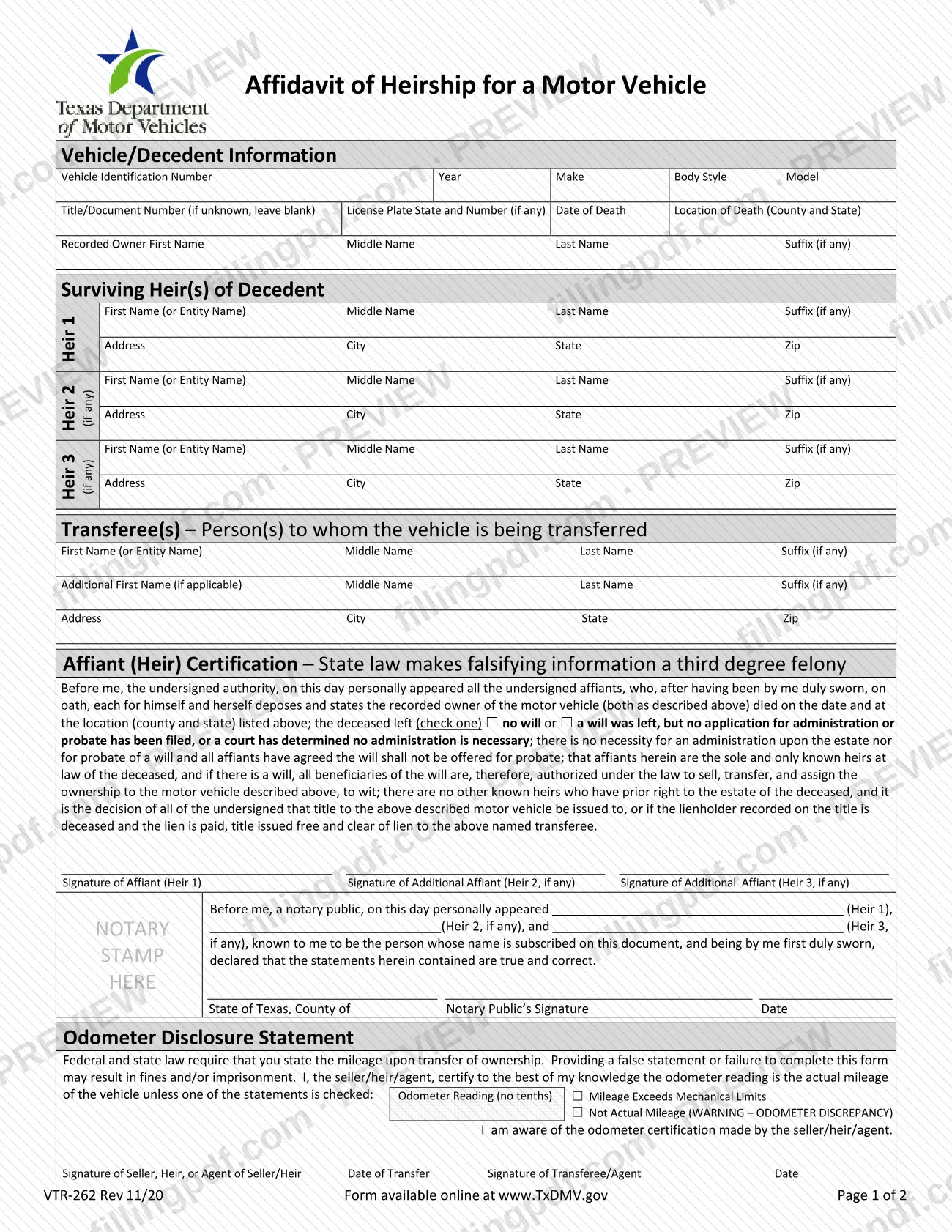
VTR-262 is the Affidavit of Heirship for a Motor Vehicle, a Texas Department of Motor Vehicles (TxDMV) form in which the heirs of a deceased vehicle owner swear before a notary that they are the heirs and agree to whom the title will be issued. It applies when the estate has had no administration and none is necessary. On this page you can fill out the form online on FillingPDF and download or print the completed PDF; TxDMV publishes the original at www.TxDMV.gov, and the transferee submits the signed form with the title application to a county tax assessor-collector's office.
Last updated
What is VTR-262?
Form VTR-262, Affidavit of Heirship for a Motor Vehicle, is the Texas Department of Motor Vehicles (TxDMV) form in which the surviving heirs of a deceased vehicle owner swear, before a notary, that they are the sole known heirs and decide who receives the vehicle title.
The form has four parts on page 1: vehicle and decedent information, the surviving heirs (up to three per copy), the transferee or transferees, and the Affiant (Heir) Certification with a notary block. An Odometer Disclosure Statement follows. In the certification the affiants state that the owner died on the date and in the county and state listed, that the deceased left no will, or that a will was left but no application for administration or probate has been filed or a court has determined no administration is necessary, and that they agree the will will not be offered for probate. State law makes falsifying the information a third degree felony.
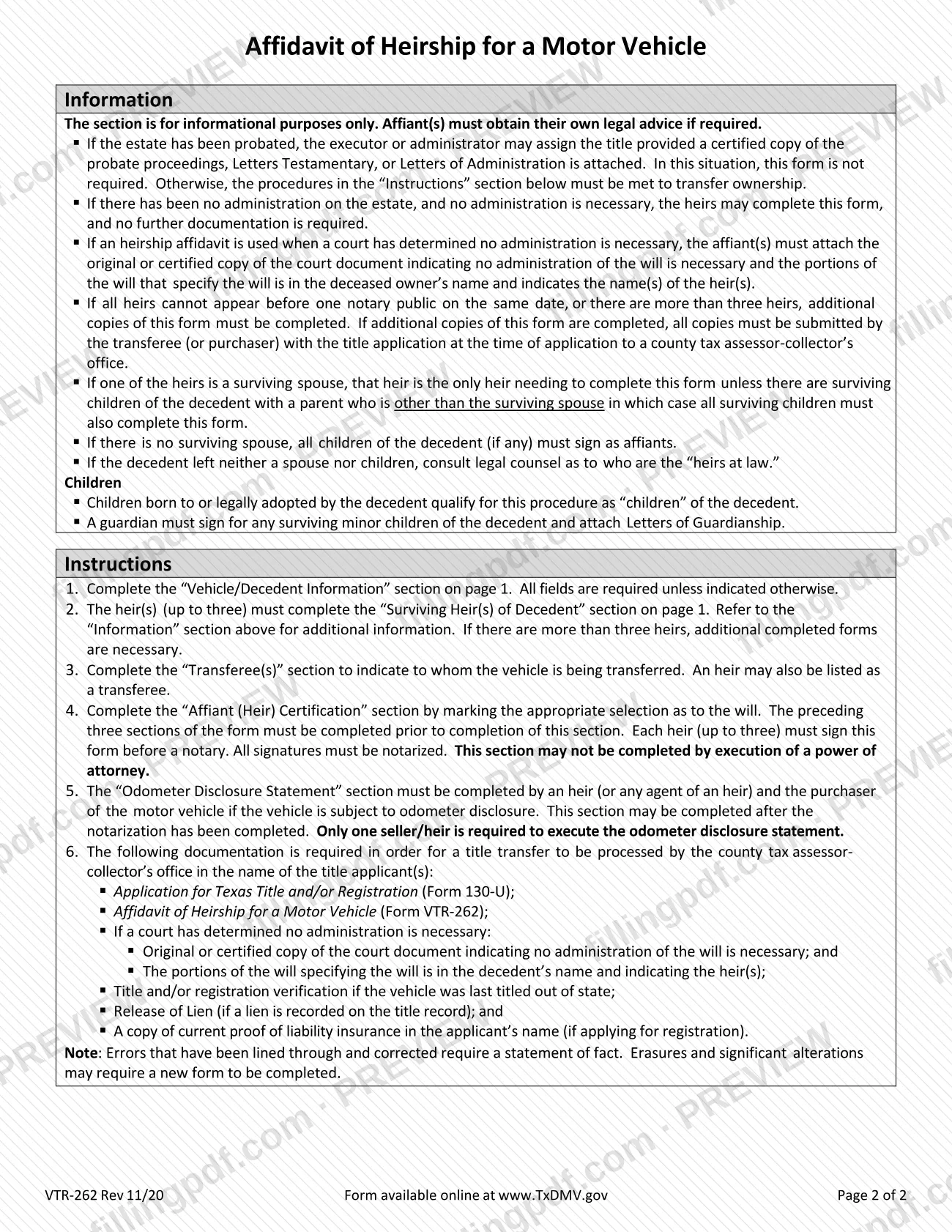
The form is not used when the estate has been probated. In that case the executor or administrator may assign the title if a certified copy of the probate proceedings, Letters Testamentary, or Letters of Administration is attached, and VTR-262 is not required. Page 2 of the form is informational and gives instructions and the list of documents the county tax assessor-collector's office needs to process the title transfer. It also advises affiants to get their own legal advice if required.
Who needs to file VTR-262?
The heirs of a deceased Texas vehicle owner use this form when there has been no administration of the estate and none is necessary. They sign it as affiants, and the person receiving the vehicle is the transferee; an heir may also be the transferee.
Who signs:
- Surviving spouse: if one of the heirs is a surviving spouse, that heir is the only one who needs to complete the form, unless the decedent has surviving children with a parent other than the spouse. Then all surviving children must also complete it.
- No surviving spouse: all children of the decedent, if any, sign as affiants.
- Neither spouse nor children: the form tells you to consult legal counsel about who the "heirs at law" are.
- Children: children born to or legally adopted by the decedent qualify. A guardian must sign for any surviving minor child and attach Letters of Guardianship.
A power of attorney cannot be used to complete the certification section. Do not use this form if the estate has been probated: the executor or administrator assigns the title with the probate documents instead.
When to file VTR-262
The form is completed when the heirs are ready to transfer the vehicle title, because the transferee submits it with the title application at the county tax assessor-collector's office. The form prints no separate deadline.
All heir signatures must be notarized before submission. The Odometer Disclosure Statement may be completed after the notarization. If all heirs cannot appear before one notary on the same date, or there are more than three heirs, complete additional copies of the form and submit all of them together with the title application. The title application and the other documents on the form's checklist are submitted at the same time.
Documents you need
- Application for Texas Title and/or Registration (Form 130-U), required for the county tax assessor-collector's office to process the title transfer.
- Affidavit of Heirship for a Motor Vehicle (Form VTR-262), with all additional copies if some heirs sign on different dates or there are more than three heirs.
- If a court determined no administration is necessary: the original or a certified copy of the court document stating that no administration of the will is necessary.
- If a court determined no administration is necessary: the portions of the will showing it is in the decedent's name and naming the heir or heirs.
- Title and/or registration verification, if the vehicle was last titled out of state.
- Release of Lien, if a lien is recorded on the title record.
- A copy of current proof of liability insurance in the applicant's name, if applying for registration.
- Letters of Guardianship, attached by a guardian who signs for a surviving minor child of the decedent.
How to fill out VTR-262
Enter vehicle and decedent information
In Vehicle/Decedent Information, enter the Vehicle Identification Number, year, make, body style and model, plus the date of death and the county and state of death. All fields are required unless marked otherwise; leave the Title/Document Number blank if unknown.
Enter the recorded owner
Write the first, middle and last name, and suffix if any, of the recorded owner of the vehicle. Enter the license plate state and number, if any.
List the surviving heirs
Under Surviving Heir(s) of Decedent, give the name (or entity name) and the address, city, state and ZIP code of Heir 1 and, if any, Heir 2 and Heir 3. If there are more than three heirs, complete additional copies.
Identify the transferee
Under Transferee(s), enter the name of the person to whom the vehicle is being transferred, an additional transferee if applicable, and the address. An heir may also be listed as a transferee.
Mark the will statement
In the Affiant (Heir) Certification, check either no will or that a will was left but no application for administration or probate has been filed, or a court has determined no administration is necessary. Complete the preceding three sections before this one.
Sign before a notary
Each heir, up to three, signs in the affiant signature boxes in front of a notary, who completes the State of Texas, County of line, signature, date and stamp. Heirs who cannot appear on the same date use additional copies.
Complete the odometer disclosure
If the vehicle is subject to odometer disclosure, enter the odometer reading with no tenths, or check Mileage Exceeds Mechanical Limits or Not Actual Mileage. The seller, heir or agent signs with the date of transfer, and the transferee or agent signs and dates.
Review, download and assemble
Check names, VIN and signatures, then download or print the completed PDF from FillingPDF. Assemble the package with Form 130-U and the other documents described under How to submit.
How to submit VTR-262
The transferee (or purchaser) submits the notarized form to a county tax assessor-collector's office at the time of the title application. The form lists no mailing address, portal or other channel.
- Package: the title application, Form 130-U (Application for Texas Title and/or Registration), the completed VTR-262 and any supporting documents listed under required documents. If you completed extra copies, submit all of them.
- Signatures: every heir signs before a notary. Only one seller/heir needs to sign the Odometer Disclosure Statement, if the vehicle is subject to odometer disclosure.
- Corrections: a line-through correction requires a statement of fact. Erasures and significant alterations may require a new form.
The county tax assessor-collector's office processes the title transfer in the name of the title applicant or applicants. Ask that office about fees and processing. FillingPDF lets you fill out and download the PDF; submission follows the channel described above.
Common mistakes to avoid
- Using VTR-262 when the estate has been probated; the executor or administrator assigns the title with certified probate documents, Letters Testamentary or Letters of Administration instead.
- Signing the Affiant (Heir) Certification without a notary. All signatures must be notarized.
- Having a power of attorney sign for an heir; the certification section may not be completed by execution of a power of attorney.
- Listing only some heirs, such as omitting surviving children with a parent other than the surviving spouse, who must also complete the form.
- Putting more than three heirs on one form instead of completing additional copies, or not submitting all copies with the title application.
- Leaving both will boxes unmarked; check either no will or a will left with no probate or administration filed.
- Omitting the court document and will portions when a court has determined no administration is necessary.
- Correcting an error by erasing it; line-through corrections need a statement of fact, and erasures may require a new form.
- Skipping the Odometer Disclosure Statement when the vehicle is subject to odometer disclosure.
Frequently asked questions
What is Form VTR-262 used for?
VTR-262 is the TxDMV Affidavit of Heirship for a Motor Vehicle. Heirs use it to swear before a notary that they are the sole known heirs of a deceased owner and to name the person to whom the vehicle title will be issued, when no administration of the estate is necessary.
Do all heirs have to sign the affidavit?
It depends on the family. A surviving spouse is the only heir who must sign, unless there are surviving children of a parent other than the spouse. With no surviving spouse, all children sign. If there is neither a spouse nor children, the form says to consult legal counsel.
Does the VTR-262 have to be notarized?
Yes. Each heir, up to three per copy, must sign before a notary, and all signatures must be notarized. The Odometer Disclosure Statement may be completed after the notarization, and only one seller or heir has to sign it.
Where do I submit the VTR-262?
The transferee, or purchaser, submits it with the title application at a county tax assessor-collector's office. The form names no mailing address or online channel. If you have extra copies because of more than three heirs or different notary dates, submit them all.
What do I need to bring with the VTR-262?
Bring Form 130-U and the VTR-262. Add court documents and will portions if a court found no administration necessary, out-of-state title verification, a Release of Lien if one is recorded, and proof of liability insurance if registering. A guardian also attaches Letters of Guardianship.
Can I use VTR-262 if the estate went through probate?
No. If the estate has been probated, the executor or administrator may assign the title with a certified copy of the probate proceedings, Letters Testamentary, or Letters of Administration attached. In that situation the form is not required.
Can a power of attorney sign the VTR-262 for an heir?
No. The instructions say the certification section may not be completed by execution of a power of attorney. For a surviving minor child, a guardian signs and attaches Letters of Guardianship.
Can I fill out VTR-262 online on FillingPDF?
Yes. You can fill out the fillable PDF online on FillingPDF and download or print it. FillingPDF is an independent service and does not file the form or notarize it; the heirs sign before a notary and the transferee submits it to the county office.
Ready to fill out VTR-262?
Fill out VTR-262 now