
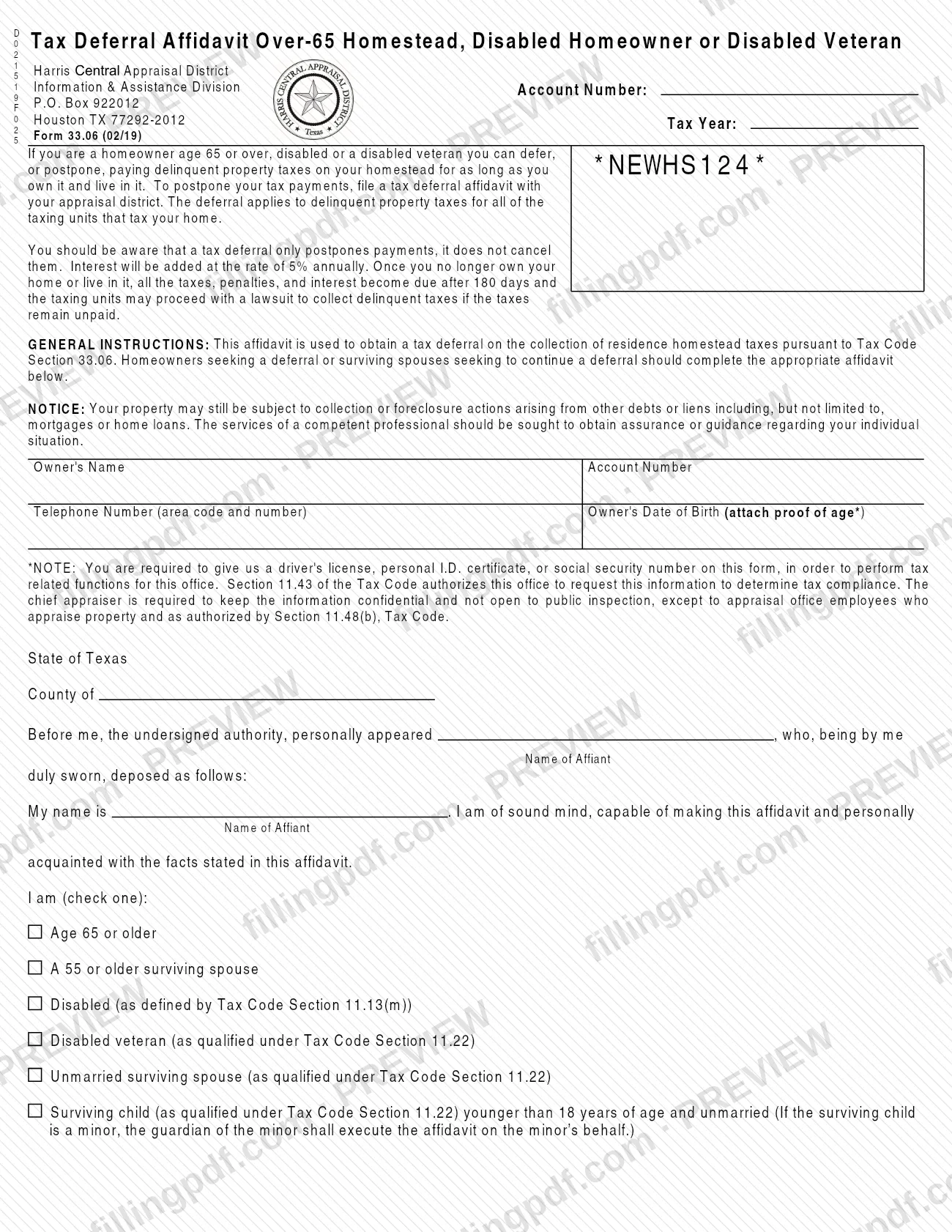
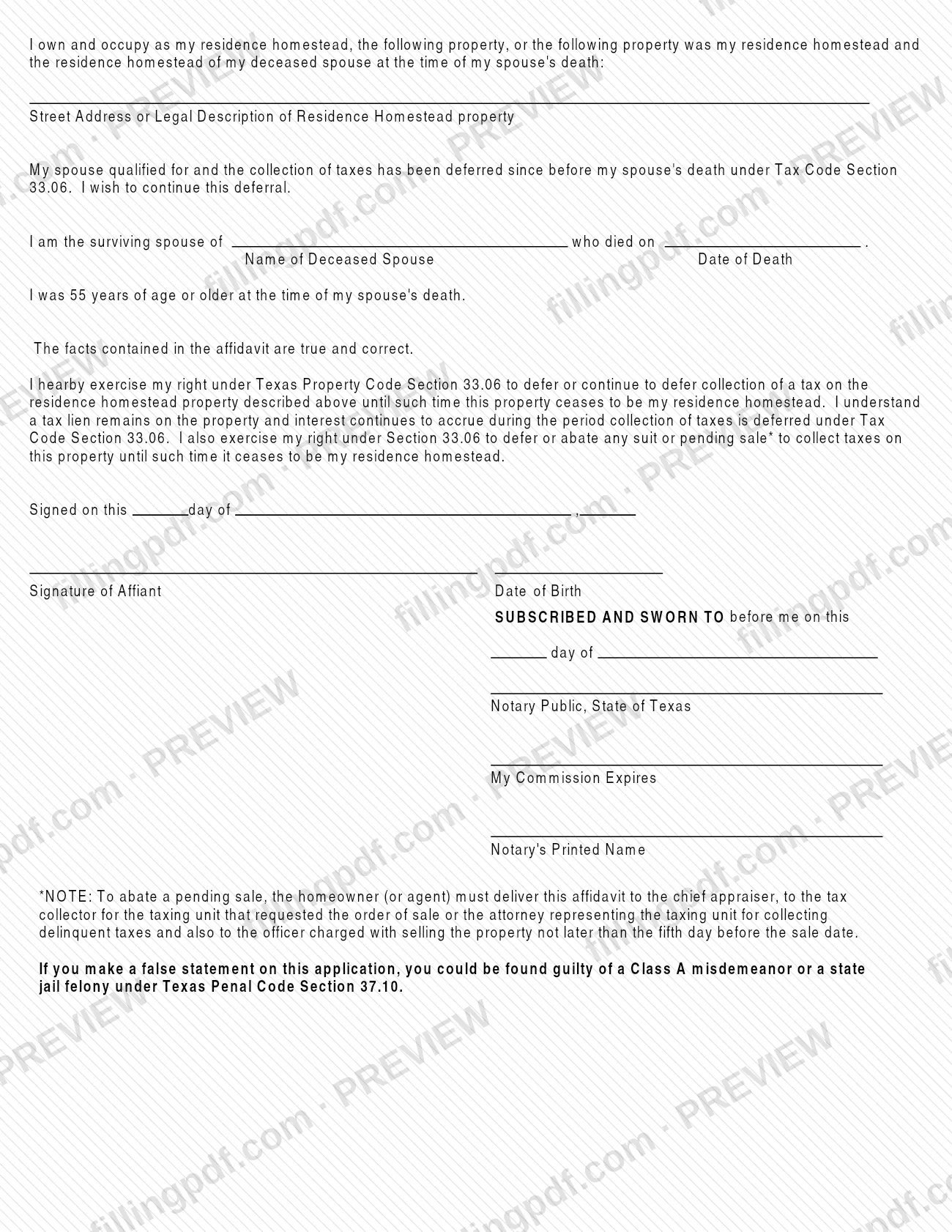
Form 33.06, the HCAD Tax Deferral Affidavit, is the sworn statement that homeowners who are 65 or older, disabled or disabled veterans file with the Harris Central Appraisal District (HCAD) to postpone paying delinquent property taxes on their homestead. It is one of the Harris County property tax forms, and the deferral applies to all of the taxing units that tax the home. On this page you can fill out the form online on FillingPDF and download or print the completed PDF. The filing rules come from HCAD, and the affidavit is sworn before a notary public.
Last updated
What is 33.06?
Form 33.06, HCAD Tax Deferral Affidavit, is the Harris Central Appraisal District (HCAD) affidavit that homeowners age 65 or over, disabled owners and disabled veterans file to defer delinquent property taxes on their homestead while they own and live in it.
The form is printed under the title Tax Deferral Affidavit Over-65 Homestead, Disabled Homeowner or Disabled Veteran. It is used to obtain a deferral of the collection of residence homestead taxes under Tax Code Section 33.06. The same affidavit also lets a surviving spouse continue a deferral that was already in place before the spouse's death.
A deferral only postpones payment; it does not cancel the taxes. A tax lien remains on the property and interest is added at the rate of 5% annually. Once you no longer own the home or live in it, all the taxes, penalties and interest become due after 180 days, and the taxing units may sue to collect taxes that remain unpaid. The form also warns that the property can still be subject to collection or foreclosure over other debts or liens, such as a mortgage or home loan.
Harris County's tax office explains that exemptions and deferrals of this kind are administered by HCAD, which then notifies the Harris County Tax Office of any change to your tax statement. By signing, the affiant also exercises the right to defer or abate a suit or pending sale to collect taxes on the property.
Who needs to file 33.06?
The main group is homeowners who own and occupy a residence homestead and are age 65 or older, disabled, or disabled veterans, and who want to postpone delinquent property taxes on that home.
On the affidavit you check one of these statuses:
- Age 65 or older.
- A 55 or older surviving spouse.
- Disabled, as defined by Tax Code Section 11.13(m).
- Disabled veteran, as qualified under Tax Code Section 11.22.
- Unmarried surviving spouse, as qualified under Tax Code Section 11.22.
- Surviving child younger than 18 years of age and unmarried, as qualified under Tax Code Section 11.22. If the child is a minor, the guardian of the minor executes the affidavit on the minor's behalf.
A surviving spouse who wants to continue a deferral that began before the spouse's death uses the same form and gives the deceased spouse's name, the date of death and confirmation of being 55 or older at that time.
The deferral covers a residence homestead only. It does not protect the property from collection or foreclosure over other debts or liens, such as a mortgage. The form suggests seeking a competent professional for guidance on your individual situation.
When to file 33.06
File the affidavit when you want to postpone paying delinquent property taxes on your homestead; the form prints no calendar deadline for the deferral itself. Taxes are deferred for as long as you own the home and live in it. After you stop owning or occupying it, everything becomes due after 180 days.
If a sale of the property is already pending, timing matters: the homeowner or an agent must deliver the affidavit to the required parties not later than the fifth day before the sale date to abate the sale. Those parties are listed under How to submit.
Interest at 5% annually accrues during the deferral. The agency page also says that after the 180 days, if taxes remain unpaid, regular penalties and interest accrue and the taxing units may proceed with a lawsuit to collect through a tax sale.
Documents you need
- Proof of age: the form asks you to attach it next to the owner's date of birth.
- A driver's license, personal I.D. certificate or social security number: the form's note requires one of them to be given on the form so the office can perform tax-related functions.
- Notary acknowledgment: the notary public completes the "Subscribed and sworn to" block, with the notary's printed name and commission expiration date, on the affidavit itself.
How to fill out 33.06
Enter account number and tax year
At the top, fill in the Account Number and the Tax Year printed in the HCAD header block for the property you are deferring taxes on.
Complete the owner information
Enter the Owner's Name, Account Number, Telephone Number (area code and number) and Owner's Date of Birth. Attach proof of age.
Provide your identification number
Give a driver's license, personal I.D. certificate or social security number as the form's note requires. HCAD's chief appraiser keeps it confidential.
Fill in the county and affiant name
Under State of Texas, enter the County of the affidavit, then write the Name of Affiant in the two places where the form asks for it.
Check your status
Under "I am (check one)", mark the one that applies: Age 65 or older, A 55 or older surviving spouse, Disabled, Disabled veteran, Unmarried surviving spouse, or Surviving child. A guardian completes the form for a minor child.
Describe the homestead property
Enter the Street Address or Legal Description of the Residence Homestead property that you own and occupy, or that was your and your deceased spouse's homestead at the time of death.
Complete the surviving spouse section
Only if you are continuing a deferral that began before your spouse's death, enter the deceased spouse's name and date of death and confirm you were 55 or older at that time.
Sign and date the affidavit
Fill in the day and month of signing, sign as Affiant and enter your Date of Birth. Do not sign until you are with the notary if the notary must witness it.
Have the notary complete the jurat
The notary public fills in the date of the sworn statement, signs, prints their name and lists the commission expiration date.
Review and download the completed PDF
Check every entry and the attachments, then download or print the completed PDF from FillingPDF and file it with HCAD as described under How to submit.
How to submit 33.06
The form is filed with your appraisal district, Harris Central Appraisal District (HCAD). It does not name any other filing channel.
- Filing with HCAD: the form's header gives the Information & Assistance Division, Harris Central Appraisal District, P.O. Box 922012, Houston TX 77292-2012. For questions about exemptions, values or name and address changes, HCAD lists 713-957-7800 and www.hcad.org. Attach proof of age and complete the notary section before filing.
- To abate a pending sale: the homeowner (or agent) must deliver the affidavit to the chief appraiser, to the tax collector for the taxing unit that requested the order of sale or the attorney representing the taxing unit for collecting delinquent taxes, and also to the officer charged with selling the property. Delivery must be made not later than the fifth day before the sale date.
HCAD administers the deferral and then notifies the Harris County Tax Office of resulting changes to your tax statement. FillingPDF lets you fill out and download the PDF; submission follows the channels above.
Common mistakes to avoid
- Treating the deferral as a cancellation of the taxes. It only postpones payment, a tax lien remains and interest accrues at 5% annually.
- Leaving out proof of age, which the form says to attach beside the owner's date of birth.
- Not giving a driver's license, personal I.D. certificate or social security number, which the form's note says you are required to provide.
- Checking more than one status, or none, under "I am (check one)".
- Leaving the notary section blank; the affidavit is sworn and subscribed before a Notary Public, State of Texas.
- Skipping the deceased spouse's name, date of death and the 55-or-older statement when continuing a deferral as a surviving spouse.
- Delivering the affidavit to only one party, or after the fifth day before the sale date, when trying to abate a pending sale.
- Signing for a minor surviving child as the child; the guardian of the minor must execute the affidavit.
- Assuming the deferral stops collection or foreclosure over other debts or liens, such as a mortgage or home loan.
Frequently asked questions
What is Form 33.06 used for?
Form 33.06 is the HCAD Tax Deferral Affidavit. Homeowners who are 65 or older, disabled or disabled veterans use it to defer delinquent property taxes on their residence homestead under Tax Code Section 33.06. Surviving spouses can also use it to continue a deferral already in place.
How does the Harris County property tax deferral for over-65 or disabled owners work?
You file the affidavit with HCAD, and the deferral covers delinquent taxes of all the taxing units that tax your home. Payment is postponed, not cancelled, while you own and live in the home. A lien remains and interest accrues at 5% annually.
Does a tax deferral cancel my property taxes?
No. The form states that a deferral only postpones payment. Interest is added at 5% annually, and once you no longer own or live in the home, the taxes, penalties and interest are due after 180 days, after which the taxing units may sue.
Does the tax deferral affidavit have to be notarized?
The form is an affidavit sworn before a notary. It has a "Subscribed and sworn to" block for a Notary Public, State of Texas, with the notary's printed name and commission expiration date, so plan to sign with a notary.
Where do I file the HCAD tax deferral affidavit?
File it with your appraisal district, HCAD. The form header lists the Information & Assistance Division, P.O. Box 922012, Houston TX 77292-2012. HCAD's phone for questions is 713-957-7800, and its website is www.hcad.org.
Can I use the affidavit to stop a pending tax sale?
Yes, the form lets you defer or abate a suit or pending sale. The homeowner or an agent must deliver it to the chief appraiser, the taxing unit's tax collector or attorney, and the officer charged with selling the property, not later than the fifth day before the sale date.
Can a surviving spouse continue a tax deferral?
Yes. If your spouse's taxes were deferred under Tax Code Section 33.06 before the death, complete the surviving spouse part: give the deceased spouse's name and date of death and state that you were 55 or older then. The affidavit is the same form.
Can I fill out Form 33.06 online on FillingPDF?
You can fill out the PDF online on FillingPDF and download or print it. FillingPDF is an independent service and does not file the affidavit with HCAD, notarize it or send it to anyone; you submit it through HCAD's channels.
Ready to fill out 33.06?
Fill out 33.06 now