
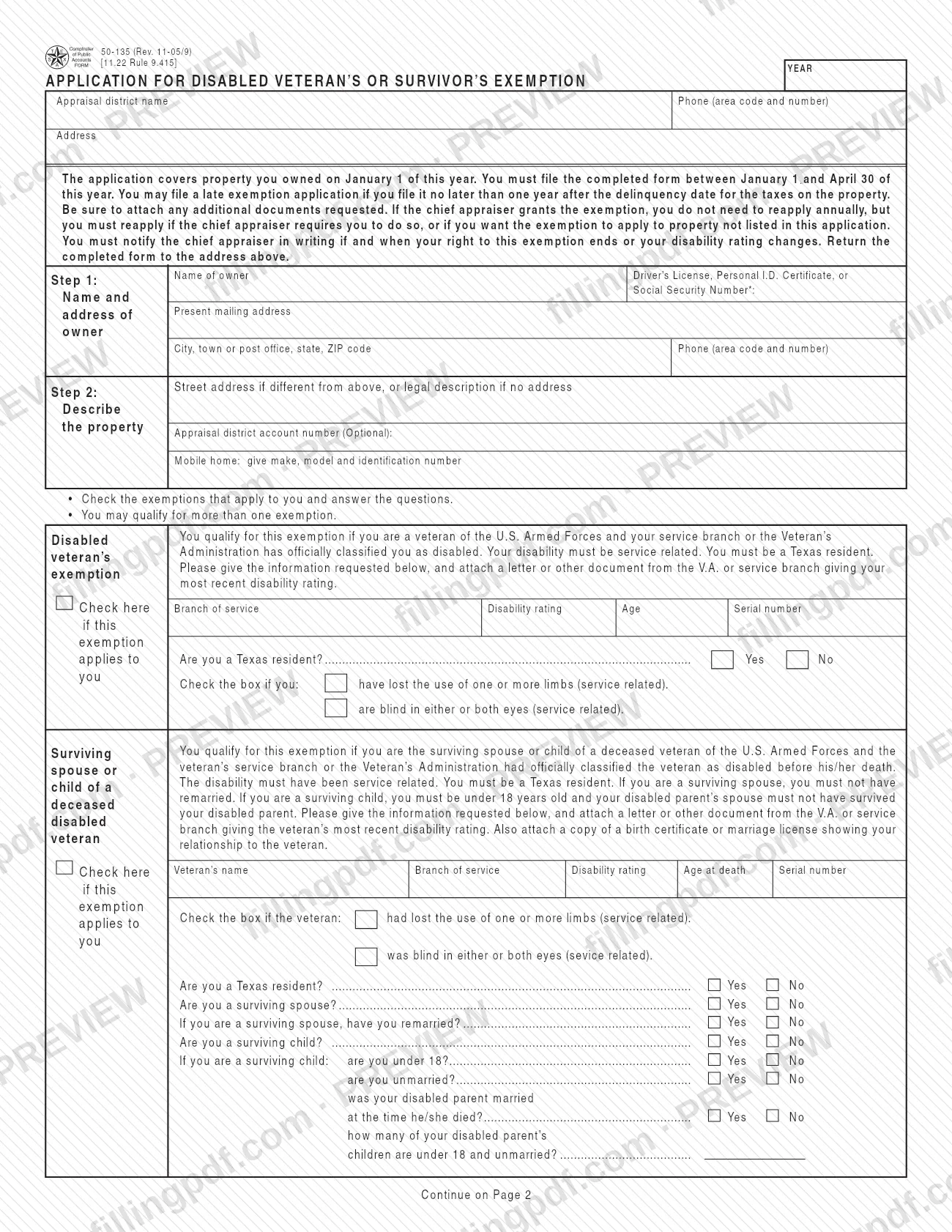
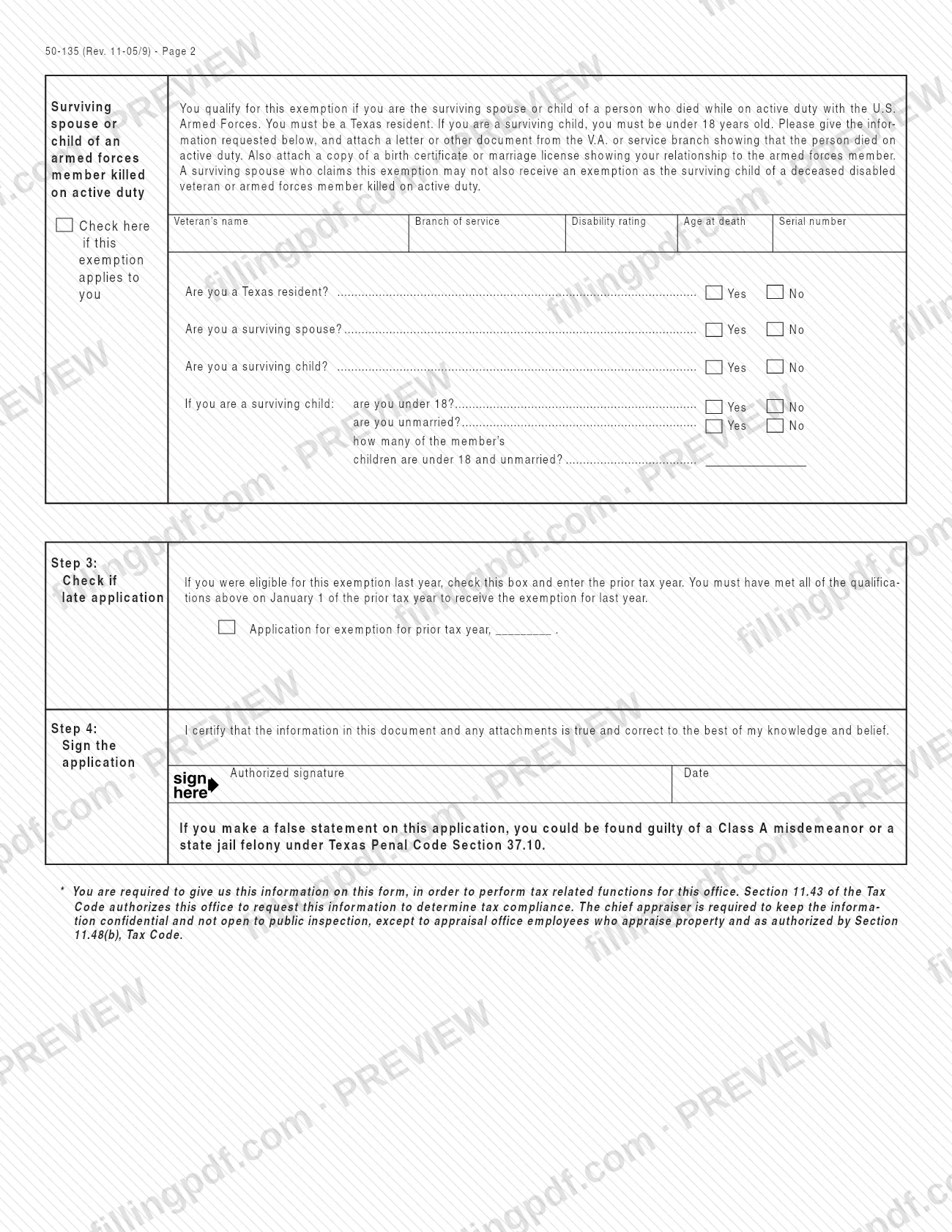
Form 50-135, Application for Disabled Veteran’s or Survivor’s Exemption, is the property tax exemption application that Hidalgo County Veterans Services lists on its Forms page as the Surviving Spouse Exemption. It is one of the Hidalgo County property tax exemption forms that veterans’ families use, and it also covers disabled veterans themselves. On this page you can fill out the form online on FillingPDF and download or print the completed PDF; the original PDF is published on the Hidalgo County website, and the completed form is returned to the appraisal district.
Last updated
What is 50-135?
Form 50-135, Application for Disabled Veteran’s or Survivor’s Exemption, is the form a disabled veteran, or the surviving spouse or child of a veteran or armed forces member, files to claim a property tax exemption on property owned on January 1.
The form is addressed to the chief appraiser of the appraisal district named at the top of the page. It carries three exemption sections, and you check each one that applies to you, because you may qualify for more than one:
- Disabled veteran’s exemption: for a veteran of the U.S. Armed Forces who has been officially classified as disabled, with a service-related disability, and who is a Texas resident.
- Surviving spouse or child of a deceased disabled veteran: for a Texas resident whose veteran spouse or parent had been officially classified as disabled, service related, before death.
- Surviving spouse or child of an armed forces member killed on active duty: for a Texas resident whose spouse or parent died while on active duty.
Hidalgo County Veterans Services lists the document under the name Surviving Spouse Exemption. It lists a Residence Homestead Exemption form separately, and that is a different document. Form 50-135 also has a late-application box for the prior tax year, and a signature block certifying that the information is true and correct.
Who needs to file 50-135?
Three groups use Form 50-135, and each must be a Texas resident:
- Disabled veterans: veterans of the U.S. Armed Forces whom their service branch or the Veteran’s Administration has officially classified as disabled, where the disability is service related.
- Surviving spouses or children of a deceased disabled veteran: the veteran must have been officially classified as disabled before death, with a service-related disability. A surviving spouse must not have remarried. A surviving child must be under 18 years old, and the disabled parent’s spouse must not have survived the parent.
- Surviving spouses or children of an armed forces member killed on active duty: a surviving child must be under 18 years old.
The application covers property you owned on January 1 of the year. A surviving spouse who claims the exemption for a member killed on active duty may not also receive an exemption as the surviving child of a deceased disabled veteran or of an armed forces member killed on active duty. If the chief appraiser grants the exemption, you do not need to reapply every year unless the chief appraiser requires it.
When to file 50-135
File the completed form between January 1 and April 30 of the year for which you want the exemption; it covers property you owned on January 1 of that year.
A late application is allowed if you file it no later than one year after the delinquency date for the taxes on the property. For a late application, check the box in Step 3 and enter the prior tax year; you must have met all the qualifications on January 1 of that prior tax year.
If the chief appraiser grants the exemption, you do not need to reapply annually. You must reapply if the chief appraiser requires it, or if you want the exemption to apply to property not listed in your application. You must also notify the chief appraiser in writing if and when your right to the exemption ends or your disability rating changes.
Documents you need
- For the disabled veteran’s exemption: a letter or other document from the V.A. or the service branch giving your most recent disability rating.
- For a surviving spouse or child of a deceased disabled veteran: a letter or other document from the V.A. or service branch giving the veteran’s most recent disability rating.
- For a surviving spouse or child of a deceased disabled veteran: a copy of a birth certificate or marriage license showing your relationship to the veteran.
- For a surviving spouse or child of an armed forces member killed on active duty: a letter or other document from the V.A. or service branch showing the person died on active duty.
- For a surviving spouse or child of an armed forces member killed on active duty: a copy of a birth certificate or marriage license showing your relationship to the member.
- Any other additional documents the form requests; the form says to be sure to attach them.
How to fill out 50-135
Complete the header
Check the appraisal district name, phone number and address at the top, and enter the tax year in the YEAR space. This is the office that receives the form.
Enter owner details in Step 1
Give the name of the owner, the Driver’s License, Personal I.D. Certificate, or Social Security Number, the present mailing address, the city, state and ZIP code, and a phone number with area code.
Describe the property in Step 2
Enter the street address if it differs from the mailing address, or a legal description if there is no address. The appraisal district account number is optional; for a mobile home give the make, model and identification number.
Complete the disabled veteran section
If it applies, check the box and give your branch of service, disability rating, age and serial number. Answer whether you are a Texas resident, and check the box if you lost the use of one or more limbs or are blind in either or both eyes (service related).
Complete the deceased disabled veteran section
Check the box if it applies and give the veteran’s name, branch of service, disability rating, age at death and serial number. Answer the Yes/No questions on Texas residency, surviving spouse, remarriage, surviving child, age under 18, being unmarried and the disabled parent’s marriage.
Complete the active duty section on page 2
If your spouse or parent died while on active duty, check the box and give the member’s name, branch, disability rating, age at death and serial number. Answer the Yes/No questions on residency, surviving spouse, surviving child, age and marital status, and enter the number of the member’s children under 18 and unmarried.
Mark a late application in Step 3
If you were eligible last year, check the box and enter the prior tax year on the line. You must have met all the qualifications on January 1 of that prior tax year.
Sign and date in Step 4
Sign on the authorized signature line and enter the date. The signature certifies that the information and attachments are true and correct.
Review, attach documents and download
Check each section against your attachments, then download or print the completed PDF from FillingPDF and return it as described under How to submit.
How to submit 50-135
The form names one channel: you return the completed application to the appraisal district at the address printed at the top of the form. Hidalgo County Veterans Services posts the form on its Forms page at https://www.hidalgocounty.us/828/Forms, but the form itself directs the return to the appraisal district.
- Return to the appraisal district: use the appraisal district name, phone number and address shown in the box at the top of the form. The form prints no portal, fax number or appointment rule.
- Attachments: include the letter or document from the V.A. or service branch, and the birth certificate or marriage license, that your exemption section requires.
- Later changes: notify the chief appraiser in writing if your right to the exemption ends or your disability rating changes.
Before you return the form, sign and date Step 4. A false statement on the application can lead to a Class A misdemeanor or state jail felony charge under Texas Penal Code Section 37.10. FillingPDF lets you fill out and download the PDF; submission follows the channels above.
Common mistakes to avoid
- Filing before January 1 or after April 30 without using the late-application box; a late application must be filed within one year after the delinquency date for the taxes.
- Leaving off the V.A. or service-branch letter showing the disability rating, or the proof that the member died on active duty.
- Omitting the birth certificate or marriage license that shows your relationship to the veteran or armed forces member.
- Claiming the surviving spouse exemption after remarrying; a surviving spouse must not have remarried.
- Claiming the surviving child exemption when you are 18 or older; a surviving child must be under 18 years old.
- Claiming both a surviving spouse exemption for a member killed on active duty and a surviving child exemption; the form does not allow both.
- Not telling the chief appraiser in writing when your right to the exemption ends or your disability rating changes.
- Submitting the form unsigned or leaving Step 4 undated; the certification needs an authorized signature and a date.
Frequently asked questions
What is Form 50-135 used for?
Form 50-135 is the application for the disabled veteran’s or survivor’s property tax exemption. A disabled veteran, or the surviving spouse or child of a veteran or armed forces member, files it with the chief appraiser to claim an exemption on property owned on January 1.
Is Form 50-135 a Hidalgo County property tax form?
Hidalgo County Veterans Services lists it on its Forms page as the Surviving Spouse Exemption. The form itself says to return it to the appraisal district whose name and address are printed at its top, and the chief appraiser decides whether to grant the exemption.
When is the deadline to file Form 50-135?
File between January 1 and April 30 of the year you want the exemption. A late application is accepted if filed no later than one year after the delinquency date for the taxes on the property, using the late-application box in Step 3.
What do I attach to Form 50-135?
Attach a V.A. or service-branch letter giving the disability rating, or showing death on active duty. Survivors also attach a birth certificate or marriage license proving their relationship to the veteran or member. Attach any other documents the form requests.
Do I have to reapply for the exemption every year?
No, not if the chief appraiser grants it. You must reapply if the chief appraiser requires it, or if you want the exemption to apply to property not listed in your application. Notify the chief appraiser in writing if your right ends or your disability rating changes.
Can a surviving spouse claim more than one exemption on this form?
You may qualify for more than one exemption on the form, so check each one that applies. The exception is that a surviving spouse who claims the active-duty exemption may not also receive an exemption as the surviving child of a deceased disabled veteran or of a member killed on active duty.
Can I fill out Form 50-135 online?
Yes. You can fill out the fillable PDF online on FillingPDF and download or print it. FillingPDF does not file the form with anyone, so you still return the completed application to the appraisal district at the address printed on the form.
Where do I send the completed application?
Return it to the appraisal district at the address printed at the top of the form. The form names no other channel, so check the phone number printed in the same box if you have questions about how that office accepts the form.
Ready to fill out 50-135?
Fill out 50-135 now