
The Standing Order on Discovery In Cases Involving Child Protective Services Signed 10-1-22 is an order of the District Courts of Hunt County, Texas, published on the Hunt County website. It sets how records are shared, which discovery needs permission from the court and which deadlines apply in cases the Texas Department of Family and Protective Services (TDFPS) files under Subtitle E of the Texas Family Code. It is a court order, not a tax document. On this page you can fill out the PDF online on FillingPDF and download or print it; the order itself is published by Hunt County at the official link below.
Last updated
What is Standing Order on Discovery In Cases Involving Child Protective Services Signed 10-1-22 – Hunt County, TX?
Standing Order on Discovery In Cases Involving Child Protective Services Signed 10-1-22 is a standing order of the District Courts of Hunt County, Texas that sets discovery rules and deadlines for litigation filed by the Texas Department of Family and Protective Services (TDFPS).
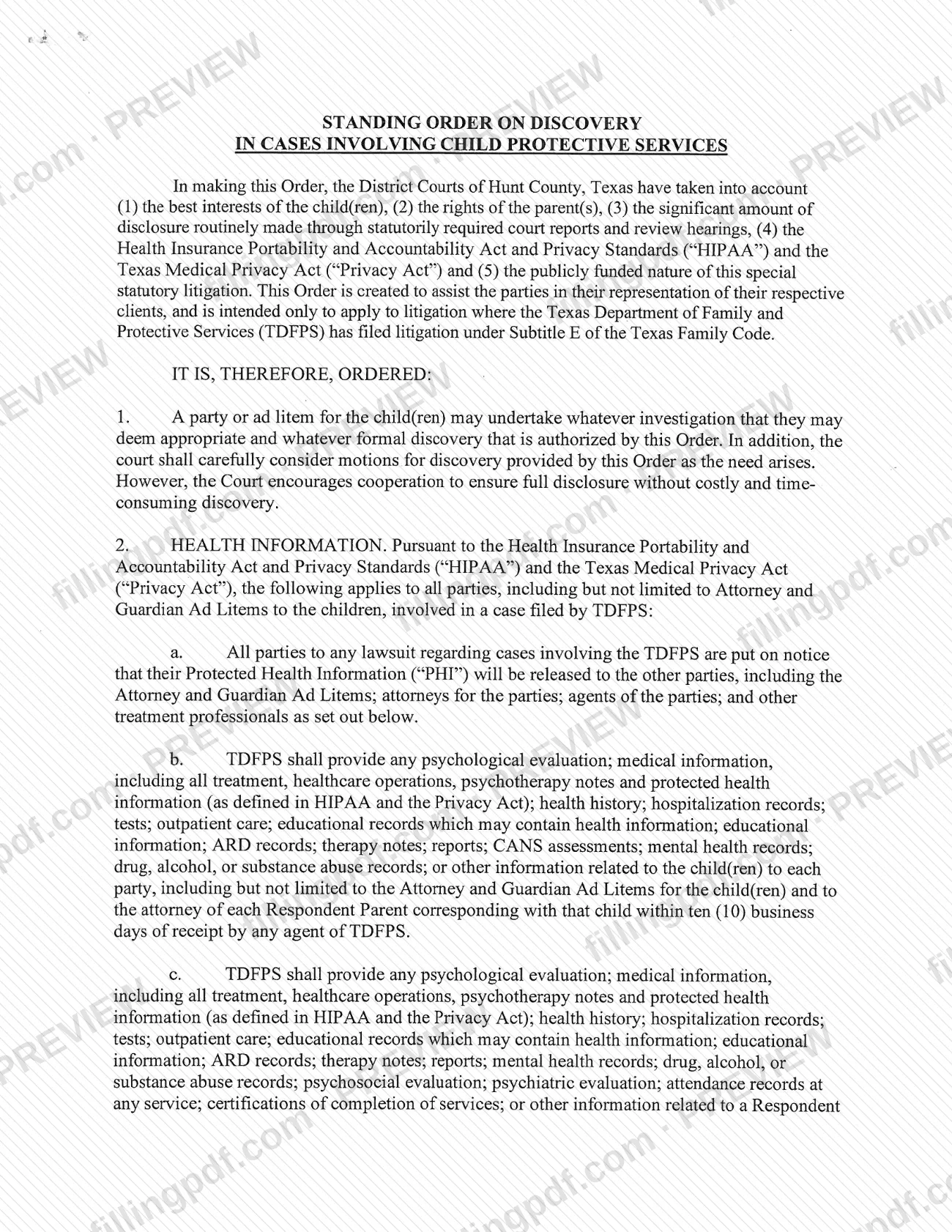
The order says it takes into account the best interests of the children, the rights of the parents, the disclosure already made through court reports and review hearings, HIPAA and the Texas Medical Privacy Act, and the publicly funded nature of this litigation. It is meant to help the parties represent their clients and applies only to litigation TDFPS has filed under Subtitle E of the Texas Family Code.
Its numbered provisions cover:
- investigation and formal discovery (paragraph 1);
- health information and the exchange of records (paragraph 2);
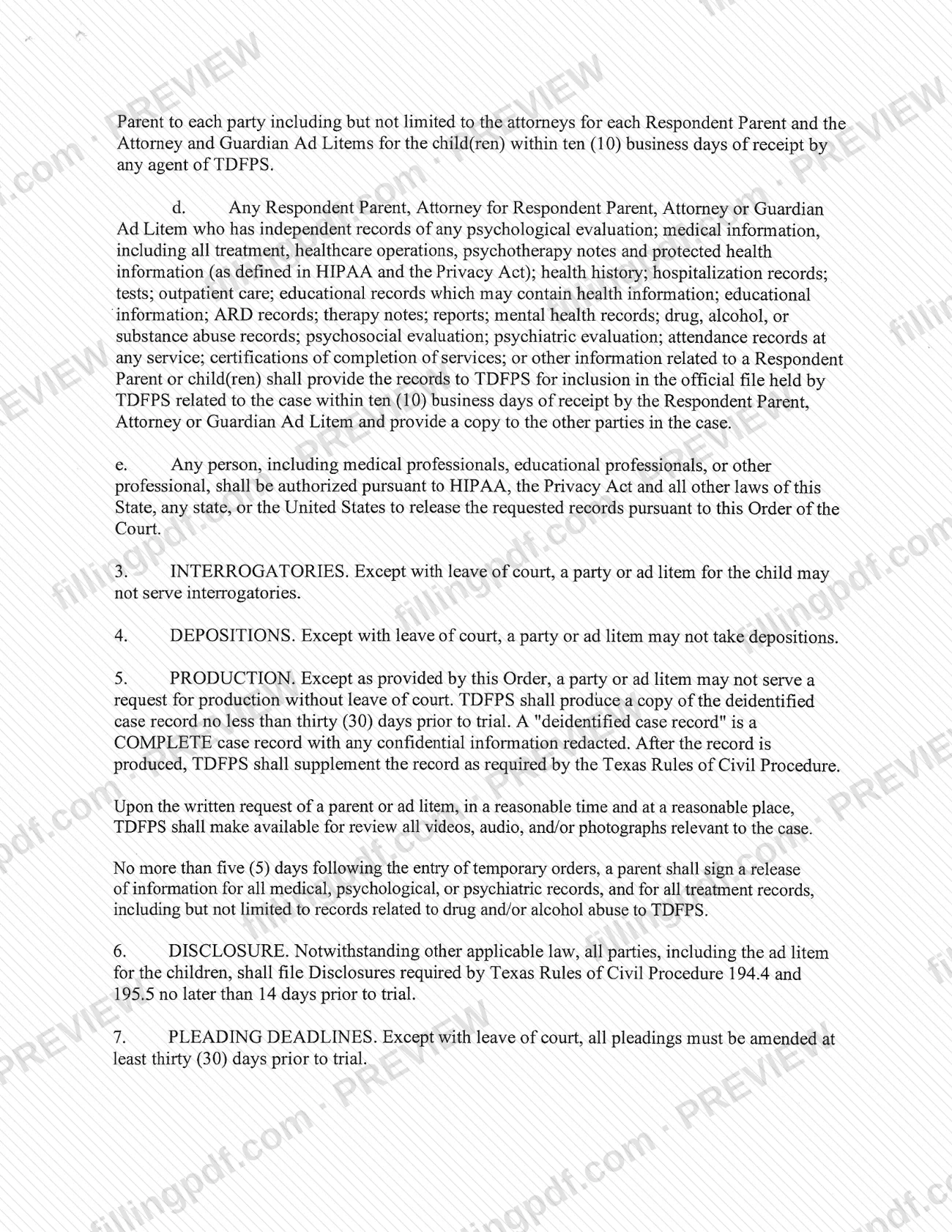
- interrogatories and depositions, which need leave of court (paragraphs 3 and 4);
- production, including the deidentified case record (paragraph 5);
- disclosures under Texas Rules of Civil Procedure 194.4 and 195.5 (paragraph 6);
- pleading deadlines (paragraph 7);
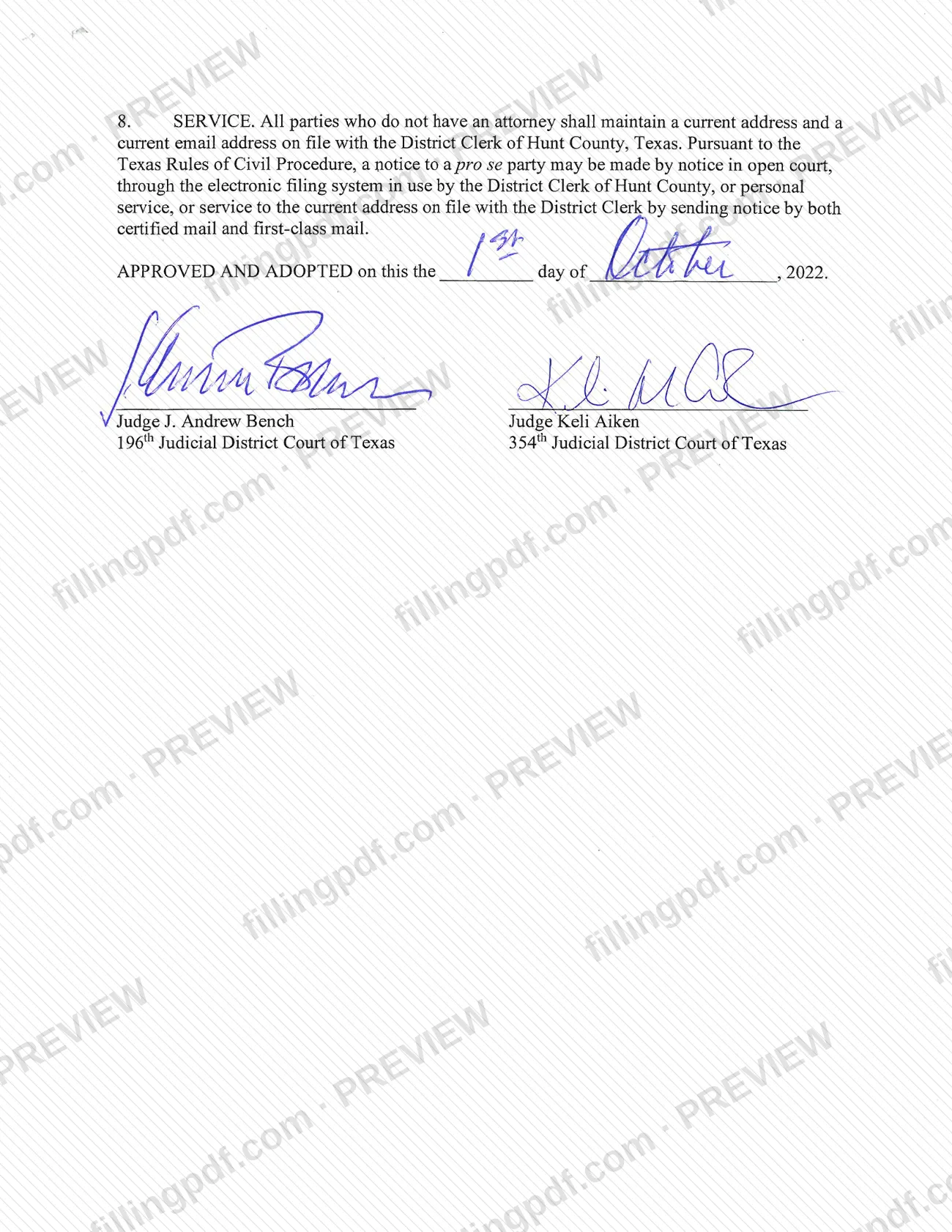
- service on parties without an attorney (paragraph 8).
The order is signed by Judge J. Andrew Bench of the 196th Judicial District Court of Texas and Judge Keli Aiken of the 354th Judicial District Court of Texas. It is not a form that a party files or a property tax document.
Who needs to file Standing Order on Discovery In Cases Involving Child Protective Services Signed 10-1-22 – Hunt County, TX?
The order governs the parties in a Hunt County case filed by TDFPS under Subtitle E of the Texas Family Code. It does not apply to other litigation.
- TDFPS provides the children's records and the Respondent Parents' records to each party within ten (10) business days of receipt by any agent of TDFPS, and produces the deidentified case record before trial.
- Respondent Parents and their attorneys receive those records. A parent signs a release of information, and anyone holding independent records must give them to TDFPS and the other parties.
- Attorneys and Guardians Ad Litem for the children receive the records and may use the discovery the order authorizes.
- Parties without an attorney must keep a current address and a current email address on file with the District Clerk of Hunt County, Texas.
Under paragraph 2, parties are put on notice that their Protected Health Information will be released to the other parties, including the Attorney and Guardian Ad Litems, the parties' attorneys, their agents and the treatment professionals described in the order.
When to file Standing Order on Discovery In Cases Involving Child Protective Services Signed 10-1-22 – Hunt County, TX
The order applies once TDFPS has filed litigation under Subtitle E of the Texas Family Code, and its deadlines then run from the events it names.
- Records received by TDFPS: provide them to the parties within ten (10) business days of receipt by any agent of TDFPS.
- Independent records held by a Respondent Parent, attorney or ad litem: provide them to TDFPS within ten (10) business days of receipt and give a copy to the other parties.
- Release of information: a parent signs it no more than five (5) days after temporary orders are entered.
- Deidentified case record: TDFPS produces it no less than thirty (30) days before trial.
- Disclosures under Texas Rules of Civil Procedure 194.4 and 195.5: file them no later than 14 days before trial.
- Amended pleadings: at least thirty (30) days before trial, unless the court gives leave.
The order sets no separate filing date for itself.
Documents you need
- A signed release of information for all medical, psychological and psychiatric records and all treatment records, including drug and alcohol abuse records, given by a parent to TDFPS no more than five (5) days after temporary orders are entered.
- Independent records (such as evaluations, medical, therapy or educational records) held by a Respondent Parent, Attorney for a Respondent Parent, or Attorney or Guardian Ad Litem, provided to TDFPS with a copy to the other parties.
- A written request from a parent or ad litem, when asking TDFPS to make videos, audio or photographs relevant to the case available for review.
- Disclosures required by Texas Rules of Civil Procedure 194.4 and 195.5, filed by all parties including the ad litem for the children.
How to fill out Standing Order on Discovery In Cases Involving Child Protective Services Signed 10-1-22 – Hunt County, TX
Confirm the order applies
Check that your case was filed by TDFPS under Subtitle E of the Texas Family Code. The order applies only to that litigation.
Read the health information notice
Paragraph 2a puts parties on notice that their Protected Health Information will be released to the other parties, attorneys, agents and treatment professionals.
Track the ten-business-day records rule
Under paragraphs 2b and 2c, TDFPS provides the child's and the Respondent Parent's records to each party within ten (10) business days of receipt by any agent of TDFPS.
Share your independent records
Under paragraph 2d, give any independent records to TDFPS within ten (10) business days of receipt and send a copy to the other parties.
Ask leave for extra discovery
Paragraphs 3, 4 and 5 bar interrogatories, depositions and requests for production without leave of court, except as the order provides.
Request review of videos and photos
Under paragraph 5, a parent or ad litem makes a written request, and TDFPS makes relevant videos, audio and photographs available at a reasonable time and place.
Sign the release of information
Under paragraph 5, a parent signs a release for medical, psychological, psychiatric and treatment records to TDFPS no more than five (5) days after temporary orders are entered.
Calendar disclosure and pleading deadlines
File disclosures under Rules 194.4 and 195.5 no later than 14 days before trial (paragraph 6), and amend pleadings at least thirty (30) days before trial (paragraph 7). TDFPS produces the deidentified case record no less than thirty (30) days before trial.
Keep your contact details current
If you have no attorney, keep a current address and email address on file with the District Clerk of Hunt County, Texas (paragraph 8).
Review and download the PDF
Check your entries against the paragraphs above, then download or print the completed PDF from FillingPDF and keep it with your case papers.
How to submit Standing Order on Discovery In Cases Involving Child Protective Services Signed 10-1-22 – Hunt County, TX
The order is not a form you send to an agency, and it prints no mailing address or portal for itself. It directs specific items to specific places:
- Records to TDFPS: a Respondent Parent, attorney or ad litem with independent records provides them to TDFPS for its official file and gives a copy to the other parties.
- Release of information: a parent signs it for TDFPS after temporary orders are entered.
- Disclosures: parties file the disclosures required by Texas Rules of Civil Procedure 194.4 and 195.5.
- Parties without an attorney: keep a current address and email address on file with the District Clerk of Hunt County, Texas. Notice to such a party may be given in open court, through the District Clerk's electronic filing system, by personal service, or to the address on file by both certified mail and first-class mail.
FillingPDF lets you fill out and download the PDF; submission follows the channels above.
Common mistakes to avoid
- Serving interrogatories or taking depositions without leave of court; paragraphs 3 and 4 allow them only with leave.
- Serving a request for production without leave of court when the order does not authorize it; paragraph 5 allows requests only as the order provides.
- Filing the Rule 194.4 and 195.5 disclosures later than 14 days before trial.
- Amending pleadings fewer than thirty (30) days before trial without leave of court.
- Holding independent records of a parent or child and not giving them to TDFPS and the other parties within ten (10) business days of receipt.
- Not signing the release of information within five (5) days after temporary orders are entered.
- Representing yourself and letting your address or email on file with the District Clerk of Hunt County go out of date.
- Treating the order as applying to every Hunt County case rather than only litigation TDFPS has filed under Subtitle E of the Texas Family Code.
Frequently asked questions
What is the Hunt County standing order on discovery in CPS cases?
It is an order of the District Courts of Hunt County, Texas that sets discovery rules, record-sharing duties and deadlines. It applies only to litigation filed by the Texas Department of Family and Protective Services (TDFPS) under Subtitle E of the Texas Family Code.
Is this document a Hunt County property tax form?
No. It is a court order on discovery in Child Protective Services cases and has nothing to do with Hunt County property tax. It asks for no tax information, and this page does not cover property tax procedures.
Who has to follow the standing order?
The parties in a TDFPS case under Subtitle E: TDFPS, Respondent Parents and their attorneys, and the Attorney and Guardian Ad Litems for the children. Parties without an attorney must also keep an address and email on file with the District Clerk of Hunt County.
How fast must records be shared under the order?
Within ten (10) business days of receipt. TDFPS provides the children's and the Respondent Parents' records to each party within that time, and anyone holding independent records gives them to TDFPS and sends a copy to the other parties within the same period.
Can I serve interrogatories or take depositions in a TDFPS case?
Not without leave of court. Paragraphs 3 and 4 bar interrogatories and depositions unless the court allows them, and requests for production also need leave except as the order provides.
When does TDFPS have to produce the case record?
No less than thirty (30) days before trial. The order calls it a deidentified case record: a complete case record with confidential information redacted. TDFPS then supplements it as the Texas Rules of Civil Procedure require.
How are parties without a lawyer notified?
By notice in open court, through the District Clerk's electronic filing system, by personal service, or to the address on file with the District Clerk by both certified mail and first-class mail. Such parties must keep a current address and email on file.
Can I fill out this standing order on FillingPDF?
You can fill out the PDF online on FillingPDF and download or print it. FillingPDF is an independent service: it does not file anything with the court or the District Clerk, and it is not connected to Hunt County.
Ready to fill out Standing Order on Discovery In Cases Involving Child Protective Services Signed 10-1-22 – Hunt County, TX?
Fill out Standing Order on Discovery In Cases Involving Child Protective Services Signed 10-1-22 – Hunt County, TX now