
Form 50-266, the Dealers Heavy Equipment Inventory Tax Statement, is the quarterly statement that heavy equipment inventory dealers file with the county tax assessor-collector, and it is a Parker County property tax filing handled through the Parker County Tax Assessor-Collector's special inventory tax collection. A dealer reports the heavy equipment sold, leased or rented in the preceding quarter and sends the unit property tax with the statement. On this page you can fill out the form online on FillingPDF and download or print the completed PDF. The form was developed by the Texas Comptroller of Public Accounts and is published by the county at its Document Center.
Last updated
What is 50-266?
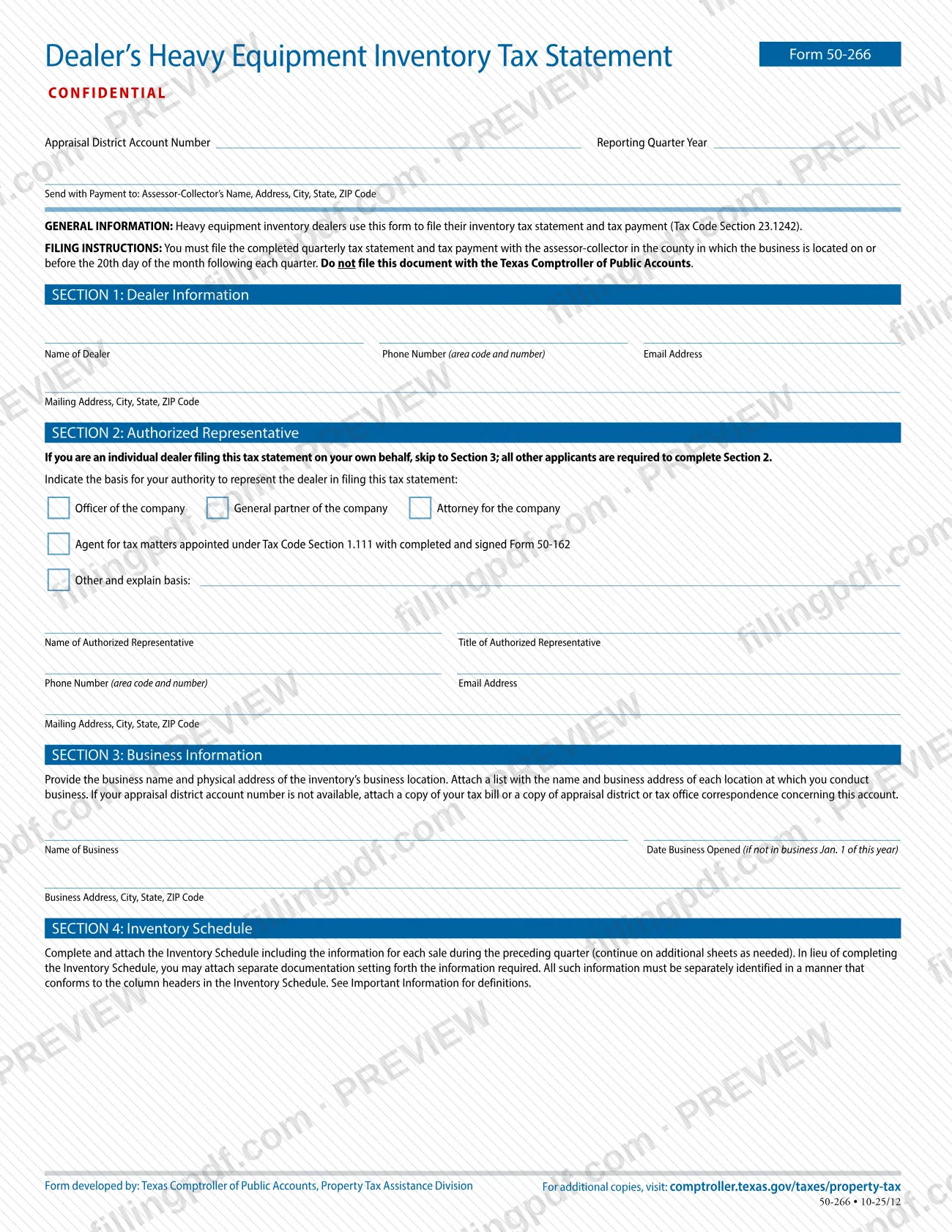
The Dealers Heavy Equipment Inventory Tax Statement (Form 50-266) is the quarterly statement that heavy equipment inventory dealers file, together with a payment of the unit property tax, with the county tax assessor-collector for heavy equipment sold, leased or rented in the preceding quarter.
The form states that it is the document dealers use to file their inventory tax statement and tax payment under Tax Code Section 23.1242, and that a dealer may use no other form for this purpose. The Texas Comptroller of Public Accounts, Property Tax Assistance Division, developed it, but the dealer files it with the assessor-collector of the county where the business is located, not with the Comptroller. In Parker County that office is the Parker County Tax Assessor-Collector, which handles special inventory tax collections. Property appraisals come from the Parker County Appraisal District, not from this office.
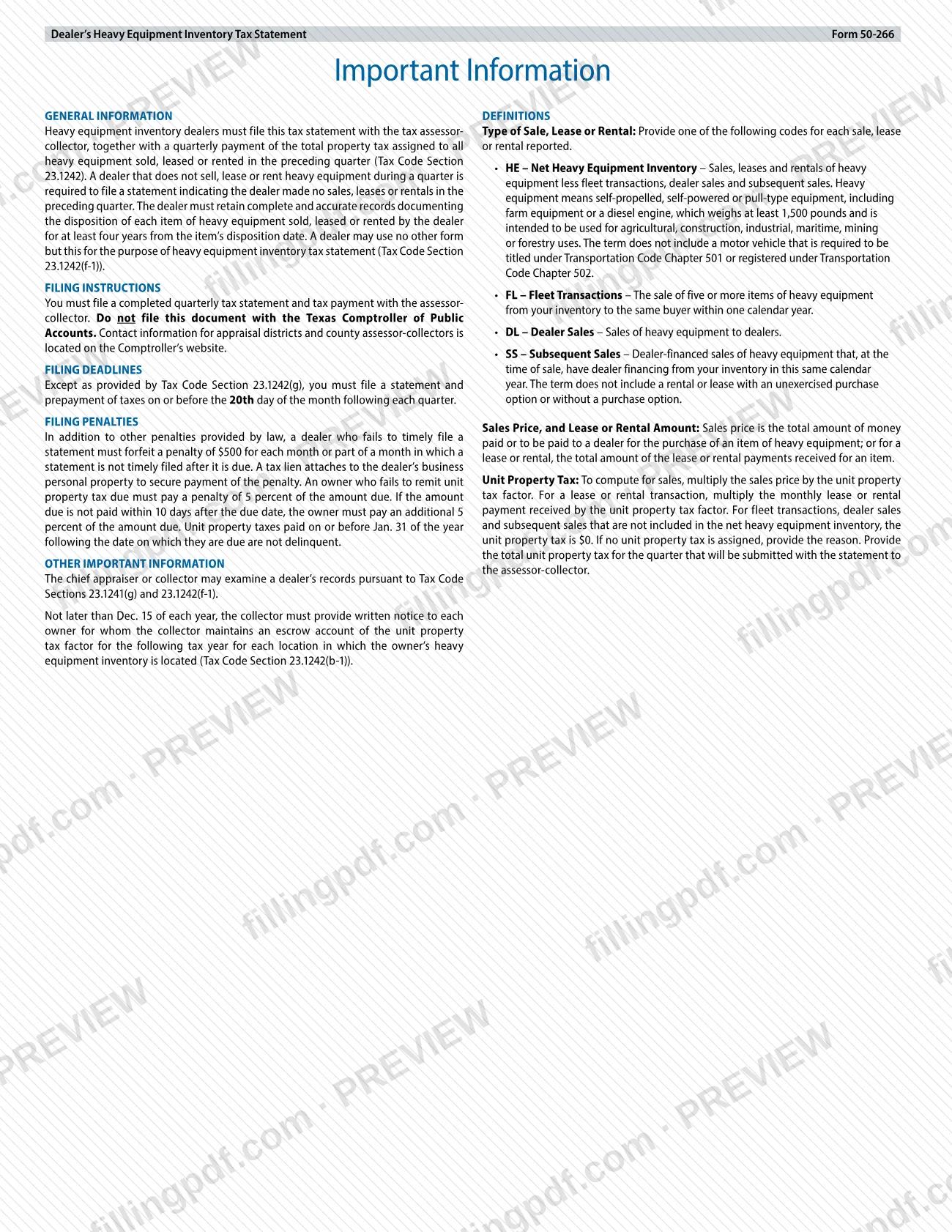
The form has six sections: dealer information, authorized representative, business information, an inventory schedule listing each sale, lease or rental, a breakdown of units and transaction amounts, and a certification and signature. Each transaction is coded as net heavy equipment inventory (HE), fleet transaction (FL), dealer sale (DL) or subsequent sale (SS). Only the net heavy equipment inventory carries unit property tax. Heavy equipment does not include a motor vehicle that must be titled or registered under the Transportation Code.
The county's special inventory pages also list separate statements for vessel and outboard motor inventory; Form 50-266 is not those.
Who needs to file 50-266?
Heavy equipment inventory dealers use Form 50-266 to file their inventory tax statement and tax payment with the assessor-collector of the county where the business is located. In Parker County, that is the Parker County Tax Assessor-Collector.
- Individual dealers filing on their own behalf complete Sections 1, 3, 4, 5 and 6 and skip Section 2.
- All other filers must complete Section 2 and state the basis of their authority: officer of the company, general partner, attorney for the company, an agent for tax matters appointed under Tax Code Section 1.111 with a completed and signed Form 50-162, or another basis with an explanation.
- Dealers with no activity still file. A dealer that does not sell, lease or rent heavy equipment during a quarter must file a statement saying so.
Do not file this document with the Texas Comptroller of Public Accounts. Do not use it for items that are not heavy equipment as the form defines it: a motor vehicle required to be titled under Transportation Code Chapter 501 or registered under Chapter 502 is excluded. The form says a dealer may use no other form for the heavy equipment inventory tax statement.
When to file 50-266
File the statement and payment on or before the 20th day of the month following each quarter, except as provided by Tax Code Section 23.1242(g). The form is quarterly, and the top of the page asks for the reporting quarter year.
A quarter with no sales, leases or rentals still requires a statement saying so.
Late filing has stated consequences. A dealer who fails to timely file forfeits a penalty for each month or part of a month the statement is late, and a tax lien attaches to the dealer's business personal property to secure it. Additional penalties apply to unit property tax that is not remitted or not paid within 10 days after the due date. Unit property taxes paid on or before January 31 of the year after the date they are due are not delinquent.
Keep complete and accurate records of each item's disposition for at least four years from the disposition date; the chief appraiser or collector may examine them.
Documents you need
- Payment of the total unit property tax for the quarter, sent with the statement to the assessor-collector.
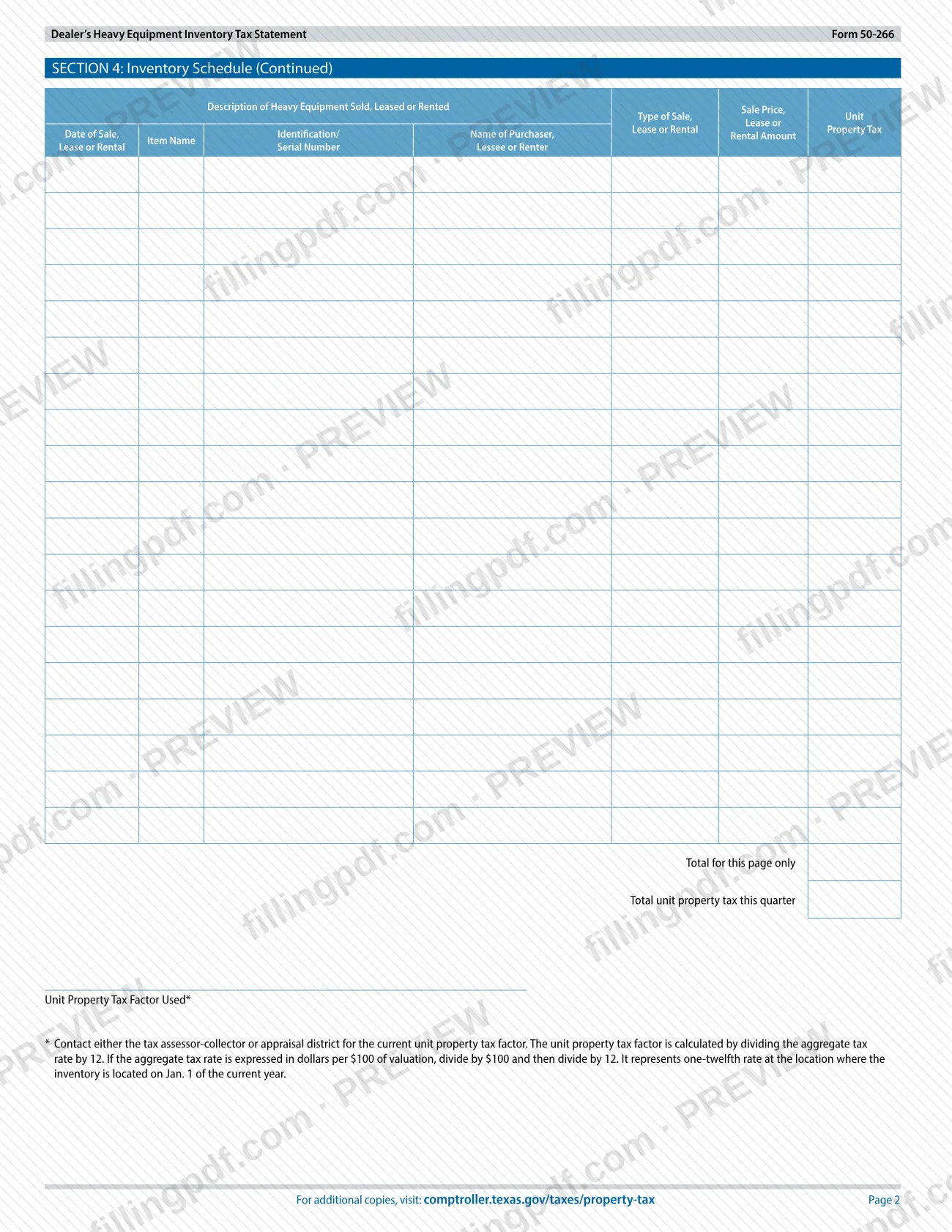
- A completed Inventory Schedule (Section 4) listing each sale, lease or rental in the preceding quarter, continued on additional sheets as needed; separate documentation may replace it if it matches the schedule's column headers.
- A list with the name and business address of each location at which you conduct business (Section 3).
- A copy of your tax bill or of appraisal district or tax office correspondence about the account, only if your appraisal district account number is not available.
- Form 50-162, completed and signed, only if the representative's authority is as an agent for tax matters appointed under Tax Code Section 1.111.
How to fill out 50-266
Enter account number and reporting quarter
At the top, write your Appraisal District Account Number and the Reporting Quarter Year. If the account number is not available, you will attach account correspondence under Section 3.
Complete Section 1, Dealer Information
Enter the Name of Dealer, phone number with area code, email address, and mailing address with city, state and ZIP code.
Complete Section 2 if required
Individual dealers filing for themselves skip to Section 3. Everyone else checks the basis of authority, enters the representative's name, title, phone, email and mailing address, and attaches Form 50-162 if they are an agent for tax matters.
Describe the business in Section 3
Enter the Name of Business, the Date Business Opened if you were not in business on Jan. 1 of this year, and the business address of the inventory location. Attach a list of every location where you conduct business.
Fill in the Inventory Schedule rows
For each sale, lease or rental in the quarter, give the item name, description, type code (HE, FL, DL or SS), date, unit identification or serial number, purchaser, lessee or renter, sale price or lease or rental amount, and unit property tax. Continue on added sheets if needed.
Total the schedule and apply the factor
Enter the total for each page and the total unit property tax for the quarter. Write the unit property tax factor used, which you get from the assessor-collector or appraisal district, and give the reason if no unit property tax is assigned.
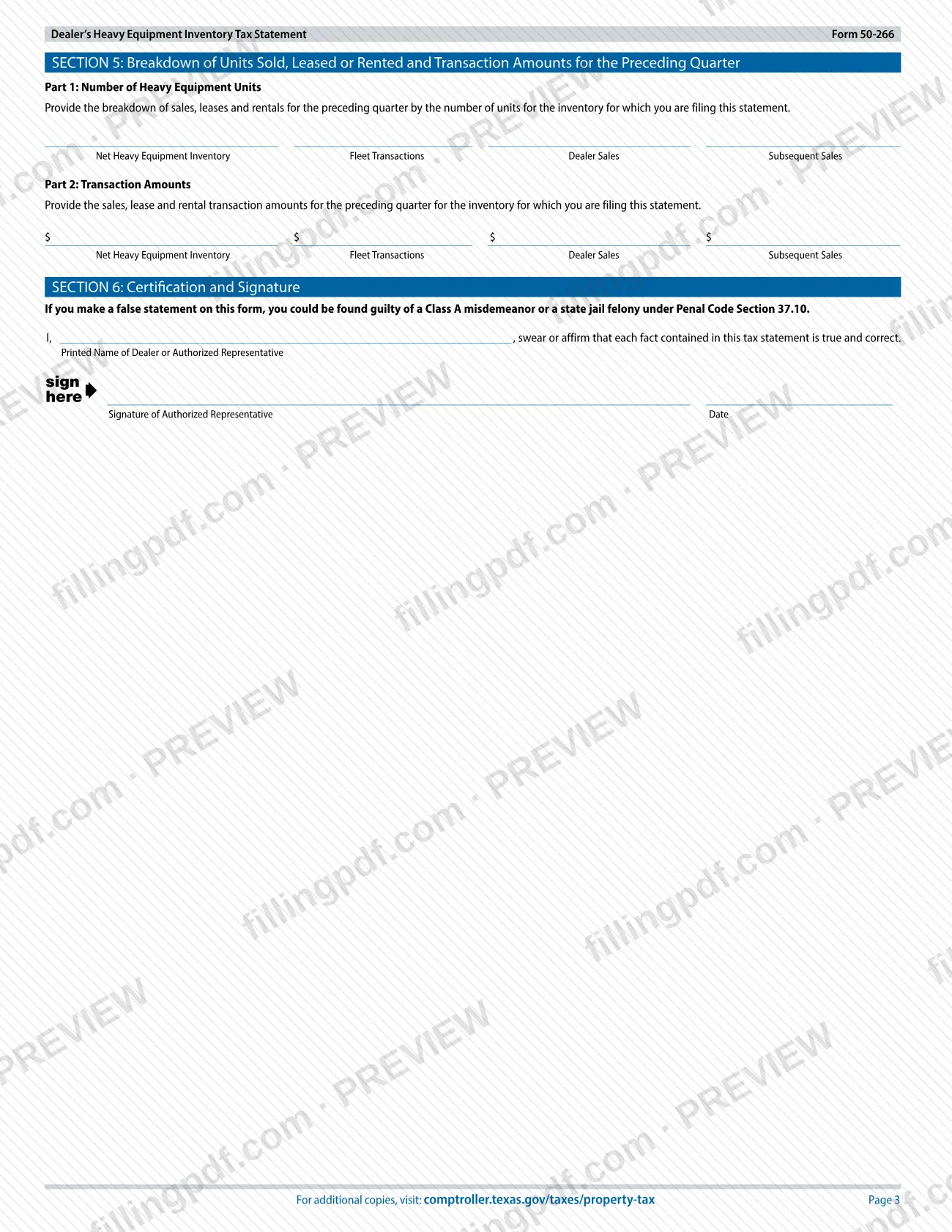
Complete Section 5, Part 1
Enter the number of units for the preceding quarter under Net Heavy Equipment Inventory, Fleet Transactions, Dealer Sales and Subsequent Sales.
Complete Section 5, Part 2
Enter the sales, lease and rental transaction amounts for the same four categories: Net Heavy Equipment Inventory, Fleet Transactions, Dealer Sales and Subsequent Sales.
Certify and sign Section 6
Print the name of the dealer or authorized representative in the certification, then sign and date. The signature line is for the authorized representative.
Review and download the completed PDF
Check the quarter, totals and codes against your records, then download or print the completed PDF from FillingPDF. Assemble the package described under How to submit with the schedule, location list and payment.
How to submit 50-266
File Form 50-266, with the unit property tax payment, with the tax assessor-collector of the county where the business is located; the form says to send it with payment to the assessor-collector. It names no online channel.
- Parker County, by mail or in person: Parker County Tax Assessor-Collector, 1112 Santa Fe Dr, Weatherford, TX 76086, the address printed on the form. The county page lists the Weatherford office as open Monday to Friday, 8:00 am to 5:00 pm, and gives the phone number 817-598-6139.
- Another county: send it to that county's assessor-collector. Contact information for appraisal districts and county assessor-collectors is on the Texas Comptroller's website.
Include the completed Inventory Schedule (or equivalent separate documentation), the list of business locations and the payment of the total unit property tax for the quarter. Do not send the form to the Texas Comptroller of Public Accounts. The form does not state accepted payment methods or the amount of any fee, so ask the Tax Assessor-Collector's office. For the unit property tax factor, contact the assessor-collector or the appraisal district; the county page gives the Parker County Appraisal District at parkercad.org or 817-596-0077.
FillingPDF lets you fill out and download the PDF; submission follows the channels above.
Common mistakes to avoid
- Filing Form 50-266 with the Texas Comptroller of Public Accounts; the form says to file it with the county assessor-collector.
- Skipping the statement for a quarter with no sales, leases or rentals; a statement saying there was no activity is still required.
- Filing after the 20th day of the month following the quarter, which brings a monthly late-filing penalty and a tax lien on business personal property.
- Leaving Section 2 blank when you are not an individual dealer filing on your own behalf.
- Omitting the list of each business location or the account correspondence when the appraisal district account number is unavailable.
- Leaving the Type of Sale, Lease or Rental code off a schedule row instead of using HE, FL, DL or SS.
- Charging unit property tax on fleet transactions, dealer sales or subsequent sales; the form says it is zero for those, and a reason is required if no tax is assigned.
- Using the annual tax rate as the unit property tax factor instead of one-twelfth of the aggregate rate.
- Signing a statement you know to be inaccurate; a false statement can be a Class A misdemeanor or a state jail felony under Penal Code Section 37.10.
Frequently asked questions
What is Form 50-266 used for?
Form 50-266 is the quarterly statement heavy equipment inventory dealers use to report heavy equipment sold, leased or rented in the preceding quarter and to file the unit property tax payment with the county assessor-collector, under Tax Code Section 23.1242.
Is this Parker County property tax form filed with the appraisal district?
No. File Form 50-266 with the Parker County Tax Assessor-Collector, which handles special inventory tax collections. Property appraisals come from the Parker County Appraisal District, which you can reach at parkercad.org or 817-596-0077 for the tax factor.
When is Form 50-266 due?
On or before the 20th day of the month following each quarter, except as provided by Tax Code Section 23.1242(g). A late statement brings a penalty for each month or part of a month it is late, plus a tax lien on business personal property.
Do I file if I had no sales, leases or rentals this quarter?
Yes. A dealer that does not sell, lease or rent heavy equipment in a quarter must still file a statement indicating there were no sales, leases or rentals in the preceding quarter.
How do I find the unit property tax factor?
Contact the tax assessor-collector or the appraisal district. The factor is the aggregate tax rate divided by 12; if the rate is in dollars per $100, divide by $100 and then by 12. It is the one-twelfth rate where the inventory is located on Jan. 1.
Which transactions carry unit property tax?
Only net heavy equipment inventory (HE). Fleet transactions (FL), dealer sales (DL) and subsequent sales (SS) carry zero unit property tax. For sales, multiply the price by the factor; for leases or rentals, multiply the monthly payment received by it.
Who has to complete Section 2?
Everyone except an individual dealer filing on their own behalf. The representative checks officer, general partner, attorney, agent for tax matters with a signed Form 50-162, or other basis with an explanation, and gives contact details.
Can I fill out Form 50-266 online on FillingPDF?
Yes. You can fill out the PDF online on FillingPDF and download or print it. FillingPDF is independent, is not affiliated with Parker County, and does not file the statement or accept payment; you submit it through the county's channels.
Ready to fill out 50-266?
Fill out 50-266 now