
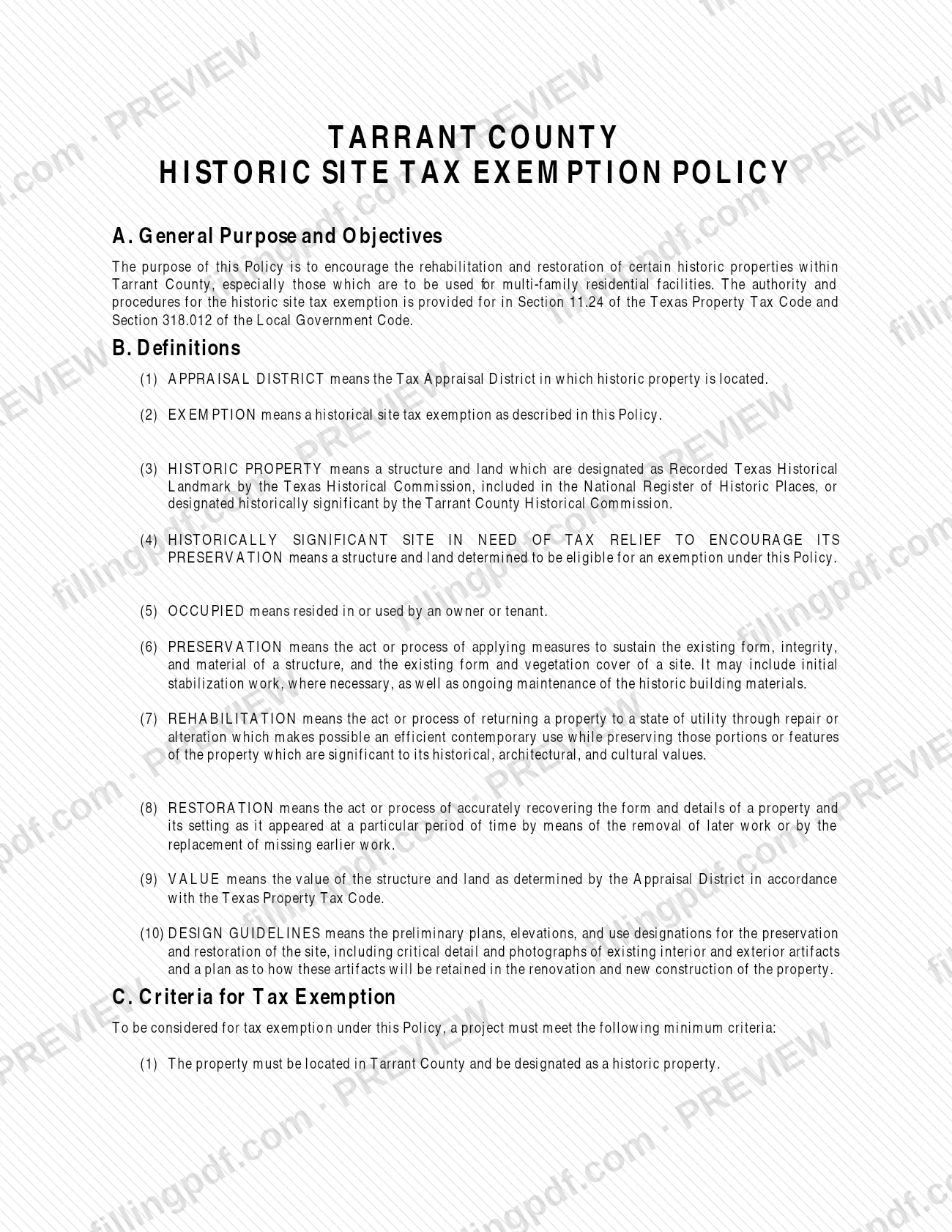
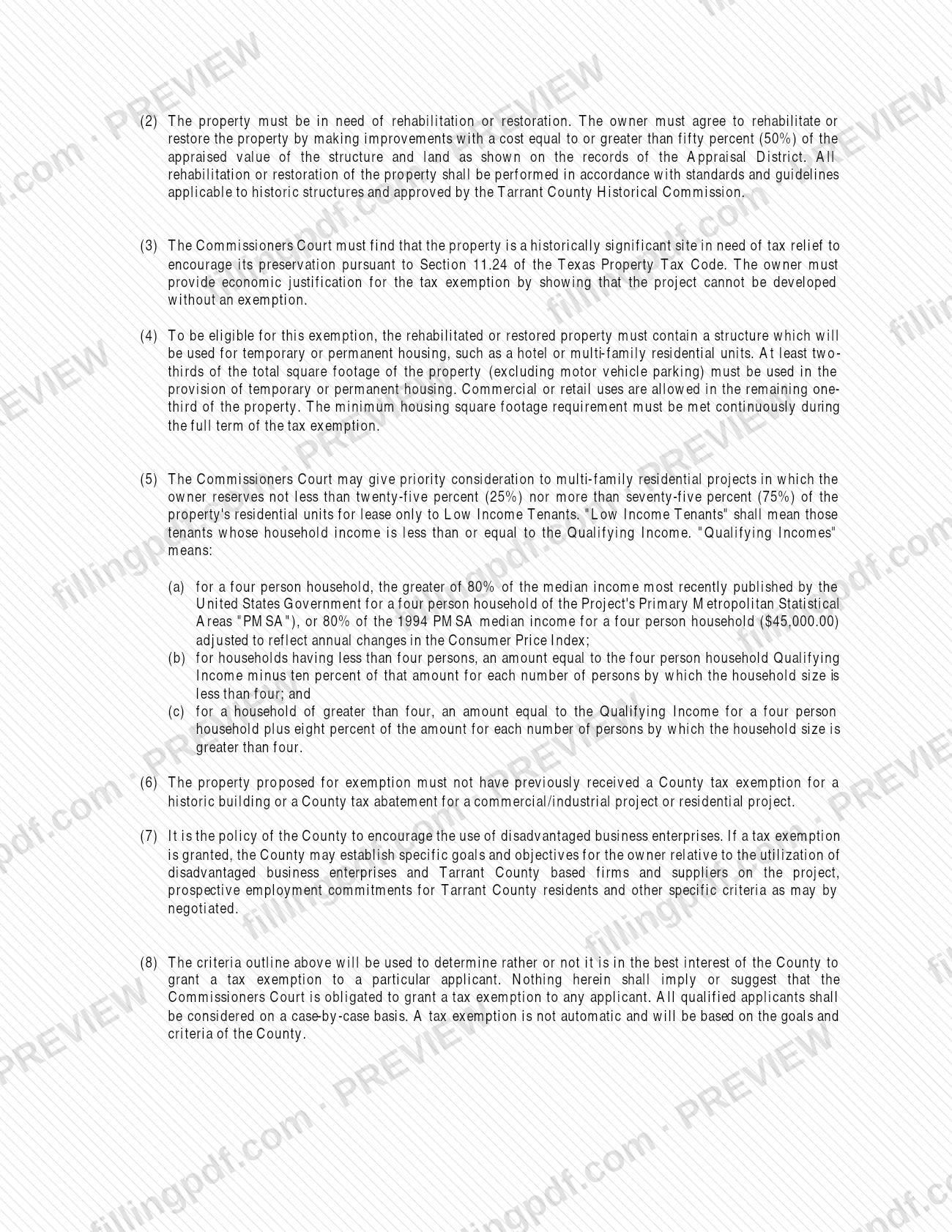
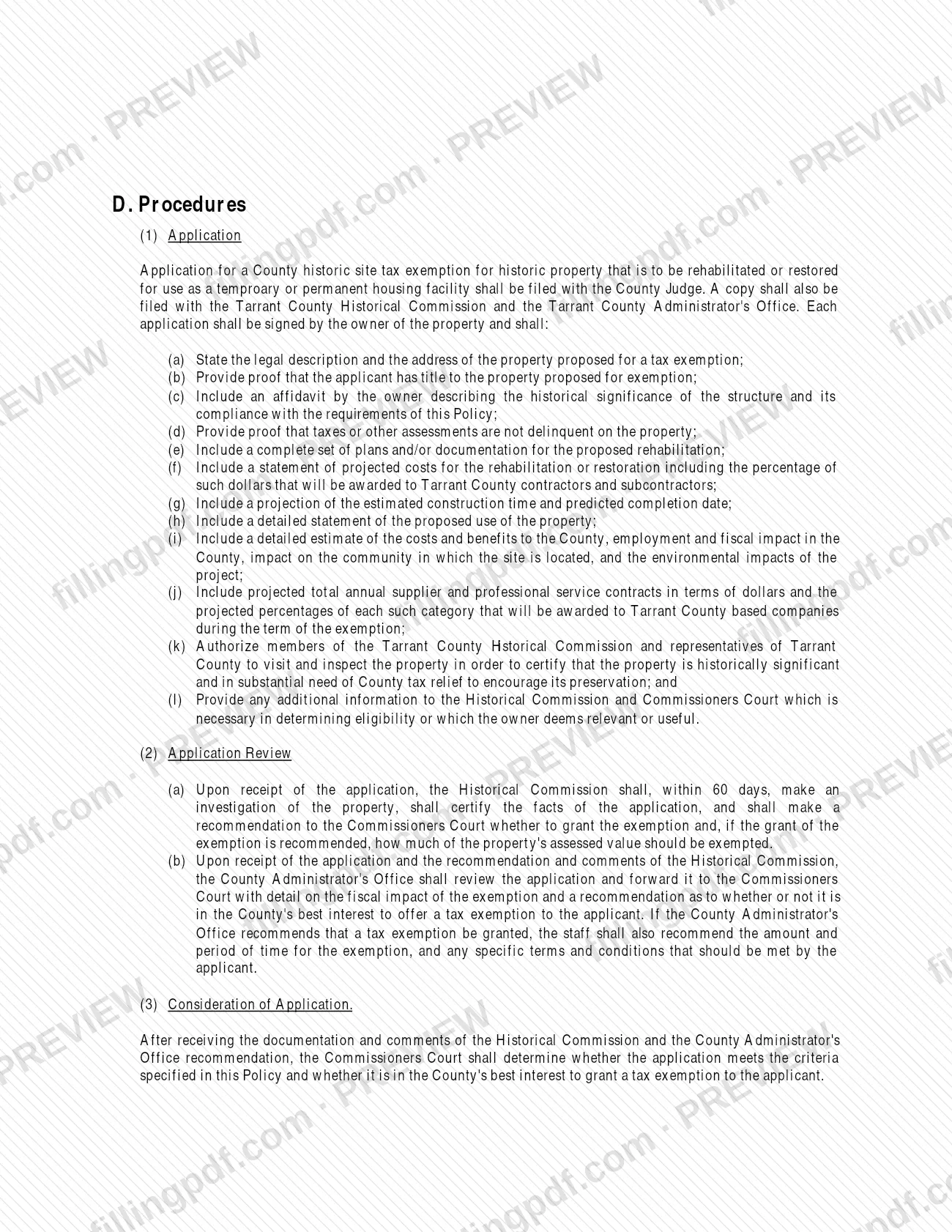
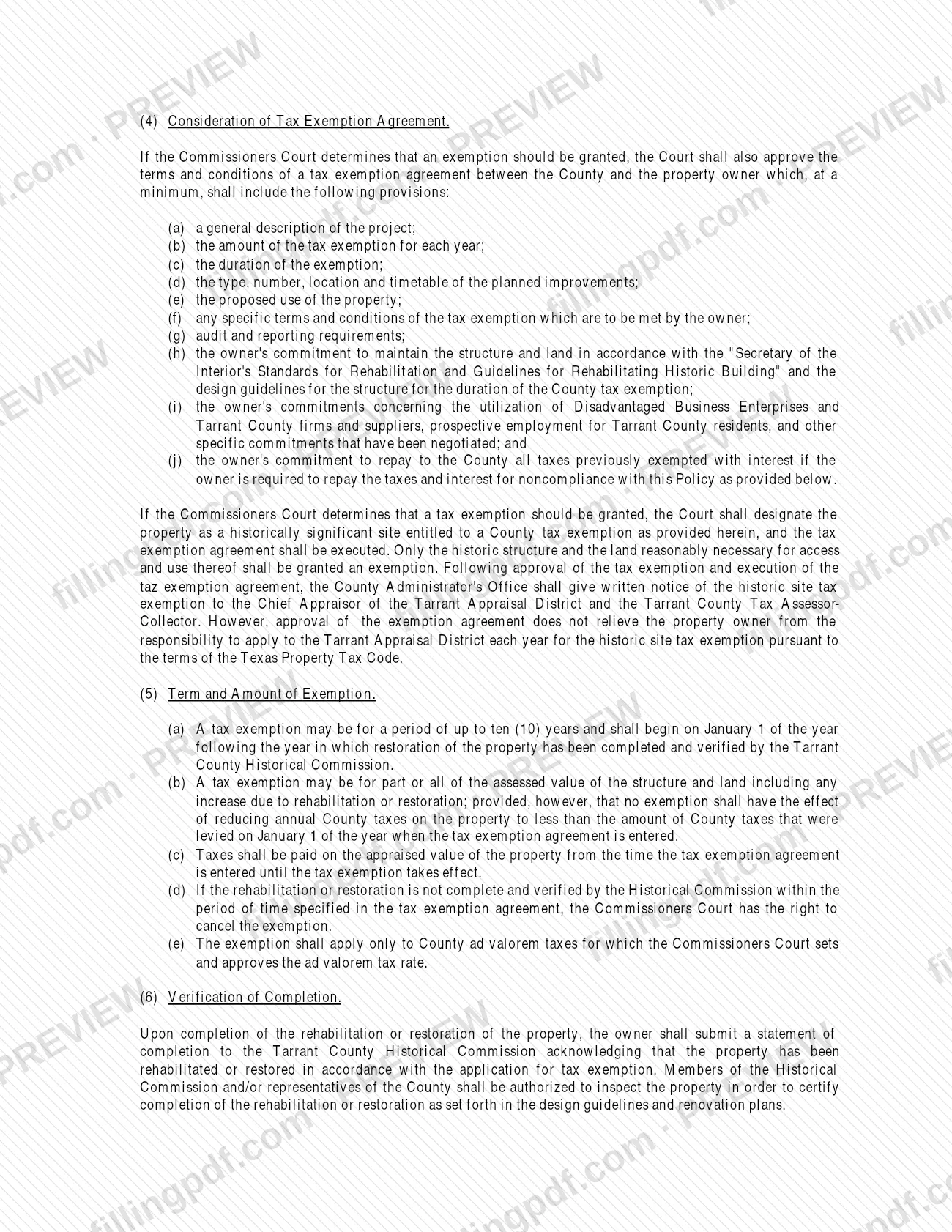
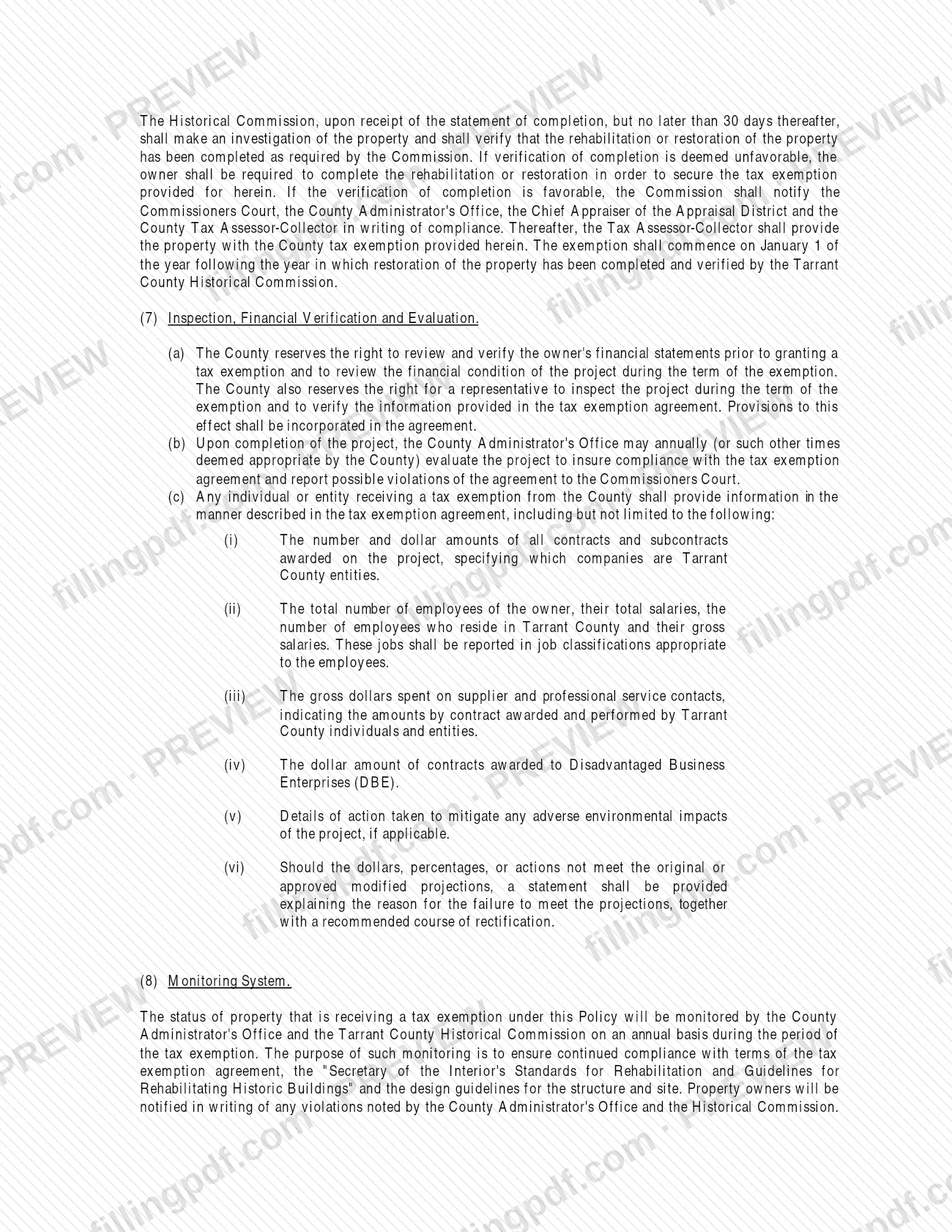
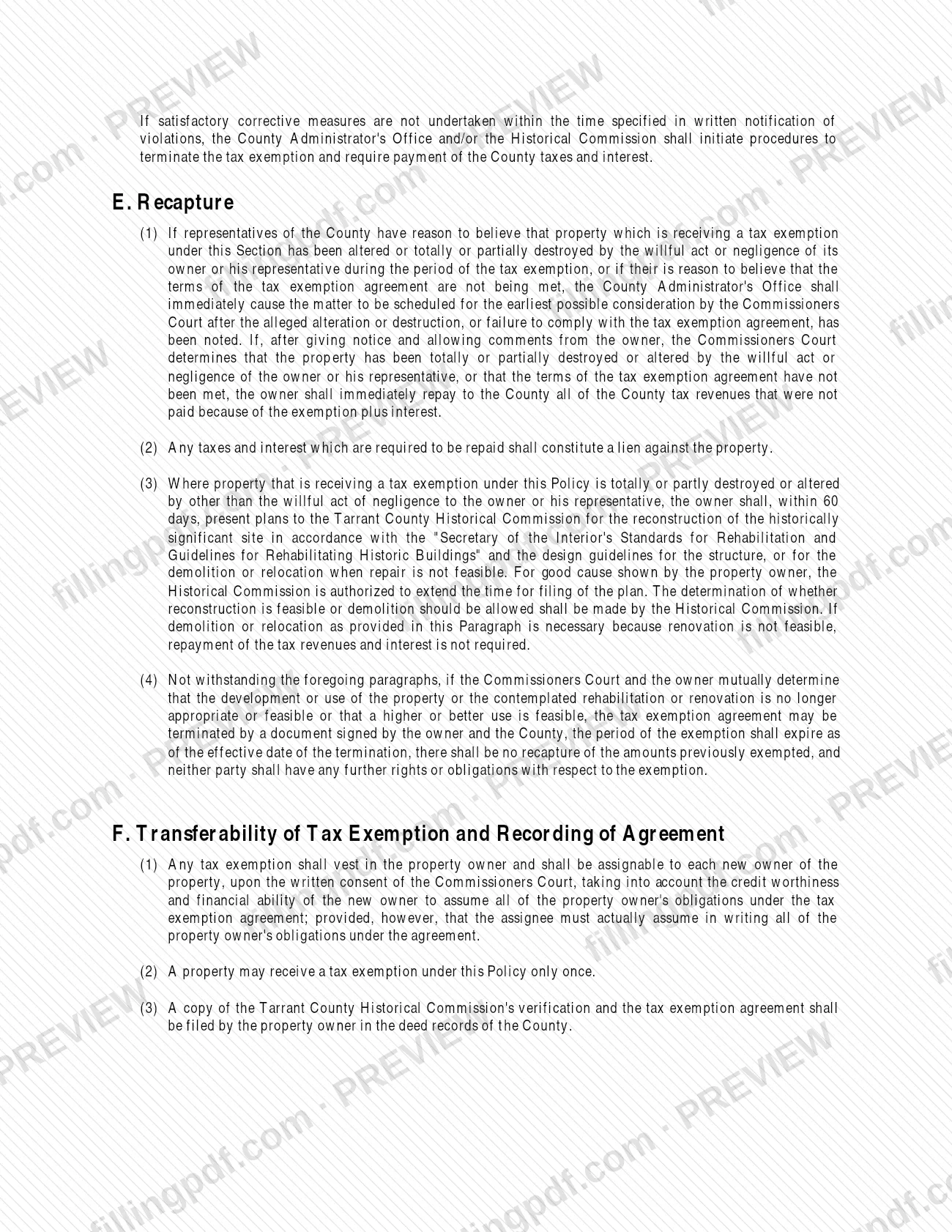

Tarrant County's Historical Site Tax Exemption is the Tarrant County policy under which the Commissioners Court may grant a county property tax exemption to the owner of a designated historic property that will be rehabilitated or restored for housing. It is one of the Tarrant County property tax documents, and it applies to county taxes only. The application is filed with the County Judge, with copies to the Tarrant County Historical Commission and the Tarrant County Administrator's Office. On this page you can fill out the PDF online on FillingPDF and download or print it; the document itself is published by Tarrant County at the official link.
Last updated
What is Tarrant County's Historical Site Tax Exemption?
Tarrant County's Historical Site Tax Exemption is the Tarrant County policy, published as the Historic Site Tax Exemption Policy, that sets the criteria and procedure for exempting a historic structure and its land from county property taxes after it is rehabilitated or restored for housing.
The stated purpose is to encourage the rehabilitation and restoration of certain historic properties in Tarrant County, especially those to be used as multi-family residential facilities. The policy cites Section 11.24 of the Texas Property Tax Code and Section 318.012 of the Local Government Code as its authority. The county's incentive programs page describes the exemption as covering the increase in value from rehabilitation or redevelopment of a historic structure used as permanent or temporary housing, including a hotel, and says affordable housing is preferred.
The Commissioners Court decides each case individually. The policy states that an exemption is not automatic and that the Court is not obligated to grant one. If it grants one, the Court also approves a tax exemption agreement with the owner. That agreement covers the project description, the yearly exempt amount, the duration, the planned improvements, audit and reporting terms and the owner's commitments.
The exemption applies only to County ad valorem taxes for which the Commissioners Court sets the rate. It is separate from the county's other incentive programs, such as the County Freeport Exemption, tax abatements and Tax Increment Financing.
Who needs to file Tarrant County's Historical Site Tax Exemption?
Owners of historic property in Tarrant County who plan to rehabilitate or restore it for temporary or permanent housing, such as a hotel or multi-family residential units, apply under this policy. The owner must sign the application.
Conditions the policy sets:
- The structure and land must be designated as a Recorded Texas Historical Landmark by the Texas Historical Commission, included in the National Register of Historic Places, or designated historically significant by the Tarrant County Historical Commission.
- The owner must agree to spend on improvements at least fifty percent (50%) of the appraised value of the structure and land shown in the Appraisal District records.
- At least two-thirds of the total square footage, excluding motor vehicle parking, must be used for housing. Commercial or retail uses may fill the remaining one-third.
- The owner must show economic justification, meaning the project cannot be developed without the exemption.
Priority consideration may go to multi-family projects that reserve 25% to 75% of units for lease to Low Income Tenants.
Not eligible: property that has already received a County historic building exemption or a County tax abatement for a commercial, industrial or residential project. A property may receive an exemption under this policy only once. A later owner may take over an exemption only with the Commissioners Court's written consent.
When to file Tarrant County's Historical Site Tax Exemption
File the application before the rehabilitation or restoration it describes, because the policy covers historic property that is "to be rehabilitated or restored" and requires plans and a projected construction schedule with the application. The policy sets no calendar deadline for submitting it.
After the County receives the application, the Historical Commission has 60 days to investigate the property, certify the facts and recommend whether to grant the exemption. The County Administrator's Office then reviews the application and forwards it to the Commissioners Court.
An exemption may last up to ten years. It begins on January 1 of the year after the Tarrant County Historical Commission verifies that the restoration is complete. When the work is finished, the owner submits a statement of completion, and the Commission verifies it no later than 30 days after receiving it. Taxes are paid on the appraised value from the date of the agreement until the exemption takes effect. Even with an approved agreement, the owner must apply to the Tarrant Appraisal District each year.
Documents you need
- Legal description and address of the property proposed for exemption, stated in the signed application.
- Proof that the applicant has title to the property.
- Owner's affidavit describing the structure's historical significance and its compliance with the policy.
- Proof that taxes and other assessments on the property are not delinquent.
- A complete set of plans or documentation for the proposed rehabilitation.
- Statement of projected costs for the rehabilitation or restoration, including the percentage of dollars to be awarded to Tarrant County contractors and subcontractors.
- Projection of estimated construction time and predicted completion date.
- Detailed statement of the proposed use of the property.
- Detailed estimate of costs and benefits to the County, employment and fiscal impact, community impact and environmental impacts.
- Projected annual supplier and professional service contracts, with the percentages awarded to Tarrant County based companies during the exemption term.
- Authorization for Historical Commission members and County representatives to visit and inspect the property.
- Any additional information needed to determine eligibility, or that the owner considers relevant.
How to fill out Tarrant County's Historical Site Tax Exemption
Confirm the property is eligible
Check that the property is in Tarrant County and designated as a Recorded Texas Historical Landmark, listed in the National Register of Historic Places, or designated by the Tarrant County Historical Commission.
State the property and ownership
Enter the legal description and address of the property proposed for exemption, and add proof that you hold title.
Describe historical significance
Attach the owner's affidavit describing the structure's historical significance and its compliance with the policy. Add proof that taxes and other assessments are not delinquent.
Document the rehabilitation plans
Include a complete set of plans or documentation for the proposed rehabilitation, with the projected construction time and predicted completion date.
Give costs and local contracting figures
State projected rehabilitation costs and the percentage to go to Tarrant County contractors and subcontractors. Add projected annual supplier and professional service contracts and the percentages going to county-based companies.
Describe use and impact
Provide a detailed statement of the proposed use, which must be housing for at least two-thirds of the square footage. Add the cost-benefit, employment, fiscal, community and environmental estimates.
Authorize site inspections
Include the owner's authorization for Historical Commission members and County representatives to inspect the property. Add any further information relevant to eligibility.
Show economic justification
Explain why the project cannot be developed without the exemption. If you reserve 25% to 75% of residential units for Low Income Tenants, say so, since that may receive priority consideration.
Sign, review and download the PDF
The owner signs the application. Check every item against the list above, then download or print the completed PDF from FillingPDF and file it as described under How to submit.
How to submit Tarrant County's Historical Site Tax Exemption
The application goes to the County Judge, with copies to two other offices.
- County Judge: file the signed application with the County Judge.
- Tarrant County Historical Commission: file a copy with the Commission, which investigates the property and recommends whether to grant the exemption.
- Tarrant County Administrator's Office: file a copy with this office, which reviews the application and sends it to the Commissioners Court with a fiscal-impact detail and a recommendation.
The policy gives no street address, portal or fee for the application, so confirm delivery details with those offices through Tarrant County at https://www.tarrantcountytx.gov.
Later filings follow separate channels. The statement of completion goes to the Tarrant County Historical Commission. A copy of the Commission's verification and the tax exemption agreement must be filed by the owner in the County deed records. The owner also applies each year to the Tarrant Appraisal District.
FillingPDF lets you fill out and download the PDF; submission follows the channels above.
Common mistakes to avoid
- Filing only with the County Judge; the policy also requires a copy to the Tarrant County Historical Commission and to the Tarrant County Administrator's Office.
- Submitting the application without the owner's signature; each application must be signed by the property owner.
- Leaving out proof of title or proof that taxes and other assessments are not delinquent.
- Planning improvements below fifty percent (50%) of the appraised value of the structure and land shown in Appraisal District records.
- Designing a project where less than two-thirds of the square footage, excluding parking, is used for housing, or letting that share drop during the exemption term.
- Applying for a property that already received a County historic building exemption or a County tax abatement, or that was exempted once before.
- Assuming an approved agreement replaces the yearly application to the Tarrant Appraisal District; the owner must still apply each year.
- Not filing the Historical Commission's verification and the agreement in the County deed records.
- Failing to present reconstruction, demolition or relocation plans to the Historical Commission within 60 days after the property is destroyed or altered other than by the owner's willful act or negligence.
Frequently asked questions
What is Tarrant County's Historical Site Tax Exemption?
It is a Tarrant County policy that lets the Commissioners Court exempt a designated historic structure and its land from county property taxes after the owner rehabilitates or restores it for housing, such as a hotel or multi-family units. Each case is decided individually and approval is not automatic.
Does this Tarrant County property tax exemption cover all my taxes?
No. The exemption applies only to County ad valorem taxes for which the Commissioners Court sets the tax rate. Taxes set by other taxing units are not covered by this policy, and the County tax cannot fall below the amount levied on January 1 of the year the agreement is entered.
Where do I file the historic site tax exemption application?
File it with the County Judge, and file a copy with both the Tarrant County Historical Commission and the Tarrant County Administrator's Office. The owner of the property must sign the application.
How much must I spend on the rehabilitation to qualify?
The owner must agree to make improvements costing at least fifty percent (50%) of the appraised value of the structure and land shown in the Appraisal District records. The work must follow historic-structure standards approved by the Tarrant County Historical Commission.
How long does the exemption last?
Up to ten years. It starts on January 1 of the year after the Tarrant County Historical Commission verifies the restoration is complete. Until it takes effect, taxes are paid on the appraised value.
Do I still have to apply to the appraisal district each year?
Yes. Approval of the exemption agreement does not relieve the owner of applying to the Tarrant Appraisal District every year for the historic site tax exemption under the Texas Property Tax Code.
What happens if I do not follow the exemption agreement?
If the Commissioners Court finds the agreement terms were not met, or the property was destroyed or altered by the owner's willful act or negligence, the owner must repay the exempted County taxes with interest. That amount is a lien against the property.
Can I fill out the Historical Site Tax Exemption PDF online?
You can fill out the PDF online on FillingPDF and download or print it. FillingPDF is an independent service and does not file anything with Tarrant County; you submit the application through the County channels described above.
Ready to fill out Tarrant County's Historical Site Tax Exemption?
Fill out Tarrant County's Historical Site Tax Exemption now