
VA Home Kitchen Food Processing Exemptions is a Virginia Department of Agriculture and Consumer Services (VDACS) fact sheet on the foods that may be made in a private home without VDACS inspection: low risk foods, acidified vegetables and honey. The Fairfax County Park Authority, which runs farmers markets in Fairfax County, posts it on its website. It is a reference sheet for home producers, not an application. On FillingPDF you can view the PDF and download or print it; the original stays on the Park Authority's website.
Last updated
What is VDACS-FSP-HKFPE?
VA Home Kitchen Food Processing Exemptions is a Virginia Department of Agriculture and Consumer Services (VDACS) fact sheet explaining which foods can be made in a private home without VDACS inspection under § 3.2‐5130 of the Code of Virginia.
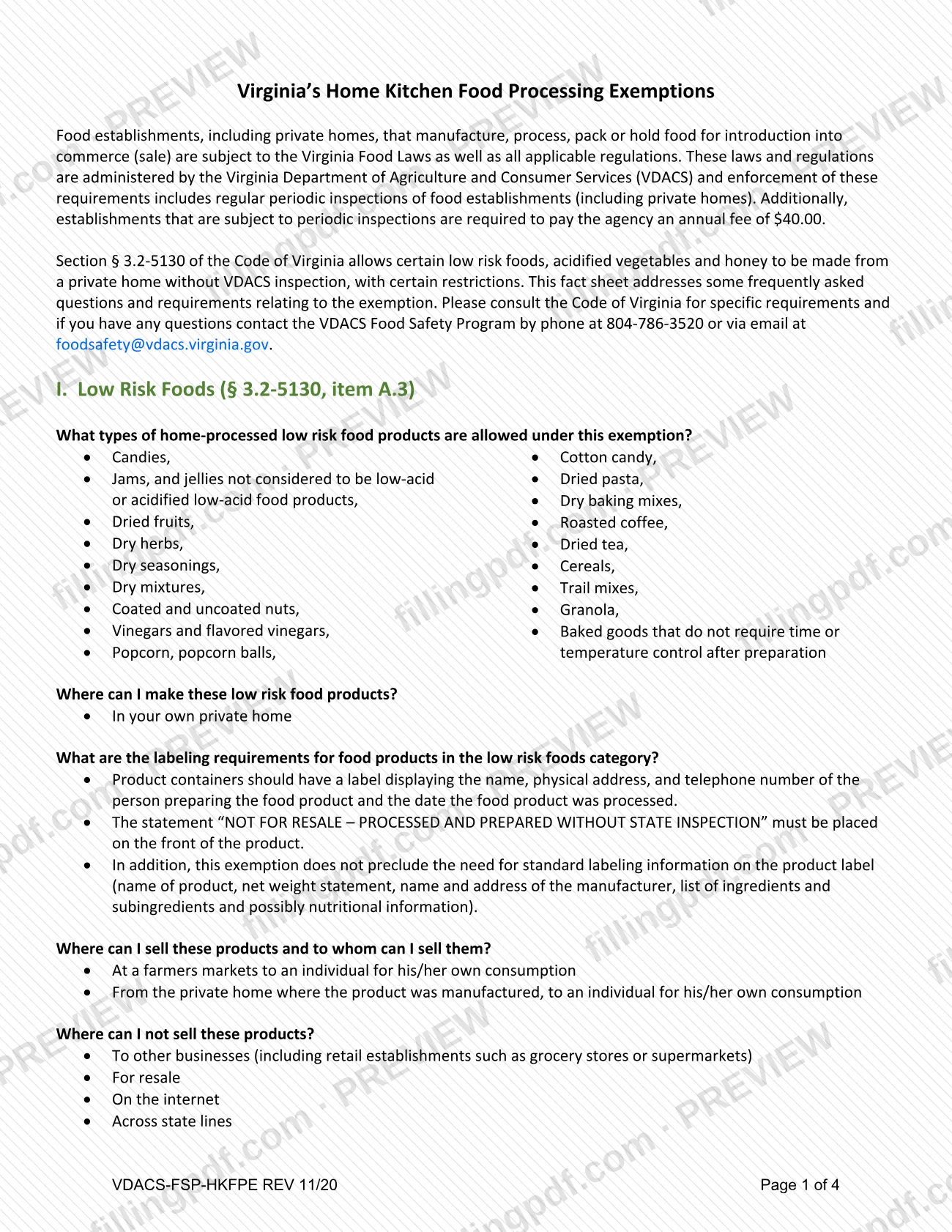
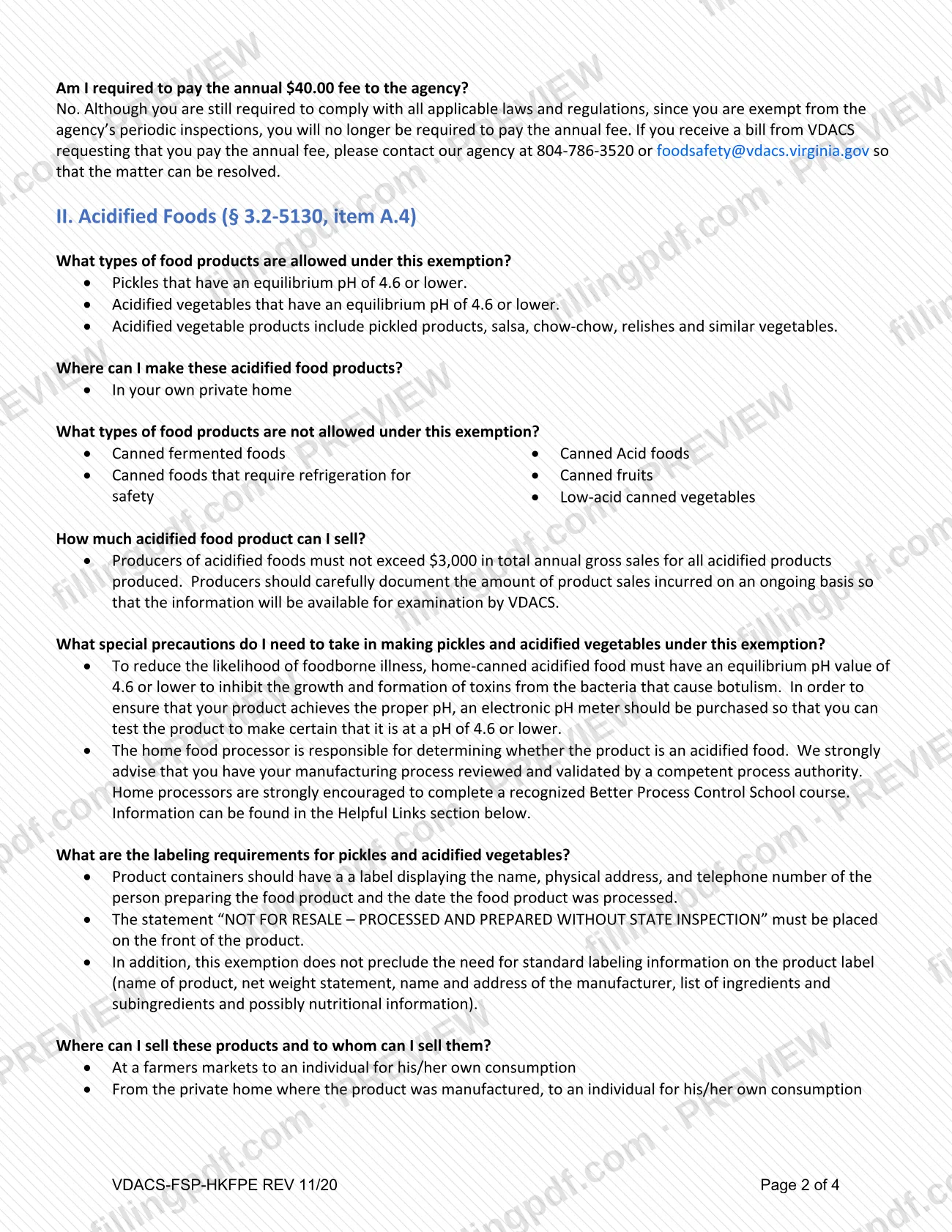
The sheet is printed as "Virginia's Home Kitchen Food Processing Exemptions" and carries the code VDACS-FSP-HKFPE, REV 11/20, four pages long. It exists because food establishments, including private homes, that make, process, pack or hold food for sale are subject to the Virginia Food Laws and to regular periodic inspections by VDACS. Section § 3.2‐5130 lifts that inspection for three groups of products, and the sheet answers common questions about each:
- Low Risk Foods (§ 3.2‐5130, item A.3): for example candies, jams and jellies, dried fruits, granola, popcorn and baked goods that need no time or temperature control after preparation.
- Acidified Foods (§ 3.2‐5130, item A.4): pickles and acidified vegetables with an equilibrium pH of 4.6 or lower.
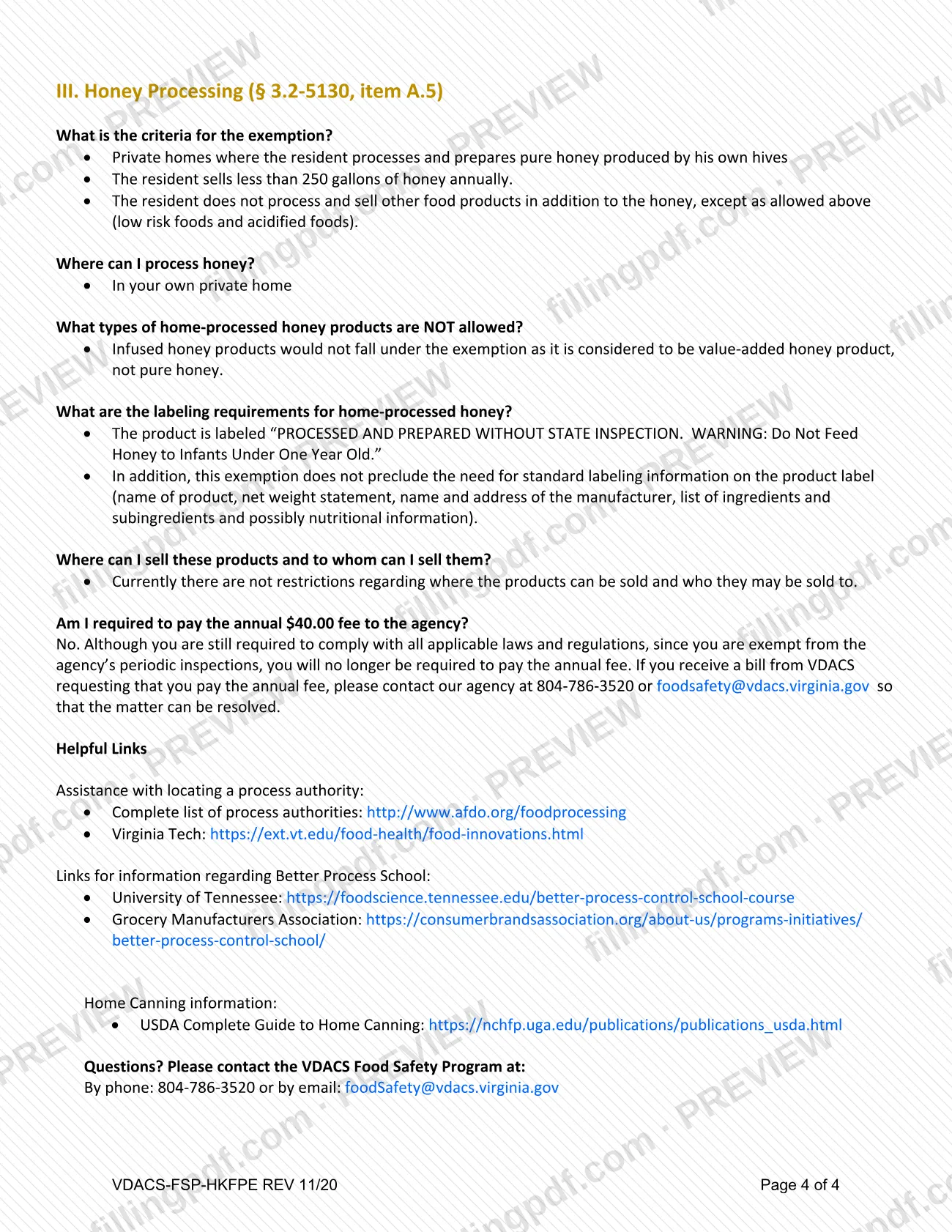
- Honey Processing (§ 3.2‐5130, item A.5): pure honey from the resident's own hives.
For each group it states where the food may be made, how it must be labeled, where and to whom it may be sold, and that the annual inspection fee does not apply. It also explains pH testing. The sheet is not an application and produces no permit; it tells you to consult the Code of Virginia for the specific requirements.
Who needs to file VDACS-FSP-HKFPE?
The fact sheet is for people who make food in their own private home and want to sell it under the § 3.2‐5130 exemption instead of being inspected by VDACS.
- Low risk food makers: home producers of the listed products, such as candies, jams and jellies that are not low‐acid or acidified, dried pasta, roasted coffee, granola or baked goods that need no time or temperature control after preparation.
- Acidified food makers: home producers of pickles, salsa, chow‐chow, relishes and similar acidified vegetables with an equilibrium pH of 4.6 or lower, whose total annual gross sales for all acidified products do not exceed $3,000.
- Honey producers: residents who process pure honey from their own hives, sell less than 250 gallons annually and do not process and sell other foods beyond the low risk and acidified foods allowed above.
The exemption does not cover canned fermented foods, canned foods that require refrigeration for safety, canned acid foods, canned fruits, low‐acid canned vegetables or infused honey, which the sheet treats as value‐added rather than pure honey.
Farmers market vendors should also know that the Fairfax County Park Authority's markets set their own rules: its vendor page says they are producer‐only and that products must be grown, raised or made from scratch by the vendor.
When to file VDACS-FSP-HKFPE
The fact sheet is not filed, and it prints no due date. Read it before you begin making food at home for sale, because the exemption depends on what you make, how you label it and where you sell it.
Some conditions run continuously. Acidified food producers must keep track of sales so that the figures can be examined by VDACS, and must stay within the annual gross sales limit for all acidified products. Honey producers must stay under 250 gallons sold per year. Each different acidified product offered for sale needs its own pH test, and a product's equilibrium pH is measured differently depending on whether it was processed less than 2 months or more than 2 months ago.
If VDACS sends you a bill for the annual inspection fee after you have become exempt, the sheet tells you to contact the agency so the matter can be resolved.
Documents you need
- Sales records for acidified foods: the sheet says producers should document sales on an ongoing basis so VDACS can examine them, to show total annual gross sales stay within the exemption limit.
How to fill out VDACS-FSP-HKFPE
Identify your product category
Decide whether your product is a low risk food (Part I, item A.3), an acidified food (Part II, item A.4) or pure honey (Part III, item A.5). The sheet has a separate section for each.
Check the allowed product list
For low risk foods, compare your product with the list in Part I. Baked goods qualify only if they do not require time or temperature control after preparation.
Confirm acidified food limits
For pickles and acidified vegetables, confirm an equilibrium pH of 4.6 or lower, that your product is not on the not‐allowed list of canned foods, and that total annual gross sales stay within the stated limit.
Plan your pH testing
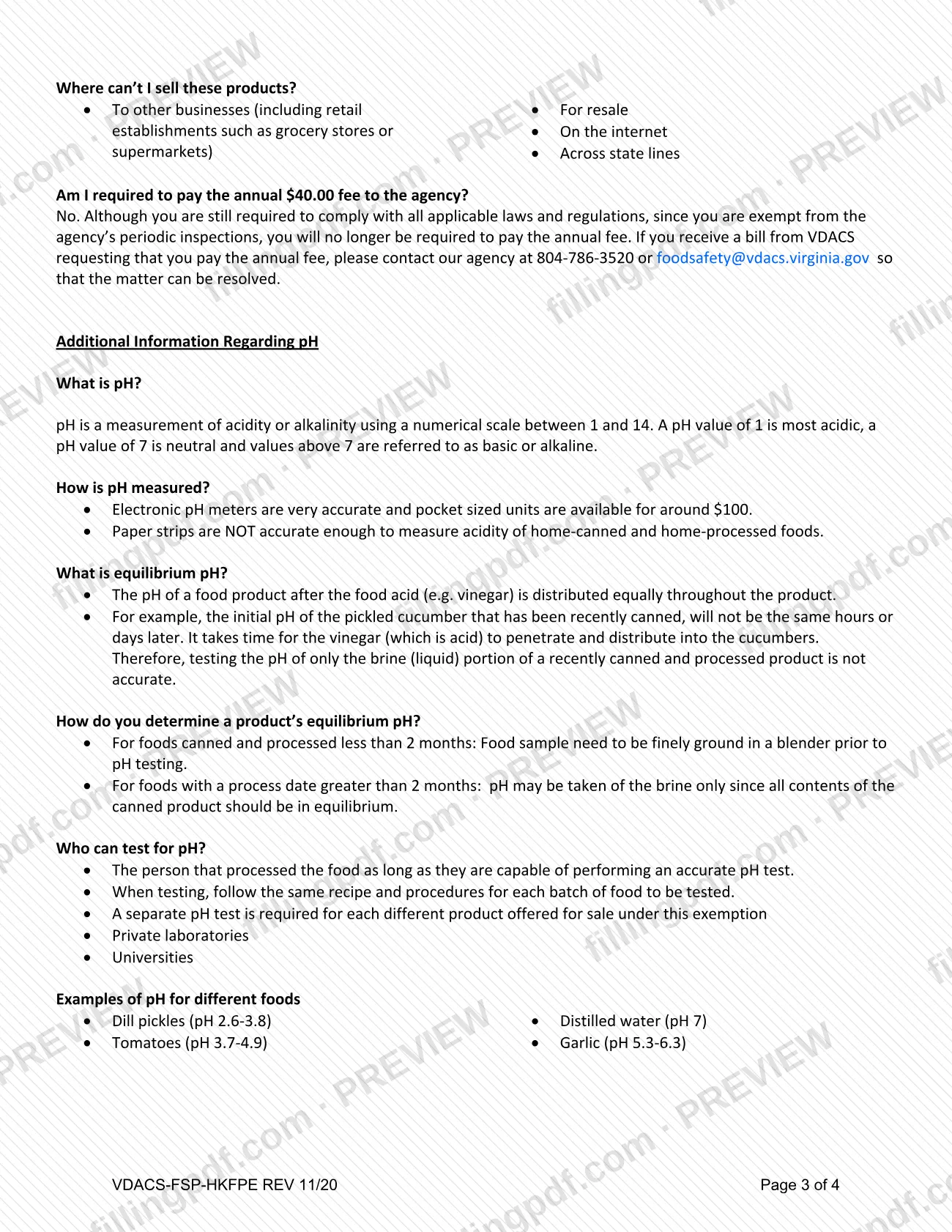
Use an electronic pH meter, test each different product separately, and follow the sheet's rules on grinding samples processed less than 2 months ago or testing brine after more than 2 months.
Check the honey criteria
In Part III, confirm the honey is pure honey from your own hives, you sell less than 250 gallons a year and you sell no other foods beyond those allowed above.
Prepare your product label
Include your name, physical address and telephone number and the processing date for low risk and acidified foods, plus the required statement on the front. Honey uses its own label wording, including the warning about infants under one year old.
Choose where you will sell
Low risk and acidified foods may be sold at farmers markets or from your home to an individual for personal consumption. Honey currently has no stated restrictions on where or to whom it is sold.
Download or print the PDF
Download or print the fact sheet from FillingPDF to keep it with your records, and contact the VDACS Food Safety Program with any questions.
How to submit VDACS-FSP-HKFPE
Nothing on this fact sheet is submitted: it prints no filing address, portal or appointment process. Questions and billing problems go to VDACS, and farmers market vendors apply through the Park Authority.
- VDACS Food Safety Program: phone 804‐786‐3520 or email [email protected], for questions about the exemption or if you receive a bill for the annual inspection fee after becoming exempt.
- Code of Virginia: the sheet directs you to § 3.2‐5130 for the specific requirements.
- Fairfax County farmers markets: the Park Authority operates 10 markets in Fairfax County and describes who can become a vendor at https://www.fairfaxcounty.gov/parks/farmersmarkets/become-vendor.
FillingPDF lets you view and download the PDF; any contact with VDACS or the Park Authority follows the channels above.
Common mistakes to avoid
- Selling exempt low risk or acidified products online, across state lines, to other businesses such as grocery stores, or for resale; the sheet lists all of these as not allowed.
- Leaving the statement "NOT FOR RESALE – PROCESSED AND PREPARED WITHOUT STATE INSPECTION" off the front of a low risk or acidified product.
- Skipping the standard label information (product name, net weight, manufacturer name and address, ingredients), which the exemption does not replace.
- Measuring acidity of home‐canned foods with paper strips; the sheet says they are not accurate enough and recommends an electronic pH meter.
- Testing only the brine of a pickled product processed less than 2 months ago; it should be finely ground and tested, because equilibrium pH takes time to develop.
- Applying one pH test to several products; a separate test is required for each different product sold under the acidified exemption.
- Selling canned fruits, canned acid foods or low‐acid canned vegetables under the acidified exemption; they are listed as not allowed.
- Selling infused honey as exempt honey; the sheet treats it as value‐added honey, not pure honey.
- Exceeding 250 gallons of honey a year, or selling other foods beyond the allowed low risk and acidified foods, and still claiming the honey exemption.
Frequently asked questions
What are the Virginia home kitchen food processing exemptions?
They are exemptions under § 3.2‐5130 of the Code of Virginia that let certain low risk foods, acidified vegetables and honey be made in a private home without VDACS inspection, with restrictions on labeling, sales and, for acidified foods, annual gross sales. The VDACS fact sheet explains each group.
Do I have to pay the annual VDACS fee if I qualify for the exemption?
No. The sheet says that because you are exempt from periodic inspections, you no longer pay the annual fee, though you must still follow all applicable laws and regulations. If VDACS bills you anyway, contact the Food Safety Program at 804‐786‐3520 or [email protected].
Can I sell home‐made jams, baked goods or pickles online in Virginia?
Not under the low risk or acidified exemptions. The sheet lists the internet, other states, other businesses and resale as places you cannot sell them. You may sell to an individual for personal consumption at a farmers market or from your home.
What is the sales limit for acidified foods under the exemption?
Producers of acidified foods must not exceed $3,000 in total annual gross sales for all acidified products. The sheet says to document sales carefully on an ongoing basis so VDACS can examine the records.
What must the label say on exempt low risk and acidified foods?
The label shows your name, physical address, telephone number and the date processed, and the front must say "NOT FOR RESALE – PROCESSED AND PREPARED WITHOUT STATE INSPECTION." Standard label information such as net weight and ingredients is still needed.
How do I test the pH of pickles for the acidified exemption?
Use an electronic pH meter; paper strips are not accurate enough. For foods processed less than 2 months ago, finely grind a sample before testing. After more than 2 months, you may test the brine. Each different product needs its own test.
Is there any limit on selling exempt honey?
The honey must be pure honey from your own hives, with sales under 250 gallons a year and no other foods sold beyond the allowed low risk and acidified foods. The sheet says there are currently no restrictions on where or to whom it is sold.
Is this a Fairfax County property tax document?
No. It is a food safety fact sheet from VDACS, posted by the Fairfax County Park Authority for its farmers markets. It says nothing about Fairfax County property tax.
Can I fill out this fact sheet online on FillingPDF?
The sheet is informational and has no application to complete. FillingPDF lets you view it and download or print the PDF. FillingPDF is independent, is not affiliated with VDACS or the Park Authority, and does not submit anything on your behalf.
Ready to fill out VDACS-FSP-HKFPE?
Fill out VDACS-FSP-HKFPE now