
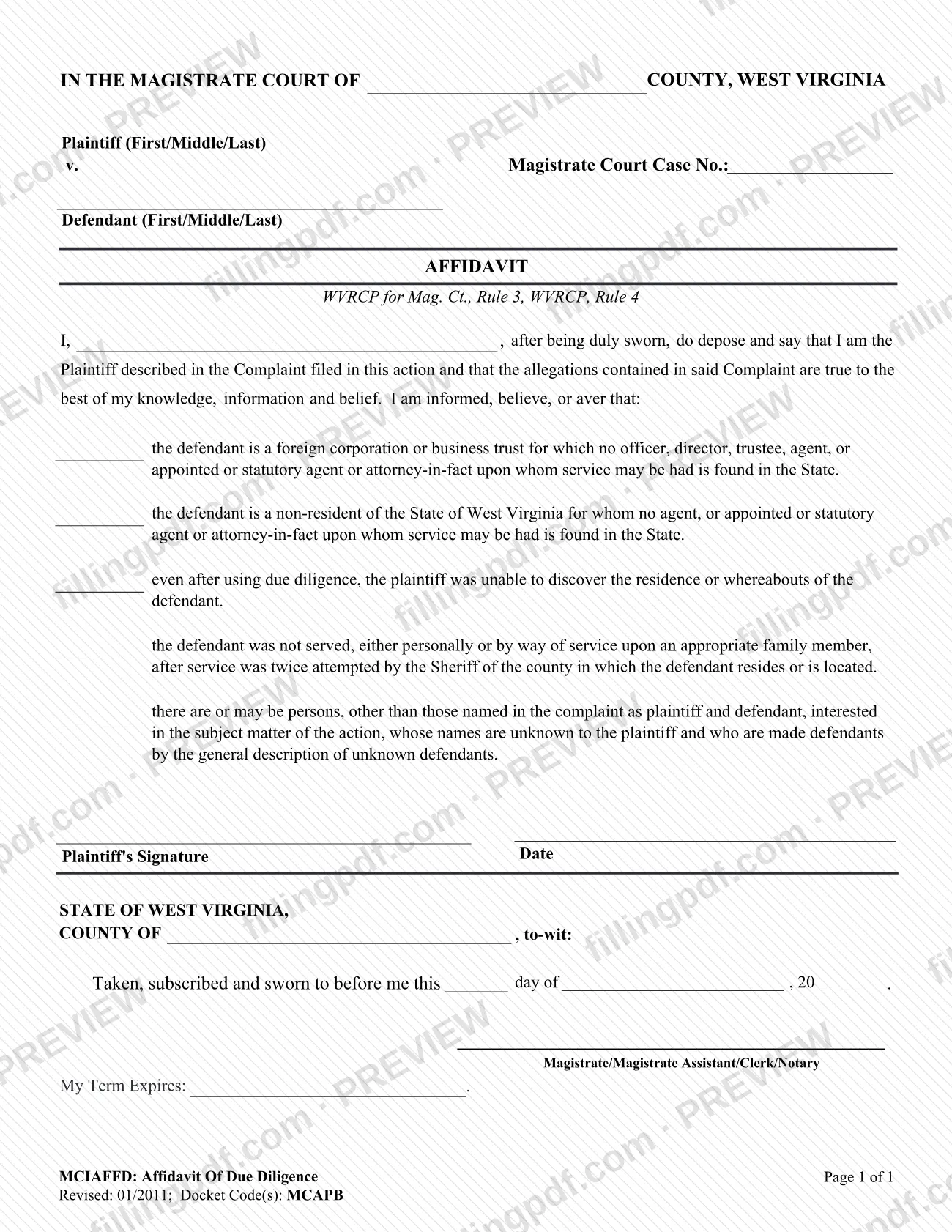
The affidavit of due diligence (Form MCIAFFD) is a one-page sworn statement that a plaintiff makes in a West Virginia Magistrate Court civil case, published by the Supreme Court of Appeals of West Virginia. The plaintiff checks the statement that fits, such as a defendant whose whereabouts could not be found or who was not served after two Sheriff attempts, signs it, and swears to it before an authorized officer. On this page you can fill out the form online on FillingPDF and download or print the completed PDF; the form itself is published by the West Virginia courts.
Last updated
What is MCIAFFD?
The Affidavit of Due Diligence (Form MCIAFFD) is the West Virginia Magistrate Court form on which a plaintiff states under oath that the allegations in the filed Complaint are true to the best of the plaintiff's knowledge, information and belief, and that one of five listed circumstances about the defendant applies.
The form is headed "In the Magistrate Court of ___ County, West Virginia" and cites the West Virginia Rules of Civil Procedure for Magistrate Courts, Rule 3, and WVRCP, Rule 4. It carries the plaintiff and defendant names and the Magistrate Court case number. The plaintiff checks the statement or statements that apply:
- the defendant is a foreign corporation or business trust with no officer, director, trustee, agent, or appointed or statutory agent or attorney-in-fact on whom service may be had found in the State;
- the defendant is a non-resident of West Virginia with no such agent or attorney-in-fact found in the State;
- even after using due diligence, the plaintiff was unable to discover the defendant's residence or whereabouts;
- the defendant was not served, personally or through an appropriate family member, after the Sheriff of the county where the defendant resides or is located twice attempted service;
- other persons may be interested in the subject matter and their names are unknown, so they are made defendants as unknown defendants by general description.
The affidavit is signed and dated by the plaintiff and then taken, subscribed and sworn before a Magistrate, Magistrate Assistant, Clerk or Notary. The printed footer reads "MCIAFFD: Affidavit Of Due Diligence," revised 01/2011, Docket Code(s): MCAPB. The West Virginia courts list it among their civil forms for Magistrate Court.
Who needs to file MCIAFFD?
The plaintiff in a West Virginia Magistrate Court civil action completes this affidavit when one of the five statements printed on it is true in the case. The wording is first person: "I am the Plaintiff described in the Complaint filed in this action," so the person swearing is the plaintiff, not the defendant or a third party.
The statements cover these situations:
- a foreign corporation or business trust defendant with no one in the State on whom service may be had;
- a defendant who is a non-resident of West Virginia with no agent or attorney-in-fact in the State;
- a defendant whose residence or whereabouts the plaintiff could not discover even after using due diligence;
- a defendant not served after the county Sheriff twice attempted service;
- unknown persons interested in the subject matter, who are made defendants by general description.
You check only the statement or statements that apply to your case. The form is not for a plaintiff whose defendant was served, and it does not say that anyone may swear on the plaintiff's behalf. A Magistrate, Magistrate Assistant, Clerk or Notary completes the sworn portion at the bottom.
When to file MCIAFFD
The affidavit is made after the Complaint has been filed, because the plaintiff swears about "the Complaint filed in this action" and enters the Magistrate Court case number. It is used when one of the printed circumstances arises, for example after the Sheriff has twice attempted service without success or after the plaintiff has been unable to find the defendant's whereabouts. The form prints no deadline of its own. Rule 3 of the West Virginia Rules of Civil Procedure for Magistrate Courts and Rule 4 of the WVRCP are cited on it, so check those rules or ask the magistrate court clerk about timing in your case.
How to fill out MCIAFFD
Enter the county in the heading
In "In the Magistrate Court of ___ County, West Virginia," write the county of the magistrate court that has your case.
Enter plaintiff and defendant names
Write the Plaintiff's first, middle and last name and the Defendant's first, middle and last name in the caption.
Enter the case number
Fill in the Magistrate Court Case No. as it appears on your Complaint.
Write your name in the oath
On the line after "I," enter the plaintiff's name. The statement declares that you are the Plaintiff described in the Complaint.
Check the statements that apply
Check each box that is true: foreign corporation or business trust, non-resident defendant, unable to discover whereabouts after due diligence, not served after two Sheriff attempts, or unknown defendants. Leave the others blank.
Sign and date as plaintiff
Add the Plaintiff's Signature and Date in the signature line. Do this when you are ready to swear to the affidavit.
Fill in the sworn block
Enter the county after "COUNTY OF" and have the Magistrate, Magistrate Assistant, Clerk or Notary complete the day, month, year, signature and "My Term Expires."
Review and download the completed PDF
Check names, case number and checked boxes, then download or print the completed PDF from FillingPDF and take it to the officer to be sworn.
How to submit MCIAFFD
The form names no filing channel, address, portal or fee. It is headed with the Magistrate Court of a West Virginia county and a case number, so it belongs in that case; ask the clerk of that magistrate court how the court accepts filings.
- Swear it first. The plaintiff signs and dates the form, and the statement is then taken, subscribed and sworn before a Magistrate, Magistrate Assistant, Clerk or Notary, who completes the sworn block with the county, date and, for a notary, term expiration.
- Keep the original sworn copy. The form has a single signature line for the plaintiff and a single line for the officer.
- Where it is found. The West Virginia courts list it as "Affidavit of Due Diligence," form MCIAFFD, in the Civil category of their court forms page at https://www.courtswv.gov/public-resources/court-forms.
FillingPDF lets you fill out and download the PDF; submission follows the court's channels.
Common mistakes to avoid
- Leaving the county blank in the heading "In the Magistrate Court of ___ County, West Virginia" or omitting the Magistrate Court case number.
- Checking none of the five statements, so the affidavit does not say which circumstance applies to the defendant.
- Checking the Sheriff-attempts statement when service was not attempted twice by the Sheriff of the county where the defendant resides or is located.
- Having someone other than the plaintiff sign; the text reads "I am the Plaintiff described in the Complaint."
- Leaving the line after "I," empty, so the affiant is not named.
- Signing without the plaintiff's signature and date, or not having the statement taken, subscribed and sworn before a Magistrate, Magistrate Assistant, Clerk or Notary.
- Leaving the State/County line, the sworn day, month and year, or "My Term Expires" blank in the sworn block; the officer completes those entries.
- Checking the unknown defendants statement without the plaintiff truly not knowing the names of other interested persons.
Frequently asked questions
What is an affidavit of due diligence in West Virginia magistrate court?
It is a sworn statement, Form MCIAFFD, in which the plaintiff says the Complaint's allegations are true to the best of the plaintiff's knowledge and that a listed circumstance applies, such as being unable to discover the defendant's whereabouts after using due diligence.
Who signs the affidavit of due diligence?
The plaintiff signs and dates it, because the text says "I am the Plaintiff described in the Complaint." It is then taken, subscribed and sworn before a Magistrate, Magistrate Assistant, Clerk or Notary, who signs the sworn block.
Which statements can I check on Form MCIAFFD?
Five: foreign corporation or business trust with no agent in the State; non-resident defendant with no agent in the State; whereabouts undiscovered despite due diligence; no service after two Sheriff attempts; and unknown interested persons made defendants by general description. Check those that apply.
Can I fill out the Affidavit of Due Diligence online?
Yes. You can fill out the fillable PDF online on FillingPDF and download or print it. FillingPDF is an independent service and does not file the form with the court; you still need to have it sworn before an authorized officer.
Does the form need to be notarized?
It must be taken, subscribed and sworn before a Magistrate, Magistrate Assistant, Clerk or Notary, so a notary is one of four officers who can complete it. The form lists no other witness requirement.
Where do I file the affidavit of due diligence?
The form gives no address. It is headed with the Magistrate Court of a West Virginia county and your case number, so ask the clerk of the magistrate court handling your case how that court accepts it.
Is there a fee to file Form MCIAFFD?
The form prints no fee and no payment instructions. Contact the clerk of the magistrate court in your case if you need to know whether any court fee applies when you file it.
Ready to fill out MCIAFFD?
Fill out MCIAFFD now