
The Cooling Temperature Log is a record sheet from Boulder County Licensing for tracking how fast prepared and cooked food cools. Each entry lists the date, the food, and the time, temperature and name for every reading, and the top of the sheet prints the cooling limits the readings are measured against. On this page you can fill out the log online on FillingPDF and download or print the completed PDF; the original is published by Boulder County at www.BoulderCountyFood.org and in the county's food safety tools for restaurant managers.
Last updated
What is Cooling Temperature Log – Boulder County?
The Cooling Temperature Log is a record sheet published by Boulder County Licensing for tracking food as it cools: the date, the food, and the time, temperature and name for each reading, checked against the cooling limits printed at the top.
The limits printed under Regulation Requirements are:
- Room temperature prepared foods: cool to 41°F within 4 hours.
- Cooked foods: cool from 135°F to 70°F in 2 hours. If the food reaches 70°F in 2 hours, there are an additional 4 hours to cool it to 41°F.
A note on the log adds that approved methods must be used to rapidly cool food and that food must not be covered until it reaches 41°F. The sheet also prints the corrective action: if cooked food does not reach 70°F within the first 2 hours, it can be reheated to 165°F and then rapidly cooled, and if after the first 2 hours it still has not reached 70°F, it has to be thrown away.
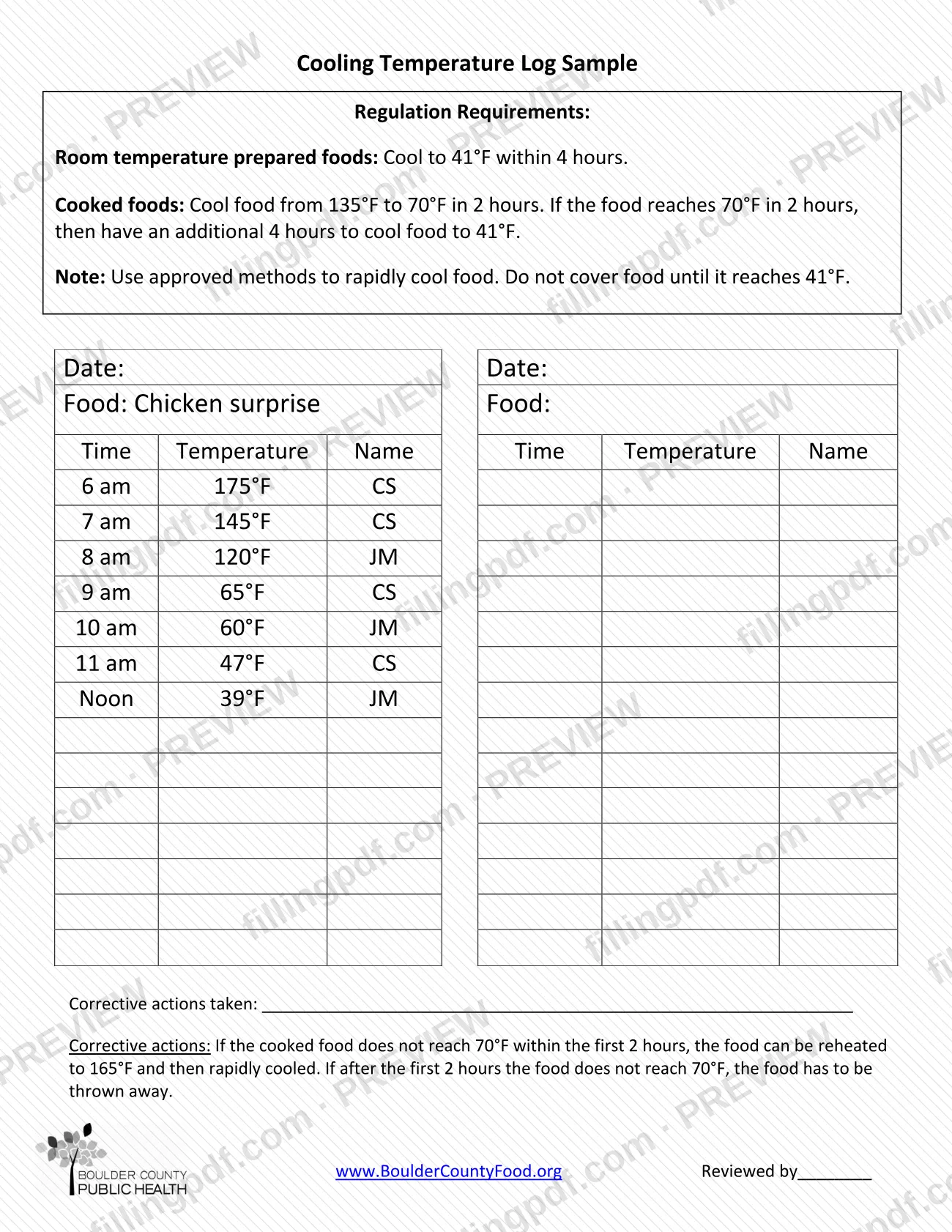
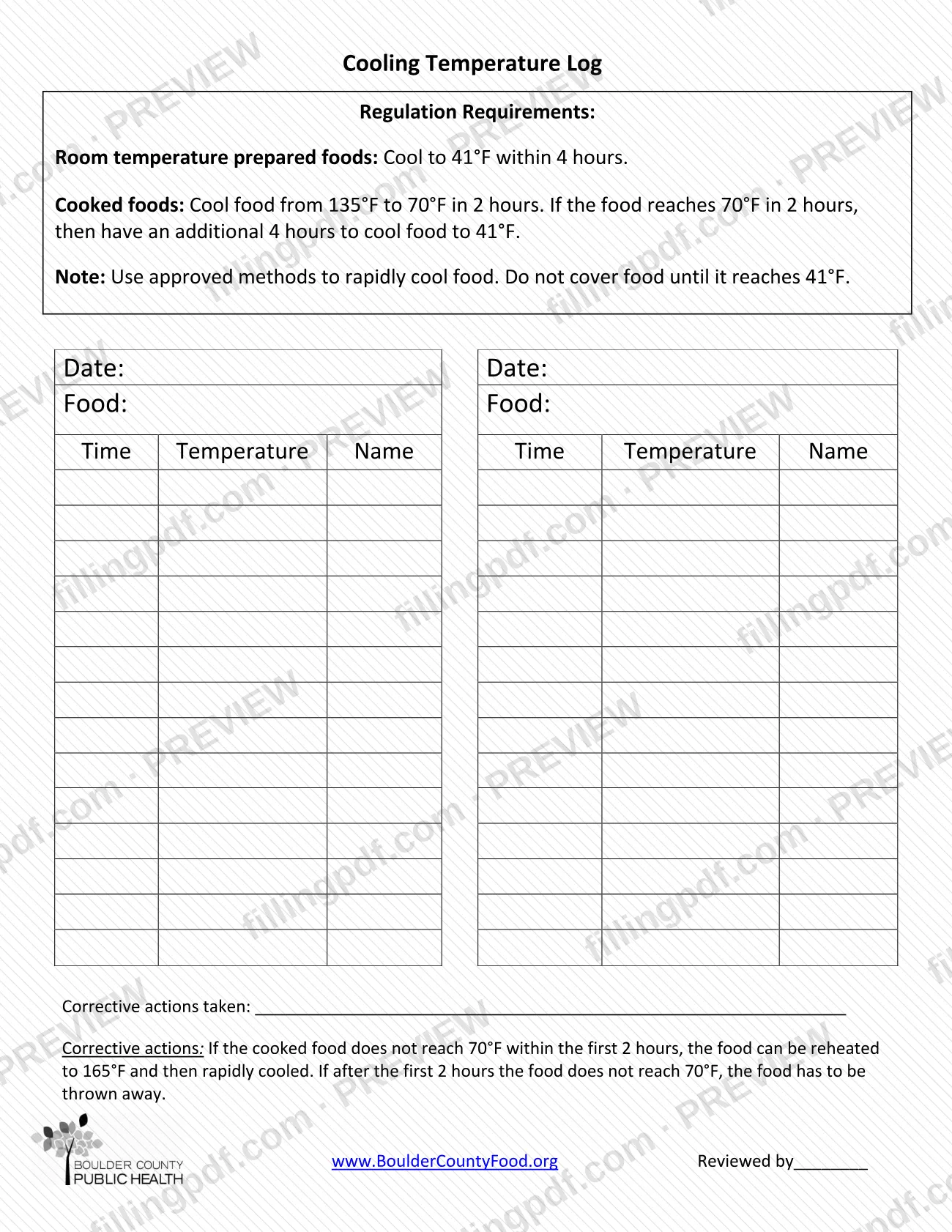
The PDF holds two parts. The first is a Cooling Temperature Log Sample, filled in with an example (chicken surprise, with readings from 6 am at 175°F to noon at 39°F, entered by two people). The second is the blank Cooling Temperature Log. Each has two side-by-side columns of Date, Food, Time, Temperature and Name, a line for Corrective actions taken and a Reviewed by line. The county's page places the log among its tools for Active Managerial Control (AMC) in restaurants and other retail food establishments.
Who needs to file Cooling Temperature Log – Boulder County?
The log is meant for the people who prepare and cool food in restaurants and other retail food establishments, and for the managers who review the records. Boulder County Licensing lists it among the tools for restaurant managers under Food Safety and Active Managerial Control (AMC), a practice built on three basics: create policies based on your business' needs, train your employees on your policies, and follow up with the expectation that employees are following them.
How the log is used:
- Staff who cool food write the date, the food, and the time, temperature and name for each reading. The sample shows two different people entering readings on the same food.
- Managers or reviewers sign off on the Reviewed by line at the bottom.
- Anyone cooling cooked foods or room temperature prepared foods checks the readings against the limits printed at the top of the sheet.
The log does not state who is legally required to keep it or how long records must be retained. Ask Boulder County Licensing, or check www.BoulderCountyFood.org, if you need to know whether your establishment must keep these records.
When to file Cooling Temperature Log – Boulder County
Use the log each time you cool room temperature prepared foods or cooked foods, starting the entries when cooling begins. Room temperature prepared foods must reach 41°F within 4 hours. Cooked foods must go from 135°F to 70°F within 2 hours, and if they reach 70°F in that time there are an additional 4 hours to reach 41°F, so record the time of each reading across the whole cooling period. If cooked food has not reached 70°F after the first 2 hours, write down the corrective action taken. The log prints no due date and no filing deadline of its own.
How to fill out Cooling Temperature Log – Boulder County
Review the cooling limits first
Read the Regulation Requirements at the top: 41°F within 4 hours for room temperature prepared foods, and 135°F to 70°F in 2 hours (then 41°F in 4 more hours) for cooked foods.
Enter the date
Write the date in the Date space above the column you are using. The sheet has two side-by-side columns, each with its own date.
Name the food being cooled
Write the food on the Food line, as the sample does with its example dish. Use a new column or sheet for each different food.
Record the time of each reading
In the Time column, write the time of every temperature check, starting when cooling begins. The sample logs one reading per hour from 6 am to noon.
Record the temperature
In the Temperature column, write the reading in °F next to its time. Compare it with 70°F at the 2-hour mark for cooked foods and with 41°F by the end of the cooling period.
Add the name of the person
In the Name column, enter the name of the person who took the reading; the sample shows initials.
Write any corrective actions
Under Corrective actions taken, describe what you did if cooked food missed 70°F within 2 hours, such as reheating to 165°F and rapidly cooling it, or throwing the food away.
Have the log reviewed
The Reviewed by line at the bottom is for the person who reviews the completed log.
Review and download the completed PDF
Check each time, temperature and name, then download or print the completed PDF from FillingPDF and keep it as your cooling record.
How to submit Cooling Temperature Log – Boulder County
The Cooling Temperature Log prints no mailing address, portal or filing channel, so there is nothing to send to Boulder County Licensing on the form itself. It is a working record: staff fill in the readings, and a reviewer signs the Reviewed by line. The form is published at www.BoulderCountyFood.org, and the county lists it among its tools for restaurant managers. For questions about whether and how your establishment must keep or provide these logs, contact Boulder County Licensing. FillingPDF lets you fill out and download the PDF; any submission follows the channels the county gives.
Common mistakes to avoid
- Covering the food before it reaches 41°F; the log's note says not to cover food until then.
- Using the 4-hour window for cooked food from the start; cooked food must first go from 135°F to 70°F in 2 hours.
- Letting cooked food miss 70°F in the first 2 hours without writing a corrective action in the Corrective actions taken area.
- Continuing to cool food that has not reached 70°F after the first 2 hours; the log says that food has to be thrown away.
- Leaving the Name column blank for a reading, so no one is recorded as having taken it.
- Copying the sample's entries (chicken surprise, the example times and temperatures) onto your own log instead of your actual readings.
- Skipping the Reviewed by line at the bottom of the log.
- Relying on a cooling method that is not an approved method; the log says to use approved methods to rapidly cool food.
Frequently asked questions
What is the Cooling Temperature Log?
It is a Boulder County Licensing record sheet for food cooling. You write the date, the food, and the time, temperature and name for each reading, and compare them with the cooling limits printed at the top. It also has lines for corrective actions and for a reviewer.
What are the cooling limits on the log?
Room temperature prepared foods must cool to 41°F within 4 hours. Cooked foods must cool from 135°F to 70°F in 2 hours; if they reach 70°F in that time, there are an additional 4 hours to reach 41°F. Use approved methods and do not cover food until it reaches 41°F.
What if cooked food does not reach 70°F in 2 hours?
The log lists a corrective action: the food can be reheated to 165°F and then rapidly cooled. It also states that if after the first 2 hours the food does not reach 70°F, the food has to be thrown away. Record what you did under Corrective actions taken.
Is the Cooling Temperature Log a Boulder County property tax form?
No. This document is a food safety record from Boulder County Licensing for tracking cooling temperatures. It has nothing to do with boulder county property tax, and the log contains no tax information or tax filing instructions.
Can I fill out the Cooling Temperature Log online?
Yes. You can fill out the PDF online on FillingPDF and download or print it. FillingPDF is an independent service, not affiliated with Boulder County, and it does not file or send the log to anyone.
Where do I send the Cooling Temperature Log?
The log prints no address or filing channel. It is a record you complete and have reviewed on the Reviewed by line. For questions about providing logs to the county, contact Boulder County Licensing or see www.BoulderCountyFood.org.
What is the sample page in the PDF for?
The first page is a Cooling Temperature Log Sample showing a completed example: chicken surprise cooled from 175°F at 6 am to 39°F at noon, with entries by two people. The second page is the blank log you fill out with your own readings.
What is Active Managerial Control for restaurants?
Boulder County describes Active Managerial Control (AMC) as three basics: create policies based on your business' needs, train employees on them, and follow up to be sure they are followed. The county lists this log among its tools for restaurant managers.
Ready to fill out Cooling Temperature Log – Boulder County?
Fill out Cooling Temperature Log – Boulder County now